人工智能(AI)

Search documents
反内卷牛市——A股一周走势研判及事件提醒
Datayes· 2025-11-09 14:39
Core Viewpoint - The article discusses the recent focus on price-increasing industries, highlighting a shift from financial re-inflation to physical re-inflation, with an emphasis on cyclical industries and essential sectors that are experiencing price increases [1][2]. Group 1: Industry Trends - Recent price increases in essential commodities are attributed to a phenomenon termed "physical re-inflation," with significant attention on cyclical industries such as non-ferrous metals, steel, coal, and petrochemicals [1]. - The market is witnessing a surge in cyclical stocks, driven by expectations of a strong economic cycle in the coming year, particularly in infrastructure projects linked to the five-year planning cycle [2]. - The supply-side constraints due to anti-involution policies are influencing price dynamics, with industries facing greater anti-involution measures showing higher price elasticity [2]. Group 2: Economic Indicators - The Consumer Price Index (CPI) for October rose by 0.2% year-on-year, up from a decline of 0.3% the previous month, indicating a shift in consumer prices [5]. - The Producer Price Index (PPI) showed a month-on-month increase of 0.1%, marking the first rise of the year, although it still reflects a year-on-year decline of 2.1% [8][9]. - The service price growth rate increased from 0.6% to 0.8% year-on-year, driven by seasonal demand and ongoing reforms in medical service pricing [6]. Group 3: Sector Performance - The electric power equipment sector has seen significant capital inflows, with net purchases reaching 483.93 billion yuan, indicating strong market interest [30][31]. - The basic chemical and banking sectors also attracted substantial investments, with net inflows of 216.79 billion yuan and 65.96 billion yuan, respectively [30]. - The storage sector is experiencing price hikes, with NAND flash memory prices increasing by up to 50%, impacting the entire supply chain [10]. Group 4: Future Outlook - The article anticipates continued inflationary pressures from rising commodity prices, although the impact on downstream prices may experience a time lag due to anti-involution measures [9]. - The construction of major infrastructure projects, such as the "Yin Da Ji Min" water diversion project, is expected to stimulate economic growth in the Chengdu Plain economic zone [4].



AI“电荒”引爆电网设备板块,年内大涨43%、16股创新高
Di Yi Cai Jing· 2025-11-09 10:44
Core Viewpoint - The A-share market's power grid equipment sector has surged, driven by the dual narratives of AI catalysis and energy transformation, with a notable 12.45% increase in the first trading week of November, highlighting investor interest in the sector's growth potential amid performance disparities among companies [1][2][3]. Group 1: Market Performance - The power grid equipment index rose by 12.46% in the week, reaching 5872.41 points, with a year-to-date increase of 43.11%, marking the highest level since June 2015 [2]. - 16 stocks within the power grid equipment sector reached historical highs, with notable performers including Zhongneng Electric (up 78.36%), Moen Electric (up 48.57%), and TEB Electric (up 35.34%) [2]. Group 2: Industry Dynamics - The trading activity in the power grid equipment sector has increased since May, with the index showing seven consecutive months of gains, primarily driven by AI-related electricity shortages [3]. - The U.S. Energy Information Administration (EIA) forecasts that electricity consumption will reach historical highs in 2025 and 2026, driven by AI and data center expansions, with Goldman Sachs predicting a 175% increase in global electricity demand from AI data centers by 2030 [3]. Group 3: Investment Trends - The State Grid Corporation of China reported over 420 billion yuan in fixed asset investments from January to September, a year-on-year increase of 8.1%, with expectations for total investments to exceed 650 billion yuan in 2025 [4]. - The "14th Five-Year Plan" emphasizes the importance of a new energy system, advocating for accelerated construction of smart grids and microgrids [4]. Group 4: Financial Performance - The power grid equipment sector's revenue and net profit showed growth, with 42 key companies reporting a total revenue of 263.7 billion yuan (up 12%) and a net profit of 22.2 billion yuan (up 14%) for the first three quarters [5][6]. - Significant performance disparities exist within the sector, with non-UHV main networks showing a net profit growth of 38.2%, while distribution and meter companies faced declines of 23.6% and 28.4%, respectively [6]. Group 5: Institutional Holdings - Public funds slightly reduced their holdings in the power grid equipment sector, with a 0.6% share of total market value, down 0.6 percentage points year-on-year [7]. - Institutions favor leading companies in overseas markets and those with growth potential in data center businesses, such as Siyi Electric, TEB Electric, and Jinpan Technology [7]. Group 6: Technological Advancements - Institutional investors are increasingly interested in solid-state transformer (SST) technology, which is seen as a suitable solution for data center power demands [8]. - Jinpan Technology has developed an SST prototype for high-voltage direct current (HVDC) applications, with plans for testing and certification [8].
2025新能源新材料产业创新会议:分享创新实践,前瞻产业未来
Zhong Guo Hua Gong Bao· 2025-11-09 08:53
Group 1 - The conference focused on innovations in the "dual new" fields, particularly in new energy and new materials, highlighting the importance of technological advancements and green solutions [1] - Metal-organic frameworks (MOF) gained attention following the announcement of the 2025 Nobel Prize in Chemistry, with significant potential applications in energy storage, environmental remediation, industrial catalysis, and biomedicine [1] - The rapid development of artificial intelligence (AI) is transforming material design, exemplified by the creation of an AI design platform for gas separation polyimide materials, which drastically reduces the time needed for performance feedback from days to hours [1] Group 2 - China leads the global flow battery energy storage industry, showcasing advantages in resources, costs, and technology, with potential for optimizing energy structures and maximizing returns through integration with the petrochemical sector [2] - The successful delivery of the first large-scale green hydrogen coupled biomass gasification project in October 2023 is expected to make green methanol cost-competitive with traditional fossil fuels by 2030 [2] - Innovative technologies developed by companies, such as high-efficiency heat transfer systems and carbon emission reduction processes, are contributing to both environmental sustainability and cost savings for petrochemical enterprises [2]
智能眼镜行业“吹牛”成风
Jing Ji Guan Cha Bao· 2025-11-09 05:04
Core Insights - The smart glasses industry is experiencing a surge of optimism, with many companies claiming significant order volumes and potential for growth, but there is a disconnect between what is promised and what is delivered [1][2][3] - The competition is intensifying, with various startups and established tech companies vying for market share, leading to inflated claims about sales and orders [2][4] - The actual sales figures and order fulfillment rates are often much lower than reported, raising concerns about the sustainability of the market [5][6] Group 1: Market Dynamics - Companies like Rokid, VITURE, and others are entering the smart glasses market, with expectations of high demand and significant orders from major tech players [2][4] - The industry is characterized by a high rate of return for smart glasses, with some manufacturers reporting return rates as high as 40% to 50% [6][8] - The gap between projected sales and actual performance is evident, with many companies unable to meet their own ambitious targets [3][5] Group 2: Investment Sentiment - Investors are cautious about the smart glasses sector, with some choosing to focus on upstream supply chain opportunities rather than direct investments in smart glasses manufacturers [13][14] - The trend of over-reporting sales figures and order volumes is prevalent, leading to skepticism among investors regarding the true health of the market [5][6] - The potential for a bubble exists, as many companies are competing to secure funding without delivering on their promises [14][15] Group 3: Product Development Challenges - Smart glasses are still considered "half-finished" products, with many companies struggling to balance performance, weight, and battery life [9][10] - The integration of advanced technologies into smart glasses has led to increased complexity, making it difficult for manufacturers to deliver a viable product [9][10] - The industry is facing significant hurdles in achieving the necessary functionality and user experience that consumers expect [10][14]
【环球财经】一周前瞻:美国CPI或首次缺席,中概股财报季揭幕
Xin Hua Cai Jing· 2025-11-09 03:36
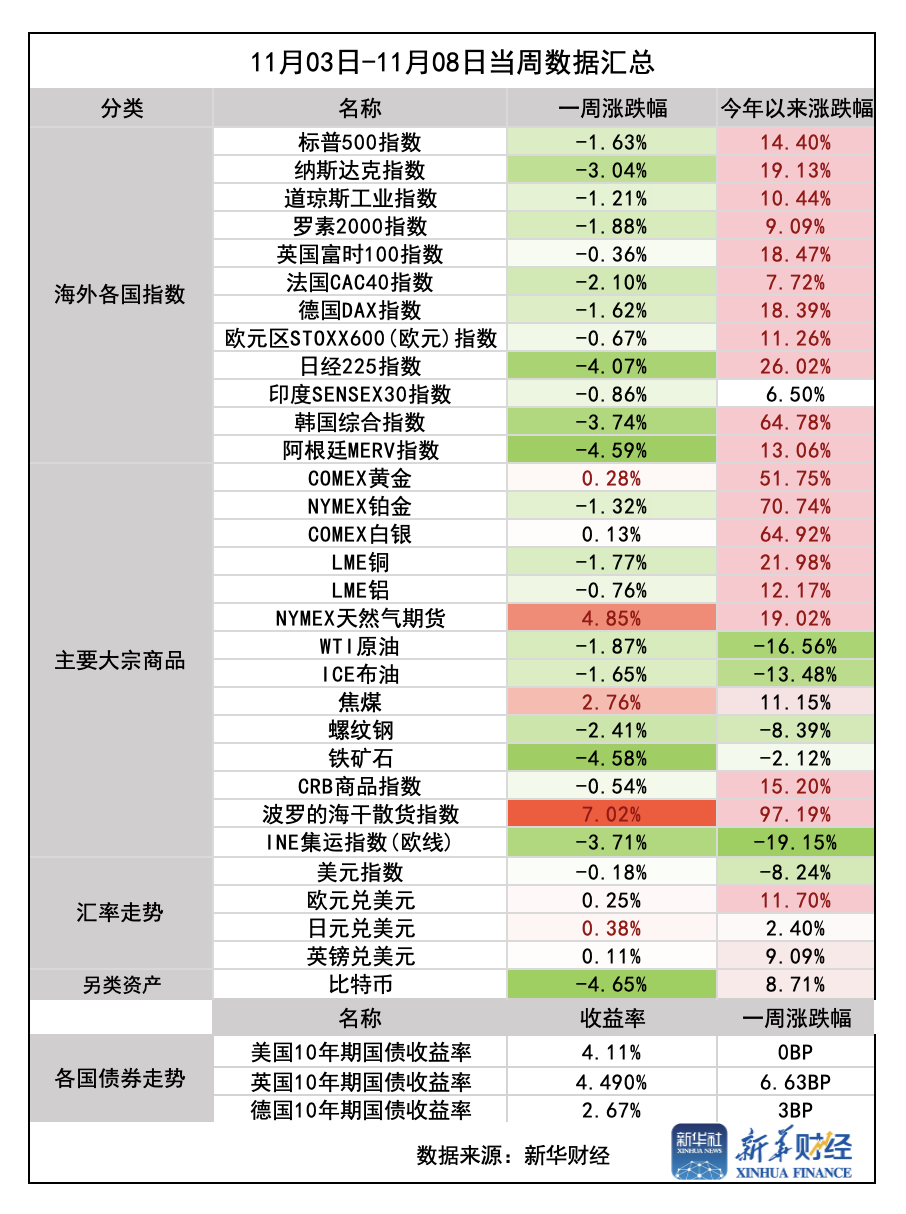
新华财经上海11月9日电(葛佳明) 本周(11月3日至8日),美国政府停摆进入第六周,经济数据真空正使美联储12月降息决策 陷入困境,美股大幅下挫,美元指数呈现先涨后跌的走势,贵金属市场继续剧烈震荡。 美股市场方面,标普500指数收报6728.80点,本周累计下跌1.63%;道琼斯工业平均指数收报46987.10点,本周累跌1.21%;纳指 收报230004.538点,本周累跌3.04%;罗素2000指数收报2432.824点,本周累跌1.88%。 对高估值的担忧推动美股科技股本周多数走弱,科技股七巨头(Magnificent 7)指数累跌3.21%,其中英伟达累跌7.08%,特斯拉 累跌5.92%,Meta累跌4.11%,微软累跌4.05%,谷歌A累跌0.84%,苹果累跌0.70%,亚马逊则累计微涨0.08%。 欧洲市场方面,欧洲STOXX 600指数本周累计下跌0.67%,德国DAX本周累计下跌1.62%;法国CAC 40指数收本周累跌2.10%; 英国富时100指数本周累跌0.36%。 亚太市场方面,日经225指数跌超4%,市场对美股人工智能(AI)板块或存在泡沫的担忧加剧,使得韩国股市遭遇重挫,韩国综 ...
帮主郑重:黄仁勋急赴台积电抢芯片,A股中长线该盯啥?
Sou Hu Cai Jing· 2025-11-09 02:42
Core Insights - Huang Renxun's frequent visits to TSMC indicate a strong demand for Nvidia's new chips, driven by the explosive growth of the AI industry [4][5] - The shortage of storage chips highlights ongoing demand in the semiconductor supply chain, which is crucial for long-term investment strategies in A-shares [4][5] Industry Dynamics - Nvidia's latest chip requirements are soaring, with both GPU and CPU demands increasing significantly, reflecting the broader AI industry's rapid expansion [4] - Huang Renxun's statement about the diverse applications of Nvidia's GPUs, including AI, scientific research, and quantum computing, underscores the company's competitive advantage and resilience against potential competition from companies like Google and Amazon [4] Investment Strategy - Long-term investment in A-shares should focus on companies with technological barriers and strong performance that align with the growth of the AI industry, particularly in semiconductor manufacturing and storage sectors [5] - The ongoing demand in the AI supply chain suggests that companies involved in chip manufacturing and related industries will continue to see sustained growth, making them attractive for long-term investment [5]
Gartner2026预测:这十大战略技术趋势,将决定企业未来竞争力
Sou Hu Cai Jing· 2025-11-08 18:56
Core Insights - Gartner identifies ten strategic technology trends that organizations need to focus on by 2026, emphasizing the unprecedented speed of innovation and transformation in the current year [1][3]. Group 1: AI Supercomputing Platforms - AI supercomputing platforms integrate various computing resources to manage complex workloads, enhancing performance and innovation potential [6]. - By 2028, over 40% of leading companies will apply hybrid computing paradigms to critical business processes, a significant increase from the current 8% [8]. Group 2: Multi-Agent Systems - Multi-agent systems consist of multiple AI agents that interact to achieve complex individual or collective goals, enhancing automation and collaboration [10]. Group 3: Domain-Specific Language Models (DSLM) - DSLMs are tailored AI models trained on specific industry data, providing higher accuracy and compliance for specialized tasks compared to general models [11]. - By 2028, over half of generative AI models used by enterprises will be domain-specific [13]. Group 4: AI Security Platforms - AI security platforms offer unified protection mechanisms for AI applications, helping organizations monitor activities and enforce usage policies [16]. - By 2028, over 50% of enterprises will utilize AI security platforms to safeguard their AI investments [16]. Group 5: AI Native Development Platforms - AI native development platforms enable rapid software development through generative AI, allowing non-technical experts to create applications [19]. - By 2030, 80% of enterprises will transform large software engineering teams into smaller, agile teams empowered by AI [19]. Group 6: Confidential Computing - Confidential computing protects sensitive data by isolating workloads in trusted execution environments, crucial for regulated industries [20]. - By 2029, over 75% of business processes handled in untrusted infrastructures will be secured through confidential computing [22]. Group 7: Physical AI - Physical AI empowers machines and devices with perception, decision-making, and action capabilities, providing significant benefits in automation and safety [23]. Group 8: Proactive Cybersecurity - Proactive cybersecurity is becoming a trend as organizations shift from passive defense to active protection, with AI-driven solutions playing a key role [26]. Group 9: Digital Traceability - Digital traceability is essential for verifying the source and integrity of software and data, especially as reliance on third-party software increases [30]. Group 10: Geopolitical Repatriation - Geopolitical repatriation involves moving data and applications to local platforms to mitigate geopolitical risks, a trend expected to grow significantly by 2030 [33].


记者手记|从制冰机到榴莲球:“中国制造”在印尼电商展获青睐
Xin Hua She· 2025-11-08 14:59
Group 1 - The event showcased over 400 brands, highlighting the integration of digital technology with "Made in China" products, which attracted significant interest from international buyers [1][2] - Guangdong Hongshi Intelligent Technology Co., Ltd. presented various consumer electronic security products, including a 4G solar-powered camera with AI human tracking capabilities, demonstrating the innovative edge of Chinese manufacturing [1][2] - The popularity of creative durian-based food products from Mr. Durian (Guangdong) Industrial Co., Ltd. indicates a growing interest in local partnerships and sourcing raw materials from Indonesia [2] Group 2 - Indonesia's digital economy is projected to reach $90 billion in 2024 and grow to $360 billion by 2030, with small and medium enterprises accelerating their entry into the global market through cross-border e-commerce platforms [3] - The appeal of the Indonesian market lies in its large consumer base, youthful demographic, active social media environment, and interconnected e-commerce system, fostering collaboration between China and Indonesia in various sectors [3] - The integration of smart manufacturing and e-commerce channels is facilitating the establishment of Chinese products in Indonesia while opening doors for Indonesian enterprises to engage in the global e-commerce network [3]
泰康资产段国圣:AI切入投研赛道,资管行业价值链有望重塑
Zheng Quan Shi Bao Wang· 2025-11-08 03:52
Core Viewpoint - AI technology is reshaping the asset management industry by enhancing research capabilities and operational efficiency, transitioning from a human-driven model to a dual-driven model of human intelligence and machine intelligence [1][6]. Group 1: AI Integration in Asset Management - The asset management industry is data and knowledge-intensive, and AI's characteristics align well with its needs, enabling significant improvements in research efficiency and investment capabilities [2][4]. - Taikang Asset has developed its own deep research agent (TKDR) that integrates extensive internal and external research data, enhancing the investment research process [2][4]. Group 2: Advantages of TKDR - TKDR demonstrates advantages over traditional research methods by quickly identifying core demands, utilizing resources efficiently, and producing structured research outputs [3][5]. - The system is designed to support active investment research, aligning with the methodologies of active researchers and enhancing the quality and timeliness of outputs [5]. Group 3: Future Outlook and Strategic Development - The construction of an intelligent agent system is seen as a key driver for AI development, with plans to create a collaborative human-machine research paradigm [6][8]. - The transition to AI-driven asset management is expected to enhance decision-making across various functions, including investment strategy, risk management, and operational efficiency [6][7]. Group 4: Recommendations for AI Implementation - To effectively advance AI initiatives, asset management firms should establish supportive mechanisms, optimize governance structures, and develop talent teams that align with AI transformation [7][8]. - Emphasizing collaboration between business and technology teams is crucial for successful AI integration, ensuring that AI applications are closely aligned with business objectives [8].
2025年第三季度全球IPO趋势报告:稳健驾驭IPO规划(英文版)
Sou Hu Cai Jing· 2025-11-08 01:09
Core Insights - The global IPO market showed a robust recovery in Q3 2025, with 914 IPOs raising a total of $110.1 billion, marking a 5% increase in volume and a 41% increase in proceeds compared to the previous year [1][27][23] - The US, India, and Greater China were the primary drivers of this resurgence, contributing nearly 70% of global IPO transactions and 80% of total proceeds [1][23][24] - Regulatory reforms and market innovations have played a crucial role in enhancing market activity, with exchanges streamlining listing processes and introducing alternative pathways like SPACs and direct listings [2][18][49] Global IPO Market Review - The first three quarters of 2025 saw a total of 914 IPOs, with proceeds reaching $110.1 billion, indicating a gradual recovery in the market [27] - Q3 2025 experienced a significant uptick, with deal volume increasing by 19% and proceeds surging by 89% year-over-year [23][24] - The US achieved its strongest IPO quarter since Q4 2021, while India set a record with 146 IPOs raising $7.2 billion [24][27] Regional Market Dynamics - The Asian market, particularly India, led in IPO volume, driven by active trading in sectors like fintech and manufacturing [2][31] - Greater China maintained strong performance in strategic sectors such as advanced manufacturing and semiconductors, achieving double-digit growth in both deal volume and proceeds [29][31] - The US continued to dominate in terms of capital raised, supported by strong valuations in the technology sector [28][31] Regulatory Landscape - Global exchanges are accelerating reforms to attract innovative firms, with flexible listing rules and streamlined processes becoming common [42][47] - Regulatory changes are aligned with sectoral priorities, focusing on technology, advanced manufacturing, and digital infrastructure [43][47] - Enhanced investor protection measures are being implemented alongside these reforms to maintain market integrity [54][56] PE-Backed IPO Trends - The number of PE-backed IPOs more than doubled year-over-year, with proceeds increasing by 68%, reflecting a shift in exit strategies among private equity firms [62][63] - PE-backed IPOs have shown strong aftermarket performance, particularly in sectors like technology and industrials, with notable gains in the Chinese mainland [64][66] - The trend indicates a growing preference for mature, profitable companies among PE sponsors, emphasizing the importance of financial stability and governance [69][72] Future Outlook - The global IPO market is expected to continue its recovery, with optimism driven by easing monetary policies and strong corporate earnings [76][78] - However, challenges such as persistent inflation and geopolitical uncertainties may impact investor sentiment and IPO valuations [80][81] - Companies are advised to align their strategies with macro trends and demonstrate robust financial health to capitalize on upcoming market opportunities [12][76]