
固定资产投资

Search documents
国泰海通|海外策略:一页纸精读行业比较数据:11月
国泰海通证券研究· 2025-11-27 14:14
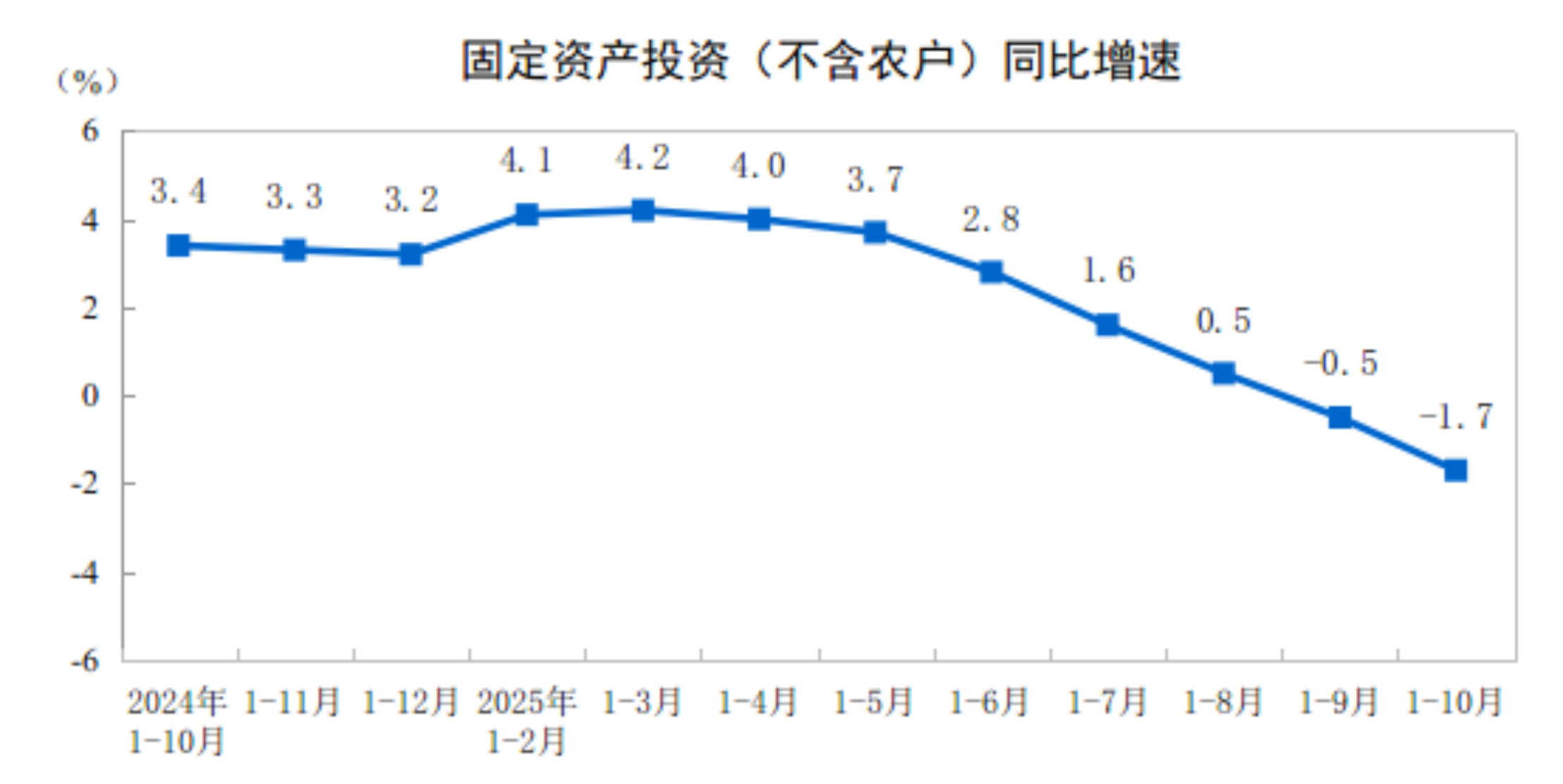
Investment Chain - Prices of tin, silver, and gold have risen since November 2025. [1] - Fixed asset investment growth rate has decreased to -1.70% as of October 2025, with real estate development investment down by -14.70%. [1] - Manufacturing fixed asset investment growth rate is at 2.7%, while infrastructure investment growth rate is at 1.51%. [1] - Prices of copper, aluminum, lead, zinc, and nickel have decreased, while power coal prices slightly increased to 698 RMB/ton. [1] Consumption Chain - Consumer confidence index rose to 89.60 in September 2025. [2] - Nominal growth rate for October 2025 fell to 2.90%, with cumulative nominal growth rate down by 4.30%. [2] - Sales area of commercial housing saw a cumulative year-on-year decline of -7.63% in October 2025. [2] - Automobile sales growth rate decreased to 8.82% in October 2025, and home appliance retail sales fell by -10.25%. [2] Export Chain - Export growth rate to the US increased in October 2025, while exports to the EU, Japan, and ASEAN saw a decline. [3] - Cumulative export growth rates for products like agricultural goods, toys, furniture, and steel have decreased. [3] - The overall export growth rate fell to 20.21% in October 2025, with textile exports down by -9.10%. [3] Price Chain - Pork prices increased to 12.24 RMB/kg as of November 19, 2025, while oil prices decreased to 57.95 USD/barrel. [4] - Prices for cotton and white sugar have declined, while MDI prices showed mixed trends. [4] - New credit increased to 220 billion RMB in October 2025, with life insurance premium income growth rate down to 12.68%. [4]


行业比较月报:一页纸精读行业比较数据:11月-20251127
GUOTAI HAITONG SECURITIES· 2025-11-27 12:06
Investment Chain - Since November, prices of tin, silver, and gold have increased. In October 2025, the cumulative year-on-year growth rate of fixed asset investment decreased to -1.70%, with real estate development investment declining by 14.70%. Manufacturing fixed asset investment growth rate fell to 2.7%, and infrastructure investment growth rate decreased to 1.51% [7][8] - In November 2025, prices of copper, aluminum, lead, zinc, and nickel have decreased, while the price of thermal coal slightly increased to 698 RMB/ton. The average price of ordinary cement has risen, and steel prices have decreased [7][8] Consumer Chain - The consumer confidence index rose to 89.60 in September 2025. In October 2025, the nominal year-on-year growth rate fell to 2.90%, with a cumulative nominal year-on-year growth rate decline of 4.30%. The sales area of commercial housing in October saw a year-on-year growth rate drop to -7.63% [8][9] - In October 2025, automobile sales decreased by 8.82% year-on-year, and home appliance retail sales fell by 10.25% year-on-year. In December 2024, tourism revenue in Beijing increased by 11.40% year-on-year, while in March 2024, tourism revenue in Hainan decreased by 20.03% [8][9] Export Chain - In October 2025, the year-on-year growth rate of exports to the United States increased, while exports to the EU, Japan, and ASEAN saw a decline. Cumulative year-on-year growth rates for refined oil, coke, and shipbuilding increased, while exports of agricultural products, toys, furniture, lighting, coal, steel, plastics, auto parts, and aluminum decreased [9][10] - The export amount year-on-year growth rate fell to 20.21% in October 2025, with textile exports decreasing by 9.10% and machinery exports declining by 1.10% [9][10] Price Chain - In November, pork prices decreased, and oil prices also saw a decline. As of November 25, 2025, WTI crude oil price fell to 57.95 USD/barrel. The price of PVC dropped to 4400 RMB/ton, while the price of pure MDI rose to 19350 RMB/ton and the price of polymer MDI decreased to 14550 RMB/ton [10][11]
2025年1-10月份全国固定资产投资基本情况
Guo Jia Tong Ji Ju· 2025-11-27 08:04
Core Insights - National fixed asset investment (excluding rural households) reached 4,089.14 billion yuan from January to October 2025, showing a year-on-year decline of 1.7% on a comparable basis [1][4] - Private fixed asset investment decreased by 4.5% year-on-year [1][4] - In October, fixed asset investment (excluding rural households) fell by 1.62% month-on-month [1] Investment by Industry - First industry investment totaled 807.5 billion yuan, with a year-on-year growth of 2.9% [3][4] - Second industry investment reached 14,841.1 billion yuan, growing by 4.8% year-on-year, with industrial investment specifically increasing by 4.9% [3][4] - Third industry investment was 25,242.9 billion yuan, showing a decline of 5.3% year-on-year [3][4] - Within the second industry, mining investment grew by 3.8%, manufacturing investment increased by 2.7%, and investment in electricity, heat, gas, and water production and supply surged by 12.5% [3][4] Investment by Region - Eastern region investment decreased by 5.4% year-on-year, while central region investment fell by 0.5% [3] - Western region investment saw a slight increase of 0.4%, and northeastern region investment dropped significantly by 11.7% [3] Investment by Registration Type - Domestic enterprises' fixed asset investment declined by 1.7% year-on-year [4] - Investment from Hong Kong, Macau, and Taiwan enterprises decreased by 1.8% [4] - Foreign enterprises' fixed asset investment experienced a notable decline of 12.1% [4]
图说中国宏观专题:近期宏中观体感温差
2025-11-26 14:15
Summary of Key Points from the Conference Call Industry Overview - The macroeconomic data for October indicates a slowdown across various sectors, including industrial production, services, investment, retail sales, exports, and real estate sales, with notable declines in industrial value-added growth to 4.9% year-on-year, down 1.6 percentage points from the previous month [2][26]. Core Insights and Arguments - **Industrial Production**: The industrial value-added growth rate fell to 4.9% in October, with manufacturing showing significant deceleration. The electricity and water industries saw slight increases, while sectors like food and beverage, as well as non-ferrous metals, experienced declines [1][3][4]. - **Investment Trends**: Fixed asset investment decreased by 1.7% year-on-year in October, with real estate development investment dropping to 18% of total fixed asset investment, the lowest since 2018. This indicates a reduced reliance on real estate within the economy [1][2][4]. - **Real Estate Market**: The real estate market remains under pressure, with declines in new construction, construction, and completion areas. The second-hand housing market also showed weakness, with both new and second-hand housing price indices reflecting fatigue [5][6]. - **Retail Sales**: Social retail sales grew by 2.9% year-on-year in October, slightly lower than September's 3%. However, offline consumption and service sector spending showed improvement, with retail sales excluding automobiles growing by 4% [6][9]. - **PMI Data**: The manufacturing PMI decreased to 49, indicating contraction, while the services PMI saw a slight increase, suggesting a lack of significant improvement in economic recovery [7][26]. - **Inflation Metrics**: The CPI rose to 0.2% year-on-year, driven by a low base effect from the previous year and supply reductions in certain categories. The PPI remained negative at -2.1%, although the decline was less severe than before [11][12]. Additional Important Insights - **Fiscal and Monetary Policy**: Fiscal spending saw a significant drop of 9.8% year-on-year, while tax revenues remained robust, particularly personal income tax, which grew by 27.26%. However, the overall fiscal policy appears insufficient to counteract the economic slowdown [22][24]. - **Consumer Behavior**: Despite a general decline in retail data, certain sectors like high-end services and overseas brands showed signs of recovery. The demand for services such as business travel and hotel stays remained stable [20][15]. - **Sectoral Disparities**: There is a noticeable divergence between different industries, with some sectors performing relatively well while others face greater challenges. This structural change in the economy necessitates close monitoring [27][26]. This summary encapsulates the key points from the conference call, highlighting the current state of the economy and various sectors, along with the implications for future investment opportunities and risks.
今年1-10月,东莞外贸进出口总额同比增长14.7%
Nan Fang Du Shi Bao· 2025-11-26 12:59
Economic Overview - Dongguan's economy showed overall stability in the first ten months of 2025, with a focus on high-quality development and the implementation of various policy measures [2] Industrial Production - The industrial added value of enterprises above designated size increased by 4.2% year-on-year. Key industries such as electronic information manufacturing, electrical machinery and equipment manufacturing, and chemical manufacturing saw increases of 7.5%, 8.5%, and 10.8% respectively [3] - New momentum industries performed well, with advanced manufacturing and high-tech manufacturing added value growing by 6.4% and 7.9% respectively. High-tech product output also saw significant growth, with integrated circuits, smartwatches, servers, and sensors increasing by 78.4%, 34.2%, 28.8%, and 24.6% respectively [3] Foreign Trade - The total foreign trade import and export volume reached 12,982.4 billion yuan, a year-on-year increase of 14.7%, with imports at 5,056.2 billion yuan (up 25.4%) and exports at 7,926.2 billion yuan (up 8.7%). In October, the total foreign trade volume grew by 17.3% year-on-year [4] Consumer Market - The total retail sales of social consumer goods amounted to 3,597.63 billion yuan, reflecting a year-on-year growth of 1.6%. Notable growth was seen in dining revenue (up 2.4%) and retail of goods (up 1.4%). Certain essential and upgraded goods experienced strong sales, with retail sales of staple food, hardware, and sports entertainment goods increasing by 50.0%, 26.6%, and 26.1% respectively [5] - Online consumption also surged, with retail sales through public networks increasing by 19.6% year-on-year [5] Fixed Asset Investment - Total fixed asset investment decreased by 3.2% year-on-year, but the decline narrowed by 1.9 percentage points compared to the previous nine months. Excluding real estate development investment, fixed asset investment grew by 16.9% [6][7] - Investment in advanced manufacturing and high-tech manufacturing saw significant increases of 51.2% and 66.0% respectively, while real estate development investment fell by 49.2% [7] Financial Market - By the end of October, the balance of deposits in financial institutions reached 28,929.77 billion yuan, a year-on-year increase of 2.1%, while the balance of loans was 19,917.25 billion yuan, up 3.4% [8] Consumer Price Index - The Consumer Price Index (CPI) decreased by 1.0% year-on-year, with six categories of goods and services experiencing price declines. Notably, transportation and communication prices fell by 3.1%, while medical care prices rose by 1.5% [9]

苏州规上工业总产值超4万亿 今年前10月全市经济保持平稳运行态势
Su Zhou Ri Bao· 2025-11-25 00:42
Economic Overview - In the first ten months of 2025, Suzhou's industrial output value exceeded 4 trillion yuan, with industrial investment reaching 193.4 billion yuan, an increase of 9% [1] - The city's economy has maintained a stable operation, focusing on stabilizing foreign trade, promoting industries, and expanding investment and consumption [1] Industrial Performance - The added value of large-scale industries increased by 7.6% year-on-year, with total industrial output value at 4,000.9 billion yuan, growing by 4.0% [1] - Key sectors showed growth: electronic information industry increased by 5.5%, metal products industry by 9.5%, and instrument manufacturing by 9.9% [1] - High-tech industries contributed 2,240.4 billion yuan, growing by 6.5% [1] Service Sector - From January to September, the revenue of large-scale service industries grew by 7.7%, with transportation, warehousing, and postal services increasing by 9.4% [1] - Software and information technology services saw a growth of 10.9%, while leasing and business services grew by 12.1% [1] Investment Trends - Fixed asset investment totaled 507.75 billion yuan, a decrease of 3.8% year-on-year, but excluding real estate development, it grew by 5.2% [1] - Industrial investment reached 193.4 billion yuan, up by 9.0%, with electronic information industry investment increasing by 17.1% [1] - General equipment manufacturing investment rose by 19.2%, and electrical machinery and equipment manufacturing investment grew by 23.9% [1] Consumer Market - Social retail sales of consumer goods totaled 758.84 billion yuan, with a year-on-year growth of 3.1% [2] - The largest growth in retail sales was seen in grain and oil food categories, which increased by 17.0% [2] - Online retail sales through wholesale and retail sectors grew by 8.0% [2] Foreign Trade - The total import and export value reached 2,278.9 billion yuan, growing by 6.0% year-on-year [2] - Exports totaled 1,425.94 billion yuan, an increase of 7.0%, while imports were 852.96 billion yuan, up by 4.5% [2] - Trade with countries and regions involved in the Belt and Road Initiative grew by 15.7%, accounting for 44.7% of total trade [2] Financial Sector - By the end of October, the balance of deposits in financial institutions was 5,680.4 billion yuan, a year-on-year increase of 5.7% [2] - The balance of loans in financial institutions reached 5,998.61 billion yuan, growing by 7.8% year-on-year [2] Price Trends - In October, consumer prices in urban areas rose by 0.1% year-on-year, with clothing prices increasing by 1.7% and housing by 0.3% [2] - Prices for daily necessities and services rose by 2.4%, while healthcare increased by 1.7% [2] - Food and tobacco prices decreased by 2.2%, and transportation and communication costs fell by 1.1% [2]
阶段性调整延续
Qi Huo Ri Bao· 2025-11-24 07:54
Economic Overview - The A-share market has shown a decline in sectors such as energy metals, power equipment, and electronics, while defensive sectors like agriculture, home appliances, and banking have performed relatively better [1] - Fixed asset investment has decreased by 1.7% year-on-year from January to October, with a notable decline in real estate investment by 14.7% [2] - Industrial production has slowed down, with a year-on-year growth of 6.1% for the first ten months, and a drop to 4.9% in October compared to the previous month [2] Financial Data - In October, new RMB loans amounted to 220 billion, a decrease of 280 billion compared to the same month last year, while the social financing scale increased by 816.1 billion, down by 595.9 billion year-on-year [3] - M2 growth has slowed to 8.2%, down from 8.4%, and M1 growth has decreased to 6.2%, reflecting a cautious approach from enterprises towards investment [3] Market Sentiment - The Federal Reserve's hawkish signals have raised concerns about persistent inflation, leading to a decrease in expectations for interest rate cuts in December [4] - The domestic economic data has shown a downward trend, suggesting that the stock index may enter a phase of adjustment in the short term [4]
上半年民间固投同比增8.4% 制造业投资增速连续3个月回升
Mei Ri Jing Ji Xin Wen· 2025-11-24 04:09
数据显示,上半年,民间固定资产投资184539亿元,同比增长8.4%。第二产业投资增长3.8%,其中制 造业投资增长6.8%,增速连续三个月回升,比一季度加快3.0个百分点,比上年同期加快1.3个百分点。 高技术制造业投资同比增长13.1%,增速比全部投资快7.1个百分点。 对此,中原银行首席经济学家、中国国际经济交流中心学术委员会委员王军认为,在投资增速放缓的情 况下,民间投资增长相对较快的主要原因是,今年以来,在大力降低实体经济以及制度性交易成本方 面,我国顺应国际间税收竞争的大趋势,降低制造业、交通运输、建筑、基础电信服务等行业及农产品 图片来源:新华社 每经记者|张钟尹 每经编辑|毕陆名 7月16日,国家统计局发布上半年国民经济运行数据。数据显示,2018年1~6月份,全国固定资产投资 (不含农户)297316亿元,同比增长6%,增速比1~5月份回落0.1个百分点。从环比速度看,6月份固定 资产投资(不含农户)增长0.48%。 在当日举行的国新办新闻发布会上,国家统计局新闻发言人毛盛勇分析指出,从投资的三大领域看,制 造业投资连续三个月增长速度加快,增长势头还是不错的,这个势头下半年还有望延续。对于房 ...

沈建光:中国投资并没有失速
Sou Hu Cai Jing· 2025-11-23 08:56
Core Viewpoint - The decline in China's fixed asset investment (FAI) growth has raised concerns about an "investment slowdown," but the actual contribution of capital formation to GDP growth remains stable, indicating that the situation may not be as dire as perceived [3][4][16]. Group 1: Fixed Asset Investment Trends - China's fixed asset investment growth has significantly decreased, with cumulative year-on-year growth dropping from 2.8% in the first half of the year to -1.7% by October [5][7]. - The decline in fixed asset investment is evident, with a drop from 2.3% in Q2 to -6.1% in Q3, and further down to -11.2% in October [5][8]. - Despite the decline in FAI, capital formation contributed 0.9% to GDP growth in Q3, supporting a GDP growth rate of 4.8%, only slightly down from 5.2% in Q2 [13]. Group 2: Capital Formation Insights - Capital formation, which is a more accurate representation of investment's contribution to GDP, has not shown a significant decline, contradicting the narrative of an investment slowdown [4][16]. - The capital formation year-on-year growth rate was 3.2% in Q2 and 1.2% in Q3, indicating a slowdown but not a complete collapse [8]. - The contribution of capital formation to GDP remains significant, suggesting that the overall economic impact of investment is still positive [13]. Group 3: Factors Influencing Investment Data - The disparity between fixed asset investment and capital formation can be attributed to different statistical definitions, with FAI reflecting nominal values and capital formation reflecting real values [10][11]. - A notable decline in land acquisition costs, which fell from -8.6% in Q2 to -17.9% in Q3, has significantly impacted fixed asset investment figures [12]. - The growth in intangible assets, such as software investments, has contributed positively to capital formation, further widening the gap between the two metrics [15].

前10月江苏省工业增加值同比增长6.8%
Guo Ji Jin Rong Bao· 2025-11-21 07:13
Group 1: Industrial Growth - The industrial added value in Jiangsu Province increased by 6.8% year-on-year from January to October, with a 5.8% increase in October alone [1] - Among the 40 major industries, 27 experienced year-on-year growth, resulting in a growth coverage of 67.5% [1] - The top ten key industries, including electronics, pharmaceuticals, and power generation, outperformed the provincial average, contributing a total of 4 percentage points to the overall industrial growth [1] Group 2: Equipment Manufacturing - The added value of the equipment manufacturing sector accounted for 55.4% of the total industrial added value, showing an increase of 0.2 and 1.1 percentage points compared to the previous months and 2024, respectively [1] - In October, the equipment manufacturing sector's added value grew by 8%, surpassing the overall industrial growth by 2.2 percentage points, contributing 76.9% to the total industrial added value growth [1] - Key sectors such as electronics and aerospace have maintained double-digit growth for ten consecutive months [1] Group 3: High-tech Manufacturing - High-tech manufacturing and digital core product manufacturing saw year-on-year growth of 11.7% and 9.4%, respectively, exceeding the overall industrial growth by 5.9 and 3.6 percentage points [2] - Specific industries like optoelectronic devices, lithium-ion batteries, and integrated circuits experienced significant growth rates of 21%, 27.6%, and 34.1% [2] - Production volumes for integrated circuits, industrial robots, and semiconductor components also showed robust growth, with increases of 18.5%, 19.9%, 11.3%, and 10.5% [2] Group 4: Fixed Asset Investment and Consumption - From January to October, fixed asset investment in Jiangsu Province decreased by 8.7%, with infrastructure investment down by 2.2% [2] - Manufacturing investment fell by 4.1%, although the decline was 0.4 percentage points less than in the previous months [2] - Real estate development investment saw a significant drop of 19.8% [2] Group 5: Retail Sales - The total retail sales of consumer goods reached 38,816.8 billion yuan, marking a year-on-year growth of 4.0% from January to October [3] - In October, retail sales of household appliances and audio-visual equipment, as well as computers and related products, grew by 7.4% and 48%, respectively [3] - Year-on-year sales growth for wholesale and retail sectors was 5.1% and 7.6%, while accommodation and catering sectors saw increases of 2.7% and 5.1% [3]