技术分析

Search documents
环宇证券|股市投资新篇章开户启程黄金交叉点亮你的财富之路
Sou Hu Cai Jing· 2025-11-13 22:32
Group 1 - The article discusses the significance of the "golden cross" in market analysis, indicating a shift in market sentiment from cautious to optimistic when the short-term moving average crosses above the long-term moving average [3][4] - It emphasizes that the golden cross should not be viewed in isolation but rather in conjunction with trading volume, market conditions, and the fundamentals of individual stocks for a comprehensive assessment [3][4] - The ongoing reforms in the capital market, particularly the implementation of the registration system, are creating profound changes in the A-share market, allowing quality companies more opportunities to list and enabling investors to share in corporate growth [3][4] Group 2 - The article highlights that investing is a long-term endeavor, likening the appearance of a golden cross to a checkpoint in a marathon, prompting investors to reassess their strategies based on in-depth research and macroeconomic changes [4][5] - It points out that modern investors have access to advanced tools such as smart stock selection and quantitative strategies, but the effectiveness of these tools ultimately depends on the user's depth of understanding [4][5] - The narrative concludes that the journey of wealth accumulation is continuous, with each crossing point serving as both a summary and a new beginning, reinforcing the importance of valuing knowledge and maintaining a passion for learning [5]


【有本好书送给你】百年资管巨头柏基的投资哲学:专注长期,聚焦成长
重阳投资· 2025-11-12 07:32
Core Viewpoint - The article emphasizes the importance of reading as a pathway to growth and wisdom, highlighting the investment philosophy of long-term growth and the significance of understanding changes in the market [2][10][15]. Group 1: Investment Philosophy - The article introduces the investment philosophy of Baillie Gifford, which focuses on long-term growth and understanding market changes rather than short-term gains [10][15]. - Baillie Gifford's investment strategy has successfully identified and invested in high-growth companies like Amazon, Tesla, and Nvidia, leading to exceptional returns [10][19]. - The philosophy is rooted in the belief that true competitive advantages take at least five years to manifest, and that long-term investments can maximize returns through compounding effects [19][20]. Group 2: Long-Term Investment Strategy - Long-term investment is defined as investments held for more than five years, with a focus on patience and understanding the future potential of companies [17][20]. - The article discusses the challenges of maintaining a long-term perspective in a market driven by short-term information and pressures [16][17]. - Baillie Gifford's approach includes low turnover in portfolios and continuous engagement with company management to ensure alignment with long-term goals [18][19]. Group 3: Growth Investment Focus - The article categorizes growth companies into three types: transformative growth companies, vibrant growth companies, and enduring growth companies, each with distinct characteristics and investment potential [22][23]. - Baillie Gifford prioritizes non-linear growth and exceptional returns, often investing in private companies that are not yet publicly traded [22][23]. - The firm emphasizes the importance of management quality and corporate culture in sustaining long-term growth [24][25]. Group 4: Global Investment Perspective - Baillie Gifford's investment strategy is globally oriented, seeking opportunities across various regions and sectors, particularly in rapidly growing markets [26]. - The firm has a historical commitment to global investment, leveraging its long-standing presence in the market to identify growth opportunities worldwide [26].

量化数据揭秘:机构震仓与散户补仓的天壤之别
Sou Hu Cai Jing· 2025-11-11 07:23
Core Insights - The recent surge in Japanese and South Korean stock markets, particularly in semiconductor stocks like SK Hynix and Samsung Electronics, contrasts with the stagnant performance of A-shares, leading to mixed feelings among retail investors [1][2] Market Performance - The Shanghai Composite Index has risen by 19.6% from April 7 to October 30, yet less than 40% of individual stocks have outperformed the index [2] - Among 4,200 rising stocks during this period, over 4,000 experienced a price fluctuation exceeding 30%, indicating a lack of ability to capitalize on market opportunities [2][4] Investment Behavior - Retail investors often rely on outdated technical analysis methods, while institutional investors utilize advanced tools like quantum computing for market predictions [2][4] - The disparity in market participation is evident, with institutional investors in Japan and South Korea comprising over 70% of the market, compared to a retail-dominated market in China [6][7] Institutional Influence - The analysis of stock rebounds shows that the first three rebounds were driven by retail investors, while the fourth rebound indicated significant institutional involvement [6] - The presence of institutional investors is crucial for market stability and growth, as evidenced by their ability to create clear signals in a mature market [7] Future Outlook - The ongoing structural transformation in the Chinese market necessitates a shift in investment strategies, with a focus on data-driven decision-making to avoid losses [7] - The evolution of the market suggests that individual investors must enhance their understanding of data analytics to remain competitive against institutional players [7]

美股抛售何时休?这些技术点位或成关键!
Jin Shi Shu Ju· 2025-11-07 13:23
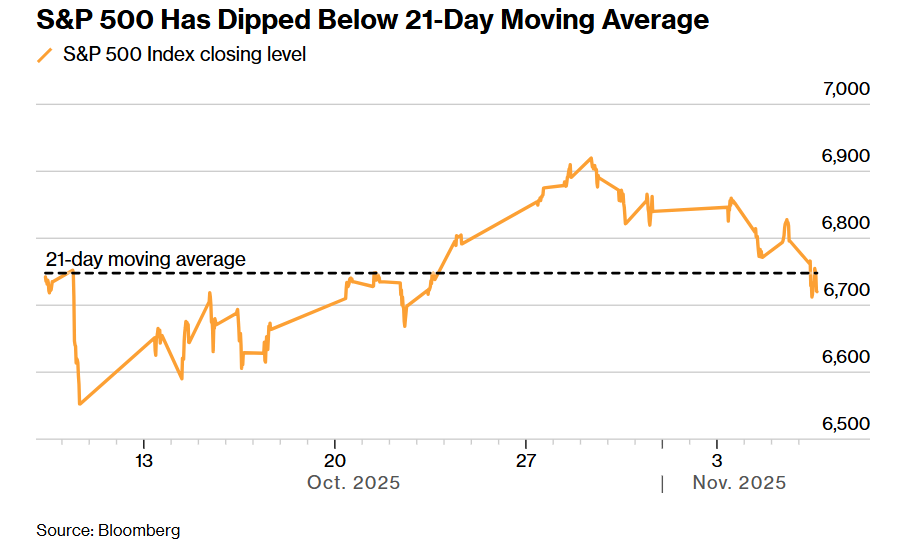
Core Viewpoint - The U.S. stock market is experiencing turbulence, with concerns over the return on investments in the AI sector and high stock valuations leading to a decline in the S&P 500 index, which fell to 6720.32 points, the lowest in two weeks [1] Group 1: Market Analysis - The S&P 500 index has dropped below the 21-day moving average, indicating a potential turning point as investors face uncertainty due to government shutdowns and the Fed's policy path [4] - The index has seen a decline of 2.5% from its previous record high, with the Chicago Board Options Exchange Volatility Index (VIX) rising to around 20 [4] - The Challenger Group reported that announced layoffs in October reached the highest level for this time of year in over 20 years, driven by cost-cutting in AI-related sectors [4] Group 2: Technical Indicators - Key support levels for the S&P 500 index are being closely monitored, with the next significant point being the 6700 mark, where a high volume of options contracts may provide short-term support [5] - Analysts from Morgan Stanley identified the 6740-6800 range as critical technical levels, with a more significant support level at 6640 points [5] - Increased hedging activity has been noted, with the VIX hovering around the critical 20-point mark, indicating rising market vulnerability [5][6] Group 3: Upcoming Catalysts - The upcoming earnings report from NVIDIA on November 19 is anticipated to be a potential market catalyst, especially as the earnings season approaches its end [5]
技术分析师:6665点,标普500止跌的关键点位
智通财经网· 2025-11-07 12:26
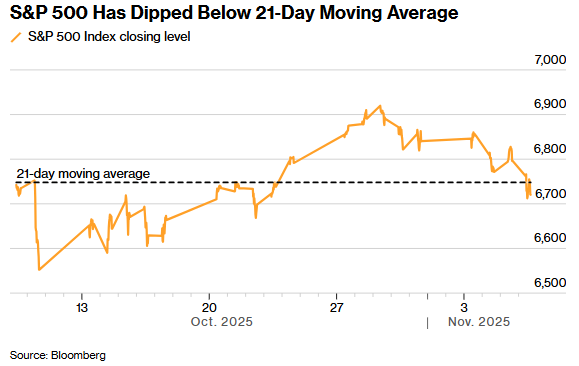
Market Overview - The U.S. stock market has experienced significant volatility, with traders analyzing technical charts to identify potential support levels amid concerns over the return on billions of dollars invested in artificial intelligence [1] - The S&P 500 index fell to 6720 points, marking a two-week low, with the 50-day moving average at 6665 points identified as a critical support level [1] - A breach of the 6665 points could signal a "technical crack," while a rebound to 6748.10 points may reignite market risk appetite [1] Technical Analysis Insights - The next key level for technical analysts is the 6700-point mark, where a high volume of open options contracts may provide short-term support [2] - Morgan Stanley strategists highlight the 6740 to 6800 points range as significant technical levels, with a broader mid-term support at 6640 points [2] - Increased hedging activity has been noted, with the VIX index hovering around the critical level of 20, indicating heightened market volatility [2] Market Sentiment and Economic Indicators - The number of layoffs announced in October reached a 20-year high, driven by cost-cutting measures related to artificial intelligence, contributing to market uncertainty [1] - The seven major tech giants' stock price return index fell by 2%, marking the third decline in six trading days, reflecting investor concerns over unsustainable valuations [1] - The upcoming earnings report from Nvidia on November 19 is anticipated to be a potential market catalyst [2]
【广发金工】PMI数据有所回落,债券资产有望回暖:大类资产配置分析月报(2025年10月)
广发金融工程研究· 2025-11-05 03:18
Macro and Technical Perspectives on Asset Allocation - The macro perspective indicates a bearish outlook on equity assets, while the technical perspective shows an upward trend with moderate valuation and a state of capital outflow [1][5][20] - For bonds, the macro perspective is bullish, but the technical perspective indicates a downward trend [1][5][20] - Industrial products are viewed negatively from a macro perspective, with a downward price trend also noted technically [1][5][20] - Gold assets are favored in the macro view, with a technical upward price trend [1][5][20] Asset Performance Tracking - The fixed ratio + macro indicators + technical indicators combination yielded a return of 10.51% in 2025, with an annualized return of 12.05% since April 2006 [2][21] - The volatility-controlled + macro indicators + technical indicators combination achieved a return of 15.69%, while the risk parity + macro indicators + technical indicators combination returned 6.99% [2][30] Asset Class Analysis - Equity assets are currently under pressure from macro indicators, while technical indicators suggest an upward trend but with capital outflow [20][21] - Bond assets are supported by macro indicators, but technical indicators show a downward trend [20][21] - Industrial products face macro headwinds and technical downward trends [20][21] - Gold assets benefit from favorable macro indicators and an upward technical trend [20][21] Valuation and Capital Flow Indicators - The equity risk premium (ERP) for the CSI 800 index is at 53.94%, indicating a moderate valuation level [13][14] - The latest capital flow indicator for equity assets shows a net outflow of 316 billion, reflecting a capital outflow state [16][17] Summary of Asset Class Scores - The overall scores for asset classes based on macro and technical indicators show equities at 1, bonds at 3, industrial products at -2, and gold at 2 [19][20] - The combined analysis suggests a bearish outlook for equities and industrial products, while bonds and gold are viewed positively [20][21]

冷艺婕:11.2黄金周期跟单可查验净收益 原油周初看震荡
Sou Hu Cai Jing· 2025-11-02 06:50
Group 1 - The article emphasizes the importance of integrity and factual analysis in trading and investment strategies [1] - It highlights the unique strengths of female analysts in providing detailed and patient guidance to ordinary investors, particularly in addressing psychological and technical challenges [1] - The author shares insights from years of experience, stressing that common pitfalls in trading can lead to significant losses for investors [1] Group 2 - The analysis of gold indicates a current downtrend with a potential for short-term rebounds, but significant resistance is expected above [3] - The gold price is noted to be in a corrective phase, with the possibility of completing an ABC retracement pattern [3] - The upcoming week is critical for determining the direction of gold prices based on opening trends [3] Group 3 - The oil market is described as experiencing low volatility with a focus on a trading range between 61.5 and 59.5 [5] - The recommendation is to adopt a high sell and low buy strategy due to the lack of a clear directional trend [5] - Both short positions and long positions are seen as having potential opportunities in the current market environment [5]
降息希望浇灭澳元跌幅扩大
Jin Tou Wang· 2025-10-31 06:34
Group 1 - The Australian dollar (AUD) is trading weakly around 0.6550 against the US dollar (USD), with a current exchange rate of 0.6541, reflecting a decline of 0.15% [1] - The market has downgraded expectations for a Federal Reserve rate cut in December, leading to a stronger USD, which has pressured the AUD [1] - China's official manufacturing PMI data for October showed weak performance, negatively impacting market sentiment and contributing to the pressure on the AUD [1] Group 2 - The Australian inflation report dampens hopes for a rate cut by the Reserve Bank of Australia (RBA) this year, with the probability of a 25 basis point cut to 3.35% on November 4 nearly zero [1] - Economists surveyed expect the RBA to maintain the current rate of 3.60%, with the benchmark rate projected to bottom out at 3.35% by mid-next year [1] - Westpac's chief economist suggests that there is still room for two more 25 basis point cuts next year, with the first potentially in May and the second in August [1] Group 3 - Technical analysis indicates that the AUD/USD is currently in a neutral trend, trading within a rectangular consolidation pattern [2] - Initial resistance is at the psychological level of 0.6600, followed by the upper boundary of the rectangle around 0.6630; a breakout could lead to a bullish trend towards the yearly high of 0.6707 [2] - Key support is at the 9-day EMA level of 0.6544; a drop below this support could weaken short- and medium-term price momentum, potentially leading to a decline towards the lower boundary of the rectangle around 0.6450 [2]
郑氏点银:今夜宣布降息,黄金趁机触底快速反补拉升
Sou Hu Cai Jing· 2025-10-29 15:12
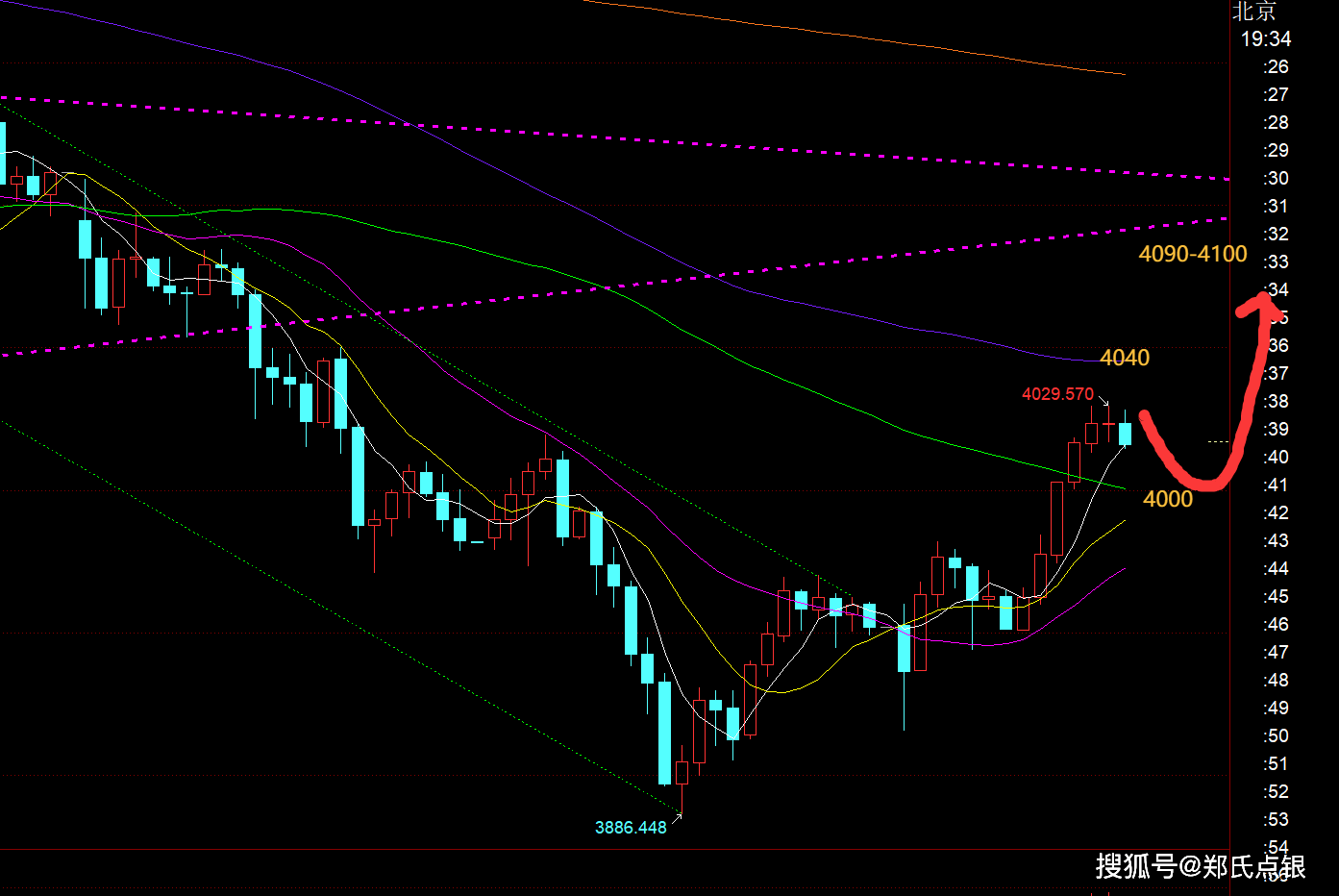
Group 1 - The article discusses the recent fluctuations in gold prices, highlighting a significant drop to a low of 3886 before a rebound occurred, indicating potential support levels around 3915 and 3960 [1][3] - It emphasizes the importance of the 4050 resistance level for gold, suggesting that if the price can close above this level, it may lead to further upward movement towards 4134 and potentially 4200 [1][3] - The analysis indicates that the recent price action may represent a "false breakdown," with expectations of a bullish reversal if the price can stabilize above the midline at 4056 [1][3] Group 2 - Silver is noted to be performing stronger than gold, having broken above the 5-day moving average, with key support levels identified at 47.4, 47.6, and 47.8 [5] - The article suggests that if silver can maintain above these support levels, it may continue to rise towards resistance targets of 48.4 and potentially 49.3-49.4 [5] - The technical analysis provided is based on extensive market observation and aims to guide traders in their decision-making processes [5]
利弗莫尔的一生:求财得财,求死得死
猛兽派选股· 2025-10-29 04:16
Core Viewpoint - The article discusses the cyclical nature of stock market patterns, particularly in the context of PCB (Printed Circuit Board) stocks, and highlights the importance of recognizing leading stocks and pivot points for investment decisions [1][2][5]. Group 1: Market Trends and Signals - The PCB market trend can be initially sensed through the performance of two drilling equipment stocks, with a pivotal signal emerging last Monday, followed by collective movement on Tuesday [1]. - Leading stocks exhibit clear trajectories and signals, which aids in decision-making and reduces cognitive load for investors [2][3]. Group 2: Historical Insights from Livermore - Livermore's trading philosophy emphasizes the recurrence of certain patterns, particularly the phenomenon of volume reversal following extreme low volume, which often coincides with the breakout of minimum resistance levels [5]. - Despite his lack of formal education, Livermore developed a day trading model based on price records, achieving significant early success, but faced challenges on Wall Street due to delays in price quotes [5]. - Livermore's eventual failures were attributed to ignoring technical analysis and succumbing to narrative-driven decisions, leading to significant financial losses [6]. Group 3: Personal Struggles and Legacy - Livermore's financial downfall was compounded by personal issues, including extravagant spending and emotional turmoil, which ultimately affected his trading decisions and risk management [6]. - His suicide is framed as a choice of a strong individual rather than a sign of weakness, drawing parallels to other notable figures who faced existential crises [7]. - Despite his struggles, Livermore left behind a considerable amount of cash and assets, indicating that his trading career had its successes [6][7].