杠铃策略

Search documents
“黑天鹅之父”塔勒布最新分享,深谈反脆弱、黄金、关税以及中国机会
聪明投资者· 2025-08-06 07:03
Core Insights - The concept of "fragility" and "antifragility" is crucial for understanding how systems respond to shocks, with antifragile systems benefiting from volatility [2][4][32] - Gold is identified as a key asset that can benefit from uncertainty in the current economic climate [2][94][96] - The current U.S. tariff policies are seen as exacerbating systemic fragility, particularly in the context of high debt and inflation [5][120] Group 1: Fragility and Antifragility - Traditional financial models assume a stable and predictable world, which is often not the case, leading to hidden fragility in diversified portfolios [4][12][111] - The "barbell strategy" is proposed as a better investment approach, allocating 80% to extremely safe assets and 20% to high-risk investments [4][78][115] - Fragile systems experience accelerated losses under stress, while antifragile systems can thrive and grow stronger from shocks [30][41][52] Group 2: Economic Context - The interconnectedness of the global economy has increased the impact of localized shocks, making systems more fragile [56][58] - Current high levels of debt in developed economies like the U.S. and Europe contribute to their fragility, limiting growth potential [64][66][120] - China is viewed as having a stronger "convexity," meaning it can rebound more effectively from shocks due to its systemic advantages in research, manufacturing, and diplomacy [6][108][141] Group 3: Investment Strategies - Investors are advised to be cautious and to avoid structures that appear stable but may hide significant risks, such as those seen in "generalized Bob Rubin trades" [70][74][81] - The importance of hard stop-loss strategies is emphasized over traditional risk management models that rely on normal distribution assumptions [78][79] - The current economic environment is characterized by high uncertainty, making a conservative approach preferable for investors [131][140]


成交回升,沪指上涨
Hua Tai Qi Huo· 2025-08-06 05:54
FICC日报 | 2025-08-06 成交回升,沪指上涨 市场分析 国内推动学前教育免费。国内方面,国务院办公厅印发《关于逐步推行免费学前教育的意见》明确,从2025年秋 季学期起,免除公办幼儿园学前一年在园儿童保育教育费,不含伙食费、住宿费、杂费等。同时,民办幼儿园也 可享受与公办幼儿园"同等"减免水平,高出免除水平的部分可继续向在园儿童家庭收取。国新办周四举行国务院 政策例行吹风会,介绍逐步推行免费学前教育政策有关情况。海外方面,特朗普再次批评鲍威尔降息太迟,称可 能很快宣布美联储新任主席。特朗普还宣布,将在未来24小时内"大幅"提高对印度的关税,并将在一周内宣布药 品和芯片关税,其中药品关税最终可能高达250%。 股指回升。现货市场,A股三大指数高开高走,上证指数涨0.96%收于3617.6点,创业板指涨0.39%。行业方面,板 块指数全线收涨,银行、钢铁、传媒、通信行业涨幅居前。当日沪深两市成交金额回升至1.6万亿元。央行等七部 门联合印发金融支持新型工业化指导意见,坚持分类施策、有扶有控,推动产业加快迈向中高端,防止"内卷式" 竞争。《意见》明确,到2027年建成适配制造业高端化、智能化、绿色化发 ...
策略周评 | 震荡整固,向好趋势未变
Sou Hu Cai Jing· 2025-08-04 06:02
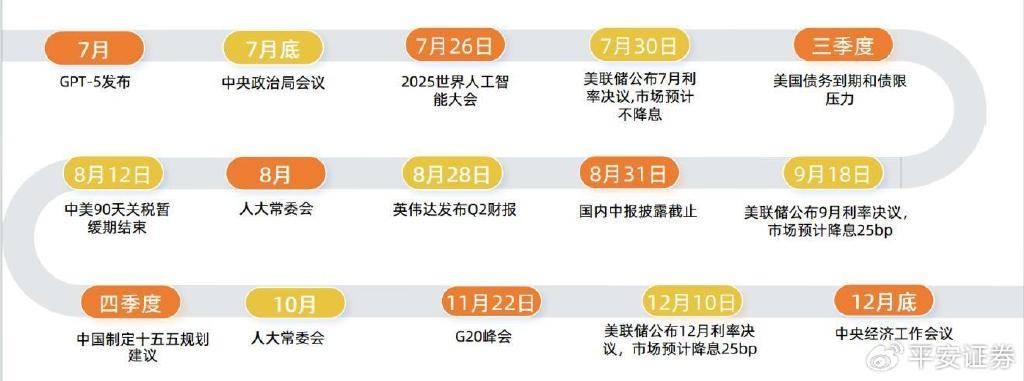
来源:平安证券 1、市场点评 震荡整固,向好趋势未变(风险偏好回落) 上周全球股市普跌,A港股表现优于海外,市场逐步验证"东稳西荡"。沪指突破3600点后小幅回落,港股在汇率扰动下跌幅较大。近期关税谈判 与政治会议相对中性,未能提供突破性线索;未来主线结构尚未确立,市场持续年内创新高后止盈需求回归下震荡。往后看,市场对于政策和中 美谈判的乐观预期修正,止盈需求逐步消化后,市场有望逐步企稳回升,但中期"政策-经济-市场"的良性循环未变,下半年A港股估值中枢逐步抬 升,港股表现或优于A股,积极把握布局良机。 1)稳中求进,资本市场重要性提升:政治局会议表态积极,整体延续4月政治局会议的基调,强调逆周期调节稳步推进,首次提出增强资本市场 包容性与回稳势头; 2)海外就业大幅下修,降息预期抬升:美国7月就业与前值大幅下修,美股、美元大跌,年内降息预期大幅改善; 3)政策仍有发力空间:各部委、各行业合力推进"反内卷",雅江水电站、农村公路改造等基建项目强化需求端支撑,人工智能大会明确AI战 略,"扩内需"、"反内卷"等政策年内有望持续加码。 坚守核心资产,杠铃配置(关注持仓结构) 1)中期科技成长弹性更优。"反内卷"加 ...
诺亚控股殷哲对谈塔勒布:用反脆弱应对宏观新范式
点拾投资· 2025-08-04 02:06
Core Insights - The article emphasizes the importance of understanding "Black Swan" events and the concept of "Antifragility" in both investment and life, as articulated by Nassim Nicholas Taleb during a recent summit [1][2]. Group 1: Black Swan and Antifragility - Black Swan events are characterized by rarity, significant impact, and predictability in hindsight, highlighting that unknown factors are often more critical than known ones [2]. - Antifragility refers to systems that benefit from volatility and chaos, thriving under stress rather than merely surviving [2]. Group 2: Modern Society and Vulnerability - Modern societal structures exhibit scalability and connectivity, leading to a "winner-takes-all" phenomenon where a few entities capture the majority of wealth [4]. - The acceleration of information transfer can result in severe impacts from a limited number of events, increasing overall societal vulnerability [5]. Group 3: Economic Insights - The global economic structure shows that while the debt levels in Europe and Japan continue to rise without growth, China's economy is positioned as more antifragile, growing at a faster pace [7][12]. - Historical data indicates that the economic impact of crises has been increasing, with losses from recent events being significantly larger than those from earlier crises [6]. Group 4: Investment Strategies - Investors are advised to be cautious of debt, relying on a "barbell strategy" to hedge against tail risks and avoid overvalued assets with unreliable cash flows [8]. - Gold is identified as a superior antifragile asset, having appreciated by 40% as the dollar's status as a reserve currency diminishes [11]. Group 5: Future Outlook - The article posits that China's economy is likely to experience greater prosperity compared to many other countries, suggesting that Chinese investors can afford to take on more risk [12].

莫愁前路
Guotou Securities· 2025-08-03 11:31
Group 1 - The report indicates that the recent market pullback is primarily due to profit-taking after significant domestic and international events, yet the technology growth sector continues to show strong profitability [2][10] - The report maintains an optimistic outlook for the market, suggesting that the index will perform better than expected due to ongoing inflows of medium to long-term capital and a rebalancing of stock and bond asset allocations [2][10] - The report highlights that the current environment of liquidity is conducive to a bull market, emphasizing the importance of selecting the right investment direction, particularly focusing on the ChiNext Index and technology innovation in Q3 [2][3] Group 2 - The report notes that the banking sector has experienced a significant pullback, with the banking index down over 6% since mid-July, indicating a potential end to the decline as the volatility in the banking sector has returned to historically low levels [2][27][28] - The report suggests that the current valuation of the banking sector is high, with the price-to-book ratio at 0.74 and the price-to-earnings ratio at 7.49, indicating a mismatch between valuation and profitability [35][36] - The report emphasizes that the banking sector's dividend yield remains attractive compared to long-term bond yields, which may support continued investment from long-term capital [36][37] Group 3 - The report identifies that the ChiNext Index and technology sectors are poised for recovery, supported by favorable macroeconomic policies and emerging industry trends such as AI, innovative pharmaceuticals, and new energy vehicles [3][60] - The report highlights that the current valuation of the ChiNext Index is at a historical low, with a price-to-earnings ratio of 33.89, suggesting a relative valuation advantage compared to other major indices [60][63] - The report indicates that the profitability of the ChiNext Index is significantly higher than the overall A-share market, with a profit growth rate of 19% in the first quarter, further supporting its investment appeal [61][63]
波动是常态,N刷塔勒布“反脆弱”哲学
天天基金网· 2025-08-01 12:01
Core Viewpoint - The article emphasizes the importance of recognizing and preparing for "black swan" events, which are rare and unpredictable occurrences that can have significant impacts on markets. It advocates for a "antifragile" investment approach that benefits from uncertainty rather than attempting to predict these events [3][4][10]. Group 1: Understanding Black Swan Events - Black swan events are defined as extremely rare occurrences that lie outside the realm of regular expectations and can have devastating effects once they occur. Examples include the subprime mortgage crisis and geopolitical conflicts [6]. - The article identifies three main factors that contribute to the emergence of black swan events: cognitive biases, system fragility, and tail risks. Cognitive biases lead investors to rely too heavily on historical data, while system fragility arises when systems depend on specific assumptions that, if disrupted, can lead to collapse [6][7][8]. Group 2: Antifragile Investment Strategies - The article discusses several strategies to enhance portfolio resilience against black swan events: - **Barbell Strategy**: This involves allocating most assets to low-risk investments (like government bonds) and a small portion to high-risk assets, minimizing potential losses during black swan events [11]. - **Multi-Asset Allocation**: Diversifying investments across various asset classes that are low or negatively correlated can help mitigate the impact of specific shocks. For instance, during economic downturns, high-quality bonds may rise in value while stocks fall [12]. - **Multi-Strategy Allocation**: This strategy involves investing in various independent strategies that have different risk-return profiles, providing a hedge against market volatility [13]. - **Utilizing Options**: Options can serve as effective tools for hedging against black swan events due to their non-linear payoff structures. For example, buying deep out-of-the-money put options can provide significant protection at a low cost [14][15]. Group 3: Conclusion and Implementation - The article concludes that the best approach to dealing with uncertainty is to build an investment system with antifragile characteristics in calm periods, rather than reacting in panic during crises. Continuous learning and adaptation are essential for successfully navigating the complexities of the market [16].

年内最强基金“闭门谢客”
Guo Ji Jin Rong Bao· 2025-07-30 15:52
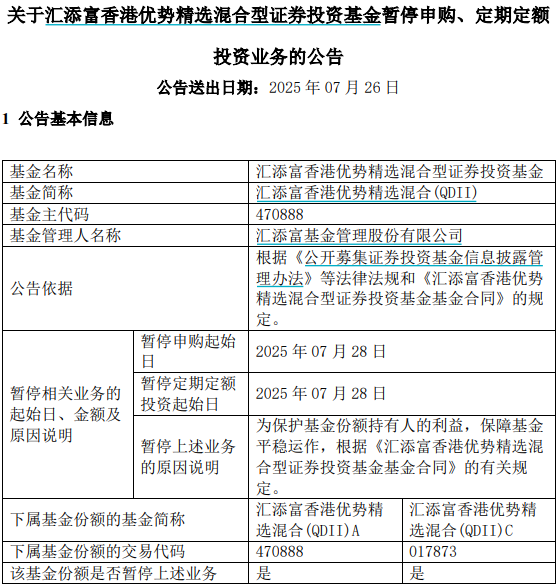
Core Viewpoint - The recent surge in the Hong Kong stock market has led several QDII funds, including the top-performing Huatai-PineBridge Hong Kong Advantage Select, to suspend subscriptions to protect the interests of existing investors [1][4][11]. Group 1: Fund Performance and Actions - Huatai-PineBridge Hong Kong Advantage Select (QDII) reported a year-to-date net value increase of 139.12% as of July 28, making it the top fund in the market [1][6]. - Multiple QDII funds have announced restrictions or suspensions on subscriptions and regular investments, including those tracking European and Japanese markets, to ensure stable operations and protect investor interests [3][4]. - The suspension of subscriptions is attributed to excessive investor enthusiasm, leading to tight foreign exchange quotas [1][6][11]. Group 2: Market Trends and Investor Behavior - The QDII fund sector has seen a significant increase in total scale, reaching 683.77 billion yuan by the end of June, up from 611.32 billion yuan at the end of last year, despite a slight decrease in the number of funds [9]. - The inflow of funds into cross-border ETFs, particularly those related to Hong Kong stocks, has been notable, with significant net inflows recorded for various ETFs [10]. - The current market environment is characterized by a "barbell strategy," where investors are allocating funds to both dividend stocks and growth stocks, influenced by liquidity conditions and risk preferences [10].
又现赎回风波,债基抱团松动,这两类债券ETF却逆流而上!
Sou Hu Cai Jing· 2025-07-28 07:40
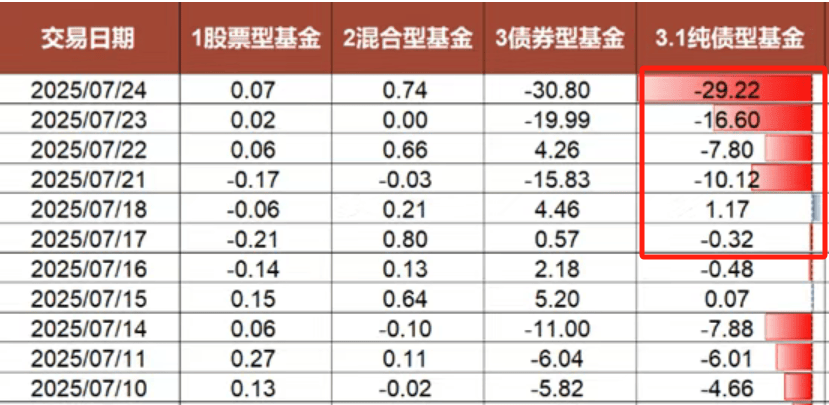
Market Overview - The equity and commodity markets have both risen recently, while the bond market faces significant pressure. The Shanghai Composite Index reached a new high for the year on July 21, closing at 3593.66 points on July 25, with a weekly increase of 1.67% [1] - From July 21 to 25, pure bond funds experienced net redemptions for five consecutive trading days, with nearly 100 billion yuan redeemed on July 24 alone [1] Fund Performance - On July 24, several bond funds, including the Xingyin Zhongdai Preferred Investment Grade Credit Bond Index C, reported large redemptions [1] - Data shows that insurance institutions have reduced their holdings of government bonds for three consecutive months, with reductions of 8.9 billion yuan, 7.4 billion yuan, and 1.2 billion yuan in April, May, and June respectively [2][3] Bond Market Dynamics - Despite the modest reduction in holdings, the shift in insurance capital, which was previously a major investor in long-term government bonds, is noteworthy [3] - As of the end of Q2, the total scale of public bond funds reached a historical high of 10.93 trillion yuan, up 860 billion yuan from the end of Q1 [4] Investment Strategies - The "barbell strategy" remains popular among institutional investors, balancing high-dividend assets with growth sectors like technology and new consumption [7] - There is a notable increase in the assets of bond ETFs, with a total of 510.5 billion yuan across 39 bond ETFs as of July 25, indicating a trend of institutional investors seeking opportunities in long-term government bonds and innovative bonds [8] Performance of Bond ETFs - The BoShi Shanghai 30-Year Government Bond ETF and Pengyang Zhongdai 30-Year Government Bond ETF have shown relatively strong performance in terms of risk-adjusted returns, despite trailing behind the CSI 300 Index [9] - Institutions remain optimistic about the bond market, suggesting that current market fluctuations present good entry points for bond investments [9]
瑞银H股投资框架更新:维持乐观看法,政策法规、盈利、创新和资金流动等影响最大
IPO早知道· 2025-07-25 02:27
Core Viewpoint - The article discusses the investment framework for H-shares in Hong Kong, highlighting the increasing allocation of southbound investors and the potential downward pressure on short-term earnings forecasts due to competition in the food delivery and other industries [3][4][5]. Group 1: Key Factors Influencing H-shares - The key factors driving H-shares, in order of importance, are: 1) policies and regulations; 2) earnings (especially earnings adjustment trends); 3) innovation; 4) capital flow (particularly from southbound investors) and interest rates; 5) valuation; 6) macro conditions; 7) geopolitical factors [4]. - The market is experiencing short-term pressure due to competition in the food delivery sector, which may lead to downward adjustments in earnings forecasts [5][8]. Group 2: Changes in H-share Investment Dynamics - The increase in southbound holdings has changed the dynamics of H-share investments, including: 1) reduced sensitivity to geopolitical issues; 2) greater impact of capital flow (especially southbound) and local liquidity (like HIBOR) on index performance; 3) decreased correlation with global markets; 4) reduced influence of economic factors due to a higher weight of technology stocks in the index [6]. - Despite the challenges, the valuation of Hong Kong stocks remains attractive compared to other domestic assets and global markets, which may support capital inflows from southbound and international investors [5][6]. Group 3: Short-term Outlook and Strategy - UBS analysts predict a 4% downside risk to market earnings forecasts for the Hang Seng China Enterprises Index, primarily due to competition in the food delivery industry [8]. - The company maintains an optimistic view on H-shares and the overall Chinese stock market, suggesting a "buy on dips" strategy due to attractive valuations, particularly in AI-related technology stocks [8]. - The focus on capital flow and innovation is expected to be crucial for market performance in the short term, with a recommendation for a barbell strategy in industry selection [8].

以创业板定投助力“长钱长投”天弘基金联合深交所举办ETF大讲堂活动
和讯· 2025-07-22 10:39
Core Viewpoint - The article emphasizes the growing importance of ETFs as a long-term investment tool in the Chinese market, particularly with the launch of a new dynamic PB-based investment strategy for the ChiNext index by Tianhong Fund and the Shenzhen Stock Exchange [1][2]. Group 1: ETF Market Overview - The domestic ETF market has surpassed 4 trillion yuan, with stock ETFs exceeding 3 trillion yuan, indicating a rising demand for index tools among investors [1]. - Tianhong Fund's total index fund management scale is projected to exceed 130 billion yuan by the end of 2024, ranking 9th in the industry, with over 90 products and more than 12 million holders [3]. Group 2: Investment Strategy - The newly introduced ChiNext investment strategy uses dynamic PB percentiles as a valuation anchor, promoting a "buy low, sell high" approach by adjusting investment amounts based on PB levels [2][5]. - The strategy aims to enhance investor experience by addressing four major pain points in regular investment practices, focusing on effective buying and selling conditions [2][4]. Group 3: Market Trends and Insights - The ChiNext index has been optimized to improve investment value, with new mechanisms for monthly removal of risk warning stocks and ESG negative screening, enhancing the quality of index samples [8]. - The overall valuation of the ChiNext is currently at a relatively reasonable historical level, indicating a higher probability of positive returns in the future [8]. Group 4: Educational Initiatives - The Shenzhen Stock Exchange has been actively promoting ETF product innovation and investor participation through educational events like the "ETF Lecture Hall," aiming to instill a scientific investment mindset among investors [4][10]. - The collaboration between Tianhong Fund and Ant Wealth has led to the development of practical tools such as "Target Investment" and "Index Traffic Light" to assist investors [3].