地缘政治风险

Search documents
黄金股盘初走高 紫金黄金国际涨超6% 金价逼近历史高位
Ge Long Hui· 2025-12-15 02:39
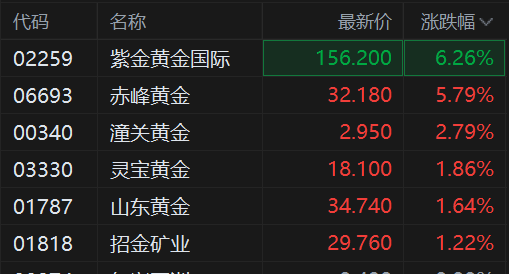
12月15日,港股黄金股盘初拉升走强,其中,紫金黄金国际涨超6%领衔,赤峰黄金涨5.8%,潼关黄金 涨近3%,灵宝黄金、山东黄金、招金矿业均涨超1%。 消息上,亚洲早盘黄金小幅走高。现货黄金上涨0.6%,报每盎司4,324美元,不断逼近历史新高位。 Tickmill执行董事Joseph Dahrieh表示,金价继续受益于市场对美联储将进一步放松货币政策的坚定预 期、各国央行的持续买入,以及不断扩大的地缘政治风险,这些风险正维持着避险资金流。本周市场焦 点可能将是美国的主要政府数据,例如将于周二公布的11月就业报告和将于周四公布的11月CPI数据。 | 代码 | 名称 | 最新价 | 涨跌幅 √ | | --- | --- | --- | --- | | 02259 | 紫金黄金国际 | 156.200 | 6.26% | | 06693 | 赤峰黄金 | 32.180 | 5.79% | | 00340 | 漳关黄金 | 2.950 | 2.79% | | 03330 | 灵宝黄金 | 18.100 | 1.86% | | 01787 | 山东黄金 | 34.740 | 1.64% | | 01818 | 招 ...

港股异动丨黄金股盘初走高 紫金黄金国际涨超6% 金价逼近历史高位
Ge Long Hui· 2025-12-15 01:51
Group 1 - Hong Kong gold stocks experienced a strong rally at the beginning of trading, with Zijin Mining International leading the gains, rising over 6% [1] - Other notable performers included Chifeng Jilong Gold Mining up 5.8%, Tongguan Gold up nearly 3%, and Lingbao Gold, Shandong Gold, and Zhaojin Mining all rising over 1% [1][2] - The spot gold price increased by 0.6%, reaching $4,324 per ounce, approaching historical highs [1] Group 2 - Joseph Dahrieh, Executive Director of Tickmill, indicated that gold prices are benefiting from strong market expectations for further easing of monetary policy by the Federal Reserve, ongoing purchases by central banks, and escalating geopolitical risks [1] - This week, the market focus will be on key U.S. government data, including the November employment report to be released on Tuesday and the November CPI data on Thursday [1]
黄金小幅走高,受一些有利因素支撑
Sou Hu Cai Jing· 2025-12-14 23:55
亚洲早盘 黄金小幅走高。Tickmill执行董事Joseph Dahrieh在一封电子邮件中表示,金价继续受益于市场 对美联储将进一步放松货币政策的坚定预期、各国央行的持续买入,以及不断扩大的地缘政治风险,这 些风险正维持着避险资金流。本周市场焦点可能将是美国的主要政府数据,例如将于周二公布的11月就 业报告和将于周四公布的11月CPI数据。现货黄金上涨0.1%,报每盎司4,305.27美元。 ...
原油产业周报:地缘紧张难抵基本面弱势,油价震荡偏弱-20251215
Nan Hua Qi Huo· 2025-12-14 23:30
1. Report Industry Investment Rating - Not provided in the document 2. Core Viewpoints - Oil prices are fluctuating within a range due to the uncertainty of geopolitical situations and the continuous weakness of fundamentals. The tense situation between the US and Venezuela has replaced the Russia-Ukraine conflict as the short - term price - determining factor, but the market's sensitivity to geopolitics has decreased. The interest rate cut has been priced in earlier and has limited impact on oil price drivers. The long - term trading logic of crude oil still needs to focus on the evolution of the long - term supply - demand pattern. [1][5][7] 3. Summary by Directory 3.1 Core Contradictions and Strategy Recommendations 3.1.1 Core Contradictions - Oil prices are fluctuating between geopolitical uncertainty (US - Venezuela tensions) and weak fundamentals. The Fed's 25 - basis - point interest rate cut was already priced in by the market, so its current impact on prices is neutral. The market's sensitivity to geopolitical risks has decreased, and the follow - up should focus on the development of the US - Venezuela situation. [1] 3.1.2 Speculative Strategy Recommendations - **Market Positioning**: Short - term shock and relative stability. - **Strategy Recommendations**: - **Unilateral**: Trade within the range, paying attention to the potential pressure around $65/barrel and the potential support around $62/barrel for Brent oil. - **Arbitrage**: Wait and see. - **Options**: Wait and see. [9] 3.2 This Week's Important Information and Next Week's Focus Events 3.2.1 This Week's Important Information - **Positive Information**: The US has imposed sanctions on individuals, shipping companies, and tankers operating in Venezuela's oil sector. Russian crude oil deliveries to India and China have declined for three consecutive weeks, likely due to new US sanctions. [10] - **Negative Information**: US Gulf Coast gasoline inventories have risen for four consecutive weeks, and implied demand has declined. US crude oil inventories in Cushing, Oklahoma, and strategic petroleum reserve inventories have changed, and commercial crude oil inventories (excluding strategic reserves) have decreased by 1800,000 barrels, a 0.4% decline. [11][12] 3.2.2 Next Week's Focus Events - Pay attention to the development of the US - Venezuela situation, as it is currently the short - term price - determining factor, but the market's sensitivity to it has decreased. [13] 3.3 Disk Interpretation 3.3.1 Volume, Price, and Capital Analysis - **Trend Analysis**: International oil prices have remained stable overall, continuing the recent shock pattern and showing a four - month consecutive decline. - **Domestic Market**: The SC2601 contract of the SC main force closed at 437.6 yuan/ton, a weekly decline of 3.55%. The trading volume of INE crude oil futures on the Shanghai Futures Exchange increased by 9,721 lots to 84,693 lots. - **Foreign Market**: The US oil main contract fell 0.12% to $57.53/barrel, a weekly decline of 4.24%; the Brent crude oil main contract fell 0.11% to $61.21/barrel, a weekly decline of 3.98%. The trading volume of WTI crude oil futures on the New York Mercantile Exchange decreased by 45,419 contracts to 1,868,023 contracts, and the net long position of managed funds decreased by 1,025 contracts to - 12,671 contracts. [16][18][21] 3.3.2 Internal - External Spread Tracking - **Spread**: As of December 12, the SC - Brent continuous 1 spread was $0.28/barrel, the SC - WTI continuous 1 spread was $3.94/barrel, the SC - Dubai continuous 1 spread was $0.97/barrel, and the Brent - WTI continuous 1 spread was $3.66/barrel. - **Arbitrage**: The theoretical price of SC M + 3 was 475.46 yuan/barrel, and the deviation from the market price increased. The theoretical on - shore profit of SC was - 29.05 yuan/barrel, and the loss narrowed compared with last week. The SC - Brent spread was weak, and the domestic crude oil was relatively weak under the background of OPEC+ production increase. [27][28] 3.4 Valuation and Profit Analysis 3.4.1 Crude Oil Market Monthly Spread Tracking - As of December 12, the Brent monthly spread (01 - 03) was $0.48/barrel, the WTI monthly spread (01 - 03) was $0.41/barrel, and the SC monthly spread (01 - 03) was - 5 yuan/barrel. [31] 3.4.2 Crude Oil Regional Spread Tracking - As of December 12, the SC - Brent continuous 1 spread was $0.27/barrel, and the Brent - WTI continuous 1 spread was $3.66/barrel. [43] 3.4.3 Downstream Crude Oil Valuation Tracking - The cracking spreads and refining profits in European, North American, Asia - Pacific, and Chinese markets have all shown different degrees of changes, with some declining and some showing small increases or decreases. [58][60] 3.5 Supply - Demand and Inventory Deduction 3.5.1 Supply - Side Tracking - In October, global crude oil and related liquid production was 108.18 million barrels per day, a decrease of 310,000 barrels per day compared with September. The EIA has slightly increased its production forecasts for 2025 and 2026. US, OPEC, and Non - OPEC DoC countries' crude oil production also had corresponding changes in October and future forecasts. [93] 3.5.2 Demand - Side Tracking - Information on the seasonal trends of US refinery crude oil weekly feed and weekly operating rates, as well as China's major refinery operating rates and refining margins, is provided. [82][85] 3.5.3 Inventory - Side Tracking - Seasonal trends of US commercial crude oil weekly inventories (excluding strategic reserves) and Cushing crude oil weekly inventories are presented. [87] 3.5.4 Import - Export Tracking - Seasonal trends of US and Russian crude oil export volumes and the types of ships used for export are shown. [89][91] 3.5.5 Balance Sheet Tracking - The EIA's forecasts for global, US, and OPEC countries' crude oil production in 2025 and 2026 are presented. [93]
金价暴涨50%后,风险警报全面拉响!2026年金价会迎来大幅回调吗
Sou Hu Cai Jing· 2025-12-14 04:47
12月8日,一个值得载入金融史册的日子。 这一天,现货黄金价格年内涨幅逼近60%,而标普500指数也上涨了超过16%。 国际清算银行发布的一份报告, 将这一现象称为"至少50年来首次",并指出黄金与美股同时呈现这种"爆炸性上涨"态势,往往预示着潜在泡沫的存在,之后常伴随着负回报或低迷时期。 这份来自"央行中的央行"的警示,像一颗投入平静湖面的石子,在狂热的黄金市场中激起了层层涟漪。 进入2025年,市场对美联储将连续降息的预期不断强化,特别是在8月和9月美国非农就业数据接连弱于预期之后,资金涌入黄金市场的速度明显加快。 更 有甚者,市场开始担忧美联储的独立性。 有分析指出,美国总统对美联储的干预增加,提名倾向大幅降息的官员,持续施压主席降息,这些举动都加剧了 市场对美元信用根基的担忧,成为了金价上涨的"助燃剂"。 第二股力量,则来自对美元和美国财政可持续性的深层焦虑。 这不仅仅是利率问题,更是信用问题。 美国联邦政府债务规模已超过37万亿美元,且仍在快 速增长。 更戏剧性的是,2025年10月,美国政府因两党争斗再度陷入"停摆",关键经济数据发布进入"真空期"。 这些事件让全球投资者不得不思考:美国的债务问题 ...
12月12日金价:大家要做好准备,下周起,金价很可能这样走
Sou Hu Cai Jing· 2025-12-13 02:07
金价猛涨,银价更疯!你一定没想到,今年涨得最猛的贵金属不是黄金,而是它身边那个"小兄弟"白银。截至12月12日,现货白银年内涨幅居然超过了 110%,直接把黄金60%的涨幅甩在了身后。这个数字让不少老投资者都直呼意外。 就在12月12日,现货黄金价格最高触及每盎司4285.75美元,创下一个多月来的新高。国内各大金店的价格牌也跟着翻新,老庙黄金等品牌首饰金价已标至 1339元/克,投资金条价格则在每克969-1019元之间。 白银的表现更为抢眼,同期创下每盎司64.31美元的历史新高。这场贵金属市场的火爆行情,在12月初的冬天里烧得格外热烈。 美联储按下降息按钮 这波行情的直接推手,是美联储在12月议息会议中的决定。当地时间12月10日,美联储宣布将联邦基金利率目标区间下调25个基点,至3.5?.75%的水平。这 是美联储今年连续第三次降息。 降息意味着资金的使用成本降低,而黄金本身是不产生利息的资产。利率下降使得持有黄金的机会成本随之降低,自然提升了它的吸引力。与此同时,降息 通常会给美元带来压力,12月12日美元指数跌破99关口,而以美元计价的黄金则显得"更便宜"了,这进一步推动了价格上涨。 不只是利率在 ...

石油沥青日报:局部现货上涨,关注委内瑞拉局势-20251212
Hua Tai Qi Huo· 2025-12-12 04:33
1. Report Industry Investment Rating - Unilateral: Neutral, waiting for the bottom to consolidate [2] - Cross-variety: None [2] - Cross-period: None [2] - Spot-futures: None [2] - Options: None [2] 2. Core View of the Report - Crude oil prices continue to be weak, with insufficient support at the cost end of asphalt. The market is in a state of oscillating bottom-building, and the rebound momentum is temporarily limited. Although the rigid demand for asphalt remains weak, the reduction in the circulation of asphalt spot resources in some areas today has driven up local prices. There are currently some winter storage contracts being released in the north, and although the downstream receiving sentiment is still cautious, there are some bottoming signals. Additionally, attention should be paid to the recent changes in the situation in Venezuela, as the US seized a Venezuelan oil tanker the day before yesterday, and there are signs of a decline in Venezuelan oil shipments according to shipping schedule data. Although there were many arrivals of diluted asphalt in the early stage and the current resources are relatively abundant, with the discount continuously decreasing, attention should be paid to the risk of raw material tightening caused by future geopolitical factors [1] 3. Summary by Relevant Catalogs Market Analysis - On December 11, the closing price of the main BU2602 contract of asphalt futures in the afternoon session was 2,960 yuan/ton, up 27 yuan/ton or 0.92% from the previous day's settlement price. The open interest was 208,301 lots, a net increase of 2,329 lots, and the trading volume was 256,002 lots, a net increase of 114,769 lots [1] - The spot settlement prices of heavy-traffic asphalt from Zhuochuang Information are as follows: Northeast, 3,156 - 3,500 yuan/ton; Shandong, 2,880 - 3,370 yuan/ton; South China, 2,930 - 3,150 yuan/ton; East China, 3,100 - 3,220 yuan/ton [1] - Yesterday, the spot prices of asphalt in Shandong and North China increased, while those in East China and Sichuan and Chongqing decreased. The spot prices of asphalt in other regions were generally stable [1] Charts - The report includes charts showing the spot prices of heavy-traffic asphalt in various regions (Shandong, East China, South China, North China, Southwest, Northwest), the closing prices of the petroleum asphalt futures index, the main contract, and the near-month contract, the near-month spread, the unilateral trading volume and open interest, the main contract trading volume and open interest, the weekly output of domestic asphalt, the output of independent refineries, the output in Shandong, East China, South China, and North China, the consumption of domestic asphalt in roads, waterproofing, coking, and shipping fuel, and the inventory of asphalt refineries and social inventory (all with corresponding units) [3]
金荣中国:全球经济不确定性下,避险资产黄金再次闪耀光芒
Sou Hu Cai Jing· 2025-12-12 04:01
Fundamental Analysis - Gold prices have surged, currently trading around $4,270 per ounce, following a strong breakout after the Federal Reserve's third consecutive rate cut of 25 basis points, which led to a 1.2% increase in gold prices, reaching a one-month high of $4,285.75 per ounce [1][3] - The decline of the US dollar index to a near two-month low of 98.13 has been a significant factor in driving gold prices higher, as a weaker dollar reduces the cost of gold for international buyers, thereby stimulating demand [3] - The Federal Reserve's dovish stance, emphasizing monitoring labor market trends and acknowledging persistent inflation, suggests the possibility of further rate cuts, which has bolstered investor sentiment towards gold [3][4] - Historical trends indicate that periods of Fed easing typically coincide with strong rebounds in gold prices, as seen with the recent increase in spot gold prices and the rise of silver to a historical high of $64.31 per ounce [4] Technical Analysis - The daily chart indicates a strong bullish breakout, with gold prices closing around $4,279, suggesting potential upward movement towards historical highs near $4,380 [7] - Short-term price action has shown consolidation around the $4,265 level, with a recent breakout above $4,250 leading to further upward momentum, testing levels around $4,285 [7] - Traders are advised to monitor support levels above $4,250 and consider long positions, targeting resistance levels around $4,290 to $4,320 [7] Geopolitical Factors - Global geopolitical tensions, including the situation in Ukraine and statements from US President Trump regarding Venezuela, have added to the uncertainty, further supporting gold as a safe-haven asset [5] - The interplay of Fed rate cuts, inflation pressures, declining US Treasury yields, and geopolitical risks has collectively driven gold prices to recent highs, with silver also reaching record levels [5]
美委地缘风险高黄金T+D大涨
Jin Tou Wang· 2025-12-12 03:09
在被问及"美方扣押委内瑞拉油轮后,美国对委行动是否仍仅聚焦毒品问题"时,美国总统特朗普表示, 美方应对举措涉及"远不止毒品",并称委内瑞拉向美国输入大量罪犯。 特朗普称,美国"正在采取强有力行动",并表示边境地区的毒品运输已下降92%。在回应中,特朗普进 一步暗示美方可能升级行动范围,称"行动很快就会从海上延伸至陆地",但未透露具体细节。 【最新黄金t+d行情解析】 摘要今日周五(12月12日)亚盘时段,黄金T+D目前交投于965元附近,截至发稿,黄金T+D暂报963.40元/ 克,涨幅0.90%,最高触及964.88元/克,最低下探951.00元/克。目前来看,黄金T+D短线偏向看涨走 势。 今日周五(12月12日)亚盘时段,黄金t+d目前交投于965元附近,截至发稿,黄金t+d暂报963.40元/克,涨 幅0.90%,最高触及964.88元/克,最低下探951.00元/克。目前来看,黄金t+d短线偏向看涨走势。 【要闻速递】 上海黄金t+d早盘开盘于951.50元/克,随后震荡上行,盘中最高触及964.88元/克,截至发稿报962.50元/ 克,涨幅0.81%。从技术面看,金价成功突破955元/克的关键阻 ...
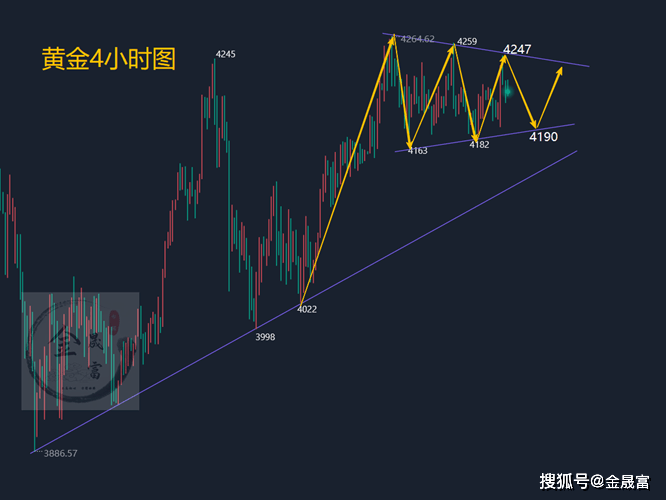
金晟富:12.11黄金继续震荡拉扯洗盘!晚间黄金分析参考
Sou Hu Cai Jing· 2025-12-11 11:09
能力不在脸上,本事不在嘴上!在投资的路上我不敢保证能带你赚多少,因为只要你配合,盈利从来没 有上限,每一位学员我都用自己最大的能力为其谋取利润,如果你还沉迷亏损,那我无话可说,但是若 想盈利,请找我金晟富,有实力才能这么自信!(有缘认识是一种缘分,多一个朋友也不会让你损失什 么,先看实力再谈合作,你赢我陪你君临天下,你输我陪你东山再起!)需要带单的朋友,可在博主个 人简介寻找联系! 近期有哪些消息面影响黄金原油走势?后市黄金多空该如何研判? 周四(12月11日)国际黄金价格从近一周高位回落,因美联储发布分歧明显的降息决议,使投资者对明年 宽松节奏的不确定性加剧;与此同时,白银继续刷新历史新高。截至发稿,现货黄金下跌0.4%,至 4,210.88 美元,此前一度触及12月5日以来最高水平4247美元。黄金从 4,200 美元关口附近略有反弹,但 目前仍维持看跌倾向。美元在前一日美联储决议后大幅下跌至 10 月 24 日以来最低水平后吸引部分买 盘,收复部分跌幅。这反而限制了黄金利用盘中温和上涨刷新周内高点的能力。不过,由于市场押注美 联储将进一步降息,美元上行空间似乎有限,而这继续为无收益资产的黄金提供支撑。此 ...