
新能源汽车

Search documents
理想汽车(02015) - 自愿公告2025年12月交付更新资料
2026-01-01 10:08
Li Auto Inc. 理想汽車 (於開曼群島註冊成立以不同投票權控制的有限責任公司) (股份代號:2015) 香港交易及結算所有限公司及香港聯合交易所有限公司對本公告的內容概不負責,對其準確性 或完整性亦不發表任何聲明,並明確表示概不會就本公告全部或任何部分內容而產生或因倚賴 該等內容而引致的任何損失承擔任何責任。 1 股東及潛在投資者於買賣本公司證券時,務請謹慎行事。 承董事會命 理想汽車 董事長 李想 自願公告 2025年12月交付更新資料 於2026年1月1日,中國新能源汽車市場的領導者理想汽車(「理想汽車」或「本公 司」)(納斯達克:LI;香港交易所:2015)宣佈,2025年12月,理想汽車交付新車 44,246輛。2025年第四季度,理想汽車交付109,194輛。截至2025年12月31日, 理想汽車歷史累計交付量為1,540,215輛。 2025年12月,理想汽車跨過150萬輛累計交付量的里程碑;理想L9、理想L7及理 想L6三款車型同步登陸埃及、哈薩克斯坦和阿塞拜疆市場,開啟橫跨中亞、高加 索地區及非洲的市場佈局;此外,本公司正式發佈理想AI眼鏡Livis,收穫用戶積 極反饋。 截至202 ...

吉利汽车(00175) - 未经审核之二零二五年十二月销量及二零二六年销量目标
2026-01-01 10:01
香港交易及結算所有限公司及香港聯合交易所有限公司對本公佈之內容概不負責,對其 準確性或完整性亦不發表任何聲明,並表明不會就因本公佈全部或任何部份內容而產生 或因倚賴該等內容而引致之任何損失承擔任何責任。 GEELY AUTOMOBILE HOLDINGS LIMITED 未經審核之二零二五年十二月銷量及 - 1 - 除上述所披露的銷量外,寶騰於二零二五年十二月實現汽車銷量15,291部,較去年同期增 長約34%。此外,二零二五年全年 ,寶騰累計實現 汽車銷量162,601部,較去年同期 增長 約7%。 董事會已將本集團二零二六年的銷量目標定為 3,450,000部,較二零二五年所實現 的總銷 量增長約 14% 。其中,吉利品牌 的銷量目標 為2,750,000部,極氪品牌 的銷量目標 為 300,000部,領克品牌的銷量目標為400,000部。此外,新能源汽車 的銷量目標為2,220,000 部,較二零二五年所實現的新能源汽车銷量增長約32%。 敬請注意,本公佈所披露的數 據為未經審核數字,尚未經本公司核數師確認, 相關數據 或會作出調整,並有待最終確認。 股東及潛在投資者 應於本集團刊發財務業績後, 審慎 ...

产业临界点已至:从“超车”到“领跑”,车企体系力迎来大考
Jing Ji Guan Cha Wang· 2026-01-01 08:21
Core Insights - The Chinese electric vehicle (EV) market has crossed a significant milestone, with the monthly retail penetration rate of new energy passenger vehicles surpassing 50% at the beginning of the year and reaching a historical high of 62.3% by year-end, indicating a fundamental shift in market dominance [1] - The annual production and sales of new energy vehicles in China are expected to grow by over 30% year-on-year, solidifying their role as the core growth engine in a market experiencing only modest overall growth [1] - The industry is transitioning from a "policy market" reliant on subsidies to a "value market" driven by consumer demand and technological value, marking a new phase of competition focused on comprehensive system capabilities [3] Industry Dynamics - The competition landscape has evolved into a zero-sum game within a fixed market size, emphasizing structural replacement rather than mere sales growth [3] - Key dimensions of competition have shifted to include technology iteration speed, lifecycle costs, ecological service capabilities, and user operation efficiency [3] - The window for technological competition has drastically shortened, with smart technology becoming a basic requirement rather than a differentiating feature [3] Export and Ecosystem - China's automotive exports are projected to exceed 7 million units this year, with successful international expansion requiring a complete system that includes localized R&D, production, brand building, and sales service networks [4] - The relationship between automotive companies and tech giants is evolving into deep co-creation alliances, shifting competition from individual companies to ecological alliances [4] Policy and Market Trends - The external policy environment is increasingly demanding systemic capabilities, with the gradual phasing out of tax exemptions for new energy vehicle purchases [4] - Industry consensus is shifting towards pursuing high-quality development, moving away from the "scale at the cost of losses" model [4] Dongfeng Motor Group's Strategy - Dongfeng Motor Group aims to achieve over 1 million new energy vehicle sales by 2025, with a significant increase in the share of its own brands to 63%, marking a milestone in its strategic restructuring [5] - The establishment of Dongfeng Yipai Automotive Technology Company represents a critical strategic move to integrate resources and enhance competitiveness in the mainstream market [6][7] Yipai Technology's Transformation - Yipai Technology has undergone a comprehensive restructuring to align with market demands, focusing on integrated operations across the entire value chain [7] - The new company structure aims to create a collaborative combat system, with distinct roles for different brands to cover various market segments [7] Technological Advancements - Yipai Technology is developing advanced manufacturing capabilities, including the world's first 16,000-ton integrated die-casting equipment and plans for self-developed solid-state batteries [8] - The company is also establishing a "Yipai+" ecosystem through partnerships with leading firms, enhancing its technological capabilities and accelerating commercialization [8][9] Future Outlook - Yipai Technology's sales reached 275,700 units in 2025, a 28% year-on-year increase, positioning it as a key player in achieving Dongfeng's sales target [9] - The company plans to launch six new models and enhance existing products to improve user experience and competitiveness in the market [9] Conclusion - The case of Yipai Technology illustrates the necessity for traditional automotive giants to undergo organizational and mindset transformations to thrive in the evolving landscape of the electric vehicle industry [11]

小鹏汽车2025年全年交付量达42.94万台 同比增长126%
Zheng Quan Shi Bao Wang· 2026-01-01 08:17
人民财讯1月1日电,2026年1月1日,小鹏汽车公布最新交付成绩:2025年1—12月,小鹏汽车累计交付 新车共429445台,同比增长126%。2025年12月,小鹏汽车共交付新车37508台,实现同环比双增长。小 鹏X9在12月共计交付5424台,创历史单月最高交付纪录,环比增68%,同比增289%。2025年1—12月, 小鹏汽车海外市场交付量45008台,同比增长96%。 ...
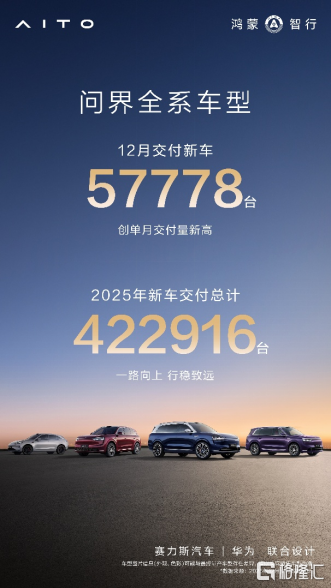
再创新高!问界全年交付突破42万辆,单月超5.7万辆
Ge Long Hui· 2026-01-01 06:29
Core Insights - The company, Wanjie, achieved a record delivery of over 57,000 new vehicles in December 2025, totaling over 420,000 deliveries for the year, leading the high-end electric vehicle market [1] - Since its launch, Wanjie has delivered over 970,000 new vehicles, establishing itself as a significant player in the Chinese new energy market [1] Group 1: Product Launches and Market Position - In 2025, Wanjie launched several models including the Wanjie M9 2025 version, Wanjie M8 range-extended and electric versions, and the all-new Wanjie M7, enhancing its product lineup and driving strong sales growth [3] - The Wanjie M9 has maintained its position as the best-selling luxury SUV in the 500,000 yuan and above segment for 20 consecutive months, with over 260,000 units delivered since its launch [3] - The Wanjie M8 has quickly captured the high-end SUV market priced at 400,000 yuan, with over 150,000 units delivered in just 8 months [3] - The Wanjie M7, launched in September 2025, has become a value choice in the 300,000 yuan SUV segment, with over 370,000 units delivered [3] Group 2: Service Expansion and Future Strategy - Wanjie is expanding its offline presence, adding over 80 user centers in 2025, resulting in a service network covering over 200 cities with nearly 400 centers [5] - The company employs smart measures such as remote diagnostics and OTA upgrades to enhance user experience [5] - In 2026, Wanjie aims to uphold its "smart reshaping luxury" philosophy, focusing on user-centric approaches and integrating traditional luxury with technological advancements to lead the high-end new energy vehicle market [5]

002709,预计净利润大增
Shang Hai Zheng Quan Bao· 2026-01-01 04:21
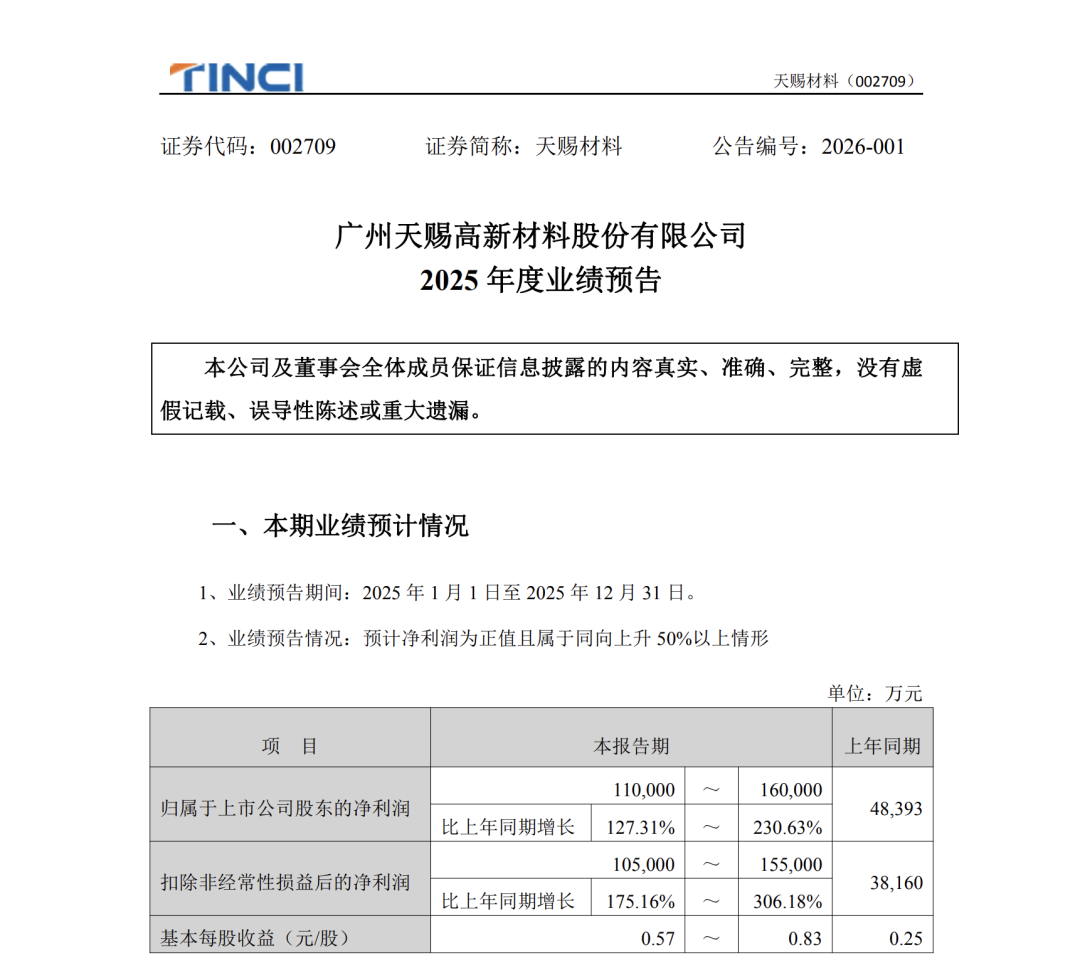
Core Viewpoint - The company Tianqi Materials (002709) forecasts a significant increase in net profit for 2025, projecting a range of 1.1 billion to 1.6 billion yuan, representing a growth of 127.31% to 230.63% compared to 2024 [1][3]. Financial Performance - The net profit attributable to shareholders is expected to be between 1.1 billion and 1.6 billion yuan, with a year-on-year growth of 127.31% to 230.63% [1][3]. - The net profit after deducting non-recurring gains and losses is projected to be between 1.05 billion and 1.55 billion yuan, reflecting a growth of 175.16% to 306.18% compared to the previous year [3]. - Basic earnings per share are expected to be 0.57 yuan to 0.83 yuan, up from 0.25 yuan in the previous year [3]. Market Position and Product Demand - The company has maintained a leading position in the global market for lithium-ion battery electrolytes, with a market share increasing from 28.8% in 2021 to 36.4% in 2023, producing over 390,000 tons in 2023 [4]. - The company has established 15 production bases in China, with the largest located in Jiujiang, Jiangxi Province, which is also the world's largest manufacturing base for liquid lithium hexafluorophosphate [4]. - The company has signed significant procurement contracts for electrolytes with major battery manufacturers, totaling nearly 3 million tons for the second half of 2025 [4]. Recent Trends and Future Outlook - The company's revenue has fluctuated in recent years, declining from 22.317 billion yuan in 2022 to 12.518 billion yuan in 2024, with net profit dropping from 5.714 billion yuan to 484 million yuan during the same period [4]. - Since the third quarter of this year, the price of lithium hexafluorophosphate has increased by over 240% from its low point earlier in the year, contributing to a revenue increase of 22.34% to 10.843 billion yuan and a net profit increase of 24.33% to 421 million yuan for the first three quarters of 2025 [4]. - The company currently has an electrolyte production capacity of approximately 850,000 tons and lithium hexafluorophosphate capacity of about 110,000 tons, with production nearing full capacity due to rising demand, particularly in the energy storage market [5].

华尔街见闻早餐FM-Radio | 2026年1月1日
Hua Er Jie Jian Wen· 2025-12-31 23:28
Market Overview - In 2025, U.S. stock and bond markets faced declines, with major indices experiencing four consecutive days of losses. However, the tech sector supported the Nasdaq, which rose over 20% for the year, while Nvidia and Google saw annual gains of nearly 40% and 65%, respectively [2] - The U.S. unemployment claims fell to 199,000, nearing historical lows, indicating a recovering job market [19] - The Chinese manufacturing PMI for December returned to the expansion zone at 50.1, while the non-manufacturing PMI was at 50.2, suggesting a slight improvement in economic activity [27] Commodity Market - Precious metals experienced significant volatility, with gold and silver prices rising over 60% and nearly 150% for the year, marking the largest annual gains since 1979 [2] - Crude oil prices fell approximately 20% in 2025, representing the largest annual decline in five years, with Brent crude also experiencing a three-year consecutive drop [2] - Copper prices increased over 40% for the year, achieving the highest annual gain since 2009 [2] Company and Industry Developments - OpenAI reported an average employee compensation of $1.5 million, setting a record in the tech industry [20] - Blue Arrow Aerospace's IPO has been accepted, aiming to become the first commercial rocket company listed in China, following a successful launch of its reusable rocket [29] - Chinese electric vehicle brands achieved a record market share of 12.8% in Europe, with significant sales increases for companies like BYD and Chery [29] Financial Regulations - The China Securities Regulatory Commission announced a reduction in public fund subscription fees and sales service fees, with no sales service fees for fund shares held for over a year [18]

车圈2025:价格战没赢家,但淘汰赛已有出局者
Ge Long Hui· 2025-12-31 20:53
Core Insights - The automotive industry is transitioning from price competition to a focus on systematic and ecological strategies [3][23] - In 2025, the penetration rate of new energy vehicles (NEVs) reached a historic high, indicating a significant shift in consumer acceptance and market dynamics [5][13] - Traditional fuel vehicle manufacturers are struggling to maintain their market position against the rising dominance of domestic brands [6][14] Group 1: Market Dynamics - The price war initiated by domestic brands has continued into 2025, impacting the average profit margins across the industry [8][6] - The penetration rate of NEVs reached 62.2% in early December 2025, marking a significant milestone in the market [13] - Domestic brands are leading the charge in the NEV sector, with a penetration rate of 79.6% for new energy passenger vehicles [13] Group 2: Company Performance - Leading new energy vehicle manufacturers like Xiaopeng and Leap Motor have exceeded their annual sales targets, showcasing strong market adaptability [18][19] - Traditional brands like Geely and BYD are also performing well, with Geely's NEV sales reaching 153.4 million units, a 97% year-on-year increase [19][20] - In contrast, some joint venture brands are struggling, with Nissan and Honda experiencing significant declines in sales [20][21] Group 3: Technological Advancements - The introduction of the new battery safety standard (GB38031-2025) is expected to drive technological upgrades across the industry [11][12] - The focus on intelligent driving technology has intensified, but recent incidents have raised concerns about safety and regulatory standards [9][10] - Companies are increasingly collaborating with tech firms to enhance their smart driving capabilities, as seen with Audi and BMW partnering with Huawei [28][29] Group 4: Strategic Shifts - The competition is evolving from price wars to a comprehensive battle over ecosystem capabilities and technological integration [23][24] - Companies are adjusting their strategies to focus on product-market fit, intelligent configurations, and supply chain efficiency [21][22] - The future of the automotive industry will depend on the ability to integrate diverse technological pathways and create unique value for consumers [30]



碳酸锂行情“V型反转” 2026年能否继续“狂飙”?
Zhong Guo Jing Ying Bao· 2025-12-31 15:21
Core Viewpoint - The lithium carbonate market is expected to experience a rebound in 2025, with prices showing a V-shaped recovery after hitting a low of 59,000 yuan/ton in June, eventually surpassing 130,000 yuan/ton by December, marking an increase of over 120% from the low point [1][2][3]. Price Trends - In early 2025, lithium carbonate prices fluctuated around 75,200 yuan/ton, dropping below 70,000 yuan/ton by the end of April and reaching a low of 59,000 yuan/ton in June [1]. - By July 2025, prices began to rebound, breaking through 65,000 yuan/ton on July 14, 70,000 yuan/ton on July 21, and closing at 76,680 yuan on July 24, eventually exceeding 120,000 yuan/ton by December 23 [2]. - The price trajectory for 2025 is characterized by a typical V-shaped curve, with significant recovery driven by demand from the energy storage sector and a reduction in inventory levels [1][2]. Demand and Supply Dynamics - The demand for lithium carbonate is supported by a substantial increase in global power battery installations, which reached approximately 867.4 GWh from January to October 2025, a year-on-year growth of 34% [3]. - The new energy storage capacity in China exceeded 100 million kilowatts by September 2025, representing a growth of over 30 times compared to the end of the 13th Five-Year Plan, accounting for over 40% of the global total [4]. - The long-term outlook for lithium demand remains optimistic, with projections indicating that global lithium demand could reach 2 million tons of lithium carbonate equivalent by 2026, driven by sectors such as electric vehicles and energy storage [7]. Industry Performance - The recovery in lithium prices has positively impacted the performance of lithium companies, with stock prices of Tianqi Lithium and Ganfeng Lithium increasing by over 160% and 173%, respectively, since their lows in April [3]. - Ganfeng Lithium reported a net profit increase of 364.02% year-on-year in its third-quarter report, reflecting improved financial performance amid rising lithium prices [3]. Future Outlook and Challenges - The market may face uncertainties in 2026, with potential downward pressure on prices if inventory levels rise significantly due to slower-than-expected growth in energy storage demand [8]. - The development of alternative technologies, such as sodium batteries, may introduce new variables into the market, potentially exerting downward pressure on lithium carbonate prices, although current production scales and costs differ significantly from lithium batteries [9].
操作:不等了!调仓,大调仓!减仓2个方向,抄底3个基金
Ge Long Hui· 2025-12-31 13:31
Group 1 - The market is experiencing consolidation, with a focus on gradually increasing positions in rare metals, quality mixed funds, and semiconductors [1] - The supply side of rare metals is becoming rigid due to policy restrictions from key resource countries and domestic export controls, providing long-term price support [1] - Demand for rare metals is expanding, driven by stable growth in sectors like new energy vehicles and emerging industries such as AI and low-altitude economy [2] Group 2 - The semiconductor sector is showing a trend of steady upward movement, with significant room for growth as it benefits from policy support and long-term industry demand [2] - The semiconductor industry is characterized by both certainty and elasticity, with new demands from AI and digital economy driving the entire supply chain's prosperity [2] - The investment in semiconductor ETFs reflects confidence in the sector's growth potential amid ongoing U.S.-China technology competition [2] Group 3 - The focus on value investment in mixed funds includes sectors like chips, construction materials, and basic chemicals, with a positive outlook for future performance [3] - The fund manager emphasizes investing in high-quality companies with competitive advantages, aiming for balanced portfolio performance [3] - The mixed fund has shown a year-to-date increase of 27.33% and a total return of 107.79% since inception, indicating strong growth potential [3]
