
生态化

Search documents
兴业银行2025年年报:资负结构优化,净息差保持韧性
和讯· 2026-03-28 08:34
Core Viewpoint - In 2025, under the "14th Five-Year Plan," the banking industry faces significant challenges, yet Industrial Bank has demonstrated resilience and growth, achieving positive revenue and net profit growth for two consecutive years, showcasing a "bottoming out and recovery" trend [1] Financial Performance - In 2025, Industrial Bank's operating income reached 212.74 billion yuan, a year-on-year increase of 0.24%, while net profit attributable to shareholders was 77.47 billion yuan, up 0.34% year-on-year [1] - The bank's net fee and commission income was 25.89 billion yuan, reflecting a 7.45% increase, reversing a previous downward trend [1] - The total assets under management of the bank's five asset management subsidiaries reached 3.65 trillion yuan, growing by 26.07% compared to the beginning of the year [1] Risk Management - The bank's risk costs have decreased, with new non-performing loans peaking and impairment provisions down by 4.26% year-on-year [2] - As of the end of 2025, the non-performing loan ratio was 1.08%, stable compared to previous periods, while the attention loan ratio decreased by 0.02 percentage points to 1.69% [2] - In the real estate sector, the bank's corporate real estate financing balance decreased by 53.3 billion yuan, and new non-performing loans in this area have declined year-on-year [2] Asset and Liability Management - Industrial Bank has adopted a dual approach to asset and liability management, focusing on optimizing asset structure and reducing costs on the liability side to maintain net interest margin resilience [3][5] - By the end of 2025, the total loan amount reached 5.95 trillion yuan, with significant growth in green loans (up 19.05%), technology loans (up 18.47%), and medium to long-term loans in manufacturing (up 14.91%) [4] - The bank's total deposits reached 5.93 trillion yuan, with retail deposits exceeding 1.8 trillion yuan, enhancing the stability of low-cost deposits [5] Strategic Upgrades - Industrial Bank has transitioned from "three cards" to "four cards," expanding its strategic focus to include technology finance, green finance, wealth banking, and investment banking [7][8] - The bank's customer base has significantly increased, with corporate clients rising from 930,000 to 1.67 million and retail clients from 79.56 million to 115 million [7] - The bank aims to enhance its core advantages by focusing on digitalization, green initiatives, internationalization, and comprehensive services, positioning itself as a leading value bank [8]



高净值需求升维迭代,湾区财富管理进入“超级连接器”时代
Nan Fang Du Shi Bao· 2026-02-06 02:06
Core Insights - The Greater Bay Area (GBA) is experiencing a significant evolution in wealth management demands among high-net-worth individuals, shifting from traditional asset preservation to more complex needs such as cross-border capital operations, global business expansion, family inheritance, tax planning, and children's education [1][2] - Wealth management services are transitioning from product competition to a focus on ecosystem integration, cross-border collaboration, and long-term client relationships, indicating a new phase in the industry [1][2] Demand Evolution - Entrepreneurs and high-net-worth individuals in the GBA are increasingly seeking comprehensive, cross-domain services, moving from basic asset management to more integrated solutions that include corporate financing and global strategies [2] - Real-life examples illustrate this trend, with clients requiring services that encompass overseas market consulting, international credit management, and multi-currency asset allocation, highlighting the demand for financial partners with global connectivity and resource integration capabilities [2] Market Response - Standard Chartered Bank has opened a new priority private banking center in Shenzhen Bay, designed as a "super connector" to meet the evolving needs of GBA clients, emphasizing a one-stop wealth management service [3] - The center's strategic location and innovative design aim to provide a blend of traditional services and unique offerings like "overseas management" support, facilitating clients' expansion into international markets [3] Strategic Perspective - Standard Chartered's investment in wealth management for affluent clients is growing at approximately 10% annually, with China identified as a key market due to its significant potential for high-quality development [4] - The establishment of the Shenzhen Bay center is seen as a vital step in enhancing the bank's dual-engine service model between mainland China and Hong Kong, supporting long-term wealth preservation and growth for clients [5]
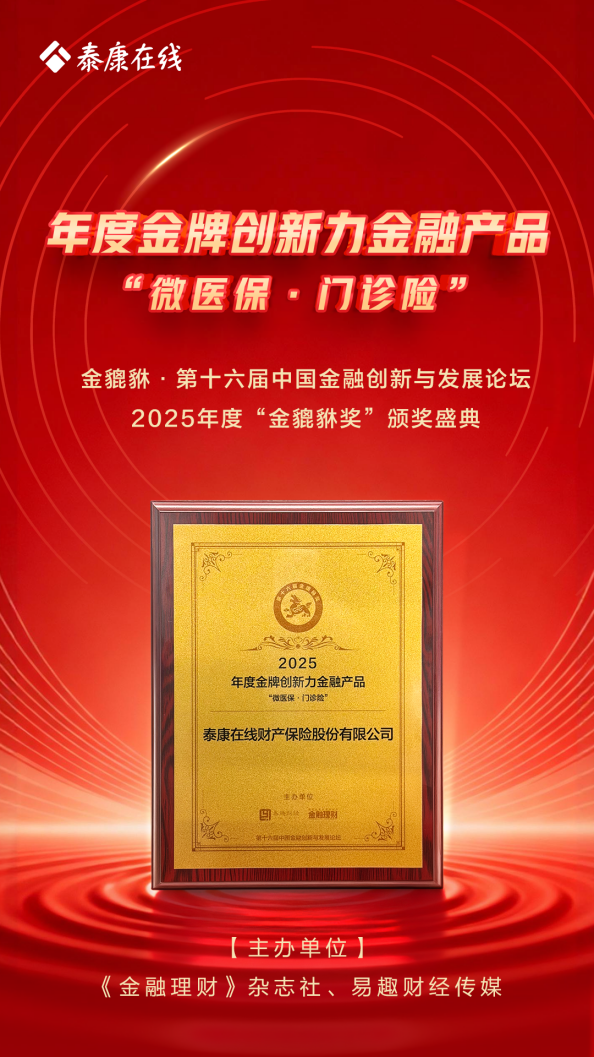
聚焦高频场景,破解日常医疗保障难题 泰康在线“微医保·门诊险”斩获殊荣
Cai Fu Zai Xian· 2026-01-30 09:26
Core Insights - The "Micro Insurance Outpatient Plan" launched by Taikang Online and Tencent Weibo has won the "2025 Annual Gold Medal Innovative Financial Product" award, highlighting its precise product positioning, innovative service model, and inclusive value [1] Group 1: Product Innovation - The product breaks traditional health insurance barriers in both claims and underwriting through innovative mechanisms, optimizing the process for obtaining and using coverage [3] - It features a "0 deductible" claim model, allowing for reimbursement starting from 0 yuan, which significantly lowers the claims threshold for users [3] - The underwriting process is simplified with "no health declaration" required, making it accessible to a wide age range from 6 to 65 years old, reflecting inclusivity in financial services [4] Group 2: Comprehensive Coverage - The plan establishes a clear online and offline comprehensive coverage system targeting daily high-frequency medical needs, providing full-process health protection [5] - Online services include a "24/7 online consultation and medication delivery" with an annual coverage of 20,000 yuan and an 80% reimbursement rate, allowing users to avoid hospital visits for medication [5] - Offline coverage offers 10,000 yuan per year with a 50% reimbursement for the first two visits, covering various expenses beyond the basic medical insurance catalog [5] Group 3: Ecosystem Development - The "Micro Insurance Outpatient Plan" serves as a key hub in building a "insurance + medical + health" ecosystem, fulfilling the roles of user, data, and service entry points [6] - This innovative model transitions the insurance role from mere post-claim payouts to proactive service and health management, enhancing user engagement and loyalty [6] - The award recognition reflects the industry's shift towards high-frequency, scenario-based, and ecological upgrades in health insurance, with plans for further development of integrated inclusive products [6]
智启厨房新未来:浙江美大2026年会发布AI新品,共筑智慧生态新标杆
Quan Jing Wang· 2026-01-20 11:09
Core Insights - Zhejiang Meida is initiating a profound strategic restructuring in response to the ongoing challenges in the integrated stove industry, emphasizing the need to embrace change and develop new models for sustainable growth [1] Group 1: Market Challenges - The integrated stove market is experiencing significant challenges, with retail sales in Q1 2025 dropping to 2.5 billion yuan, a year-on-year decline of 34.5%, and average prices falling from 12,000 yuan to 8,000 yuan [1] - The traditional smoke stove market is expected to see a temporary boost due to national subsidy policies in 2025, but will face demand exhaustion thereafter [1] Group 2: Strategic Initiatives - The annual meeting serves as a declaration of Zhejiang Meida's strategic transformation, focusing on smart and ecological solutions to address market challenges [2] - The launch of the "AI Meida" design software aims to enhance terminal sales through rapid design capabilities and interactive experiences, marking a significant step in the company's smart kitchen ecosystem [2] Group 3: Investment and Policy Alignment - Zhejiang Meida's investment of approximately 110 million yuan in autonomous driving technology company MoVision, acquiring about 4.87% equity, aligns with national policies promoting structural optimization in the kitchen appliance industry [3] - The company's strategy is in line with the national directive to enhance the adaptability of consumer goods supply and demand, emphasizing innovation and the development of smart home solutions [3] Group 4: Industry Evolution - The kitchen appliance industry is shifting from single-category competition to cross-domain ecological competition, with smart technology recognized as the future [4] - The global integrated smart kitchen market is projected to grow from 3.1 billion USD in 2025 to 17.6 billion USD by 2031, with a compound annual growth rate of 31.5% [4] Group 5: Future Direction - Zhejiang Meida is transitioning from a product manufacturer to a smart home solution provider, aiming to create a diversified product matrix that integrates smart kitchen appliances with whole-home customization [4] - The company is focused on building an internal smart kitchen ecosystem while exploring external technological collaborations and growth opportunities [5]

苏企“出海”开辟价值新航道
Xin Hua Ri Bao· 2026-01-12 20:55
Group 1 - The core transformation of Jiangsu enterprises is shifting from a traditional single product export model to providing integrated solutions that combine products, technology, services, and business models in the global market [1][2] - Jiangsu Guanhai Medical Technology Co., Ltd. has achieved a significant breakthrough in 2024 by localizing the assembly of dialysis machines, thereby enhancing the accessibility of quality medical resources to more patients globally [2][6] - The export of packaging machinery from Jiangsu reached 5.08 billion yuan in the first eleven months of 2025, marking a year-on-year increase of 32.1% [3] Group 2 - The shift from "selling products" to "selling solutions" is driven by global supply chain restructuring, technological advancements, and evolving customer demands, particularly evident in Jiangsu [2][4] - Jiangsu enterprises are actively expanding into international markets, moving from simple equipment exports to high-tech, customized system solutions, showcasing strong resilience in development [3][4] - The collaboration between government and enterprises has formed a powerful synergy to overcome challenges such as cultural differences and technical barriers in the global market [4][5] Group 3 - Jiangsu enterprises are increasingly adopting a value co-creation approach in their international operations, which enhances customer loyalty and allows for higher profit margins compared to traditional product exports [7][8] - The future of solution exports is expected to exhibit three significant characteristics: intelligence, greenness, and ecological sustainability, with companies integrating advanced technologies like AI and IoT into their solutions [7][8] - Jiangsu enterprises are positioning themselves to navigate from "Made in China" to "China Solutions," contributing significantly to high-quality global economic development [8]
我国首批生态海盐产品发布
Xin Lang Cai Jing· 2026-01-10 20:33
Core Viewpoint - The launch of China's first batch of ecological sea salt products marks a significant advancement in the country's salt industry, transitioning towards "ecological, standardized, and high-end" development [1][2] Group 1: Product Characteristics - Ecological sea salt is produced according to the newly established group standard "Ecological Sea Salt," which emphasizes resource, energy, environmental, and quality attributes [1] - The raw materials for ecological sea salt must come from clean seawater that meets national water quality standards, specifically Class II or above, to avoid industrial and domestic pollution [1] - The production process adheres to a zero-chemical addition policy, aiming to preserve marine nutrients and minimize environmental impact [1] - Quality control measures include stricter limits on contaminants like lead and arsenic, and a "not detected" standard for 16 types of phthalate plasticizers [1] Group 2: Certification and Traceability - A strict certification and traceability system has been established, requiring companies to undergo professional evaluations by the China Salt Industry Association and to accept dynamic supervision and regular reviews [2] - Each package of ecological sea salt includes a unique traceability QR code, allowing consumers to verify the source of raw materials, production processes, and testing results [2] Group 3: Participating Companies - The first batch of certified ecological sea salt products was showcased by six companies: Fujian Salt Industry Group, Dalian Salt Chemical Group, Cangzhou Salt Industry Group, Tianjin Changlu Handu Salt Field, Shandong Luyuan Group, and Hainan Salt Industry Group [2] - These companies will quickly establish online and offline sales channels in their respective regions for consumer access [2]
报告:海尔连续17年居全球大型家用电器品牌零售量第一
Ren Min Wang· 2026-01-08 03:24
Core Insights - Haier has maintained its position as the world's leading brand in large home appliances for 17 consecutive years, with a global market share increase from 6.3% to 12.1% since 2009, demonstrating robust growth and resilience [1] - The company's growth is attributed to its smart home strategy, transitioning from merely selling appliances to providing a platform service ecosystem that enhances user experience through software-defined scenarios [1] Group 1: Strategic Framework - Haier's success is a result of its user-centric "126" strategy, which includes one innovative channel (smart home), two major platforms (customer platform and user lifecycle platform), and six capabilities (globalization, high-end, digitalization, intelligence, ecology, and greenness) [2] - The globalization aspect focuses on enhancing capabilities across sales, marketing, service, logistics, procurement, R&D, and manufacturing, allowing for localized product adaptations based on regional needs [2] Group 2: High-End and Digital Transformation - The high-end strategy emphasizes leadership through technological innovation, with products like the "Lazy Three-Tub Washing Machine" achieving significant sales milestones shortly after launch [5] - Digital transformation aims for "extreme efficiency," enhancing user experience through a fully digitized process that allows for synchronized delivery and installation, significantly reducing delivery times [5][6] Group 3: Intelligent and Ecological Innovations - Haier's approach to intelligence involves moving from product intelligence to scenario intelligence, integrating AI capabilities into home appliances for enhanced user interaction and automation [6] - The ecological strategy connects over 66 million resources to provide comprehensive services across various life scenarios, extending smart living from home to travel [6] Group 4: Commitment to Sustainability - Haier integrates ESG principles into its governance, offering green products that exceed energy efficiency standards, with commitments to achieve global carbon neutrality by 2050 [6]

2025:激情与繁荣 混沌与秩序
Zhong Guo Qi Che Bao Wang· 2026-01-06 02:13
Core Viewpoint - The Chinese automotive market in 2025 is characterized by intense competition and transformation, with a mix of prosperity and individual challenges, leading to a redefinition of industry order and competition dynamics [4][9]. Group 1: Market Dynamics - The year 2025 saw over 200 new car models launched, with more than 40 new models released in September alone, marking a historical high in new car releases [4]. - The penetration rate of L2-level and above assisted driving functions in new energy passenger vehicles reached 87% from January to October 2025, indicating rapid advancements in intelligent driving technology [5]. - The total number of electric vehicle charging infrastructure reached 18.645 million by the end of October 2025, a 54% increase year-on-year, solidifying China's position as a leader in charging facilities [5]. Group 2: Technological Advancements - The development of solid-state batteries is gaining momentum, with several automakers announcing timelines for mass production, indicating a shift towards more efficient battery technology [5]. - The market for new energy vehicles (NEVs) experienced significant growth, with pure electric vehicle sales accounting for 64% of total NEV sales from January to November 2025 [6][7]. - The automotive industry is witnessing a shift from traditional competition to ecosystem-based competition, emphasizing value creation and integration [9]. Group 3: Marketing and Consumer Engagement - Automotive marketing in 2025 has evolved, with executives actively engaging in live demonstrations and immersive marketing experiences to connect with consumers [6]. - The rise of scene-based marketing strategies has transformed how new vehicles are presented, creating emotional connections with consumers [6]. Group 4: Export Growth - Chinese automotive exports reached 6.343 million units from January to November 2025, a year-on-year increase of 18.7%, with new energy vehicle exports growing by 102.9% [8]. - The shift in export strategies from simple vehicle sales to localized production and assembly has enhanced the reputation and competitiveness of Chinese brands in international markets [8]. Group 5: Industry Challenges - The automotive industry faces challenges such as price wars, safety concerns, and misleading marketing practices, which threaten market integrity and consumer trust [9][10]. - The average profit margin for the automotive industry was reported at 4.5% in the first three quarters of 2025, lower than the average of 6% for downstream industrial enterprises, highlighting financial pressures [10]. Group 6: Regulatory Changes - New regulations, including the revised Anti-Unfair Competition Law, aim to establish clearer guidelines for marketing practices and protect consumer rights [13][15]. - The introduction of mandatory safety standards for electric vehicle batteries and intelligent driving systems reflects a proactive approach to addressing safety concerns in the industry [14][13]. Group 7: Future Outlook - The automotive industry is moving towards a focus on long-term sustainability and healthy development, with a growing consensus on the need for fair competition and ethical practices [12][16]. - The emphasis on integrity, technology, and value creation is expected to guide the industry towards high-quality development in the coming years [16].

产业临界点已至:从“超车”到“领跑”,车企体系力迎来大考
Jing Ji Guan Cha Wang· 2026-01-01 08:21
Core Insights - The Chinese electric vehicle (EV) market has crossed a significant milestone, with the monthly retail penetration rate of new energy passenger vehicles surpassing 50% at the beginning of the year and reaching a historical high of 62.3% by year-end, indicating a fundamental shift in market dominance [1] - The annual production and sales of new energy vehicles in China are expected to grow by over 30% year-on-year, solidifying their role as the core growth engine in a market experiencing only modest overall growth [1] - The industry is transitioning from a "policy market" reliant on subsidies to a "value market" driven by consumer demand and technological value, marking a new phase of competition focused on comprehensive system capabilities [3] Industry Dynamics - The competition landscape has evolved into a zero-sum game within a fixed market size, emphasizing structural replacement rather than mere sales growth [3] - Key dimensions of competition have shifted to include technology iteration speed, lifecycle costs, ecological service capabilities, and user operation efficiency [3] - The window for technological competition has drastically shortened, with smart technology becoming a basic requirement rather than a differentiating feature [3] Export and Ecosystem - China's automotive exports are projected to exceed 7 million units this year, with successful international expansion requiring a complete system that includes localized R&D, production, brand building, and sales service networks [4] - The relationship between automotive companies and tech giants is evolving into deep co-creation alliances, shifting competition from individual companies to ecological alliances [4] Policy and Market Trends - The external policy environment is increasingly demanding systemic capabilities, with the gradual phasing out of tax exemptions for new energy vehicle purchases [4] - Industry consensus is shifting towards pursuing high-quality development, moving away from the "scale at the cost of losses" model [4] Dongfeng Motor Group's Strategy - Dongfeng Motor Group aims to achieve over 1 million new energy vehicle sales by 2025, with a significant increase in the share of its own brands to 63%, marking a milestone in its strategic restructuring [5] - The establishment of Dongfeng Yipai Automotive Technology Company represents a critical strategic move to integrate resources and enhance competitiveness in the mainstream market [6][7] Yipai Technology's Transformation - Yipai Technology has undergone a comprehensive restructuring to align with market demands, focusing on integrated operations across the entire value chain [7] - The new company structure aims to create a collaborative combat system, with distinct roles for different brands to cover various market segments [7] Technological Advancements - Yipai Technology is developing advanced manufacturing capabilities, including the world's first 16,000-ton integrated die-casting equipment and plans for self-developed solid-state batteries [8] - The company is also establishing a "Yipai+" ecosystem through partnerships with leading firms, enhancing its technological capabilities and accelerating commercialization [8][9] Future Outlook - Yipai Technology's sales reached 275,700 units in 2025, a 28% year-on-year increase, positioning it as a key player in achieving Dongfeng's sales target [9] - The company plans to launch six new models and enhance existing products to improve user experience and competitiveness in the market [9] Conclusion - The case of Yipai Technology illustrates the necessity for traditional automotive giants to undergo organizational and mindset transformations to thrive in the evolving landscape of the electric vehicle industry [11]

尊界S800,何以代表时代?
Yang Shi Wang· 2025-12-29 13:46
Core Insights - The global automotive industry is at a historical crossroads in 2025, transitioning from "quantity accumulation" to "quality leap," marking a critical point for China's automotive sector to evolve from a major player to a strong one [1] - The market focus has shifted from mere electrification to intelligence and ecosystem integration, emphasizing computational power, algorithms, and user experience throughout the product lifecycle [1] Group 1: Market Dynamics - The ultra-luxury car market, traditionally dominated by European brands, is experiencing changes due to economic cycles and generational shifts in consumer preferences [4][5] - Traditional luxury brands face challenges as their innovation has stagnated, while younger consumers demand advanced technological experiences, leading to a "value recognition crisis" in the high-end market [5] Group 2: Product Launch and Performance - The ZunJie S800, launched on May 30, 2023, is a high-end luxury sedan co-developed by Huawei and JAC Motors, priced between 708,000 to 1,018,000 yuan, featuring advanced driving assistance systems [6] - Within 175 days of its launch, the ZunJie S800 received over 18,000 pre-orders and achieved a monthly delivery of over 2,000 units, surpassing its main competitors [7] - By December 16, 2023, the cumulative delivery of the ZunJie S800 exceeded 10,000 units, setting a record for delivery speed in the Chinese ultra-luxury electric vehicle segment [8] Group 3: Production and Quality - The ZunJie S800 has demonstrated impressive production capabilities, achieving over 200 units delivered in a single day by December 25, 2023, with a total of 3,127 units delivered that month [10] - The vehicle's success is attributed to its innovative design and technology, which resonate with high-net-worth individuals, shifting their preferences from traditional brand symbols to technology-driven experiences [10][11] Group 4: Strategic Insights - The "ZunJie Effect" signifies that the S800 has transcended its role as mere transportation, becoming a social symbol among high-net-worth individuals [14] - The vehicle's design incorporates advanced features such as a dual zero-gravity seat and intelligent ambient lighting, enhancing the luxury experience for passengers [12] - The ZunJie S800 exemplifies a new luxury paradigm focused on intelligent experiences and ecological collaboration, creating a competitive edge that traditional luxury brands struggle to replicate [11][15] Group 5: Industry Transformation - The success of the ZunJie S800 reflects a broader trend in China's manufacturing sector, showcasing a shift from merely producing to defining and innovating within the automotive industry [16][19] - The collaboration between Huawei and over 240 top-tier suppliers has led to significant advancements in high-end manufacturing capabilities, breaking previous dependencies on foreign technology [16][17] - The integration of digital twin technology in production processes has enabled precise quality control and efficient manufacturing, setting a new standard for the industry [17] Group 6: Future Outlook - The achievements of the ZunJie S800 represent a significant step towards China's goal of becoming a strong automotive nation, emphasizing the importance of technological innovation and user experience [19] - The ongoing challenge for the industry will be to maintain technological leadership and deepen brand identity while replicating success in global markets [19]

