
全国统一大市场

Search documents
趋势研判!2025年中国体育服务行业产业链、产业规模、行业政策、重点企业及发展路径分析:产业规模将达2.78万亿元,行业升级驱动体育产业高质量发展 [图]
Chan Ye Xin Xi Wang· 2025-07-07 01:31
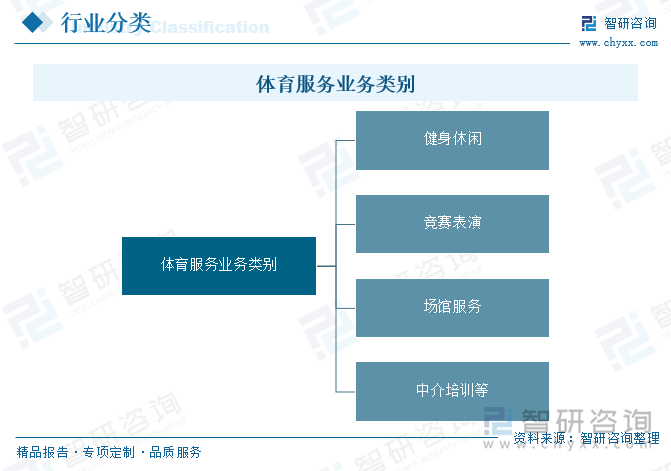
Core Insights - The sports service industry is a crucial part of the sports sector, providing non-material products related to sports through specialized and market-oriented methods [1][3][4] - In 2023, China's sports industry reached a total scale of 3.67 trillion yuan, with the sports service sector accounting for 2.11 trillion yuan, or 57.30% of the total [1][4][7] - The sports service industry is expected to grow significantly, with projections of 2.61 trillion yuan in 2024 (67.02% of the total) and 2.78 trillion yuan in 2025 (68% of the total) [1][7][25] Industry Definition and Business Categories - The sports service industry encompasses a wide range of activities, including fitness and leisure, competition performances, venue services, and intermediary training [3][4] - It aims to meet diverse needs such as health, entertainment, competition, and education [3][4] Current Development Status - The sports service industry has seen rapid growth, with a reported revenue increase of 24.1% year-on-year in the first three quarters of 2024 [7] - The industry is becoming increasingly important within the broader sports sector, reflecting rising consumer spending power [4][7] Industry Chain Structure - The industry chain includes upstream suppliers of sports equipment and venue construction, midstream service providers, and downstream consumers such as event attendees and fitness enthusiasts [9][11] Competitive Landscape - The sports service industry features a diverse competitive landscape with numerous players, including state-owned, private, and foreign enterprises [18] - Key companies include Lisheng Sports, Zhongti Industry, Feifan Lingyue, and Amer Sports, which hold significant market positions [18][20] Development Environment and Policies - National policies promoting sports and fitness have significantly boosted the growth of the sports service industry [15][17] - Recent policies focus on enhancing consumer engagement and supporting high-quality sports events and activities [15][17] Future Development Path - The sports service industry is expected to contribute to high-quality economic development and improved living standards, while also adapting to new market demands and technological advancements [25] - The integration of emerging technologies like AI and virtual reality is anticipated to transform the industry, offering personalized sports products and services [25]



时报访谈丨徐晓明:“五统一、一开放”是建设全国统一大市场的系统工程
Sou Hu Cai Jing· 2025-07-07 00:44
Core Viewpoint - The construction of a unified national market is a strategic foundation for China's high-quality economic development and a key path to enhance international competitiveness, addressing issues like market fragmentation and inefficient resource allocation [2][21]. Group 1: Five Unifications and One Opening - The basic requirements for building a unified national market are "five unifications and one opening," which include unifying market basic systems, infrastructure, government behavior standards, market regulation enforcement, and factor resource markets, while continuously expanding both domestic and foreign openness [2][3]. - The "five unifications and one opening" framework provides clear guidance for the systematic project of building a unified national market, focusing on resource integration, rule optimization, and barrier removal to form an efficient, fair, and fully open market system [2][3]. Group 2: Implementation and Collaboration - The implementation of this systematic project requires joint efforts from governments, enterprises, and society, with the government playing a leading role in top-level design, enterprises adapting to new rules, and society supporting reform measures [3][21]. - Future discussions should explore how to balance unification with diversity and maintain safety in openness, ensuring that "five unifications and one opening" work in synergy to inject lasting momentum into high-quality development [3][21]. Group 3: Market Basic System Unification - Unifying the market basic system is fundamental to overcoming the fragmentation of rules, as current regional differences in market access, property rights protection, and competition policies lead to high cross-regional operational costs and low resource allocation efficiency [4][5]. - Key measures for achieving this unification include standardizing legislation, strengthening legal protections, building data-sharing platforms, and integrating emerging technologies into the unification process for better governance [5][4]. Group 4: Market Infrastructure Unification - The interconnectivity of transportation, communication, and logistics infrastructure directly affects market operational efficiency, and a lack of coordinated planning can lead to resource waste and redundant investments [6][7]. - Attracting more social capital for infrastructure unification and prioritizing the resolution of bottleneck areas are essential for supporting the construction of a unified national market [6][7]. Group 5: Government Behavior Standardization - Standardizing government behavior is crucial to correcting policy execution deviations, as some local governments over-promise incentives, disrupting market order, while others impose excessive burdens on enterprises [8][9]. - A unified policy execution standard should be established by the central government to prevent local governments from acting independently, and real-time monitoring of policy execution should be implemented to ensure effective policy implementation [9][8]. Group 6: Market Regulation Enforcement Unification - Achieving unified market regulation enforcement is vital due to significant regional differences in regulatory standards, necessitating the establishment of a national regulatory framework led by the central government [10][11]. - Collaboration among various departments and the involvement of third-party evaluation agencies can enhance regulatory efficiency and effectiveness [11][10]. Group 7: Factor Resource Market Unification - The marketization of factor resource allocation, including land, labor, capital, technology, and data, is essential for the operational quality of the unified national market, yet current restrictions hinder their flow [12][13]. - Measures to promote marketization include deepening land system reforms, optimizing household registration management, and enhancing the capital market system to support small and medium-sized enterprises [13][12]. Group 8: One Opening as a Link - High-level openness is not only a continuation of domestic reforms but also a crucial way to integrate into the global economic system, facilitating the introduction of advanced technologies and management experiences [15][16]. - Key measures for expanding openness include optimizing the business environment, simplifying foreign investment processes, and actively participating in international trade agreements [16][15].

智库要论 | 赵忠秀:“十五五”产业链供应链发展:在开放与创新中筑牢安全韧性
Sou Hu Cai Jing· 2025-07-07 00:44
Group 1: Industry Resilience and Trade Dynamics - The adjustment of foreign trade structure highlights the stability of China's industrial chain, with equipment manufacturing exports reaching 6.22 trillion yuan, accounting for 58.3% of total exports in the first five months of 2025 [3][19] - Emerging products such as industrial robots and electric vehicles are leading growth, reflecting an increase in the "new" and "green" content of foreign trade [3][19] - Trade cooperation with countries along the Belt and Road is deepening, with trade volume surpassing 50% for the first time in 2024 [3][19] Group 2: Foreign Investment Trends - Foreign investment is increasingly directed towards technology-intensive industries, indicating an upgrade in supply chain cooperation [4][19] - In the first five months of 2025, actual foreign investment in China reached 358.19 billion yuan, with high-tech industries attracting 109.04 billion yuan [4][19] - Notable growth in foreign investment includes a 146% increase in e-commerce services and a 74.9% increase in aerospace manufacturing [4][19] Group 3: Digital Transformation and Economic Integration - The digital economy's core industries accounted for 10% of GDP in 2024, achieving the target set in the 14th Five-Year Plan one year ahead of schedule [5][19] - Digital technologies are increasingly integrated into various sectors, enhancing supply chain responsiveness and market competitiveness [5][19] - Knowledge-intensive services now represent 38.5% of total service exports, indicating strong growth potential [5][19] Group 4: Institutional Opening and Global Value Chains - The removal of all foreign investment restrictions in the manufacturing sector demonstrates China's commitment to investment liberalization [7][19] - By 2024, actual foreign investment in the manufacturing sector exceeded 220 billion yuan, with high-tech manufacturing accounting for 11.7% [7][19] - The expansion of service sector openness has been significant, with 50.2% of foreign investment in services concentrated in 11 cities [7][19] Group 5: Innovation and Strategic Industry Development - Enterprises are increasingly recognized as the main drivers of innovation, with over 75% of R&D investment coming from them [10][19] - Central enterprises are forming innovation alliances in strategic emerging industries, focusing on overcoming key technological challenges [11][19] - The establishment of 178 national high-tech zones is fostering the growth of high-tech enterprises and new industries [11][19] Group 6: Internal and External Trade Integration - The construction of a unified national market is progressing, facilitating smooth resource flow and breaking down local protectionism [12][19] - The establishment of overseas economic and trade cooperation zones is enhancing international capacity cooperation [12][19] - These efforts are significantly improving the resilience and risk resistance of China's industrial and supply chains [12][19] Group 7: Comprehensive Support System for Supply Chain Security - The integration of reforms, opening up, and innovation is essential for enhancing the security and resilience of China's industrial chain [14][19] - Expanding cooperation with emerging markets and enhancing international collaboration through the Belt and Road Initiative is a priority [14][19] - The promotion of a unified national market and the reduction of internal trade barriers are crucial for stimulating domestic market vitality [15][19]
“减法”破壁垒,“加法”增活力——加快建设全国统一大市场一线观察之一
Xin Hua She· 2025-07-06 13:31
Core Viewpoint - The construction of a unified national market is essential for high-quality development and responding to changes in the global landscape, with various regions and departments actively implementing measures to enhance market vitality and economic circulation [1]. Group 1: Market Access and Reforms - Continuous improvement of market access systems is a necessary requirement for building a unified national market, with recent reforms reducing the negative list of market access from 151 items in 2018 to 106 items in the 2025 version [4]. - The reduction of administrative approvals has led to increased market vitality, allowing various business entities to engage in more sectors and enhancing their operational clarity and stability [4][5]. - The introduction of new policies and practices, such as the establishment of the Shenzhen-Hong Kong Cell Valley Medical Technology Company, demonstrates the commitment to allowing foreign investment in advanced medical technologies [5]. Group 2: Industry Growth and Investment Opportunities - The low-altitude economy is expanding, with over 80,000 related enterprises currently existing in China, driven by clearer standards and regulations that facilitate operational capabilities [3]. - Significant contracts, such as the 804 million yuan project awarded to Beijing Micro-Nano Star Technology Co., indicate the growing involvement of private enterprises in high-tech sectors like satellite development [4]. - The Zhejiang San'ao Nuclear Power Project and various high-speed rail projects highlight the increasing participation of private capital in critical infrastructure, enhancing investment opportunities [4]. Group 3: Breaking Down Barriers - Efforts to eliminate market barriers are ongoing, with initiatives like the "non-prohibited entry" principle and the establishment of supplier reserves for major projects, which have allowed companies to access new markets and increase revenue [7]. - The Guangxi Beihai City has opened its shared electric bike market, addressing previous monopolistic practices and promoting fair competition [8]. - The introduction of innovative measures, such as the testing of autonomous delivery vehicles in Hunan, reflects the commitment to lowering entry barriers for new technologies and products [9]. Group 4: Regulatory and Legal Framework - The establishment of a legal framework for market access, including the release of typical cases related to market access administrative litigation, aims to enhance the rule of law in market entry [12]. - The promotion of the private economy and the establishment of fair competition mechanisms are crucial for ensuring equitable market participation [12]. - Continuous reforms in service optimization and regulatory processes are being implemented to facilitate smoother business operations and enhance the overall market environment [11].
7月信用债投资策略思考
Huafu Securities· 2025-07-06 13:21
Group 1 - The report indicates that the credit bond market is expected to maintain a slightly bullish trend in July and the third quarter, driven by factors such as potential export weakness and the central bank's liquidity measures [2][10][11] - The report highlights the importance of selecting liquid credit bond issuers and maintaining trading flexibility, with specific attention to timely profit-taking opportunities [11][12] - The report suggests focusing on city investment bonds in regions with strong debt management capabilities, such as Shandong, Henan, and Guangxi, particularly in cities like Liuzhou, which is actively addressing its debt issues [3][12][15] Group 2 - The report emphasizes that addressing "involution" and resolving overcapacity issues are becoming key tasks for local governments, with expectations for more policies to guide and resolve these challenges [3][23][25] - The report notes that the financial bond market has seen significant movements, with credit spreads for certain bonds narrowing, indicating a need for cautious investment strategies [4][10] - The report discusses the potential for investment in high-quality enterprises and regions with strong economic fundamentals, particularly in provinces like Guangdong, Jiangsu, and Zhejiang, which are expected to have robust debt management capabilities [43][44][48]
“反内卷”政策对市场影响几何?
ZHONGTAI SECURITIES· 2025-07-06 12:38
Group 1: Impact of "Anti-Inner-Loop" Policy on the Market - The "Anti-Inner-Loop" policy has gained significant attention from the central government, particularly in industries facing overcapacity, as highlighted in the Central Financial Committee meeting on July 1, 2025 [2][11] - Following the policy announcement, sectors such as photovoltaic and cement have taken measures to reduce production and optimize industry structure, leading to a strong market response with noticeable capital inflow [2][11] - The policy aims to enhance supply structure, stabilize market expectations, and improve overall industry efficiency and competitiveness [11][12] Group 2: Investment Recommendations - The current market is in a volatile phase, with investment hotspots concentrated in technology, military industry, and state-owned enterprises, benefiting from stable policies and capital inflow from U.S. markets [5][16] - The technology sector is expected to be a key focus in July, supported by reduced policy uncertainty and domestic planning emphasizing technology [16][17] - The military sector is anticipated to perform well due to increased defense budgets and upcoming high-profile military events [17] - State-owned enterprises and public utilities are seen as having good allocation value in the third quarter, given the weakening internal dynamics of real estate and strict regulatory measures [18] Group 3: Market Overview and Trends - The market has shown a trend of oscillating upward, with major indices such as the Wind All A, CSI 300, and CSI 2000 rising by 1.22%, 1.54%, and 0.59% respectively [8][21] - The steel, banking, and building materials sectors have led the market, indicating a recovery in activity levels [21][23] - The average turnover rate for the entire market has increased, reflecting a rise in trading activity [27][28]
机械行业周报(20250630-20250706):关注长期竞争力企业,重视机器人场景落地-20250706
Huachuang Securities· 2025-07-06 12:16
Investment Rating - The report maintains a "Recommended" rating for the mechanical industry, emphasizing the importance of focusing on companies with long-term competitive advantages and the implementation of robotics in various scenarios [2][7]. Core Insights - The mechanical industry is expected to enter a new recovery cycle due to increased monetary and fiscal policies, with a focus on domestic demand stimulation [7]. - The report highlights the shift of humanoid robots from product development to customer acquisition and the critical phase of commercial implementation, particularly in sectors like automotive manufacturing and intelligent logistics [7]. - Investment suggestions include focusing on companies in the industrial control sector, robotics, machine tools, cutting tools, testing, engineering machinery, and logistics equipment [7]. Summary by Sections Key Company Earnings Forecasts, Valuation, and Investment Ratings - Companies such as 汇川技术 (Inovance Technology), 法兰泰克 (Flantech), and 信捷电气 (Xinjie Electric) are rated as "Strong Buy" with projected EPS growth from 2.12 to 3.01, 0.60 to 0.94, and 1.83 to 2.78 respectively from 2025E to 2027E [3][8]. - The report provides a detailed earnings forecast and valuation metrics for various companies, indicating strong growth potential in the mechanical sector [3]. Industry and Company Investment Views - The report discusses the precision reducer market, which is expected to reach a scale of 9.1 billion yuan in 2024, with domestic companies increasing their market share [21][22]. - The report identifies three major downstream application scenarios for precision reducers: industrial robots, high-end machine tools, and humanoid robots, highlighting the growth potential in these areas [23]. - Companies like 博众精工 (Bozhong Precision) are noted for their multi-track business layout and significant revenue growth, with a projected CAGR of 11.94% from 2018 to 2024 [27][29]. Key Data Tracking - The report includes macroeconomic data, such as the manufacturing PMI index and fixed asset investment growth rates, which are crucial for understanding the industry's performance [34][35]. - It also tracks the monthly sales of excavators and forklifts, providing insights into the demand trends within the mechanical sector [41][42].
每周主题、产业趋势交易复盘和展望:高切低轮动,继续关注深海、脑机和消费电子-20250706
Soochow Securities· 2025-07-06 05:26
Market Overview - The average daily trading volume for the entire A-share market was 1.44 trillion CNY, a slight decrease of approximately 50 billion CNY compared to the previous week[8] - The Shanghai Composite Index rose by 1.40% during the week, with a year-to-date increase of 26.3%[12] Market Style Performance - Large-cap value stocks outperformed with a weekly gain of 1.94%, while small-cap growth stocks lagged with a gain of only 1.14%[12] - The relative performance of small-cap stocks remained positive, indicating a sustained advantage over large-cap stocks[15] Participant Performance - The "National Team" index showed the best performance with a weekly increase of 1.97% and a year-to-date increase of 16.32%[23] - The private equity heavy index increased by 1.22% this week, reflecting a year-to-date gain of 54.71%[23] Market Sentiment - The total number of stocks that rose during the week was 4,054, with 94 stocks hitting the daily limit up, while 7 stocks hit the limit down[25] - The margin trading balance increased to nearly 1.86 trillion CNY, indicating a rise in market participation[29] Sector Trends - Strong sectors included steel, building materials, and photovoltaic, driven by government policies promoting a unified national market[39] - The innovation drug sector received a boost from new measures supporting high-quality development[39] Future Events - Key upcoming events include the Samsung Unpacked product launch on July 9 and the 2025 China Automotive Forum from July 10-12[44] Strategic Focus - The report emphasizes three strategic focuses for 2025: promoting domestic circulation, achieving technological self-reliance, and expanding openness[45] - Specific areas of interest include consumer electronics, industrial automation, and AI applications[45] Risk Factors - Potential risks include slower-than-expected economic recovery, uncertainties in overseas interest rate cuts, and geopolitical tensions[48]
实探华北最大的“菜篮子”:每天万吨果蔬进出,助力全国统一大市场
Hua Xia Shi Bao· 2025-07-05 13:02
Core Insights - The Shouheng Gaobeidian International Agricultural Products Trading Center is a major hub for fruit imports in the Beijing-Tianjin-Hebei region, with a daily throughput of 40,000 to 60,000 tons of fruits and vegetables, peaking at 70,000 to 80,000 tons during the busy season [1][4] - The market's imported fruit trading area occupies about 30% of the total area but accounts for over 55% of the total trading value of fruits [2] - The market is expanding its offerings to include a variety of frozen products and pre-prepared dishes, indicating a shift from basic agricultural products to processed food items [3][4] Market Operations - On July 2, approximately 24.5 million boxes and 1.44 million durians were sold, showcasing the rapid turnover of products [1] - The market has hundreds of merchants engaged in the import fruit trade, with a significant focus on frozen products, including a dedicated section for pre-prepared dishes [3] - The Shouheng Group is actively developing international supply chain operations, linking over 100 suppliers from more than 50 countries to enhance the variety of imported food available in China [4] Strategic Expansion - The Shouheng Group is establishing a nationwide network of agricultural product markets, with the Xianggan Shouheng City project already operational and achieving a trading volume of over 10 million tons within a year and a half [6] - The Gaobeidian market and the Xianggan project serve as strategic points for the company's national layout, facilitating a comprehensive agricultural product circulation ecosystem [6] - The Caofeidian terminal project, recently completed, is expected to enhance the logistics capabilities of the Gaobeidian market, further supporting the supply of imported fruits and frozen products [7]
刘国中在广东调研时强调:有力有效推进农业科技创新 加快先进医疗器械研发应用
news flash· 2025-07-05 12:05
Group 1 - The core viewpoint emphasizes the need for effective promotion of agricultural technology innovation and accelerated development and application of advanced medical devices [1][2] - The focus is on enhancing agricultural productivity through technology, particularly in key areas such as seed industry, agricultural machinery, feed, and cultivation techniques [1] - There is a strong emphasis on the integration and promotion of agricultural technology achievements to improve service for farmers and enhance agricultural efficiency [1] Group 2 - The government aims to increase policy support and optimize the innovation ecosystem for medical device research and development [2] - Encouragement for enterprises, hospitals, and research institutions to focus on cutting-edge technologies and critical "bottleneck" technologies in pharmaceuticals and medical devices [2] - The goal is to establish a unified national market for pharmaceuticals and medical devices, supporting companies in international competition and expanding the development space for the medical industry [2]