积极财政政策

Search documents
2025年人民银行通过买断形式回购国债、地方政府债券近7万亿元
Sou Hu Cai Jing· 2026-01-15 08:27
Core Viewpoint - The People's Bank of China (PBOC) is actively managing government bond issuance and liquidity to support the financial market and ensure smooth issuance at reasonable costs [1] Group 1: Government Bond Issuance - In 2025, the total issuance of government bonds is projected to reach 16 trillion yuan, with a net increase of 6.6 trillion yuan for the year [1] - The year-end balance of government bonds is expected to be approximately 40 trillion yuan [1] Group 2: Holders of Government Bonds - Financial institutions, including banks and non-bank financial institutions, hold a significant portion of government bonds, with banks holding 27 trillion yuan, non-bank financial institutions holding 5 trillion yuan, and foreign institutions holding 2 trillion yuan [1] Group 3: Role of the People's Bank of China - The PBOC will repurchase government bonds and local government bonds through a buyout method, with the scale approaching 7 trillion yuan in 2025, enhancing market liquidity for government bonds [1]
【高端访谈】专访经济学家、华夏新供给经济学研究院创始院长贾康:政府有效投资是提振消费的重要动力之一
Sou Hu Cai Jing· 2026-01-14 12:46
Core Viewpoint - The article emphasizes the implementation of a more proactive fiscal policy in 2026, aimed at stimulating domestic demand and supporting high-quality economic development as part of the "14th Five-Year Plan" [1][3]. Fiscal Policy Expansion - The term "more proactive" indicates an increase in the expansionary fiscal policy, with a focus on maintaining a high deficit rate, which was over 4% last year, and matching borrowing scales to cover the deficit [4][10]. - The coordination between fiscal and monetary policies is crucial, with fiscal policy playing a significant role in structural adjustments while monetary policy focuses on total demand management [4][10]. Key Areas for Fiscal Investment - Fiscal policy will prioritize areas such as industrial upgrading, technological self-reliance, and social welfare to enhance high-quality development [5][6]. - Specific measures include tax incentives, special funds, and support for critical sectors like semiconductors and aerospace to address "bottleneck" issues [5][6]. Enhancing Domestic Demand - The government aims to better coordinate supply-side structural reforms with domestic demand expansion, focusing on boosting consumption and improving investment efficiency [7][8]. - Effective investment is essential for job creation, particularly in the private sector, which has seen a decline in investment activity [8][9]. Social Security and Consumer Confidence - Strengthening the social security system is vital to alleviate public concerns regarding healthcare, education, and housing, thereby encouraging consumer spending [9]. - Specific measures to stimulate consumption include subsidies for replacing old products and local governments issuing consumption vouchers [9]. Coordination of Fiscal and Monetary Policies - The article discusses the importance of aligning fiscal and monetary policies, particularly during economic downturns, where fiscal policy is more effective in driving growth [10][11]. - The current approach involves a "double easing" strategy, combining proactive fiscal measures with moderately loose monetary policies to enhance liquidity and support economic recovery [11]. Innovation and Productivity - Developing new quality productivity is essential for high-quality growth, requiring a focus on institutional innovation alongside technological advancements [12][13]. - Fiscal support is necessary for original innovation, particularly in the early stages of research and development, to mitigate risks and encourage private sector participation [14][15].

划重点!部委年度工作会议透露今年要做这五件事
Xin Lang Cai Jing· 2026-01-14 06:06
宏观政策协同发力:稳增长与提质效并重 智通财经记者 | 张一诺 2026年作为"十五五"规划开局之年,开好局、起好步至关重要。岁末年初,国家发展改革委、财政部、 工业和信息化部、商务部、中国人民银行等中央部委密集召开年度工作会议,智通财经梳理会议要点发 现,各部委围绕扩内需、强产业、防风险、促开放、稳民生五大核心主线,细化部署了2026年重点任 务,全年经济发展蓝图更为清晰。 兴业研究宏观市场部高级研究员何帆对智通财经表示,宏观政策作为经济运行的 "压舱石",2026年延 续"积极财政 + 适度宽松货币"的组合基调,同时更加强调政策的精准性、协同性和可持续性,着力为经 济回升向好营造稳定环境。 财政政策靠前发力提效,精准赋能重点领域。全国财政工作会议明确提出"继续实施更加积极的财政政 策",在保持必要支出力度的同时,突出"提质增效"核心导向。政策部署呈现三大亮点:一是支出规模 合理扩大,通过优化政府债券工具组合、提高转移支付效能,确保财政资金直达关键领域;二是资金投 向精准聚焦,推动更多资金资源投资于人,强化重点领域保障;三是政策工具持续创新,继续发行超长 特别国债,优化以旧换新补贴机制。 货币政策保持宽松基 ...
高市早苗将解散众议院进行大选
日经中文网· 2026-01-14 03:28
Core Viewpoint - The Japanese Prime Minister, Fumio Kishida, is expected to dissolve the House of Representatives and call for elections in early February 2024, aiming to expand the ruling party's seats while the cabinet's approval rating remains high [2][4]. Group 1: Election Timing and Strategy - The last House of Representatives election was held in October 2024, making the interval between elections relatively short at just 1 year and 4 months [4]. - There are various proposals for the election announcement and voting dates, including January 27 for the announcement and February 8 for voting, or February 3 for the announcement and February 15 for voting [4]. - Kishida's decision to dissolve the House at the start of the regular session has been criticized as contradictory to his previous cautious stance on early dissolution [4]. Group 2: Political Context and Challenges - The ruling Liberal Democratic Party (LDP) and the Japan Innovation Party hold a slim majority with 233 seats in the House, while the ruling party is in a minority position in the Senate, leading to an unstable political environment [5]. - Kishida's push for active fiscal policies and enhanced intelligence capabilities has faced criticism from opposition parties [5]. - The LDP's coalition agreement includes conservative policies, which may deepen the divide between parties as many are set with a deadline of the 2026 regular session [5]. Group 3: Internal and External Factors - Kishida's government has maintained a cabinet approval rating above 70% for three consecutive months since its establishment in October 2025, which has fueled internal discussions about dissolving the House while support is high [5]. - The upcoming budget deliberations in February and March may expose the government to criticism from opposition parties, increasing the urgency for elections [5]. - Kishida's recent diplomatic engagements with leaders from South Korea and Italy may serve to showcase international cooperation before the elections [5]. Group 4: Implications of Dissolution - If the House is dissolved at the start of the regular session, budget discussions will be postponed until after the elections, complicating the approval process for the annual budget [7]. - The decision to dissolve may also be influenced by China's increasingly tough stance towards Japan, particularly in light of Kishida's comments regarding Taiwan [7]. - Analysts suggest that if Kishida wins the upcoming elections, it could stabilize his administration and potentially lead to a more favorable response from China [7].

日本政府拟解散众议院引发市场担忧 债汇遭遇“双杀”
Xin Hua Cai Jing· 2026-01-13 09:29
由于高市领导的自民党目前在众议院的议席未能单独过半,市场担心如果自民党在重新举行的大选中胜 出,将进一步助长高市积极财政政策,因此对解散众议院重新举行大选保持警惕。 (文章来源:新华财经) 新华财经东京1月13日电 由于日媒有报道称日本首相高市早苗已决定在本月23日国会开幕日解散众议 院、提前举行大选,市场对日本财政状况恶化的忧虑急剧上升,周二再现债汇"双杀"。 13日,在东京债券市场,由于投资者纷纷抛售日本长期国债,导致长债收益率急剧上扬。作为长期利率 指标的新发10年期国债收益率一度升至2.16%,触及1999年2月以来的近27年高位。去年10月3日高市当 选自民党总裁前,日本新发10年期国债收益率尚在1.66%水平。随着高市上台,投资者对日本政府大肆 推进积极财政政策导致财政恶化的忧虑不断加深,各种期限的长期国债普遍遭到投资者抛售,导致长债 价格下跌、收益率不断上扬,接连突破历史高点。仅3个多月时间,新发10年期国债收益率上升0.5%。 当天,东京外汇市场日元对美元汇率也急剧走软,由上一个交易日的1美元兑157.48日元下探至158.97日 元,下跌约1.5日元。去年10月3日日元对美元汇率还徘徊于1美 ...
2025年12月物价数据点评:价格改善,政策提质增效
Shanghai Securities· 2026-01-13 08:42
Group 1: CPI Analysis - In December 2025, the Consumer Price Index (CPI) rose by 0.8% year-on-year, an increase of 0.1 percentage points, reaching the highest level since March 2023[7] - Month-on-month, CPI turned positive with a 0.2% increase, reversing a previous decline of 0.1%[14] - Food prices increased by 1.1%, contributing approximately 0.17 percentage points to the year-on-year CPI increase[7] Group 2: PPI Analysis - The Producer Price Index (PPI) decreased by 1.9% year-on-year, but the decline narrowed by 0.3 percentage points compared to the previous month[13] - Month-on-month, PPI rose by 0.2%, marking a continuous increase for three months, with the growth rate expanding by 0.1 percentage points[20] - Key industries such as coal mining and black metal smelting saw a reduction in price decline, indicating some improvement in PPI[22] Group 3: Economic Outlook - The core CPI, excluding food and energy, remained stable at a 1.2% year-on-year increase, maintaining above 1% for four consecutive months, indicating steady demand[16] - The overall low price levels create space for policy adjustments, with expectations for more proactive fiscal and moderately loose monetary policies[29] - The central economic work conference emphasized the need for policies to promote stable economic growth and reasonable price recovery[29] Group 4: Risks - Potential risks include worsening geopolitical events, changes in international financial conditions, and unexpected shifts in US-China policies[32]
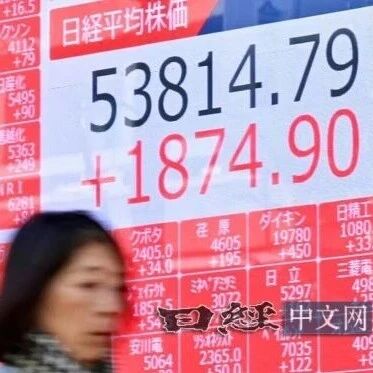
日经开盘大涨1800点,首次站上5万3000点
日经中文网· 2026-01-13 02:23
Group 1 - The Nikkei average stock index surged by 1800 points after opening on January 13, indicating strong market performance [2][4] - Reports suggest that Japanese Prime Minister Sanae Takaichi is considering the impact of dissolving the House of Representatives at the beginning of the regular Diet session on January 23, which has led to increased expectations for proactive fiscal policies [4] - The index exceeded the previous historical high of 52,518 points set on January 6, and is currently operating within the 53,000 point range [2]
2026年3月全国两会展望
CAITONG SECURITIES· 2026-01-12 12:41
Fiscal Policy - The central economic work conference in 2025 emphasized a more proactive fiscal policy, with a focus on optimizing the "two new and two heavy" projects, including an allocation of CNY 625 billion in special long-term bonds[2] - Approximately CNY 2200 billion is planned for "two heavy" project construction, indicating a significant boost in fiscal spending for 2026[2] Monetary Policy - The central bank aims to maintain a moderately loose monetary policy, balancing growth and price recovery, with potential for rate cuts and reserve requirement ratio reductions in 2026[2] - There is expected room for further monetary easing throughout the year, supporting economic stability and risk prevention[2] Industrial Policy - The 20th Central Committee and the "14th Five-Year Plan" propose building a modern industrial system centered on advanced manufacturing and accelerating high-level technological self-reliance[2] - Key focus areas for 2026 include quantum technology, brain-computer interfaces, 6G, embodied intelligence, and commercial aerospace[2] Macroeconomic Outlook - GDP growth for the first half of 2025 was reported at 5.3%, with a decline to 4.8% in Q3, but 2026 is expected to show resilience despite high base effects[2] - CPI in December 2025 increased by 0.2% month-on-month and 0.8% year-on-year, while PPI showed a similar month-on-month increase, indicating potential for inflation recovery in 2026[2] Investment Recommendations - Technology innovation and advanced manufacturing are projected to be the main development lines, with confidence in GDP growth for 2026, especially as CPI and PPI are expected to exit deflation[2] - The A-share market is anticipated to transition from a technology-driven bull market in 2025 to a broader bull market in 2026, reflecting the overall positive outlook for Chinese assets[2] Risk Factors - Potential risks include slower-than-expected policy progress, economic growth falling short of expectations, and geopolitical uncertainties[2]
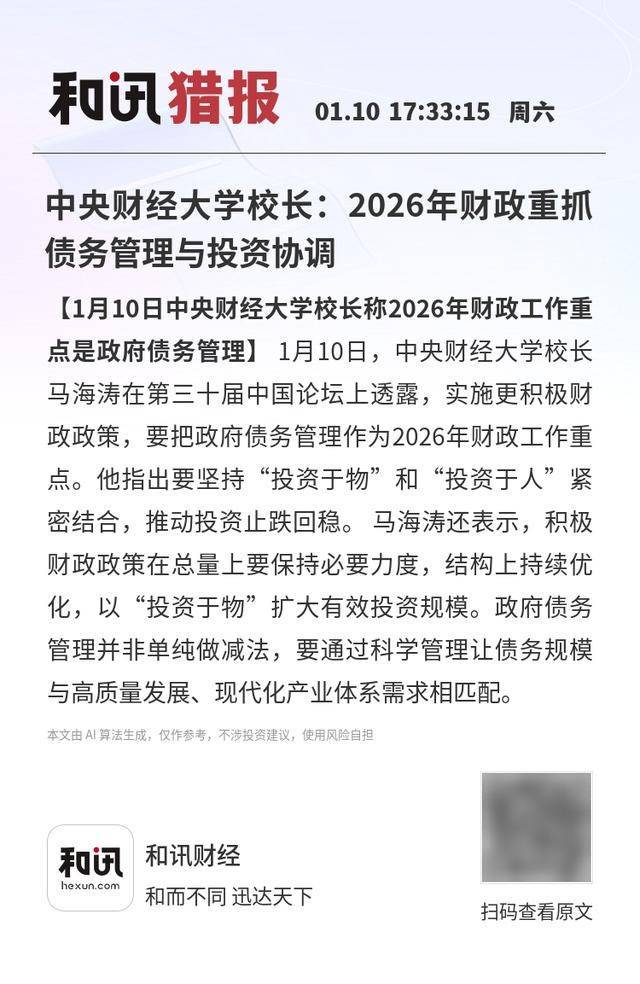
中央财经大学校长:2026年财政重抓债务管理与投资协调
Sou Hu Cai Jing· 2026-01-10 11:05
Group 1 - The core viewpoint is that government debt management will be a key focus of fiscal work in 2026, emphasizing the need for a more proactive fiscal policy [1][2] - The approach will combine "investment in material" and "investment in people" to stabilize and promote investment [1][2] - The proactive fiscal policy should maintain necessary strength in total volume while continuously optimizing its structure to expand effective investment scale through "investment in material" [1][2] Group 2 - Government debt management is not merely about reduction; it requires scientific management to align debt scale with high-quality development and the needs of a modern industrial system [1][2]
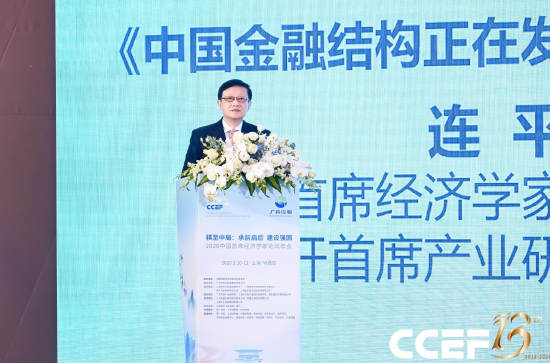
连平:房地产融资需求未来有望反弹,但不大可能回到过去状态
Xin Lang Cai Jing· 2026-01-10 06:49
Group 1 - The 2026 China Chief Economist Forum Annual Meeting will be held on January 10-11 in Shanghai, with the theme "Chess in the Middle Game: Building a Strong Nation" [1] - Lian Ping, Chairman of the China Chief Economist Forum and Dean of Guangkai Chief Industry Research Institute, emphasized that future proactive fiscal policies will continue and become more clearly defined [3][5] - China's overall fiscal situation is very good, with the capacity to maintain a strong fiscal expansion, and there will be significant financing demand in the market without noticeable contraction [3][5] Group 2 - Traditional sectors such as real estate and infrastructure are expected to remain stable and improve in the years following 2026, with overall traditional financing demand improving compared to 2025 [3][5] - Due to changes in economic structure, it is unlikely that there will be a return to the massive financing demand previously seen in the real estate sector, although there may be a slight rebound in financing demand from households and real estate companies [3][5] - The Chinese stock market is expected to stabilize in 2025 and continue this trend into 2026 and beyond, with a favorable operating environment for the capital and stock markets anticipated [3][5]