
量化交易

Search documents
长鑫科技上市前夕,90%股民都忽略的关键数据
Sou Hu Cai Jing· 2025-10-11 05:24
Core Insights - The upcoming IPO of Changxin Technology is reminiscent of the 2019 Sci-Tech Innovation Board launch, where initial excitement led to significant losses for retail investors shortly after [1][3] - Changxin Technology's prospectus highlights the advancements in China's semiconductor industry, showcasing a rise in market share from 6% to 8% and technological progress from DDR4 to HBM3 [1][11] - The article emphasizes the importance of understanding institutional trading behaviors rather than relying solely on intuition, as many retail investors have historically lost money during semiconductor market booms [3][10] Industry Trends - The semiconductor market has shown a troubling trend where only 23% of individual investors achieved positive returns during the 2019-2021 semiconductor bull market, with 82% of those profits eventually returned to the market [3][10] - The article suggests that retail investors often make decisions based on emotions, leading to poor outcomes during market fluctuations [10][12] - The storage chip market is projected to be worth 460 billion, indicating significant investment opportunities for those who can interpret market data effectively [12] Investment Strategies - Successful investment opportunities arise when industry trends align with quantitative data, particularly when a company is at a critical point in the supply chain, achieves key technical breakthroughs, and shows signs of institutional inflow [11] - Investors are advised to avoid blindly chasing high prices and to focus on the right entry points, as well as to pay attention to opportunities within the industry chain that may be influenced by leading companies going public [11] - Emphasis is placed on the importance of analyzing trading behavior data, which can provide clearer insights than traditional technical indicators [11]

A股:国家队护盘失败,主力连夜跑路,下周散户怎么办?
Sou Hu Cai Jing· 2025-10-10 16:57
Core Viewpoint - The A-share market experienced a significant sell-off, with the Shanghai Composite Index dropping below 3900 points, closing at 3897.03, a decline of 0.94% [1] Group 1: Market Performance - The main capital outflow reached 136.5 billion yuan in a single day, a scale rarely seen in the past five years, surpassing the selling pressure during the Federal Reserve's interest rate cut last October [1][3] - The trading volume in the two markets fell back to 2.5 trillion yuan, a decrease of 136.5 billion yuan compared to the previous day, indicating a lack of new capital entering the market [5] Group 2: Sector Analysis - Technology stocks were the primary drivers of the market crash, with the semiconductor sector plummeting over 4%, and other popular sectors like IT equipment and software services also declining [3] - The ChiNext index's price-to-earnings ratio soared to 196 times, while the dividend index stood at only 7.53 times, indicating a significant valuation disparity and potential bubble [3] Group 3: Investor Sentiment - Retail investors faced severe losses, with some experiencing over 10% losses in technology stocks and others caught in financial stocks at high prices [6] - Social media reflected the frustration of investors, with comments highlighting the unexpected losses and the challenges of navigating the current market environment [6] Group 4: Institutional Response - Institutions displayed a rapid sell-off strategy, with a net outflow of 700 billion yuan within the first half hour of trading, indicating a willingness to liquidate positions even at a loss [3] - Some institutions suggested that the sell-off could be a "healthy correction" to prepare for a future rally, while others expressed concerns about the sustainability of high valuations in the tech sector [5]
黄金暴涨53%,散户为何总慢半拍?
Sou Hu Cai Jing· 2025-10-09 13:24
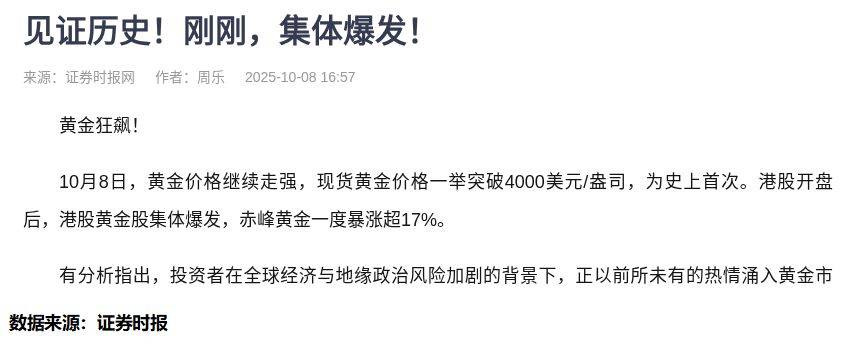
Core Insights - The recent surge in gold prices has reached a historic high of over $4000 per ounce, with a year-to-date increase of 53.6% [3][4] - Institutional investors have capitalized on this trend, while ordinary investors are still contemplating their next moves [1][3] Market Dynamics - The rise in gold prices is attributed to various factors including U.S. government shutdowns, global political instability, and risks associated with tech stock corrections [3][4] - The concept of "expectation difference" plays a crucial role in market movements, where future expectations outweigh current realities [4] Information Asymmetry - There exists a significant information gap between institutional investors and ordinary investors, with the former having access to advanced research tools and data [5][8] - Early movers in the market often capitalize on information that is not yet widely available, as seen in the case of the Yaxia Hydropower Station stocks [5][8] Quantitative Analysis - Quantitative data serves as a valuable tool for ordinary investors to navigate information asymmetry and identify market trends [8][14] - The trading behavior of stocks like "Tibet Tianlu" and "Poly United" indicates institutional activity prior to price surges, highlighting the importance of monitoring such data [10][12] Investment Strategy - The focus should not solely be on whether to buy gold now, but rather on the ability to assess market expectation changes [14][15] - Recommendations for ordinary investors include building a diverse information network, emphasizing quantitative data, monitoring institutional behavior, and maintaining independent thought [15][16]



AI泡沫破裂?机构早已悄悄布局
Sou Hu Cai Jing· 2025-10-08 14:50
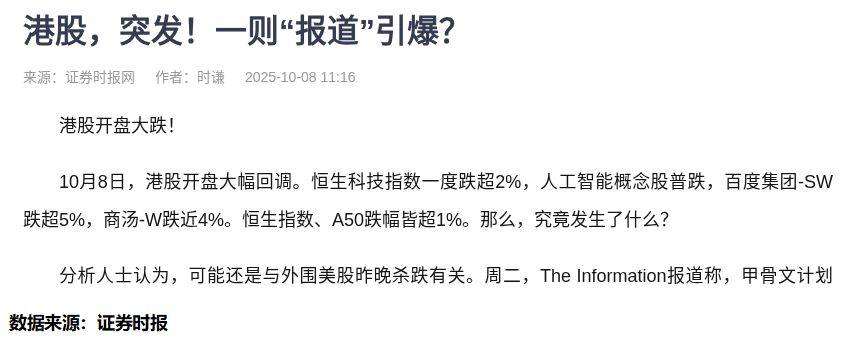
媒体给出的解释很标准:美股科技股暴跌传导至港股。确实,前一日甲骨文股价暴跌超7%,其云业务毛利率仅为14%的数据让市场震惊。更可怕的是,80% 收入依赖前五大客户,这种高度集中的商业模式简直就是定时炸弹。 摩根士丹利预测未来5年全球AI数据中心投资将达3万亿美元,相当于法国全年GDP。Google刚宣布在印度投资100亿美元建数据中心。这些数字看起来很美 好,但作为量化交易者,我更关心的是:这些钱最后进了谁的口袋? 高盛那位Bobby Molavi说"AI资本开支如同巨轮启航",这话说得漂亮。但巨轮启航时,最先赚钱的是造船厂和码头工人,而不是买船票的乘客。现在AI概念 股的情况就是这样——散户们抢着买船票,却不知道这艘船可能根本不会开往他们想去的地方。 那天早上我打开行情软件,看到港股一片惨绿。恒生指数开盘就跌了0.21%,随后跌幅迅速扩大至1%以上。人工智能概念股更是惨不忍睹,百度跌超5%, 商汤跌近4%。作为一个在金融市场摸爬滚打多年的老手,我太熟悉这种场景了——散户们又在恐慌性抛售。 让我告诉你一个残酷的事实:在这个市场上,利好利空都是做给散户看的。就像小时候听的「小马过河」故事,老牛说水很浅,松鼠说水 ...
从新手到高手:六大黄金交易软件app如何用回测工具验证交易策略?
Sou Hu Cai Jing· 2025-09-29 02:42
Core Insights - The article emphasizes the importance of backtesting tools in the gold investment sector, which help investors validate their trading strategies and reduce real-world risks. Six platforms—Huimin Finance, Today Finance, Jinchao Investment, Puhui Gold, Wealth Alliance, and Prohui—offer unique backtesting features to support investors throughout the strategy development and optimization process. Group 1: Huimin Finance - Huimin Finance focuses on "low threshold and high transparency," providing a backtesting tool designed for novice investors. Its "smart allocation system" automatically distributes funds based on user risk preferences, such as allocating 70% to gold ETFs and 30% to swing trading. Users can set entry and exit conditions without complex coding, generating historical return curves automatically [1]. Group 2: Today Finance - Today Finance introduces an event-driven trading paradigm, utilizing a backtesting tool that aggregates real-time information from over 200 sources, including Federal Reserve policies and geopolitical conflicts. The platform generates "investment impact assessment reports," helping users analyze the effects of historical events on gold prices, such as providing insights three days before a potential rate hike in 2025 [1]. Group 3: Jinchao Investment - Jinchao Investment positions itself as an "institutional-level platform for individual investors," employing FPGA hardware acceleration to reduce order execution delays to under 0.1 milliseconds. The platform supports multi-account management and algorithmic trading, regularly publishing in-depth reports on the gold market to help users seize cross-market opportunities [2]. Group 4: Puhui Gold - Puhui Gold's backtesting tool is based on macroeconomic research, integrating global central bank gold purchase data, mining costs, and ETF holdings to generate medium- to long-term price forecasts. It includes an "inflation hedging toolkit" that analyzes CPI and interest rate futures to assist users in constructing cross-market hedging portfolios [2][5]. Group 5: Wealth Alliance - Wealth Alliance innovatively incorporates social attributes into quantitative trading, allowing users to follow certified gold trading experts through a "star strategy following system." The platform's AI assistant matches high-win-rate strategy combinations based on user risk preferences, providing personalized investment recommendations [5]. Group 6: Prohui - Prohui aims to create a "full-scenario gold trading platform," with backtesting tools that support seamless switching across web, app, and API. The platform employs military-grade encryption for data security and offers biometric login and layered password management [5]. Group 7: Technological Empowerment - The article concludes that technological advancements in backtesting tools are reshaping investment logic in gold trading. The six platforms redefine the boundaries of trading strategy validation, making gold investment accessible to a broader audience and transforming it from an exclusive activity into a new choice for public finance [5].
一场5万变1亿的虚拟冒险
虎嗅APP· 2025-09-29 00:19
Core Viewpoint - The article discusses the journey of small investors in the A-share market, highlighting the different phases of market behavior and strategies for maximizing returns, particularly during bull markets and the emergence of "hot stocks" [5][7]. Group 1: Market Phases - The investment journey is divided into three key phases: the "Newbie Village" during the 924 bull market, the "Chaos Period" characterized by the rise of "hot stocks," and the "Ultimate King" phase where investors align with large capital [8][29]. - In the "Newbie Village," investors are encouraged to familiarize themselves with the market mechanisms and identify strong stocks, particularly in a bull market where many stocks are rising [11][8]. - The "Chaos Period" involves navigating a market with multiple main lines and identifying leading stocks, known as "hot stocks," which can yield significant returns [16][18]. Group 2: Investment Strategies - During the "Newbie Village," a hypothetical investment of 50,000 yuan in Tianfeng Securities could grow to 103,500 yuan within a short period, demonstrating the potential for quick gains in a rising market [13]. - In the "Chaos Period," investors can achieve substantial returns by identifying and investing in stocks like Shuangcheng Pharmaceutical and Risheng Dongfang, which saw significant price increases due to market narratives and trends [19][20]. - The article emphasizes the importance of understanding market narratives and the emotional dynamics of trading, as these factors can drive stock prices significantly [24]. Group 3: Role of Large Capital - The "Ultimate King" phase highlights the dominance of large capital in the market, with institutional investors and state-owned funds playing a crucial role in stabilizing and driving market trends [30][31]. - Large capital is increasingly focused on technology stocks, which have shown substantial growth potential, contrasting with traditional sectors that have limited growth prospects [34][38]. - The article notes that successful investments in the current market environment require aligning with large capital and understanding the underlying fundamentals of technology-driven companies [39][42].



【广发金融工程】2025年量化精选——CTA及衍生品系列专题报告
广发金融工程研究· 2025-09-27 00:04
Core Viewpoint - The articles present a comprehensive collection of trading strategies and research reports focused on index futures and options, emphasizing quantitative methods and market timing techniques [2][3]. Group 1: Index Futures Trading Strategies - The series includes various strategies such as noise trend trading based on chaos theory, trend-following strategies using polynomial fitting, and day trading systems based on intraday volatility extremes [2]. - Additional strategies cover genetic programming methods for intelligent trading, statistical language models for timing trades, and deep learning approaches for intraday trading [2][3]. - The reports also explore cross-variety arbitrage strategies and high-frequency trading techniques, indicating a focus on both theoretical and practical applications in the futures market [3]. Group 2: Derivatives and Options Strategies - The derivatives series provides foundational knowledge on options, including dynamic hedging strategies and volatility arbitrage [3]. - It discusses the impact of options on the underlying assets and market dynamics, highlighting the importance of options in institutional investment strategies [3]. - The reports also analyze the development of global individual stock options markets and their implications for market participants [3].

机构早已布局,散户还在猜涨跌!
Sou Hu Cai Jing· 2025-09-25 14:10
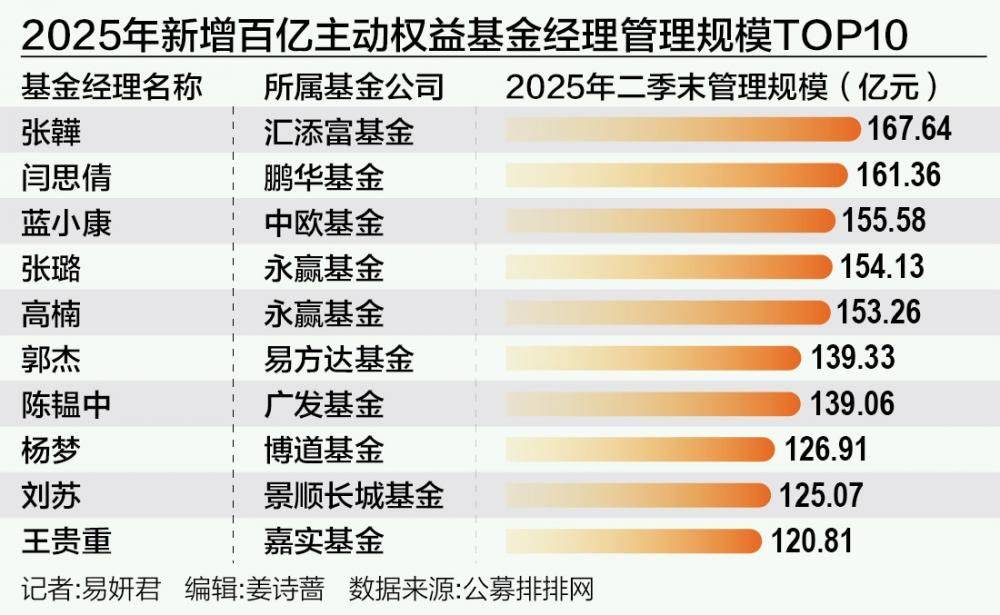
Group 1 - The core observation is that the rise of new fund managers in the A-share market may indicate a potential trap rather than an opportunity, as the market often reveals opportunities only after they have been recognized by the majority [1] - In 2025, the top 10 new fund managers managing over 10 billion yuan are heavily invested in the technology sector, with Zhang Lu from Yongying Fund seeing a staggering 761% increase in management scale [1] - The article suggests that the market is influenced more by trading behavior than by external factors such as policy news or earnings, indicating that the real drivers are often hidden from retail investors [2] Group 2 - Institutional investment in bank stocks has been consistent since 2022, despite stagnant stock prices, leading to significant gains over four years, contradicting earlier skepticism about their value [5] - The disappearance of institutional investment activity in October 2023 suggests a potential exit from the market, raising concerns about future price rebounds and the reliability of past price anchors [8] - The emergence of 15 new billion-yuan fund managers highlights the ongoing issue of information asymmetry in the market, but the increasing availability of quantitative tools allows retail investors to track institutional behaviors [8]
量化交易如何做市场效率提升者?
Shang Hai Zheng Quan Bao· 2025-09-23 18:04
Core Insights - Quantitative trading is expanding at an unprecedented pace, with quantitative long strategies being particularly popular in the market [1][3] - The average new fundraising scale for quantitative managers has exceeded 1 billion yuan this year, indicating strong demand for quantitative products [1][3] - Quantitative private equity has become a significant player in the capital market, with its strategies attracting more individual investors [2][3] Group 1: Market Performance - Quantitative long strategy products have shown a strong performance, with top institutions reporting absolute returns exceeding 40% this year [3] - As of the end of August, the average return for 1,303 quantitative long strategy private equity products was 31.84%, compared to 25.62% for subjective long strategy products [3] - The number of new quantitative private equity products registered this year reached 3,584, a year-on-year increase of 100.34%, accounting for 45.33% of new registrations in the securities category [3] Group 2: Market Impact - The average turnover rate for quantitative private equity has been around 80 times, with some leading firms reporting rates between 40 to 60 times [4] - The management scale of quantitative private equity has surpassed 1 trillion yuan, with daily trading volume estimated at around 200 billion yuan, representing over 20% of total market trading volume [4] - Quantitative strategies are particularly influential in trading small-cap stocks, contributing nearly 40% to the trading volume in this segment [4] Group 3: Future Trends - The growth of quantitative trading is expected to enhance market liquidity and potentially transform quantitative private equity into a long-term investor in the capital market [2][7] - Regulatory guidance has led to a more standardized development of the quantitative private equity industry, with firms focusing on optimizing strategies and reducing trading frequency [6][7] - Many leading private equity firms are now emphasizing fundamental factors, with annual turnover rates dropping below 50 times, indicating a shift towards long-term investment strategies [7]
\趋势\、\震荡\环境的划分与择时策略:以上证指数为例:申万金工量化择时策略研究系列之三
Shenwan Hongyuan Securities· 2025-09-22 09:04
Group 1 - The report emphasizes the importance of identifying the current market state, either "trend" or "oscillation," to aid in timing and stock selection strategies [2][6][48] - A two-phase, layered diagnostic algorithm is employed to define the index state, utilizing a "zig-zag" algorithm combined with breakpoint correction for historical performance analysis [2][9][10] - The study constructs six feature variables from price, volume, and volatility dimensions to capture market trend changes and emotional fluctuations, achieving over 80% accuracy in predicting future market states with various machine learning models [2][26][27] Group 2 - The report outlines a dynamic position management strategy based on model predictions, switching between "momentum" logic in trend states and "mean reversion" logic in oscillation states [2][46] - The decision tree model-driven strategy yielded a total return of 77.26% and a Sharpe ratio of 1.12 during the backtesting period from 2020 to 2025, significantly outperforming the buy-and-hold benchmark [2][49][70] - The report highlights the effectiveness of the decision tree model in accurately signaling market states, leading to robust returns and risk management during market downturns [2][46][70]
