地缘政治风险

Search documents
有色金属日报-20251127
Wu Kuang Qi Huo· 2025-11-27 01:55
Report Summary 1. Report Industry Investment Rating No industry investment rating is provided in the report. 2. Core Views - **Copper**: With dovish Fed statements and reduced geopolitical risks, along with tight copper raw - material supply and strong downstream demand, copper prices are expected to oscillate strongly. The reference range for the SHFE copper main contract is 86,400 - 88,000 yuan/ton, and for LME copper 3M is 10,850 - 11,100 dollars/ton [5]. - **Aluminum**: Supported by low global aluminum ingot inventories and supply disruptions, aluminum prices are likely to strengthen after an oscillatory adjustment. The reference range for the SHFE aluminum main contract is 21,450 - 21,800 yuan/ton, and for LME aluminum 3M is 2,820 - 2,890 dollars/ton [8]. - **Lead**: With increasing lead supply and weakening exports of lead - acid batteries, lead prices are expected to be weak in the short term [10]. - **Zinc**: Despite short - term tightness in zinc ore due to winter stockpiling, the zinc industry remains in an over - supply cycle, and zinc prices are expected to be weak in the short term [12]. - **Tin**: The short - term tin supply - demand is in a tight balance. Considering the high - price suppression of consumption and the marginal alleviation of ore shortages, tin prices are expected to oscillate. It is recommended to wait and see, with the reference range for the domestic main contract being 280,000 - 310,000 yuan/ton and for LME tin being 37,000 - 39,000 dollars/ton [14]. - **Nickel**: With strong supply pressure and weak demand, nickel prices are expected to be under pressure in the short term. It is not recommended to chase short or bottom - fish, and the reference range for SHFE nickel is 113,000 - 118,000 yuan/ton, and for LME nickel 3M is 13,500 - 15,500 dollars/ton [18]. - **Lithium Carbonate**: Due to the divergence between improving fundamentals and concerns about off - season demand, along with large price fluctuations, it is recommended to wait and see, with the reference range for the GFEX lithium carbonate 2605 contract being 93,000 - 99,000 yuan/ton [21]. - **Alumina**: With the recovery of overseas ore shipments and over - capacity in the smelting end, but prices approaching the cost line, it is recommended to wait and see in the short term. The reference range for the domestic main contract AO2601 is 2,600 - 2,900 yuan/ton [24]. - **Stainless Steel**: Although the spot market has seen a slight price increase and improved trading, due to weak demand in related fields, stainless - steel prices are expected to oscillate [27]. - **Cast Aluminum Alloy**: Supported by cost and supply - side policies, but with average demand, its price is expected to follow the trend of aluminum prices in the short term [29]. 3. Summary by Metal Copper - **Market Information**: Overnight US stocks rose, the offshore RMB strengthened, and copper prices oscillated upwards. LME copper inventory decreased by 75 tons to 156,500 tons, and SHFE daily warehouse receipts decreased by 0.1 to 40,000 tons. The domestic copper spot import loss narrowed to less than 800 yuan/ton [4]. - **Strategy**: With dovish Fed statements, reduced geopolitical risks, tight copper raw - material supply, and strong downstream demand, copper prices are expected to oscillate strongly [5]. Aluminum - **Market Information**: Supported by overseas supply disruption news, aluminum prices rose. LME aluminum inventory decreased by 0.2 to 542,000 tons, and domestic aluminum ingot inventories continued to decline [7]. - **Strategy**: With low global aluminum ingot inventories and supply disruptions, aluminum prices are likely to strengthen after an oscillatory adjustment [8]. Lead - **Market Information**: On Wednesday, the SHFE lead index rose 0.13% to 17,063 yuan/ton, and LME lead 3S fell 0.5 to 1,985.5 dollars/ton. Domestic lead ingot inventories rose from a low level, and LME lead inventories increased [9]. - **Strategy**: With increasing lead supply and weakening exports of lead - acid batteries, lead prices are expected to be weak in the short term [10]. Zinc - **Market Information**: On Wednesday, the SHFE zinc index fell 0.03% to 22,362 yuan/ton, and LME zinc 3S fell 2 to 3,007.5 dollars/ton. Domestic zinc ingot social inventory decreased slightly [11]. - **Strategy**: Despite short - term tightness in zinc ore due to winter stockpiling, the zinc industry remains in an over - supply cycle, and zinc prices are expected to be weak in the short term [12]. Tin - **Market Information**: On November 26, 2025, the SHFE tin main contract rose 0.89% to 298,500 yuan/ton. Tin smelter production in Yunnan and Jiangxi was stable at a high level, but raw - material supply was tight. Tin demand in emerging fields provided support, and social inventory increased by 311 tons to 8,245 tons [13]. - **Strategy**: The short - term tin supply - demand is in a tight balance. Considering the high - price suppression of consumption and the marginal alleviation of ore shortages, tin prices are expected to oscillate [14]. Nickel - **Market Information**: On Wednesday, nickel prices rebounded. The SHFE nickel main contract rose 0.95% to 117,260 yuan/ton. Nickel ore prices were stable, and nickel - iron prices continued to fall [16]. - **Strategy**: With strong supply pressure and weak demand, nickel prices are expected to be under pressure in the short term [17]. Lithium Carbonate - **Market Information**: The MMLC lithium carbonate spot index rose 2.50% to 94,469 yuan. The LC2605 contract fell 1.03% to 96,340 yuan [20]. - **Strategy**: Due to the divergence between improving fundamentals and concerns about off - season demand, along with large price fluctuations, it is recommended to wait and see [21]. Alumina - **Market Information**: On November 26, 2025, the alumina index fell 0.22% to 2,747 yuan/ton. The futures warehouse receipts increased by 0.34 to 257,900 tons [23]. - **Strategy**: With the recovery of overseas ore shipments and over - capacity in the smelting end, but prices approaching the cost line, it is recommended to wait and see in the short term [24]. Stainless Steel - **Market Information**: On Wednesday, the stainless - steel main contract rose 0.40% to 12,455 yuan/ton. Spot prices in some markets increased, and social inventory decreased to 1.0717 million tons [26]. - **Strategy**: Although the spot market has seen a slight price increase and improved trading, due to weak demand in related fields, stainless - steel prices are expected to oscillate [27]. Cast Aluminum Alloy - **Market Information**: The main AD2601 contract of cast aluminum alloy fell 0.1% to 20,695 yuan/ton. The weighted contract positions rebounded, and the warehouse receipts increased slightly [29]. - **Strategy**: Supported by cost and supply - side policies, but with average demand, its price is expected to follow the trend of aluminum prices in the short term [29].
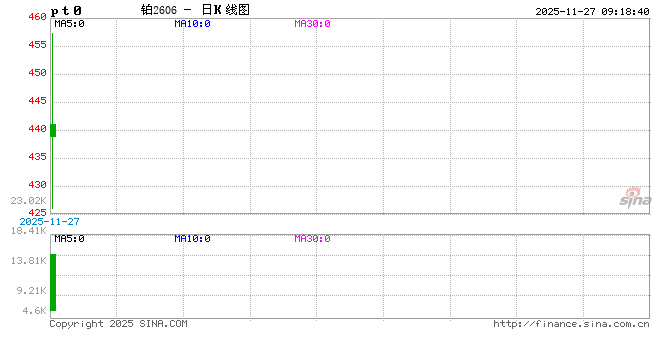
期货开盘:铂期货涨9%,沪银涨超3%,甲醇、玻璃、花生、原油涨超1%,沪锡涨近1%;沪铅跌超1%,碳酸锂跌近1%
Sou Hu Cai Jing· 2025-11-27 01:36
Core Insights - The launch of platinum and palladium futures on the domestic market is seen as a significant addition to the new energy metal futures sector, with the first contracts being reasonably priced compared to market expectations [2][4]. Group 1: Market Analysis - The first contracts for platinum and palladium futures were priced slightly above market expectations but aligned with the domestic price structure [2]. - The macroeconomic environment is supportive due to the Federal Reserve's dovish signals, with an 80% probability of a rate cut in December, which may bolster market sentiment [2]. - Geopolitical developments, such as progress in Russia-Ukraine negotiations, could reduce risk appetite and exert downward pressure on prices [2]. Group 2: Price Expectations - Initial price ranges for platinum futures are expected to be between 385 to 425 CNY per gram, while palladium futures are anticipated to range from 345 to 385 CNY per gram on their first trading day [2]. - Analysts predict that the futures for platinum and palladium may exhibit a contango structure, influenced primarily by market liquidity levels [4]. - The initial trading price range for PT2606 is projected to be 390 to 420 CNY per gram, and for PD2606, it is expected to be 340 to 370 CNY per gram [4]. Group 3: Market Performance - On the opening day of trading, domestic main contracts showed mixed performance, with platinum rising nearly 9% and other commodities like silver and glass also seeing gains [3]. - Conversely, some contracts, including lithium carbonate and paper pulp, experienced declines of nearly 1% [3].

宏观金融类:文字早评2025-11-27-20251127
Wu Kuang Qi Huo· 2025-11-27 01:19
Report Industry Investment Rating No relevant content provided. Core Viewpoints of the Report - After recent continuous declines, the index is expected to stabilize in the short - term. Policy support for the capital market remains unchanged, and technology growth is still the market's main line. The medium - to long - term strategy is to buy on dips [4]. - In the fourth quarter, the supply - demand pattern of the bond market may improve. The market is in a situation of weak domestic demand recovery and improved inflation expectations, maintaining an overall volatile trend. Pay attention to the impact of stock - bond linkage and liquidity [7]. - The expectation of the Fed's loose monetary policy has significantly increased. The overseas interest - rate cut cycle will continue, and the further driving force will be released in December. It is recommended to buy precious metals on dips [9]. - For most commodities, the market is affected by various factors such as supply - demand relationships, policies, and macro - economic conditions, showing different trends of volatility, strength, or weakness. Summary by Category Macro - Financial Stock Index - **Market News**: Six ministries including the Ministry of Industry and Information Technology jointly issued a document to enhance the adaptability of consumer goods supply and demand; the Cyberspace Administration of China strengthened the management of financial "self - media" and MCN accounts; the Guangzhou Futures Exchange announced the listing benchmark prices of platinum and palladium futures; US durable goods orders in September increased by 0.5% month - on - month [2]. - **Basis Ratio**: The basis ratios of IF, IC, IM, and IH for different contract periods are provided [3]. - **Strategy**: After recent declines, the index may stabilize in the short - term. The long - term strategy is to buy on dips [4]. Treasury Bonds - **Market News**: On Wednesday, the prices of TL, T, TF, and TS main contracts decreased. The Bank of Japan may raise interest rates in December; the winning yields of the Ministry of Finance's 2 - period treasury bonds were lower than the ChinaBond valuations. The central bank conducted 2133 billion yuan of 7 - day reverse repurchase operations, with a net withdrawal of 972 billion yuan [5]. - **Strategy**: The economic data in October was weak, and the year - end social financing growth rate may remain weak. The central bank maintains an attitude of protecting funds. The bond market is expected to be volatile in the fourth quarter, and pay attention to stock - bond linkage and liquidity [7]. Precious Metals - **Market News**: Shanghai gold rose 0.37%, and Shanghai silver rose 2.73%. COMEX gold and silver prices are also provided. A Fed governor made dovish remarks, and the market expects an 82.9% probability of a 25 - basis - point interest - rate cut in December [8]. - **Strategy**: The expectation of the Fed's loose monetary policy has increased. It is recommended to buy precious metals on dips [9]. Non - Ferrous Metals Copper - **Market News**: Overnight, US stocks rose, and the offshore RMB strengthened. LME copper prices increased, and domestic copper inventories and premiums showed certain changes [11]. - **Strategy**: Fed officials' dovish remarks increase the probability of a December interest - rate cut. The supply of copper raw materials is tight, and downstream demand is strong. Copper prices are expected to oscillate strongly [12]. Aluminum - **Market News**: Supported by overseas supply disruption news, aluminum prices rose. LME and domestic aluminum inventories and premiums changed [13]. - **Strategy**: Global aluminum inventories are low, and supply disruptions support prices. Although the downstream is entering the off - season, aluminum prices may strengthen after adjustment [14]. Zinc - **Market News**: On Wednesday, Shanghai zinc index prices decreased slightly. LME and domestic zinc inventories and basis are provided [15]. - **Strategy**: Zinc ore imports decreased in October, and the supply of zinc ore is tight during the winter stockpiling period. However, in the long - term, the zinc industry is still in an over - supply cycle. Zinc prices are expected to be weak in the short - term [16]. Lead - **Market News**: On Wednesday, Shanghai lead index prices rose slightly. LME and domestic lead inventories and basis are provided [17]. - **Strategy**: The supply of lead ingots is increasing, while the demand for lead - acid batteries is declining. Lead prices are expected to be weak in the short - term [17]. Nickel - **Market News**: On Wednesday, nickel prices rebounded. Spot prices and cost factors are provided [18]. - **Strategy**: The fundamentals of nickel are under pressure. Supply is increasing, and demand is weak. It is not recommended to chase short or bottom - fish. Wait for the nickel - iron price to stabilize [18]. Tin - **Market News**: On November 26, Shanghai tin prices rose. Supply, demand, and inventory information are provided [19]. - **Strategy**: The short - term supply - demand of tin is in a tight balance. Considering the high - price suppression of consumption and the marginal improvement of ore shortages, tin prices are expected to oscillate. It is recommended to wait and see [20]. Carbonate Lithium - **Market News**: The spot index of carbonate lithium rose, while the futures price of LC2605 decreased [21]. - **Strategy**: The improvement of fundamentals boosts bullish sentiment, but there are concerns about off - season demand. It is recommended to wait and see [21]. Alumina - **Market News**: On November 26, the alumina index decreased. Information on basis, overseas prices, and inventory is provided [22]. - **Strategy**: Overseas ore shipments are expected to increase, and the alumina smelting capacity is over - supplied. However, the current price is close to the cost line, and it is recommended to wait and see [23]. Stainless Steel - **Market News**: On Wednesday, the stainless - steel main contract price rose. Spot prices, raw material prices, and inventory information are provided [24]. - **Strategy**: The spot market price rose slightly, but the demand is affected by the real - estate market. Stainless - steel prices are expected to oscillate [25]. Cast Aluminum Alloy - **Market News**: Yesterday, the price of cast aluminum alloy oscillated. Information on contract prices, inventory, and demand is provided [26]. - **Strategy**: The cost of cast aluminum alloy provides support, and the price is expected to follow the trend of aluminum prices [27]. Black Building Materials Steel - **Market News**: The prices of rebar and hot - rolled coil main contracts decreased. Information on spot prices, registered warrants, and inventory is provided [29]. - **Strategy**: The steel market is in the off - season, and the export is affected by anti - dumping duties. Prices are expected to be weakly volatile in the short - term but may improve with policy implementation [30]. Iron Ore - **Market News**: Yesterday, the iron - ore main contract price rose. Information on spot prices, basis, and inventory is provided [31]. - **Strategy**: Overseas iron - ore shipments decreased, and the demand for iron ore is stable. The overall inventory is high, and the price is expected to oscillate [32]. Glass and Soda Ash - **Glass** - **Market News**: On Wednesday, the glass main contract price rose slightly. Information on spot prices, inventory, and positions is provided [33]. - **Strategy**: The supply of glass may decrease in December, and the demand is weak. The price is expected to oscillate at the bottom [34]. - **Soda Ash** - **Market News**: On Wednesday, the soda - ash main contract price decreased. Information on spot prices, inventory, and positions is provided [35]. - **Strategy**: The supply of soda ash is in excess, and the demand is divided. The price is expected to be weak [35]. Manganese Silicon and Ferrosilicon - **Market News**: On November 26, the prices of manganese - silicon and ferrosilicon main contracts decreased. Information on spot prices, basis, and price trends is provided [36]. - **Strategy**: The market risk appetite has weakened, and the prices of ferrous alloys have decreased. However, with the expectation of the Fed's interest - rate cut, there may be a turning point. It is recommended to pay attention to market sentiment [38]. Industrial Silicon and Polysilicon - **Industrial Silicon** - **Market News**: Yesterday, the industrial - silicon main contract price rose. Information on spot prices, basis, and production is provided [40]. - **Strategy**: The production of industrial silicon is decreasing, and the demand is affected by the polysilicon and organic - silicon industries. The price is expected to oscillate [41]. - **Polysilicon** - **Market News**: Yesterday, the polysilicon main contract price rose. Information on spot prices, basis, and production is provided [43]. - **Strategy**: The production of polysilicon is decreasing, and the supply - demand pattern may improve marginally. The price is expected to oscillate widely, and attention should be paid to platform company progress and price feedback [44]. Energy and Chemicals Rubber - **Market News**: Rubber prices rebounded. Thailand's rubber - producing areas were affected by floods, and the inventory of exchange - traded RU was low. The opinions of bulls and bears are different [46]. - **Strategy**: It is recommended to take a bullish short - term strategy and partially build positions for hedging [50]. Crude Oil - **Market News**: INE crude - oil futures prices decreased. The inventory of refined oil products in the Fujairah port increased [51]. - **Strategy**: Although the geopolitical premium has disappeared, OPEC's supply has not increased significantly. It is recommended to wait and see and test OPEC's export price - support willingness [52]. Methanol - **Market News**: The prices of methanol in different regions and the main contract increased. Information on basis and spread is provided [53]. - **Strategy**: The positive impact of Iranian device shutdowns is being realized, but the near - term high - inventory pattern remains. It is recommended to wait and see [53]. Urea - **Market News**: The prices of urea in different regions and the main contract changed. Information on basis and spread is provided [54]. - **Strategy**: The urea price is oscillating at the bottom. The supply is high, and the demand has improved. It is recommended to buy on dips [55]. Pure Benzene and Styrene - **Market News**: The spot price of pure benzene was unchanged, and the futures price of styrene rose. Information on basis, spread, and supply - demand is provided [56]. - **Strategy**: The supply of styrene is under pressure, but the demand is in the seasonal peak. The price may stop falling [57]. PVC - **Market News**: The PVC01 contract price decreased. Information on spot prices, basis, and supply - demand is provided [58]. - **Strategy**: The supply of PVC is in excess, and the demand is weak. It is recommended to short on rallies [60]. Ethylene Glycol - **Market News**: The EG01 contract price rose. Information on spot prices, basis, and supply - demand is provided [61]. - **Strategy**: The domestic supply of ethylene glycol is expected to decrease in December, but the medium - term supply - demand pattern is still weak. It is recommended to short on rallies [62]. PTA - **Market News**: The PTA01 contract price rose. Information on spot prices, basis, and supply - demand is provided [63]. - **Strategy**: The supply of PTA may increase, and the demand is affected by inventory and the off - season. The processing fee has limited upward space [64]. p - Xylene - **Market News**: The PX01 contract price rose. Information on spot prices, basis, and supply - demand is provided [65]. - **Strategy**: The load of PX is high, and the downstream PTA is in maintenance. PX may accumulate inventory in November, and the valuation may be adjusted downward [66]. Polyethylene (PE) - **Market News**: The futures and spot prices of PE decreased. Information on basis, inventory, and supply - demand is provided [67]. - **Strategy**: The price of PE is expected to be volatile at a low level. The supply is decreasing, and the demand is in the seasonal peak [68]. Polypropylene (PP) - **Market News**: The futures and spot prices of PP decreased. Information on basis, inventory, and supply - demand is provided [69]. - **Strategy**: The supply of PP is under pressure, and the demand is in the seasonal low. The price may be supported in the first quarter of next year [70]. Agricultural Products Hogs - **Market News**: Yesterday, domestic hog prices mostly decreased. The supply is high, and the demand is weak [72]. - **Strategy**: The supply of hogs is under pressure, and the demand is weak. It is recommended to short near - month contracts or conduct reverse arbitrage [73]. Eggs - **Market News**: Yesterday, the national egg prices were mostly stable. The supply and demand are in a stalemate [74]. - **Strategy**: The spot price of eggs has not followed the futures price increase. The price is expected to be oscillating in the short - term, and it is recommended to short on rallies in the medium - term [75]. Soybean and Rapeseed Meal - **Market News**: CBOT soybean prices rose. The domestic soybean inventory is high, and the meal inventory is large [76]. - **Strategy**: The global soybean supply has decreased, and the import cost has a bottom support. The meal price is expected to oscillate [77]. Oils - **Market News**: The export of Malaysian palm oil decreased, and the production increased. The domestic oil inventory may decrease in the future [78]. - **Strategy**: The high production of palm oil suppresses the price. It is recommended to take an oscillating view and turn bullish if production decreases [79]. Sugar - **Market News**: The Zhengzhou sugar futures price oscillated. The production of sugar in Brazil and India is expected to increase [81]. - **Strategy**: The global sugar supply is expected to be in excess, and the international sugar price may be weak. It is recommended to short on rallies [82]. Cotton - **Market News**: The Zhengzhou cotton futures price oscillated. The global cotton production is expected to increase [83]. - **Strategy**: The demand for cotton is not too bad after the peak season, and the price is expected to oscillate in the short - term [84].
今年金价暴涨60%还不够?专家称:明年还会继续涨!3大理由曝光?
Sou Hu Cai Jing· 2025-11-26 14:40
Core Viewpoint - The article discusses the significant rise in gold prices this year, which has increased by over 60%, and explores the potential for continued growth in gold prices next year, supported by various economic factors and expert opinions [1][11]. Group 1: Expert Opinions on Gold - Lin Qichao, the chief economist at Cathay United Bank, views gold as a long-term asset with upward potential [3]. - He provides three key reasons for a bullish outlook on gold prices [4]. Group 2: Factors Supporting Gold Price Increase - The first factor is the Federal Reserve's interest rate cuts, which lower U.S. Treasury yields and weaken the dollar, enhancing gold's appeal as a "zero-yield safe-haven asset" [6]. - The second factor is the increasing global money supply, leading to currency debasement, which drives demand for tangible assets like gold [7]. - The third factor is geopolitical risks, which historically support gold as a safe-haven asset amid global uncertainties [9]. Group 3: Price Predictions from Investment Banks - Current spot gold prices have reached $4,162 [11]. - Major Wall Street investment banks have raised their gold price forecasts for next year, with Bank of America predicting $5,000, Deutsche Bank adjusting its forecast to a range of $4,450 to $4,950, UBS targeting $4,500, and Goldman Sachs estimating $4,900, while JPMorgan Chase sets a high estimate of $5,062 [12].
山金期货贵金属策略报告-20251126
Shan Jin Qi Huo· 2025-11-26 11:10
1. Report Industry Investment Rating No relevant content provided. 2. Core Viewpoints of the Report - Gold prices are expected to be volatile and strong in the short - term, fluctuate at high levels in the medium - term, and rise step - by - step in the long - term. The core logic includes short - term risk aversion due to geopolitical risks and the existence of interest - rate cut expectations, and the influence of factors in terms of risk - aversion, monetary, and commodity attributes [1]. - The price trend of gold is the anchor for the price of silver. In terms of the capital side, the net long position of CFTC silver has recently been reduced again, and the iShare silver ETF has slightly increased its position. In terms of inventory, the recent explicit inventory of silver has slightly decreased [5]. 3. Summary According to Relevant Catalogs Gold - **Price Performance**: International prices such as Comex gold and London gold, and domestic prices like Shanghai gold futures and gold T + D all showed increases. For example, Comex gold rose 0.76% from the previous day and 2.40% from the previous week [2]. - **Position and Inventory**: Comex gold positions remained unchanged compared to the previous week, while Shanghai gold futures positions increased by 127.87%. Some inventories decreased, such as Comex gold inventory which decreased by 1.08% compared to the previous week [2]. - **Strategy**: For gold, conservative investors are advised to wait and see, while aggressive investors can buy low and sell high. It is recommended to manage positions well and set strict stop - loss and take - profit levels [3]. Silver - **Price Performance**: International prices of Comex silver and London silver, and domestic prices of Shanghai silver futures and silver T + D all increased. For instance, Comex silver rose 1.16% from the previous day and 2.39% from the previous week [5]. - **Position and Inventory**: Comex silver positions remained unchanged compared to the previous week, while Shanghai silver futures positions increased by 13.23%. Some inventories decreased, like the explicit inventory which decreased by 0.74% compared to the previous week [5]. - **Strategy**: Similar to gold, conservative investors should wait and see, and aggressive investors can adopt a high - selling and low - buying strategy. Position management and strict stop - loss and take - profit are recommended [5]. Fundamental Key Data - **Monetary Attributes**: The federal funds target rate, discount rate, and reserve balance rate all decreased by 0.25%. The Fed's total assets decreased by 0.00%. The ten - year US Treasury real yield, dollar index, and other indicators showed certain changes [7]. - **Inflation**: US inflation indicators such as CPI, core CPI, PCE price index showed different degrees of changes compared to the previous period [9]. - **Economic Growth**: US economic growth indicators including GDP, unemployment rate, and non - farm payrolls had corresponding changes [9]. - **Other Aspects**: There were also changes in data related to the labor market, real estate market, consumption, industry, trade, and economic surveys. In addition, data on central bank gold reserves, risk - aversion attributes, and commodity attributes were also presented [9][10]. Fed's Latest Interest Rate Expectations The probability of the Fed cutting interest rates in December 2025 to the range of 350 - 375 basis points is 82.9%. The probability distribution of interest - rate ranges in subsequent meetings also shows different trends [11].
美委紧张局势升级引爆避险 金价冲击4170逼近关键阻力
Jin Tou Wang· 2025-11-26 06:14
摘要今日周三(11月26日)亚盘时段,现货黄金目前交投于4160美元附近,截至发稿,现货黄金最新报 4160.70美元/盎司,涨幅0.75%,最高上探至4169.20美元/盎司,最低触及4129.07美元/盎司。目前来 看,现货黄金短线偏向看涨走势。 针对美国24日将委"太阳集团"列为"外国恐怖组织"(指其由马杜罗及政府高层领导),委外长希尔驳斥 称该组织不存在,谴责美方借此抹黑。近期,美国以"缉毒"为名在委附近加勒比海域部署多艘军舰;9 月初至今,美军在加勒比海和东太平洋击沉超20艘所谓"贩毒船",致80余人死亡。但美国缉毒署近年报 告显示,委并非流入美毒品主要来源地。 委政府多次指责,美国意图通过军事威胁策动其政权更迭,并在拉美推进军事扩张。 【最新现货黄金行情解析】 经济不确定性、地缘动荡与市场对美联储持续宽松的预期,仍将在短期支撑金价。尽管金价在4200美 元/盎司下方盘整,交易员们仍在等待新的催化剂,但黄金价格仍呈现上涨趋势。相对强弱指数(RSI)虽 然持平,但仍高于50的阈值,表明买方占据主导地位。 金价第一个关键阻力位是4200美元/盎司,其次是11月13日的高点4245美元/盎司。如果突破后者 ...
肥料产地集中于中俄等,地缘风险令价格高涨
日经中文网· 2025-11-26 02:47
肥料占据玉米生产成本的35%(照片为美国伊利诺伊州,reuters) 肥料价格创三年来新高 含有磷和氮的磷酸二铵(DAP)的国际价格8月达到每吨795美元,创下三年来的高点。9月价格小幅回 落至每吨780美元,尽管如此,仍比年初上涨了34%。 肥料价格受地缘政治风险左右。2022年,因俄乌冲突,肥料价格曾急速上涨。原因是来自全球最大肥料 出口国俄罗斯的供应不确定性上升。 肥料的原料磷矿石的全球总产量中,中国占46%。中国、摩洛哥、美国、俄罗斯这四个国家的磷矿石产 量合计占到全球的70%以上。中国于10月中旬暂停出口尿素等肥料,动摇了全球供应链…… 国际肥料价格正再度攀升。背后的原因是肥料生产地集中于中国、俄罗斯等国家,而地缘政治紧张导致 供应不稳定。中国于10月中旬暂停出口尿素等肥料,动摇了全球供应链。肥料农业生产不可或缺的物 资,其价格高涨及供应受限可能会对食品价格形成上涨压力。 与稀土管制相似 中国10月中旬暂停了氮肥尿素及磷酸二铵的出口。2024年,中国氮肥出口量比上年减少90%以上,尽管 今年春季以后似乎曾出现扩大出口的动向,但如今又再度转向实施出口管制。这种做法与中国将稀土当 作武器进行出口管制的做 ...

有色金属日报-20251126
Wu Kuang Qi Huo· 2025-11-26 02:18
Group 1: Report Overview - Report Title: Five Minerals Futures Morning Report | Non-ferrous Metals [1][31][78] - Date: November 26, 2025 Group 2: Industry Investment Rating - Not provided in the content Group 3: Core Views - Copper prices are expected to fluctuate and strengthen due to dovish Fed statements, reduced geopolitical risks, tight raw material supply, and strong downstream demand [5] - Aluminum prices are likely to strengthen after adjustment as global visible inventory is low and supply disruptions are expected, despite the approaching off - season [8] - Lead prices are expected to be weak in the short term due to increased supply, stable domestic demand, and rising inventory [10] - Zinc prices are predicted to be weak in the short term as the zinc industry is in an over - supply cycle, and recent financial assets are performing weakly [12] - Tin prices are expected to be in a tight - balance state in the short term and may fluctuate, with support from emerging demand and potential supply increases [14] - Nickel prices are likely to be under pressure in the short term due to supply increases and weak demand [18] - Lithium carbonate prices have significant market differences, and it is recommended to wait and see, focusing on first - quarter cell production and equity market sentiment [21] - Alumina prices are suggested to be observed in the short term as the industry has over - capacity and potential supply - side changes [24] - Stainless steel prices are expected to fluctuate as the market has a mixed situation of price increases and weak demand [27] - Cast aluminum alloy prices are likely to be volatile in the short term with strong cost support and average demand [30] Group 4: Summary by Metal Copper - **行情资讯**: Offshore RMB strengthened, oil prices were pressured, and copper prices rose and then fell. LME copper inventory increased, and domestic warehouse receipts decreased. Spot premiums declined, and import losses widened [4] - **策略观点**: With a high probability of Fed rate cut in December and eased geopolitical risks, copper prices are expected to fluctuate and strengthen. The reference range for SHFE copper is 85,800 - 87,000 yuan/ton, and for LME copper 3M is 10,700 - 10,900 dollars/ton [5] Aluminum - **行情资讯**: Aluminum prices fluctuated and declined. LME aluminum inventory decreased, and domestic futures positions and warehouse receipts decreased. Spot premiums declined, and market activity decreased [7] - **策略观点**: Global visible inventory is low, and supply disruptions are expected. Aluminum prices may strengthen after adjustment. The reference range for SHFE aluminum is 21,300 - 21,600 yuan/ton, and for LME aluminum 3M is 2,780 - 2,830 dollars/ton [8] Lead - **行情资讯**: Lead prices declined. Domestic and overseas inventories changed, and the basis and spreads showed certain trends [9] - **策略观点**: Supply is increasing, domestic demand is stable, and inventory is rising. Lead prices are expected to be weak in the short term [10] Zinc - **行情资讯**: Zinc prices declined slightly. Zinc ore supply is tight due to winter stockpiling, and zinc ingot inventory decreased slightly [11] - **策略观点**: The zinc industry is in an over - supply cycle. Zinc prices are expected to be weak in the short term [12] Tin - **行情资讯**: Tin prices rose. Supply is affected by raw material shortages, and demand from emerging fields provides support. Inventory increased slightly, and there are geopolitical risks in Congo (Kinshasa) [13] - **策略观点**: Tin supply and demand are in a tight - balance state. Tin prices are expected to fluctuate. The reference range for domestic SHFE tin is 280,000 - 300,000 yuan/ton, and for LME tin is 36,000 - 38,000 dollars/ton [14] Nickel - **行情资讯**: Nickel prices rebounded slightly. Spot premiums were stable, nickel ore prices were stable, and nickel iron prices declined [16] - **策略观点**: Nickel supply is increasing, demand is weak, and prices are expected to be under pressure in the short term. The reference range for SHFE nickel is 113,000 - 118,000 yuan/ton, and for LME nickel 3M is 13,500 - 15,500 dollars/ton [18] Lithium Carbonate - **行情资讯**: Lithium carbonate prices rose. The spot index and futures prices increased [20] - **策略观点**: There are differences in the market regarding short - term demand and future supply - demand improvement. It is recommended to wait and see. The reference range for the Guangzhou Futures Exchange's LC2605 contract is 92,200 - 100,600 yuan/ton [21] Alumina - **行情资讯**: Alumina prices declined slightly. The basis, overseas prices, and inventory showed certain trends [23] - **策略观点**: Overseas ore supply is expected to increase, and the industry has over - capacity. It is recommended to wait and see in the short term. The reference range for the domestic AO2601 contract is 2,600 - 2,900 yuan/ton [24] Stainless Steel - **行情资讯**: Stainless steel prices rose slightly. Spot prices increased, and inventory decreased slightly [26] - **策略观点**: Spot prices increased, but demand is weak due to the real - estate market. Stainless steel prices are expected to fluctuate [27] Cast Aluminum Alloy - **行情资讯**: Cast aluminum alloy prices rebounded slightly. The contract price, inventory, and basis changed [29] - **策略观点**: Cost support is strong, and supply is affected by policies. Prices are expected to be volatile in the short term [30]
IC Markets:黄金稳守4150美元下方,降息预期能否推动破局?
Sou Hu Cai Jing· 2025-11-25 13:43
Core Viewpoint - Gold prices have stabilized below $4150, reaching a new high in over a week, driven by expectations of a Federal Reserve rate cut in December and ongoing geopolitical risks [1][3]. Market Dynamics - The market is increasingly betting on a 25 basis point rate cut by the Federal Reserve in December, with an implied probability of about 80% according to the CME Group FedWatch tool [3][4]. - Geopolitical uncertainties, particularly the escalation of the Russia-Ukraine conflict and tensions in the Middle East, are providing additional support for gold as a safe-haven asset [3][4]. Price Movements - Gold has reached a one-and-a-half-week high but has struggled to maintain upward momentum, with slight increases observed during the European session [3]. - The dollar index remains near multi-month highs, which has limited the upside for gold prices despite the dovish outlook for the Federal Reserve [3]. Technical Analysis - ICMarkets indicates that strong overnight gains have validated multiple support levels, including an upward trend line extending from late October and the 200-period EMA on the 4-hour chart [6]. - There is a significant possibility for gold prices to push towards the $4177-$4178 range and challenge the $4200 psychological level [6]. - If gold prices fall below the $4132-$4130 range, it may present a buying opportunity, with strong support expected around $4110-$4100 [6].

药明康德“美颜”三季报:营收增18.6%,非经常性收益支撑利润,多项指标显露增长隐忧
Hua Xia Shi Bao· 2025-11-25 06:37
本报(chinatimes.net.cn)记者张斯文 于娜 北京报道 近日,无锡药明康德新药开发股份有限公司(下称"药明康德",603259.SH)披露了2025年第三季度报 告,前三季度实现营业收入328.57亿元,同比增长18.61%;归属于上市公司股东净利润120.76亿元,同 比大增84.84%。 (数据来源:Wind) 但细究业绩结构,可以看到,公司存在非经常性收益贡献显著,国内业务增长停滞、部分板块疲软、研 发投入收缩等问题。 非经常性收益拉高利润 报告显示,前三季度公司非经常性损益达25.53亿元,主要来自出售联营企业WuXi XDC Cayman Inc.部 分股票的收益(32.23亿元)。扣除该部分后,归属于上市公司股东的扣除非经常性损益净利润为95.22 亿元,同比增长率下降至42.51%,显著低于净利润增速。 对此,山东隆湶律师事务所主任、高级合伙人李富民对《华夏时报》记者表示,利润结构的健康度要 看"可持续性"。84%的净利润里,超过四成来自非经常性收益,扣非增速落后同行20个百分点,说明主 业溢价能力在收窄。CXO板块普遍把闲置资金做理财或跟投客户股权,但把公允价值变动当"主营味 道 ...