
海洋经济高质量发展

Search documents
瑞达期货锰硅硅铁产业日报-20250702
Rui Da Qi Huo· 2025-07-02 09:40
数据来源第三方,观点仅供参考。市场有风险,投资需谨慎! 研究员: 徐玉花 期货从业资格号F03132080 期货投资咨询从业证书号 Z0021386 免责声明 本报告中的信息均来源于公开可获得资料 ,瑞达期货股份有限公司力求准确可靠 ,但对这些信息的准确性及完整性不做任何保证 ,据此投资,责 任自负。本报告不构成个人投资建议 ,客户应考虑本报告中的任何意见或建议是否符合其特定状况 。本报告版权仅为我公司所有 ,未经书面许 可,任何机构和个人不得以任何形式翻版 、复制和发布。如引用、刊发,需注明出处为瑞 达 研 究瑞达期货股份有限公司研究院 ,且不得对本报告 进行有悖原意的引用 、删节和修改。 锰硅硅铁产业日报 2025/7/2 | 项目类别 | 数据指标 | 最新 | 环比 | 数据指标 | 最新 | 环比 | | --- | --- | --- | --- | --- | --- | --- | | | SM主力合约收盘价(日,元/吨) | 5,726.00 | +102.00↑ | SF主力合约收盘价(日,元/吨) | 5,436.00 | +166.00↑ | | | SM期货合约持仓量(日,手) | ...
中央财经委员会第六次会议十大重点
Cai Jing Wang· 2025-07-02 06:43
Group 1: National Unified Market Construction - The Central Economic Committee emphasizes the importance of establishing a national unified market to eliminate "involution" competition and promote the integration of domestic and foreign trade [1][3] - Key requirements include unified market infrastructure, government behavior standards, and regulatory enforcement, along with continuous expansion of internal and external openness [3][4] - Six major work guidelines focus on addressing low-price disorderly competition, enhancing product quality, and facilitating the orderly exit of backward production capacity [3][4][5] Group 2: Industry Capacity Adjustment - The push for the exit of backward and inefficient production capacity will encompass a broader range of industries, including both traditional and emerging sectors such as lithium batteries, photovoltaics, and new energy vehicles [1][5] - The strategy for capacity reduction will involve optimizing industrial layout, strengthening standard guidance, and promoting restructuring [5][6] - Historical data shows that after the supply-side structural reform initiated in 2015, profit margins in the steel and coal industries significantly improved, indicating potential benefits from similar future reforms [5] Group 3: Integration of Domestic and Foreign Trade - The meeting highlights the importance of integrating domestic and foreign trade, viewing it as a key opportunity for foreign trade enterprises to establish a presence in the domestic market and cultivate independent brands [6][7] - The establishment of a unified market system will provide institutional support for this integration, enhancing competitiveness and aligning domestic rules with international standards [6] Group 4: Marine Economy Development - The meeting outlines a focus on high-quality development of the marine economy, emphasizing innovation, efficient collaboration, and industry updates [8][9] - Key industries identified for growth include offshore wind power, modern deep-sea fishing, marine biomedicine, and marine tourism [9] - The marine economy is projected to exceed 10 trillion yuan in total output by 2024, reflecting a 5.9% year-on-year growth, presenting significant market opportunities [9]
申银万国期货首席点评:纵深推进全国统一大市场建设
Shen Yin Wan Guo Qi Huo· 2025-07-02 06:15
报告日期:2025 年 7 月 2 日 申银万国期货研究所 首席点评:纵深推进全国统一大市场建设 美国参议院表决结果通过"大而美"税收与支出法案,法案将送交众议院。美 国总统特朗普表示,有信心税收法案能在众议院获得通过。中央财经委员会召 开第六次会议,研究纵深推进全国统一大市场建设、海洋经济高质量发展等问 题。会议强调,要依法依规治理企业低价无序竞争,规范政府采购和招标投 标、招商引资,着力推动内外贸一体化发展,持续开展规范涉企执法专项行 动,健全有利于市场统一的财税体制、统计核算制度和信用体系。要加强顶层 设计,加大政策支持力度,鼓励引导社会资本积极参与发展海洋经国际贵金属 期货普遍收涨,COMEX 黄金期货涨 1.28%报 3349.90 美元/盎司,COMEX 白银期 货涨 0.20%报 36.25 美元/盎司。特朗普威胁对日本加征关税加剧贸易担忧,美 联储暗示可能降息,加上中东地缘风险持续,共同推动避险资金流入贵金属市 场济。 重点品种:黄金、集运、铜 集运欧线:EC 午后放量拉升,08 合约收于 1904.9 点,上涨 7.8%。最新一期 SCFIS 欧线表现超预期,同时近期其他联盟尚未明显跟降,7 ...
建信期货股指日评-20250702
Jian Xin Qi Huo· 2025-07-02 03:53
报告类型 股指日评 日期 2025 年 7 月 2 日 研究员:聂嘉怡(股指) 021-60635735 niejiayi@ccb.ccbfutures.com 期货从业资格号:F03124070 研究员:何卓乔(宏观贵金属) 18665641296 hezhuoqiao@ccb.ccbfutures.com 期货从业资格号:F3008762 研究员:黄雯昕(宏观国债集运) 021-60635739 huangwenxin@ccb.ccbfutures.com 期货从业资格号:F3051589 宏观金融团队 请阅读正文后的声明 #summary# 每日报告 一、行情回顾与后市展望 1.1 行情回顾: 7 月 1 日,万得全 A 开盘震荡运行后有所回落,午后震荡回升,收涨 0.27%, 近 5 成个股飘红,指数现货方面,沪深 300、上证 50、中证 500、中证 1000 收盘 分别上涨 0.17%、0.21%、0.33%、0.28%,中小盘股表现更优。指数期货表现整体 弱于现货,IF、IH 主力合约分别收涨 0.01%、0.03%,IC、IM 主力合约分别收跌 0.07%、0.25%(按前一交易日收盘价为基 ...
新世纪期货交易提示(2025-7-2)-20250702
Xin Shi Ji Qi Huo· 2025-07-02 03:40
Report Industry Investment Ratings - Iron Ore: Oscillating, with a long - term view of oscillating on the downside [2] - Coking Coal and Coke: Oscillating [2] - Rolled Steel and Rebar: Rebounding [2] - Glass: Oscillating on the downside [2] - SSE 50 Index: Rebounding [2] - CSI 300 Index: Oscillating [2] - CSI 500 Index: Uptrending [4] - CSI 1000 Index: Uptrending [4] - 2 - year Treasury Bond: Oscillating [4] - 5 - year Treasury Bond: Oscillating [4] - 10 - year Treasury Bond: Rebounding [4] - Gold: High - level oscillating [4] - Silver: High - level oscillating [4] - Pulp: Weakly oscillating [6] - Logs: Oscillating [6] - Soybean Oil: High - level oscillating [6] - Palm Oil: High - level oscillating [6] - Rapeseed Oil: High - level oscillating [6] - Soybean Meal: Oscillating on the downside [6] - Rapeseed Meal: Oscillating on the downside [6] - Soybean No. 2: Oscillating on the downside [6][8] - Soybean No. 1: Oscillating on the downside [6] - Live Pigs: Rebounding [8] - Rubber: Rebounding [11] - PX: On the sidelines [11] - PTA: Try shorting on rallies [11] - MEG: Try shorting on rallies [11] - PR: On the sidelines [11] - PF: On the sidelines [11] Core Views - The overall iron ore market shows a pattern of gradually increasing supply, relatively low demand, and port inventories entering the accumulation phase, remaining in an oversupplied situation [2] - The coking coal and coke market may experience a weak adjustment, with attention paid to the trends of hot metal and the supply side of coking coal and coke [2] - The supply of rolled steel and rebar is expected to contract, and the overall demand is difficult to show an anti - seasonal performance, with a pattern of high in the front and low in the back [2] - The glass market lacks substantial positive factors, and the price is under pressure due to weak reality [2] - The stock index market shows different trends, and with the improvement of economic data, it is recommended to hold long positions in stock index futures [2][4] - The bond market is in a state of narrow - range oscillation, and it is recommended to hold long positions in bonds lightly [4] - The gold market is affected by multiple factors and is expected to maintain high - level oscillation [4] - The pulp market is expected to oscillate weakly due to cost and demand factors [6] - The log market has relatively balanced supply and demand, and attention should be paid to the impact of the first log futures delivery [6] - The oil and fat market is expected to oscillate at a high level, and attention should be paid to the weather in the US soybean - producing areas and the production and sales of Malaysian palm oil [6] - The meal market is expected to oscillate on the downside, and attention should be paid to North American weather, soybean arrivals, and Sino - US trade negotiations [6] - The live pig market is expected to continue to rise, with the southern market potentially leading the next round of price increases [8] - The rubber market is in a state of supply - demand adjustment, and the price is expected to maintain a wide - range oscillation [11] - The polyester market shows different trends, and different trading strategies are recommended for different varieties [11] Summary by Categories Black Industry - **Iron Ore**: Recently, the spot trading of iron ore has been weak, and the basis has continued to narrow. The global iron ore shipment volume and arrival volume have both declined but are still at a high level in recent years. There is an expectation of an increase in shipments later, and the arrival pressure may increase. During the off - season in the industry, the production of five major steel products has increased, and the hot metal production has remained high. The port inventory of iron ore is still being depleted, but under the speculation of production - reduction policies, the demand for iron ore is expected to decrease. In the long term, the supply of iron ore is gradually increasing, the demand is relatively low, and the port inventory is entering the accumulation phase [2] - **Coking Coal and Coke**: There are rumors that some coking enterprises and coal mines may resume production, and the coking coal and coke market may experience a weak adjustment. The steel mills have suppressed the price of coke, and the fourth round of price cuts has been implemented. The downstream demand has weakened, and the inventory pressure of coking enterprises has increased. Under the speculation of production - reduction policies, the demand for hot metal is expected to decrease [2] - **Rolled Steel and Rebar**: Under the speculation of production - reduction policies, the supply of finished steel is expected to contract, and the market has rebounded. In the off - season, the demand for building materials has weakened, the production of five major steel products has continued to rise, the total steel inventory has stopped falling and started to rise, and the apparent demand has slightly declined. The overall demand is difficult to show an anti - seasonal performance [2] - **Glass**: There is no substantial positive factor in the glass market, and the speculative sentiment in the Shahe area has been reignited. The production line has both ignition and water - release situations. To meet the seasonal inventory depletion of glass, the daily melting volume needs to be reduced to below 154,000 tons. During the rainy season, the demand is expected to weaken, and the inventory is at a high level in recent years. In the long term, the demand for glass is difficult to increase significantly [2] Financial Industry - **Stock Index Futures/Options**: The previous trading day showed different trends for different stock indices. The inflow and outflow of funds in different sectors were different. The central government emphasized promoting the construction of a unified national market and the high - quality development of the marine economy. The Caixin China Manufacturing PMI in June rebounded, indicating the resilience of the economy, and it is recommended to hold long positions in stock index futures [2][4] - **Treasury Bonds**: The yield of 10 - year treasury bonds remained flat, and the central bank conducted reverse - repurchase operations. The market interest rate was in a state of consolidation, and the bond market showed a narrow - range rebound. It is recommended to hold long positions in bonds lightly [4] - **Precious Metals**: The gold market is affected by multiple factors such as the central bank's gold - buying behavior, interest rate policies, tariff policies, and geopolitical risks. It is expected to maintain high - level oscillation. The silver market is also affected by similar factors, and attention should be paid to the release of inflation data [4] Light Industry - **Pulp**: The spot market price of pulp has continued to be weak, and the cost support has weakened. The profitability of the papermaking industry is low, and the demand is in the off - season. It is expected that the pulp price will oscillate weakly [6] - **Logs**: The daily shipment volume of logs at the port has increased, and the first log futures delivery has driven the activity of the spot market. The arrival volume is expected to increase, and the supply pressure has rebounded. The supply - demand contradiction is not significant, and attention should be paid to the impact of the first log futures delivery on the price [6] Oil, Fat, and Feed Industry - **Oils and Fats**: The production and export of Malaysian palm oil in May were higher than expected, and the inventory has increased for three consecutive months. The export of palm oil is expected to remain strong, and the demand for soybean oil and its upstream raw materials is expected to increase. However, the supply is sufficient, and the demand is in the off - season. It is expected that the oil and fat market will oscillate at a high level [6] - **Meals**: The soybean planting area in the United States in 2025 is slightly lower than the intention in March, and the weather in the US soybean - producing areas has improved. The South American soybean harvest is abundant, and the domestic soybean arrival volume is expected to be high. It is expected that the meal market will oscillate on the downside [6] Agricultural Products - **Live Pigs**: Currently, the pig - raising end has a strong sentiment of holding back prices, and the pig price in the north is expected to continue to rise. The southern market is expected to experience a supply shortage in July and may lead the next round of price increases. The average trading weight of live pigs has decreased, and the slaughter volume has increased. It is expected that the pig price will continue to rise [8] Soft Commodities - **Rubber**: On the supply side, the natural rubber production areas are affected by rainfall, and the raw material supply is tight. On the demand side, the tire industry's production capacity utilization rate has shown a structural rebound, but it is still restricted by market demand. The inventory situation is complex, and it is expected that the rubber price will maintain a wide - range oscillation [11] - **Polyester Products**: Different polyester products have different trends. PX is expected to follow the oil price, PTA is recommended to try shorting on rallies, MEG is also recommended to try shorting on rallies, PR may oscillate weakly, and PF is expected to oscillate and consolidate [11]
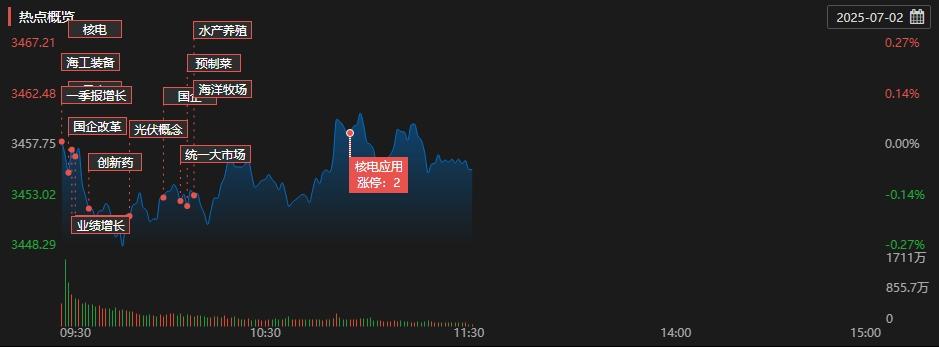
A股午评:创业板指半日跌0.84%,海工装备板块集体爆发
news flash· 2025-07-02 03:32
Market Overview - The three major A-share indices collectively declined in the morning session, with the Shanghai Composite Index down 0.04%, the Shenzhen Component Index down 0.42%, and the ChiNext Index down 0.84% [1] - The total market turnover for the half-day was 867.4 billion yuan, a decrease of 113.8 billion yuan compared to the previous day, with over 3,200 stocks declining [1] Sector Performance - The marine engineering, aquaculture, photovoltaic, and non-ferrous metal sectors showed the highest gains, while computing hardware, semiconductors, brain-computer interfaces, and diversified finance sectors experienced the largest declines [2] - The marine engineering sector saw a collective surge, with stocks like Deepwater Haina (300961), Dalian Heavy Industry (002204), and Shenkai Co. (002278) hitting the daily limit [2] - Photovoltaic concept stocks also rallied, with Yijing Optoelectronics (600537), Oujing Technology (001269), and Yamaton (002623) reaching the daily limit [2] - The banking sector remained active, with China Construction Bank and Shanghai Pudong Development Bank reaching new highs [2] - The non-ferrous metal sector was also active, with Jingyi Co. (002295) hitting the daily limit and Zijin Mining reaching a new high [2] - In contrast, computing hardware and semiconductor stocks collectively declined, with stocks like Blue Arrow Electronics (301348), Taiji Co. (300046), and Kexiang Co. (300903) leading the losses [2] - The diversified finance and digital currency sectors showed weakness, with Aijian Group (600643) hitting the daily limit down, and other stocks like Hongye Futures (001236), Cuiwei Co. (603123), and Lakala (300773) also declining [2] Notable Stocks - The strongest stocks included Chengbang Co. (603316) with five consecutive limits, and several stocks with three consecutive limits such as Kai Mei Teqi (002549) and Xuedilong (002658) [3][4] Hot Sectors - The marine engineering sector was the top performer with 11 stocks hitting the daily limit, while the nuclear power sector had 10 stocks hitting the daily limit [5][6] - The Belt and Road sector also had 10 stocks hitting the daily limit, with notable stocks including Kangda New Materials (002669) and Hailide (002206) [7] Sector Insights - The marine engineering sector is expected to benefit from the emphasis on high-quality development of the marine economy as highlighted in the Central Financial Committee's sixth meeting [10] - In the photovoltaic sector, a collective production cut of 30% by major glass manufacturers is anticipated to address supply-demand imbalances, with July's glass supply expected to decrease to 45GW [11] - The non-ferrous metal sector is influenced by renewed discussions on copper tariffs and low LME inventories, with expectations of copper prices remaining strong in the second half of the year [12]






第一创业晨会纪要-20250702
First Capital Securities· 2025-07-02 03:10
Macro Economic Group - The US manufacturing sector continues to contract, with the ISM manufacturing PMI for June at 49, indicating a decline for four consecutive months. New orders index dropped to 46.4, reflecting the largest decrease in three months [3][4] - Manufacturing output returned to expansion at 50.3 in June after three months of contraction, driven by domestic and export orders, although this improvement may be partly due to inventory accumulation in response to rising tariffs [3] - Employment index fell to 45, marking a three-month low, and the price index reached 69.7, indicating ongoing cost pressures for manufacturers [4] Industry Comprehensive Group - The Central Financial Committee's recent meeting emphasized the need for a unified national market and high-quality development of the marine economy, suggesting a potential delay in economic stimulus policies due to better-than-expected economic performance in the first half of the year [7] - The focus on regulating low-price competition among enterprises may enhance market expectations for reduced competition in highly saturated industries and increased policy support for the marine economy, potentially creating investment opportunities [7] Advanced Manufacturing Group - In June, China's heavy truck market saw wholesale sales of 92,000 units, a 4% month-on-month increase and a 29% year-on-year surge, indicating a recovery trend in the industry [10] - Electric heavy trucks have gained significant traction, with sales exceeding 15,000 units in June, representing over a 120% year-on-year growth, and a domestic penetration rate exceeding 24% [10][11] - The demand for heavy trucks is being driven by a vehicle replacement policy, although challenges remain in the freight market, including low prices and tight supply [11] Consumer Group - Jinbo Biological announced a targeted fundraising of 2 billion yuan, with strategic partnerships expected to enhance its market presence and production capabilities in the collagen protein sector [13] - The collaboration with Yangshengtang and the experience of Wan Tai Biological in international markets may facilitate Jinbo Biological's expansion and product commercialization [13]
事关海洋经济最新定调来了,多个省份已先行
Sou Hu Cai Jing· 2025-07-02 02:58
Group 1 - The central government emphasizes the need for high-quality development of the marine economy, focusing on top-level design, policy support, and encouraging social capital participation [2] - The meeting highlighted the importance of enhancing independent innovation capabilities in marine technology and fostering leading marine technology enterprises and specialized small and medium-sized enterprises [2] - Key areas for development include offshore wind power, modern deep-sea fishing, marine biomedicine, and creating marine cultural and tourism destinations [2] Group 2 - Recent high-level meetings have consistently prioritized the development of the marine economy, with specific goals set for 2024 and beyond [3] - Various provinces are actively implementing policies to boost marine economic development, with Guangdong and Shanghai leading initiatives to enhance marine industries and attract investment [4] - The northern, eastern, and southern marine economic circles in China are developing distinct advantages based on their resource endowments and industrial foundations [5]

格林大华期货早盘提示-20250702
Ge Lin Qi Huo· 2025-07-02 02:49
Group 1: Report Industry Investment Rating - The investment rating for the iron ore in the black building materials industry is "Oscillating Bullish" [1] Group 2: Core View of the Report - The iron ore market has a strong downward driving force in July, with the upper pressure level of the main contract rising to 738 and the support level at 690. Existing short positions should be held with stop - losses set [1] Group 3: Summary by Relevant Catalogs Market Review - On Tuesday, the main iron ore contract closed at 708.5, down 1.32%; the secondary main contract closed at 685.0, down 1.08%. It closed higher in the night session [1] Important Information - The Sixth Meeting of the Central Financial and Economic Commission studied issues such as promoting the construction of a unified national market and high - quality development of the marine economy, emphasizing governance of low - price and disorderly competition of enterprises, standardization of government procurement, and promotion of integrated development of domestic and foreign trade [1] - In June 2025, China's heavy - truck market sold about 92,000 vehicles (wholesale, including exports and new energy), a 4% month - on - month increase from May and a 29% year - on - year increase from 71,400 vehicles in the same period last year. It has seen three consecutive months of year - on - year growth since April, with the growth rate expanding monthly [1] - The third round and fourth batch of 8 central ecological and environmental protection inspection teams completed the on - site inspection phase in 5 provinces (Shanxi, Inner Mongolia, Shandong, Shaanxi, Ningxia) and 3 central enterprises [1] Market Logic - On Tuesday, the iron ore futures market declined significantly, weaker than the finished steel market, and stopped falling at night. The profit per ton of steel is about 100 yuan, some blast furnaces have resumed production but not at full capacity. The molten iron output remains above 2.4 million tons, close to the phased top and may decline later. The arrival and shipment volumes of iron ore decreased this period, and the port inventory decreased, releasing much inventory pressure [1] Trading Strategy - Hold existing short positions and set stop - losses [1]
万联晨会-20250702
Wanlian Securities· 2025-07-02 01:03
Core Insights - The A-share market showed mixed performance on Tuesday, with the Shanghai Composite Index rising by 0.39% and the Shenzhen Component Index increasing by 0.11%, while the ChiNext Index fell by 0.24% [2][6] - The total trading volume in the Shanghai and Shenzhen markets reached 14,658.05 billion [2][6] - In terms of industry performance, sectors such as comprehensive, pharmaceutical biology, and banking led the gains, while computer, retail, and telecommunications sectors lagged [2][6] - Concept sectors like China Shipbuilding, cell immunotherapy, and innovative drugs saw significant increases, whereas electronic ID, digital currency, and cross-border payment experienced declines [2][6] - The U.S. stock market showed mixed results, with the Dow Jones rising by 0.91%, while the S&P 500 and Nasdaq fell by 0.11% and 0.82%, respectively [2][6] Important News - The Central Financial Committee held its sixth meeting to discuss the deepening of the national unified market construction and the high-quality development of the marine economy, emphasizing the need for legal governance of low-price disorderly competition among enterprises and the promotion of integrated development of domestic and foreign trade [3][7] - The U.S. Senate passed the "Big and Beautiful" tax and spending bill, which will be sent to the House of Representatives, with President Trump expressing confidence in its passage [3][7]