
地缘政治风险

Search documents
印度雄心勃勃欲成造船大国
日经中文网· 2025-11-08 00:33
Core Viewpoint - The Indian maritime industry is rapidly developing, with a focus on expanding shipbuilding capabilities and increasing global market share, particularly as geopolitical risks prompt shipping companies to diversify their orders away from China [4][6]. Group 1: Industry Overview - Over 500 companies participated in the maritime exhibition in Mumbai, highlighting the global interest in strengthening maritime systems [4]. - The global shipbuilding market is dominated by China, South Korea, and Japan, which together account for over 90% of the market share, leaving India yet to establish a significant presence [2][10]. Group 2: Government Initiatives - The Indian government aims to transform the country into a global maritime hub, targeting an increase in the share of Indian ships in global freight from approximately 1% to 20% by 2047 [6]. - A support package worth 697.3 billion rupees (approximately 55.88 billion yuan) has been announced, which includes the establishment of a maritime development fund for shipbuilding and marine infrastructure [6]. Group 3: Company Developments - Cochin Shipyard, the largest shipbuilding company in India, has successfully delivered 70 small commercial vessels and is now focusing on international orders, having recently secured a contract for six container ships from CMA CGM [8][9]. - The company reported a sales increase of over 20% year-on-year for the fiscal year 2024, reaching approximately 50 billion rupees (around 4.01 billion yuan) [8]. Group 4: Market Dynamics - The geopolitical climate has led to increased risks associated with ordering ships from China, prompting shipping companies to seek alternatives, which benefits the Indian shipbuilding sector [9]. - The number of completed ships in India for the fiscal year 2023 is expected to reach around 200, tripling the figures from 2020 [9].


美联储报告:政策不确定性成头号金融稳定风险,央行独立性首次被点名,关注金融杠杆
Sou Hu Cai Jing· 2025-11-07 23:01
Core Viewpoint - The Federal Reserve's Financial Stability Report highlights policy uncertainty as the primary risk facing the U.S. financial system, with concerns shifting from specific trade policies to broader uncertainties, including central bank independence and the availability of economic data [1][2][3] Group 1: Policy Uncertainty - Over 61% of surveyed market participants identified policy uncertainty as the top financial stability risk, up from 50% in the spring survey [3] - The report marks the first time central bank independence has been explicitly mentioned as a risk factor, reflecting recent political pressures on the Fed [1][3] - Geopolitical risks have also gained attention, with 48% of respondents highlighting this concern, a significant increase from 23% in the previous survey [3] Group 2: Interest Rate Concerns - Concerns about rising long-term interest rates have increased, with 43% of respondents mentioning this risk, compared to just 9% in the spring survey [4] - Higher long-term rates could lead to unrealized losses for banks and impact fixed-income investors [4] Group 3: AI-Related Risks - The perception of AI-related asset valuation risks has risen sharply, with 30% of respondents viewing it as a potential shock in the next 12 to 18 months, up from 9% previously [4] Group 4: Leverage in Financial Institutions - The report emphasizes high leverage levels in non-bank financial institutions, particularly hedge funds, which have reached their highest levels since tracking began over a decade ago [7] - Hedge funds' leverage has steadily increased across various strategies, raising concerns about systemic risk [7] - Life insurance companies also exhibit high leverage, although their use of non-traditional liabilities remains limited [7] Group 5: Asset Valuation - Asset valuations are noted to be high, with stock price-to-earnings ratios nearing historical highs and corporate bond yield spreads at low levels compared to long-term averages [9] - The real estate market shows signs of vulnerability, particularly with upcoming refinancing needs in commercial real estate [9] Group 6: Debt Levels - Corporate and household debt vulnerabilities are assessed as moderate, with total debt as a percentage of GDP declining to a two-decade low [11] - While overall debt levels are manageable, certain consumer groups face repayment pressures, particularly in credit card and auto loans [11] Group 7: Financing Risks - Financing risks remain moderate, with government money market funds driving asset growth [12] - The commercial real estate market is showing signs of stabilization, but significant debt maturities in the coming year could increase volatility [12]
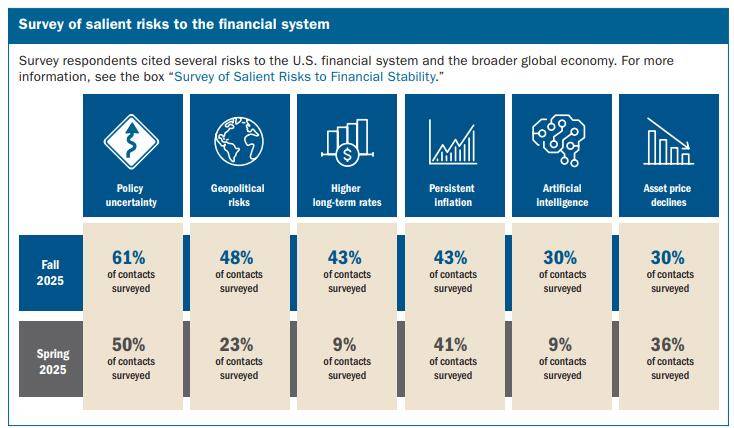
美联储金融稳定性报告:政治不确定性和地缘政治风险是最突出的稳定性顾虑
Sou Hu Cai Jing· 2025-11-07 21:18
Core Insights - The Federal Reserve's latest survey indicates that policy uncertainty, trade policy, central bank independence, and the availability of economic data are the most frequently mentioned risks to U.S. financial stability [1] - Respondents identified artificial intelligence (AI) as a primary concern for stability [1] - Other significant risks highlighted include geopolitical risks, inflation, monetary tightening, and higher long-term interest rates [1] - A shift in the current optimistic sentiment surrounding AI could lead to corrections in risk assets, potentially slowing the labor market and tightening financial conditions if the corrections are substantial [1]
美联储:政治不确定性和地缘政治风险是最突出的稳定性顾虑
Hua Er Jie Jian Wen· 2025-11-07 21:02
Core Viewpoint - The Federal Reserve identifies political uncertainty and geopolitical risks as the most prominent concerns for stability [1] Group 1 - The Federal Reserve's assessment highlights that political uncertainty is a significant factor affecting market stability [1] - Geopolitical risks are also noted as a critical concern that could impact economic conditions [1]
Policy uncertainty, geopolitical risk are top stability concerns in latest Fed survey
Reuters· 2025-11-07 21:01
Group 1 - Policy uncertainty, particularly regarding global trade and central bank independence, is a primary concern for financial stability [1] - Overall geopolitical risk is also highlighted as a significant factor affecting financial stability [1]

丰茂股份:公司将持续审慎评估并积极管理地缘政治风险
Zheng Quan Ri Bao Zhi Sheng· 2025-11-07 10:36
Core Viewpoint - The company emphasizes the importance of addressing geopolitical risks and has implemented several measures to ensure the stability and competitiveness of its overseas operations [1] Group 1: Measures to Address Geopolitical Risks - The company is advancing local production by constructing a production base in Thailand to increase overseas capacity and adapt to changes in international trade dynamics, thereby reducing potential tariffs and trade friction [1] - The company is optimizing its market layout, with a focus on diversifying its market strategy to reduce reliance on any single region, particularly in Europe and Southeast Asia [1] - The company is strengthening communication with customers and conducting ongoing analysis of global political, economic, and trade policy trends to enhance the foresight of its business decisions [1] Group 2: Commitment to Long-term Performance - The company is committed to continuously assessing and actively managing geopolitical risks to strive for long-term stable returns for investors [1]
贵金属策略报告-20251107
Shan Jin Qi Huo· 2025-11-07 10:27
Group 1: Report Investment Ratings - Not provided in the content Group 2: Core Views - The report expects precious metals to be volatile and strong in the short - term, oscillate at high levels in the medium - term, and rise in a stepped manner in the long - term. Gold price trends are the anchor for silver prices. In terms of silver, there are small increases in CFTC silver net - long positions and iShare silver ETF, and a slight decrease in recent visible silver inventories [1][6] Group 3: Summary by Directory Gold - **Core Logic**: In the short - term for hedging, the negative impact of the China - US talks has materialized, while risks such as a US government shutdown and geopolitical changes still exist. The US employment is weakening and inflation is moderate, so the expectation of the Fed's interest rate cut remains. In terms of the hedging attribute, the results and consensus of the China - US economic and trade consultations in Kuala Lumpur were announced, the US government shutdown reached 35 days, tying the longest record in history, and the US Supreme Court questioned the legitimacy of Trump's tariffs. Regarding the monetary attribute, private reports show a decrease in US employment positions in October and a surge in layoffs to a 22 - year high for the same period. The overall labor demand is still slowing down, and salary growth remains stagnant. The Fed's interest rate cut path has changed, and internal differences are intensifying. The market expects a 70% probability of a 25 - basis - point interest rate cut by the Fed in December. The US dollar index and US Treasury yields are under pressure and falling. For the commodity attribute, the CRB commodity index is oscillating weakly, and the appreciation of the RMB is negative for domestic prices [1] - **Data**: Comex gold主力合约收盘价 is $3984.80 per ounce, down $5.60 (-0.14%) from the previous day and down $53.50 (-1.32%) from the previous week. London gold is $3986.50 per ounce, up $18.30 (0.46%) from the previous day and down $7.65 (-0.19%) from the previous week. The closing price of SHFE gold主力 is 921.26 yuan per gram, up 3.46 yuan (0.38%) from the previous day and down 0.66 yuan (-0.07%) from the previous week. The closing price of gold T + D is 917.64 yuan per gram, up 0.13 yuan (0.01%) from the previous day and down 3.38 yuan (-0.37%) from the previous week. There are also data on positions, inventories, etc. [2] - **Strategy**: Conservative investors should wait and see, while aggressive investors can buy low and sell high. It is recommended to manage positions well and set strict stop - loss and take - profit levels [3] Silver - **Core Logic**: Gold price trends are the anchor for silver prices. There are small increases in CFTC silver net - long positions and iShare silver ETF, and a slight decrease in recent visible silver inventories [6] - **Data**: Comex silver主力合约收盘价 is $47.85 per ounce, down $0.02 (-0.03%) from the previous day and down $0.88 (-1.82%) from the previous week. London silver is $48.69 per ounce, up $1.08 (2.26%) from the previous day and up $0.51 (1.05%) from the previous week. The closing price of SHFE silver主力 is 11484 yuan per kilogram, up 57 yuan (0.50%) from the previous day and up 43 yuan (0.38%) from the previous week. The closing price of silver T + D is 11480 yuan per kilogram, up 59 yuan (0.52%) from the previous day and up 70 yuan (0.61%) from the previous week. There are also data on positions, inventories, etc. [7] - **Strategy**: Conservative investors should wait and see, while aggressive investors can buy low and sell high. It is recommended to manage positions well and set strict stop - loss and take - profit levels [7] Fundamental Key Data - **Fed - related**: The upper limit of the federal funds target rate is 4%, the discount rate is 4%, the reserve balance interest rate (IORB) is 3.9%, and the Fed's total assets are $66236.43 billion, down $167.70 billion (-0.00%) from the previous period. M2 year - on - year growth is 4.49%, up 0.01 percentage points from the previous period [9] - **Other Key Indicators**: The 10 - year US Treasury real yield is 2.39, up 0.02 (0.84%) from the previous day and up 0.04 (1.70%) from the previous week. The US dollar index is 99.71, down 0.45 (-0.45%) from the previous day and up 0.19 (0.19%) from the previous week. There are also data on US Treasury spreads, inflation, economic growth, labor market, real estate market, consumption, industry, trade, economic surveys, central bank gold reserves, and IMF foreign exchange reserve ratios [9][11][13]
贵金属日评:美国就业表现趋弱支撑贵金属价格-20251107
Hong Yuan Qi Huo· 2025-11-07 03:15
Report Summary 1. Report Industry Investment Rating - Not provided in the report. 2. Core Viewpoints - The weak employment performance in the US supports the prices of precious metals. The high number of corporate lay - offs in the US in October has increased the probability of a Fed rate cut in December. Along with factors such as the Fed providing liquidity, geopolitical risks, and central banks' gold - buying, precious metal prices may be supported [1]. 3. Summary by Related Catalogs Precious Metal Market Data - **Gold**: - Shanghai Gold futures' closing price was 917.80 yuan/g, with a change of 5.54 yuan compared to the previous day and - 4.12 yuan compared to the previous week. The trading volume was 238,433.00, a decrease of 157,531.00 from the previous day. The inventory remained at 87,816.00 (in ten - gram units) [1]. - COMEX gold futures' closing price was 3941.70 dollars/ounce, with a change of 43.10 dollars compared to the previous day and - 5.60 dollars compared to the previous week. The trading volume was 281,102.00, a decrease of 97,457.00 from the previous week [1]. - London gold spot price was 3968.20 dollars/ounce, with a change of - 20.20 dollars compared to the previous week [1]. - **Silver**: - Shanghai Silver futures' closing price was 11427.00 yuan/ten - gram, with a change of 151.00 yuan compared to the previous day and - 14.00 yuan compared to the previous week. The trading volume was 571,201.00, a decrease of 306,143.00 from the previous week [1]. - COMEX silver futures' closing price was 47.85 dollars/ounce, with a change of - 0.02 dollars compared to the previous day and 0.57 dollars compared to the previous week. The trading volume was 74,607.00, a decrease of 24,464.00 from the previous week [1]. - London silver spot price was 47.61 dollars/ounce, with a change of 0.51 dollars compared to the previous week [1]. Important Information - The direction of the Fed's December rate cut is unclear. This year's voting members are hesitant due to the government shutdown, and next year's members are more concerned about inflation. The Bank of England kept the interest rate at 4%, and the expectation of a December rate cut is rising [1]. - The AI revolution has accelerated the lay - off wave. In October, the number of Challenger corporate lay - offs in the US increased by 175.3% year - on - year, reaching the highest level in the same period in twenty years. The private data provider Revelio Labs reported a decrease of 9100 in non - farm employment in October [1]. Investment Strategy - Temporarily stay on the sidelines. For London gold, pay attention to the support level around 3580 - 3860 and the resistance level around 4180 - 4384; for Shanghai gold, focus on the support level around 830 - 860 and the resistance level around 950 - 1000. For London silver, pay attention to the support level around 39 - 42 and the resistance level around 50 - 55; for Shanghai silver, focus on the support level around 9400 - 10000 and the resistance level around 11600 - 12400 [1].
美欧制裁俄油企事件发酵 全球油气市场再掀波澜
Zhong Guo Hua Gong Bao· 2025-11-07 02:42
Group 1 - The Western sanctions against the Russian oil and gas industry continue, with the US and EU implementing new restrictions on Russian oil companies, impacting global oil trade flows [1][2] - The sanctions have led to a temporary increase in international oil prices, with NYMEX and ICE crude oil contracts rising by $3.29 and $3.40 respectively on October 23, but prices have since retraced significantly [2][5] - India's oil imports from Russia are expected to be affected, with a slight decrease projected for 2025, but overall imports remain significantly higher than in 2022 [2][3] Group 2 - Indian refiners are likely to comply with the sanctions, but the government is seeking alternatives to replace the 1.75 million barrels per day of Russian oil, which could impact global oil prices [3][4] - The Indian refining sector has begun adjusting its crude import structure, increasing imports from Colombia, Canada, and the Middle East while reducing Russian oil imports [3][4] - OPEC+ has decided to pause production increases in the first quarter of 2026 after a slight increase in December, reflecting concerns over global supply-demand balance amid geopolitical risks [4][5] Group 3 - OPEC+ aims to balance market share and oil prices, having restored 2.7 million barrels per day of production since April, but faces challenges from US shale oil production [4][5] - There is a significant divergence in forecasts between OPEC and the International Energy Agency regarding global oil demand and supply, indicating uncertainty in the market [5]
贵金属策略报告-20251106
Shan Jin Qi Huo· 2025-11-06 09:53
1. Report Industry Investment Rating No relevant content provided. 2. Core Viewpoints of the Report - The report predicts that precious metals will be volatile and strong in the short - term, oscillate at high levels in the medium - term, and rise step - by - step in the long - term [1]. - The price trend of gold is the anchor for the price of silver. In terms of funds, the net long position of CFTC silver and iShare silver ETF have slightly increased. In terms of inventory, the recent explicit inventory of silver has slightly decreased [6]. 3. Summary by Related Catalogs Gold Core Logic - In the short - term, although the negative impact of the China - US talks has been realized, risks such as geopolitical changes and the US government shutdown still exist. The US employment is weakening and inflation is moderate, and the market's expectation of the Fed's interest rate cut is slowing down [1]. - The results and consensus of the China - US economic and trade consultations in Kuala Lumpur have been announced. The US government shutdown has reached 35 days, tying the longest record in history. The US Supreme Court questions the legitimacy of Trump's tariffs, focusing on whether the authorization of the "Emergency State Law" has been abused [1]. - The path of the Fed's interest rate cut has changed, and internal differences are intensifying. Many Fed officials have expressed concerns about the possibility of another interest rate cut in December in different forms. ADP employment data shows that the overall labor demand is still slowing down, and wage growth has been stagnant, adding uncertainty to whether the Fed will continue to cut interest rates in December. The Fed cut interest rates by 25 basis points as expected in October, lowering the federal funds rate to 3.75% - 4.00%, the second interest rate cut this year, and announced the end of the balance - sheet reduction as of December 1. Fed Chairman Powell said that whether to further cut interest rates in December is "far from a foregone conclusion", and the data loss caused by the government shutdown may affect subsequent decisions. Currently, the market expects the probability of the Fed cutting interest rates by 25 basis points in December to remain at around 70%. The US dollar index and US Treasury yields have fallen under pressure [1]. - The CRB commodity index is oscillating weakly, and the appreciation of the RMB is negative for domestic prices [1]. Strategy - For conservative investors, it is recommended to wait and see. For aggressive investors, it is recommended to sell high and buy low. Good position management should be done, and strict stop - loss and take - profit should be set [1][3][7]. Data - International prices: The closing price of the Comex gold main contract is $3990.40 per ounce, up $49.10 (1.25%) from the previous day and up $48.70 (1.24%) from last week. The price of London gold is $3968.20 per ounce, up $17.10 (0.43%) from the previous day and down $38.50 (- 0.96%) from last week [2]. - Domestic prices: The closing price of the Shanghai gold main contract on the Shanghai Futures Exchange is 917.80 yuan per gram, up 5.54 yuan (0.61%) from the previous day and up 5.64 yuan (0.62%) from last week. The closing price of gold T + D on the Shanghai Gold Exchange is 917.51 yuan per gram, up 7.98 yuan (0.88%) from the previous day and up 10.23 yuan (1.13%) from last week [2]. - Other data such as basis, spreads, ratios, positions, inventories, CFTC management fund net positions, and gold ETFs are also provided [2]. Silver Core Logic - The price trend of gold is the anchor for the price of silver. In terms of funds, the net long position of CFTC silver and iShare silver ETF have slightly increased. In terms of inventory, the recent explicit inventory of silver has slightly decreased [6]. Strategy - For conservative investors, it is recommended to wait and see. For aggressive investors, it is recommended to sell high and buy low. Good position management should be done, and strict stop - loss and take - profit should be set [7]. Data - International prices: The closing price of the Comex silver main contract is $47.86 per ounce, up $0.96 (2.06%) from the previous day and up $0.59 (1.24%) from last week. The price of London silver is $47.61 per ounce, down $0.15 (- 0.31%) from the previous day and down $0.56 (- 1.17%) from last week [7]. - Domestic prices: The closing price of the Shanghai silver main contract on the Shanghai Futures Exchange is 11427.00 yuan per kilogram, up 151.00 yuan (1.34%) from the previous day and up 174.00 yuan (1.55%) from last week. The closing price of silver T + D on the Shanghai Gold Exchange is 11421.00 yuan per kilogram, up 181.00 yuan (1.61%) from the previous day and up 224.00 yuan (2.00%) from last week [7]. - Other data such as basis, spreads, positions, inventories, CFTC management fund net positions, and silver ETFs are also provided [7]. Fundamental Key Data - Federal Reserve: The upper limit of the federal funds target rate is 4.00%, the discount rate is 4.00%, the reserve balance interest rate (IORB) is 3.90%, the Fed's total assets are $66371.78 billion, M2 (year - on - year) is 4.49% [9]. - US Treasury bonds and dollar: The real yield of the 10 - year US Treasury bond is 2.43%, the US dollar index is 100.16, and various US Treasury bond spreads and interest rate differentials are also provided [9][10]. - US economy: GDP (annualized year - on - year) is 2.00%, GDP (annualized quarter - on - quarter) is 3.80%, the unemployment rate is 4.30%, and other economic data such as employment, consumption, industry, and real estate are also provided [9][10]. - Central bank gold reserves, IMF foreign exchange reserve ratios, gold/foreign exchange reserve ratios, geopolitical risk index, VIX index, CRB commodity index, and offshore RMB data are also provided [10]. Fed's Latest Interest Rate Expectations - The probability distribution of different interest rate ranges at different meeting dates from December 2025 to October 2027 is provided according to the CME FedWatch tool [12].