
两会政策

Search documents
宏观金融类:文字早评2026/03/02-20260302
Wu Kuang Qi Huo· 2026-03-02 02:21
Report Industry Investment Rating No specific industry investment rating is provided in the report. Core Viewpoints - In the short term, the market may continue to be in a period of oscillation and volatility reduction, suppressing the overall atmosphere. The black sector remains in a weak state and is likely to be short - sold. However, in the medium to long term, commodity bulls are expected to continue [35][42]. - Geopolitical conflicts in the Middle East, such as the US - Israel military strikes on Iran, have become a core driver for short - term price movements in precious metals, crude oil, and other commodities. The development of the situation will significantly impact prices [8][12][14]. - For different industries, specific supply - demand relationships, cost factors, and policy expectations will affect price trends. For example, in the metals industry, factors like supply disruptions and downstream demand recovery are crucial; in the energy and chemical industry, supply - demand balance and cost changes play important roles; in the agricultural products industry, factors such as production, consumption, and trade policies are key [12][14][78]. Summary by Directory Macro - finance Stock Index - **Market Information**: Military conflicts between the US and Iran, OPEC's production increase plan, new developments in large - scale models, and the militarization of artificial intelligence are the main factors affecting the stock index [2]. - **Strategy Viewpoint**: Amid the US - Iran conflict and the strong appreciation of the RMB exchange rate driving foreign capital inflows, it is recommended to pay attention to domestic two - sessions policy signals and changes in the war situation. The strategy is to buy on dips [4]. Treasury Bonds - **Market Information**: Military conflicts between Israel and Iran, Trump's plan to negotiate with Iran, and the central bank's reverse repurchase operations [5]. - **Strategy Viewpoint**: Inflation recovery may potentially suppress the bond market, and the endogenous power of economic recovery is not yet stable. The short - term safe - haven sentiment in the market due to the US - Iran conflict is beneficial for the bond market, but the subsequent trend depends on the intensity and duration of the conflict. The bond market is expected to continue to oscillate [7]. Precious Metals - **Market Information**: Geopolitical conflicts in the Middle East have led to price increases in precious metals. The price trend depends on the development of the war [8]. - **Strategy Viewpoint**: The opening prices of gold and silver are expected to gap up. If the war expands, the upward trend may continue; if the situation eases, prices are likely to return to high - level consolidation. A short - term long - position strategy is recommended [9]. Non - ferrous Metals Copper - **Market Information**: Geopolitical concerns have led to a mixed performance in copper prices. LME and domestic inventories have changed, and the basis has adjusted [11]. - **Strategy Viewpoint**: Geopolitical factors and supply - side constraints support copper prices. With the improvement of downstream operating rates, the inventory accumulation rate is expected to slow down. Short - term copper prices are strongly supported but with increased volatility [12]. Aluminum - **Market Information**: Geopolitical factors have caused aluminum prices to oscillate. Inventory and basis have changed [13]. - **Strategy Viewpoint**: Although domestic aluminum ingot inventories are at a relatively high level, they are expected to peak earlier than in previous years. Geopolitical risks increase the supply risk in the Middle East, and aluminum prices are strongly supported but with increased volatility [14]. Zinc - **Market Information**: Zinc prices have shown a slight increase. Domestic and foreign inventories and basis have changed [15]. - **Strategy Viewpoint**: The domestic zinc industry is weak. Zinc prices may follow the upward trend of copper and aluminum prices due to relative valuation [15]. Lead - **Market Information**: Lead prices have shown a slight increase. Domestic and foreign inventories and basis have changed [16]. - **Strategy Viewpoint**: Although lead inventories have increased significantly, the current price is at the lower end of the oscillation range. The narrowing of smelting profits may reduce the surplus of lead ingots. Short - term lead prices are expected to stop falling and gradually recover [16]. Nickel - **Market Information**: Nickel prices have shown a slight decline. Spot prices and cost factors have changed [17]. - **Strategy Viewpoint**: In the medium term, nickel prices are expected to rise slowly due to the reduction of RKAB quotas in Indonesia. In the short term, prices are expected to oscillate to digest inventory pressure. A buy - on - dips strategy is recommended [17]. Tin - **Market Information**: Tin prices have risen significantly. Supply - side concerns and demand - side recovery are the main factors [18]. - **Strategy Viewpoint**: Although the market has a strong sentiment to go long on tin prices, the supply - demand situation is marginally loose, and inventories are rising. It is not advisable to blindly chase the high. Tin prices are expected to oscillate widely. A wait - and - see strategy is recommended [19]. Lithium Carbonate - **Market Information**: Lithium carbonate prices have shown a slight decline. Spot and futures prices have changed [20]. - **Strategy Viewpoint**: The inventory of lithium carbonate has been depleted during the Spring Festival, and the downstream demand is resilient. The short - term supply is expected to be tight. However, if the export ban on lithium concentrate in Zimbabwe is lifted, the impact on domestic supply may be limited. Attention should be paid to downstream stocking rhythm and market sentiment [20]. Alumina - **Market Information**: Alumina prices have declined. Inventory and basis have changed [21]. - **Strategy Viewpoint**: The increase in maintenance and the delay in production start - up have led to a contraction in inventory accumulation. The high - level of warehouse receipts registration due to the premium on the futures market suppresses the upward movement of prices. A wait - and - see strategy is recommended [22]. Stainless Steel - **Market Information**: Stainless steel prices have declined. Inventory and basis have changed [23]. - **Strategy Viewpoint**: The supply - side pressure has increased due to the arrival of steel mill resources after the festival. Although the market procurement atmosphere has improved, the actual demand from downstream users is still low. Stainless steel prices are expected to oscillate upward [24]. Cast Aluminum Alloy - **Market Information**: Cast aluminum alloy prices have shown a slight increase. Inventory and basis have changed [25]. - **Strategy Viewpoint**: The cost of cast aluminum alloy is relatively high, and the demand is expected to improve with the resumption of production after the festival. Short - term prices are expected to rise [26]. Black Building Materials Steel - **Market Information**: Steel prices have shown a slight increase. Inventory and basis have changed [28]. - **Strategy Viewpoint**: The overall sentiment in the commodity market is positive, but the transmission of policies to the construction end takes time. The fundamentals of the black sector are weaker than expected before the festival. Steel prices are expected to oscillate weakly in the short term. Attention should be paid to factors such as construction site resumption rates, policy signals, and supply - side constraints [29]. Iron Ore - **Market Information**: Iron ore prices have shown a slight increase. Inventory and basis have changed. Steel mills have received emission reduction notices during important meetings [30]. - **Strategy Viewpoint**: Overseas supply has recovered after the end of weather - related impacts, and high inventories suppress price increases. The demand for iron ore is recovering, but the production of molten iron may be affected during important meetings. Iron ore prices are expected to oscillate weakly [31]. Coking Coal and Coke - **Market Information**: Coking coal prices have shown a slight increase, and coke prices have declined. Inventory and basis have changed [32]. - **Strategy Viewpoint**: After the festival, downstream users are in the active de - stocking stage, and coal production is gradually recovering. Coking coal and coke prices are expected to oscillate weakly in the short term. However, coking coal may have a relatively smooth upward trend in the second half of the year [34][35]. Glass and Soda Ash - **Glass** - **Market Information**: Glass prices have declined. Inventory has increased significantly, and the demand is weak [37]. - **Strategy Viewpoint**: The supply of the glass market is stable, but the demand is weak, and the inventory is high. Glass prices are expected to oscillate weakly in the short term [38]. - **Soda Ash** - **Market Information**: Soda ash prices are stable. Inventory has increased, and the demand is weak [39]. - **Strategy Viewpoint**: The supply of soda ash is relatively stable, and the demand is slow to recover. Soda ash prices are expected to oscillate within a narrow range [39]. Manganese Silicon and Ferrosilicon - **Market Information**: Manganese silicon and ferrosilicon prices have increased. Inventory and basis have changed [40]. - **Strategy Viewpoint**: The increase in iron alloy prices is mainly driven by market speculation and policy expectations. In the long term, the commodity market is expected to be bullish, but the short - term market may oscillate. The future trend of manganese silicon and ferrosilicon depends on the overall market sentiment and cost factors [42][43]. Industrial Silicon and Polysilicon - **Industrial Silicon** - **Market Information**: Industrial silicon prices have shown a slight increase. Inventory and basis have changed [44]. - **Strategy Viewpoint**: The supply and demand of industrial silicon are expected to increase in March. Prices are expected to oscillate. Attention should be paid to the resumption of production of large - scale factories in the northwest and downstream demand changes [45]. - **Polysilicon** - **Market Information**: Polysilicon prices have shown a slight increase. Inventory and basis have changed [46]. - **Strategy Viewpoint**: The production of polysilicon is expected to increase in March, but the inventory is still high, and the demand feedback is not good. Polysilicon prices are expected to be under pressure. A wait - and - see strategy is recommended [47]. Energy and Chemicals Rubber - **Market Information**: Due to the US - Iran conflict, the prices of crude oil and naphtha are expected to rise, driving up the price of butadiene rubber futures. The natural rubber market has both bullish and bearish factors [49]. - **Strategy Viewpoint**: It is recommended to trade short - term according to the market, set stop - losses, and enter and exit quickly. For hedging, it is recommended to open new positions or continue to hold positions by buying the NR main contract and shorting the RU2609 contract [52]. Crude Oil - **Market Information**: Crude oil prices have risen, and the inventory of refined oil products has changed [53]. - **Strategy Viewpoint**: The current oil price has already factored in a high geopolitical premium. It is recommended to take profits on rallies and focus on medium - term layout [54]. Methanol - **Market Information**: Methanol prices have declined. Inventory and basis have changed [55]. - **Strategy Viewpoint**: The downward momentum of methanol still exists, but the negative factors have weakened. It is recommended to go long on dips in the medium - term [56]. Urea - **Market Information**: Urea prices have shown a slight increase. Inventory and basis have changed [58]. - **Strategy Viewpoint**: The import window for urea has opened, and the fundamentals are expected to be negative. It is recommended to short - sell [59]. Pure Benzene and Styrene - **Market Information**: The prices of pure benzene and styrene have declined. Inventory and basis have changed [60]. - **Strategy Viewpoint**: The non - integrated profit of styrene is neutral to high, and the upward repair space of valuation is narrowing. It is recommended to gradually take profits [61]. PVC - **Market Information**: PVC prices have declined. Inventory and basis have changed [62]. - **Strategy Viewpoint**: The supply of PVC is strong, and the demand is weak. The domestic market is in a situation of oversupply, and the fundamentals are poor [63][64]. Ethylene Glycol - **Market Information**: Ethylene glycol prices have shown a slight increase. Inventory and basis have changed [65]. - **Strategy Viewpoint**: The overall load of ethylene glycol is still high, and the port inventory is under pressure. There is an expectation of further profit compression and load reduction. However, due to geopolitical factors and coal price rebounds, there is a risk of price rebound [66]. PTA - **Market Information**: PTA prices have declined. Inventory and basis have changed [67]. - **Strategy Viewpoint**: PTA is difficult to enter the de - stocking cycle. The processing fee has declined, but there is still room for valuation increase. It is recommended to go long on dips following PX in the medium - term [68]. p - Xylene - **Market Information**: p - Xylene prices have increased. Inventory and basis have changed [69]. - **Strategy Viewpoint**: p - Xylene is currently in a stock - accumulation stage, but it will gradually enter the de - stocking cycle in March. The supply - demand structure of p - Xylene and PTA is relatively strong, and it is recommended to go long on dips following crude oil in the medium - term [71]. Polyethylene (PE) - **Market Information**: PE prices have declined. Inventory and basis have changed [72]. - **Strategy Viewpoint**: The OPEC+ "moderate production increase" has led to an oscillating oil price. The PE valuation has room to decline, but the pressure on the disk has been reduced. The demand is expected to rebound after the Spring Festival [73]. Polypropylene (PP) - **Market Information**: PP prices have declined. Inventory and basis have changed [74]. - **Strategy Viewpoint**: The supply pressure of PP has been relieved, and the demand is expected to rebound seasonally. The overall inventory pressure may be alleviated. It is recommended to go long on the PP5 - 9 spread on dips [76]. Agricultural Products Live Pigs - **Market Information**: Pig prices have declined. The market is in a situation of oversupply [78]. - **Strategy Viewpoint**: The near - term pig prices are still bearish after the rebound, while the far - term prices are slightly bullish but with limited upside space. It is recommended to use reverse arbitrage or wait for the price to fall and then buy [79]. Eggs - **Market Information**: Egg prices are stable. The supply is high, and the demand may increase in the short term but decrease later [80]. - **Strategy Viewpoint**: The inventory of laying hens is large, and the behavior of delaying culling and feather replacement may weaken the medium - term price increase potential. Attention should be paid to the valuation pressure on the far - term disk [81]. Soybean and Rapeseed Meal - **Market Information**: US soybean exports, Brazilian soybean harvest progress, and domestic soybean inventory have changed [82]. - **Strategy Viewpoint**: The market rumor of an extended customs clearance time for South American soybeans has driven up the price of soybean meal. The protein meal price may be bottoming out due to increased import costs [83]. Oils and Fats - **Market Information**: The export and production of palm oil in Indonesia and Malaysia have changed, and the inventory of vegetable oils in China and India has decreased [84]. - **Strategy Viewpoint**: The short - term soybean oil price is stronger than that of palm oil and rapeseed oil. The geopolitical crisis may drive up the oil price. The medium - term outlook for oils and fats is bullish. It is recommended to wait for the price to stop falling at a low level and then buy [85]. Sugar - **Market Information**: The sugar production in India, Brazil, and Thailand has changed, and the import volume of sugar in China has increased [86]. - **Strategy Viewpoint**: The current raw sugar price is at a historical low, and there is a possibility of reducing the sugar - making ratio in Brazil after April. It is not advisable to be overly bearish. The domestic sugar price may rebound. It is recommended to participate in long positions on dips [87]. Cotton - **Market Information**: US cotton exports, domestic cotton inventory, and global cotton production and consumption have changed [88]. - **Strategy Viewpoint**: The Zhengzhou cotton futures have increased significantly after the festival. It is recommended to focus on the downstream operating rate in March. If it cooperates, the cotton price still has room to rise. A buy - on - dips strategy is recommended [91].
策略周报:两会前后市场如何演绎?
Guoxin Securities· 2026-02-28 10:50
Market Performance Insights - Historical data shows a high probability of market gains before and after the Two Sessions, with the probability of increase being 76.2% for the Shanghai Composite Index in the 20 trading days before the sessions[19] - The average gain for the Shanghai Composite Index before the Two Sessions is 1.8%, while the average gain after is 3.1%[20] - The probability of small-cap stocks outperforming large-cap stocks is nearly 90% before the Two Sessions, but drops to 50% afterward[20] Sector Analysis - Resource sectors such as steel and non-ferrous metals have shown high probabilities of gains before the Two Sessions, with probabilities exceeding 80%[22] - Consumer sectors tend to perform better during the Two Sessions, with a 60% probability of gains in industries like food and beverage[20] - Post-Two Sessions, real estate and consumer sectors have a high probability of gains, with real estate at 76.2%[20] Policy Impact - The Two Sessions serve as a critical window for observing economic policy directions, influencing market sentiment and performance[24] - Pre-Two Sessions, there is typically an increase in growth-stabilizing policy expectations, leading to active trading[24] - Post-Two Sessions, the acceleration of policy implementation often boosts optimistic market expectations, particularly for cyclical sectors[24] Current Market Conditions - The spring market rally continues, with the Shanghai Composite Index showing a 3.7% increase since February 3, and a recent weekly gain of 2.0%[1] - Recent trading volumes have increased, with average daily trading rising from 2.1 trillion to 2.4 trillion yuan[1] - Leverage funds have shifted from outflows to inflows, indicating improved market sentiment, with net purchases reaching 258.7 billion yuan recently[1] Investment Strategy - A balanced allocation strategy is recommended, focusing on sectors like AI applications, resources, and real estate, given the current market dynamics[29] - The anticipated continuation of the spring rally is supported by positive macroeconomic policies and increased liquidity in the market[28] - The focus on expanding domestic demand is expected to be a key theme in the upcoming Two Sessions, influencing investment opportunities[24]
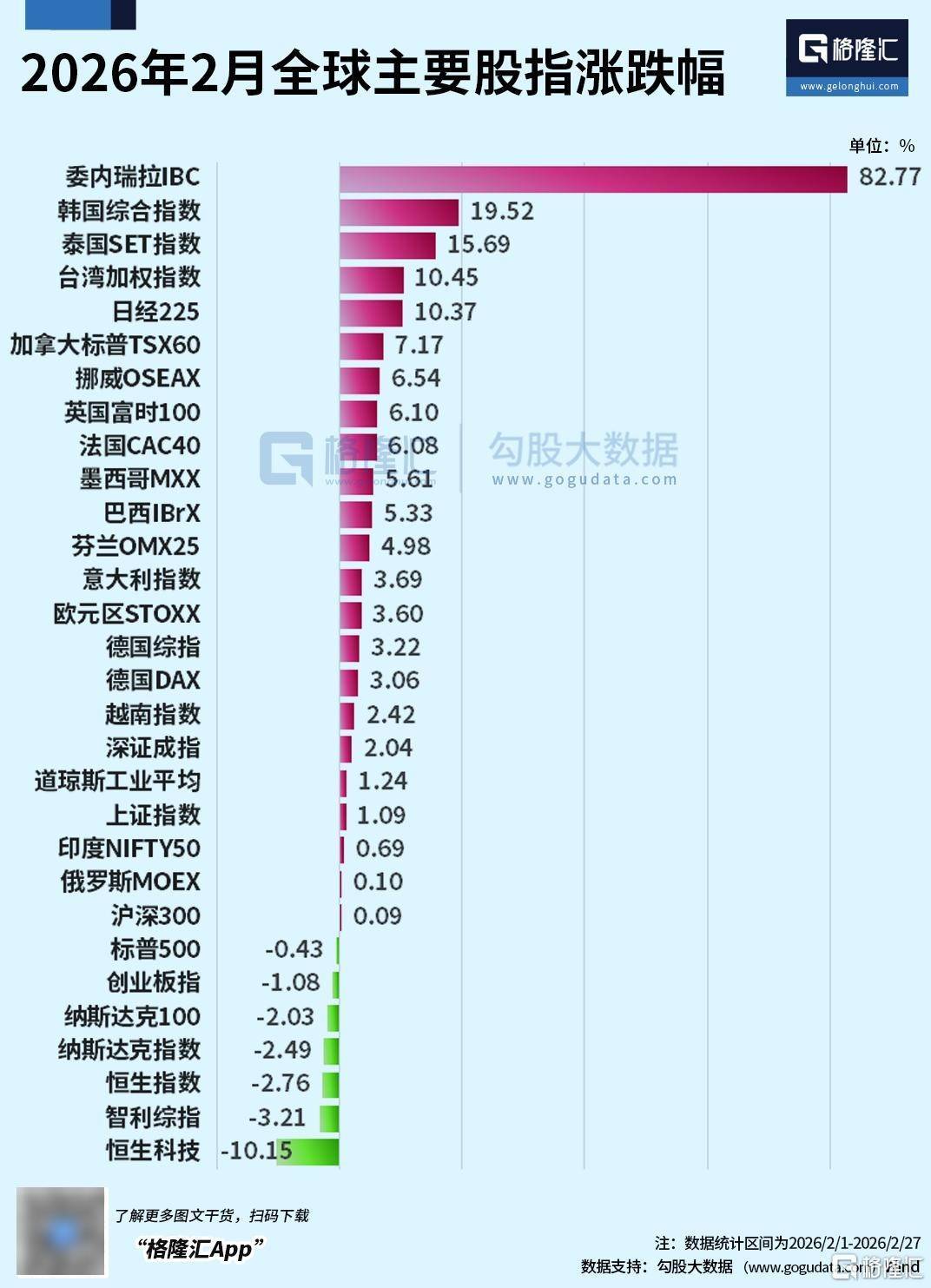
2月收官!委内瑞拉暴涨82%夺冠,港股科技股“熄火”
Sou Hu Cai Jing· 2026-02-27 14:49
Group 1 - The A-share market showed mixed performance in February, with the Shanghai Composite Index rising 1.09% to close at 4162 points, while the Shenzhen Component Index increased by 2.04% to 14495 points, and the ChiNext Index fell by 1.08% to 3310 points [4] - The Hong Kong stock market experienced a significant decline, with the Hang Seng Technology Index dropping 10.15%, marking its lowest point since July of the previous year, and the Hang Seng Index falling 2.76% to 26630 points [10] - In the A-share market, four stocks doubled in value, with notable increases including Electric Science Blue Sky at 640.97% and Aide Technology at 153.46% [4][7] Group 2 - The top-performing sectors in the A-share market over the last 20 trading days included Comprehensive with an 18.4% increase, Steel at 10.02%, and Building Materials at 8.15%, while the worst-performing sectors were Media down 4.95%, Retail down 3.54%, and Non-bank Financials down 3.33% [5] - In the Hong Kong market, the top five performing stocks included Zhipu with a 154.2% increase and Junyu Foundation at 80.65%, while the worst performers included Wuyi Vision down 40.99% and Meitu down 26.68% [10] Group 3 - Looking ahead, several brokerages expect the A-share market to remain active in March, with a focus on policy developments during the Two Sessions and opportunities in the technology sector [11][12] - For the Hong Kong market, expectations are for continued volatility, influenced by A-share movements and external factors such as the Federal Reserve's interest rate decisions and the upcoming Two Sessions [13]

铁矿石:需求驱动偏弱,短期建议空配
Hua Bao Qi Huo· 2026-02-27 08:17
1. Report Industry Investment Rating - The report suggests short - term under - allocation for iron ore [2][3] 2. Core View of the Report - The short - term macro - economic outlook is weak, the supply - demand contradiction of iron ore continues to accumulate, supply remains high year - on - year, and iron ore demand is still restricted by industrial chain profits and production restrictions during the conference. It is recommended to focus on short - term under - allocation [3] 3. Summary by Relevant Catalogs Supply - The overall overseas ore shipments have emerged from the off - season, with a significant increase in the weekly shipment volume this period. The off - season shipments this year have shown above - seasonal growth, and overseas ore shipments are at the highest level in the same period of the past five years. The supply of domestic ore is also expected to enter a seasonal recovery cycle. Overall, the supply side has entered a high - shipment stage, providing a downward driving force [3] Demand - Domestic iron ore demand mainly depends on the profit level of steel mills and the degree of steel inventory reduction. Due to the relatively high temperature this year, construction site starts may be advanced, and the market still has a certain optimistic expectation for demand. In the short term, the probability of super - expected growth in terminal demand is low. Later, attention should be paid to the steel inventory reduction node and the intensity of resumption of work. According to the seasonal law, hot metal has entered a recovery cycle, and later more attention should be paid to the recovery speed and height. From the current profit level of steel mills and demand expectation, the recovery speed remains relatively gentle. Coupled with the impact of production restrictions on steel mills in North China during the Two Sessions, the upward driving force of demand is weak [3] Inventory - Steel mills still have restocking demand after the Spring Festival, but the intensity and sustainability of restocking still depend on the recovery of terminal demand. Judging from the current port clearance level, port inventories will still be in a cumulative state. Coupled with the weakening of spot prices, it is expected that the pressure of short - term port inventory accumulation will remain high. At the same time, attention should be paid to the potential selling risk of restricted - trade inventories. The inventory driving force is downward [3] Price - The expected price range is 93 - 100 US dollars per ton (61% index), corresponding to 710 - 760 yuan per ton for Dalian iron ore futures [3] Strategy - Conduct range trading and sell call options [3]
宝城期货股指期货早报(2026年2月27日)-20260227
Bao Cheng Qi Huo· 2026-02-27 01:29
Report Summary 1. Report Industry Investment Rating No information provided. 2. Core Viewpoints - The short - term view of IH2603 is to oscillate, the medium - term view is to oscillate, and the intraday view is bullish, with an overall view of oscillatory consolidation due to the increasing expectation of policy benefits [1]. - For IF, IH, IC, and IM, the intraday view is bullish, the medium - term view is oscillatory, and the reference view is oscillatory consolidation. In the short - term, the stock index runs with a bullish bias [5]. 3. Summary by Related Catalogs 3.1 Variety Viewpoint Reference - Financial Futures Stock Index Sector | Variety | Short - term | Medium - term | Intraday | Viewpoint Reference | Core Logic Summary | | --- | --- | --- | --- | --- | --- | | IH2603 | Oscillate | Oscillate | Bullish | Oscillatory consolidation | Rising expectation of policy benefits [1] | 3.2 Main Variety Price Market Driving Logic - Financial Futures Stock Index Sector - Yesterday, all stock indices oscillated in a narrow range. The trading volume of the Shanghai, Shenzhen, and Beijing stock markets was 2556.6 billion yuan, an increase of 75.7 billion yuan from the previous day [5]. - As the Two Sessions policy time window approaches, the risk appetite of the stock market has recovered, and the trading volume has gradually increased. However, as the stock index approaches the previous high, the upward momentum has weakened in the short term [5]. - In the long - term, the expectation of policy benefits and the continuous net inflow of incremental funds into the stock market remain unchanged, which constitutes the main logic for the long - term upward movement of the stock index. The macro - policy support and the determination to support technological innovation can stabilize the macro - demand expectation, promote industrial transformation and upgrading, and improve the profit margin of listed companies. The asset allocation function of A - shares is gradually improving, which will continuously attract incremental funds into the stock market [5].
金融期货早评-20260212
Nan Hua Qi Huo· 2026-02-12 02:47
1. Report Industry Investment Rating No relevant content provided. 2. Core Views of the Report - The latest price data in January 2026 in China shows a mild recovery at a low level with structural differentiation, while the non - farm data in the US in January greatly exceeded expectations, leading to an adjustment of the market's expectations for the Fed's interest rate cuts. Domestic price repair depends on the optimization of "new supply" and the unblocking of the transmission chain in the middle and lower reaches. The economic opportunities from the visit and domestic growth - stabilizing policies may lead to a valuation repair of pro - cyclical sectors [2]. - In the short term, for the RMB exchange rate, pre - holiday seasonal settlement demand may support the RMB's appreciation, but after the holiday, its endogenous appreciation power may decline, and its linkage with the US dollar index may increase [3]. - For the stock index, the Fed's interest rate cut rhythm may be postponed, putting pressure on the stock index before the holiday. After the holiday, there may be opportunities for the IC contract [7]. - For the bond market, it is recommended to be cautious before the holiday, with a small amount of medium - term long positions in T2606 and to exit the March contract at high prices [8]. - For the container shipping European line, the market is in a small - scale shock, and funds are cautious. The spot price decline has slowed down, but there are still uncertainties in the market [11][12]. - For new energy products, the spot market for lithium carbonate is trading lightly, and it is recommended to sell volatility strategies before the holiday. For industrial silicon and polysilicon, due to high inventory, it is recommended to hold a light position or be empty before the holiday [15][17]. - For non - ferrous metals, aluminum, alumina, and cast aluminum alloy may be in a shock adjustment. Copper may be weak in its rebound, zinc may be in a shock, nickel - stainless steel may be affected by quota disturbances, tin may be adjusted in a wide - range shock, and lead may fluctuate weakly [20][26][28]. - For oilseeds and fats, for oilseeds, there are few unilateral opportunities, and it is recommended to pay attention to reverse arbitrage opportunities. For fats, the domestic market has limited driving forces and is expected to be in a shock before the holiday [31][33]. - For energy and oil and gas, for fuel oil and low - sulfur fuel oil, due to geopolitical uncertainties, it is recommended to control positions before the holiday. For asphalt, its price may follow the cost - end crude oil, and there may be a decline after the holiday [35][37][39]. - For precious metals, for platinum and palladium, the long - term bull market foundation still exists, and it is recommended to buy in steps at low prices and control positions. For gold and silver, the long - term upward trend remains, and it is recommended to reduce or empty positions before the holiday [43][45]. - For chemical products, for pulp and offset paper, it is recommended to conduct range trading. For pure benzene - styrene, pay attention to cost - end fluctuations. For LPG, pay attention to geopolitical uncertainties. For PTA - PX, it is advisable to buy at low prices. For MEG - bottle chips, it is expected to fluctuate in a wide range. For methanol, it is recommended to be empty before the holiday. For plastics and PP, the short - term driving force is limited, and it is expected to be in a shock before the holiday. For rubber, it is recommended to hold a light position before the long holiday, and it is expected to be in a range - bound shock. For urea, it is recommended to be empty before the holiday. For glass and soda ash, it is recommended to wait and see before the holiday. For propylene, pay attention to cost and risk [51][54][57][62][65][67][69][80][82][83][86]. - For black products, for rebar and hot - rolled coils, the price may be in a weak shock. For iron ore, it is advisable to wait and see cautiously before the holiday. For coking coal and coke, pay attention to the resumption rhythm after the holiday. For ferrosilicon and ferromanganese, they are in a bottom - shock state [88][91][94][95]. - For agricultural and soft commodities, for live pigs, it is recommended to go long on the 05 contract. For cotton, it is expected to be in a shock in the short term. For sugar, the upward space is limited. For eggs, the main contract is expected to decline in a shock. For rubber, it is recommended to hold a light position before the long holiday and is expected to be in a range - bound shock. For apples, the short - term demand weakens, but the decline space is limited. For red dates, the short - term price may be in a low - level shock, and the long - term price is under pressure. For logs, it is recommended to wait and see [99][100][103][104][111][113][114][116]. 3. Summaries According to Relevant Catalogs Financial Futures - **Macro**: China's CPI and PPI data in January 2026 showed a mild recovery at a low level. The US non - farm data in January was strong, affecting the market's expectations for the Fed's interest rate cuts. Indonesia plans to cut the output of the world's largest nickel mine by 70%, and the US Congressional Budget Office expects the 2026 deficit to be $1.9 trillion [1]. - **RMB Exchange Rate**: The US non - farm report in January was strong, delaying the market's expectations for the Fed's first interest rate cut. The RMB exchange rate was under the central bank's regulation and maintained a mild appreciation. Pre - holiday seasonal settlement demand may support the RMB's appreciation, but after the holiday, its endogenous appreciation power may decline [3]. - **Stock Index**: The Fed's interest rate cut rhythm may be postponed, putting pressure on the stock index before the holiday. After the holiday, there may be opportunities for the IC contract [7]. - **Treasury Bond**: It is recommended to be cautious before the holiday, with a small amount of medium - term long positions in T2606 and to exit the March contract at high prices [8]. - **Container Shipping European Line**: The market is in a small - scale shock, and funds are cautious. The spot price decline has slowed down, but there are still uncertainties in the market [11][12]. Commodities New Energy - **Lithium Carbonate**: The spot market is trading lightly. The downstream pre - holiday stocking is basically over, and the supply - demand pattern has not changed significantly. It is recommended to sell volatility strategies before the holiday [15]. - **Industrial Silicon and Polysilicon**: The market is in a wide - range shock. Due to high inventory, it is recommended to hold a light position or be empty before the holiday [16][17]. Non - Ferrous Metals - **Aluminum Industry Chain**: The non - farm data in the US was better than expected, reducing the probability of interest rate cuts. The fundamentals of aluminum have not changed much, and it may be in a shock adjustment. Alumina is expected to be weak in the long - term, and cast aluminum alloy may follow aluminum [20]. - **Copper**: The probability of a March interest rate cut has decreased, and the copper price's rebound is weak. It is recommended to hold a light position or wait and see before the holiday [20][23]. - **Zinc**: It follows the sector's adjustment, and the non - farm data suppresses the price. It is expected to be in a wide - range shock [26]. - **Nickel - Stainless Steel**: It is affected by quota disturbances. The market is in a supply - demand double - weak situation, and it is necessary to pay attention to the risk of capital withdrawal before the holiday [27][28]. - **Tin**: Its price is mainly driven by the macro situation and is expected to be in a wide - range shock adjustment [29][30]. - **Lead**: It follows the sector's fluctuation and is expected to be in a weak shock [30]. Oilseeds and Fats - **Oilseeds**: The external market of US soybeans is strong in the short - term, and the domestic soybean meal may rebound in the short - term but may be restricted by new supplies in the long - term. There are few unilateral opportunities, and it is recommended to pay attention to reverse arbitrage opportunities [31]. - **Fats**: The domestic market has limited driving forces. The palm oil market needs to observe the de - stocking process, the soybean oil has support from policies, and the rapeseed oil supply is loose. It is expected to be in a shock before the holiday [32][33]. Energy and Oil and Gas - **Fuel Oil**: It opened high and went high. The supply of high - sulfur fuel oil is being repaired, and the demand is weak in some areas. The logic is mainly related to geopolitics, and it is recommended to control positions before the holiday [35]. - **Low - Sulfur Fuel Oil**: The cost has increased, and it opened high and went high. The supply is relatively abundant in the short - term, the demand is stable, and the inventory has decreased. It is recommended to control positions before the holiday [36][37]. - **Asphalt**: Its price increase is weak. The demand has reached the freezing point before the holiday, and it may follow the cost - end crude oil. There may be a decline after the holiday [38][39]. Precious Metals - **Platinum and Palladium**: The long - term bull market foundation still exists. It is recommended to buy in steps at low prices and control positions. Pay attention to the impact of Fed officials' speeches and relevant events [43]. - **Gold and Silver**: The long - term upward trend remains, but the short - term operation is difficult. It is recommended to reduce or empty positions before the holiday [45]. Chemical Products - **Pulp - Offset Paper**: The pulp market is relatively neutral, and the offset paper futures may be in a range - bound shock. It is recommended to conduct range trading [51][52]. - **Pure Benzene - Styrene**: Pay attention to cost - end fluctuations. The supply of pure benzene increases, and the demand is flat. The supply of styrene will increase in February, and the demand will decrease during the Spring Festival [54][55]. - **LPG**: There are still uncertainties in geopolitics. The supply is neutral - low, and the demand is at a low level. It is necessary to pay attention to risk management before the holiday [56][57]. - **PTA - PX**: It benefits from the good supply - demand structure of PX. The first quarter may see inventory accumulation, and the second quarter may be in short supply. It is advisable to buy at low prices [59][62]. - **MEG - Bottle Chips**: The demand is seasonally weak, and the supply - demand balance has improved. It is expected to fluctuate in a wide range, and pay attention to geopolitical risks [63][65]. - **Methanol**: It follows geopolitics and non - ferrous metals. It is recommended to be empty before the holiday [66][67]. - **Plastics and PP**: The short - term driving force is limited. PE has a pattern of increasing supply and decreasing demand, and PP has limited supply pressure in the short - term. It is expected to be in a shock before the holiday [68][69]. - **Rubber**: It rose and then fell, with synthetic rubber leading the decline. The fundamentals have both support and pressure, and it is recommended to hold a light position before the long holiday and is expected to be in a range - bound shock [72][80]. - **Urea**: It is in a stage of over - supply due to new capacity release. The 05 contract may have a price increase expectation, but it is recommended to exit long positions and be empty before the holiday [81][82]. - **Glass and Soda Ash**: For soda ash, the demand is expected to weaken, and it is in a weak shock. For glass, there may be concentrated cold repairs before the Spring Festival, and it is recommended to wait and see before the holiday [83][84]. - **Propylene**: The fundamentals still have support, but the cost has uncertainties. Pay attention to cost, supply - demand, and risk [85][86]. Black Products - **Rebar and Hot - Rolled Coils**: The price may be in a weak shock. The supply is relatively strong compared to the demand, and the inventory is accumulating. The price may test the lower limit of the shock range [88][89]. - **Iron Ore**: The overall supply - demand is weak, and the iron water is expected to rise. It is advisable to wait and see cautiously before the holiday [90][91]. - **Coking Coal and Coke**: There are many disturbances in the overseas market, and the domestic driving force is insufficient. Pay attention to the resumption rhythm after the holiday [92][94]. - **Ferrosilicon and Ferromanganese**: They are in a bottom - shock state. The cost provides support, but the downstream inventory accumulation and high inventory of ferromanganese put pressure on the price [95]. Agricultural and Soft Commodities - **Live Pigs**: The futures price has rebounded, and it is recommended to go long on the 05 contract [98][99]. - **Cotton**: It is expected to be in a shock in the short term. The supply - demand is in a tight - balance state, and the external - internal cotton price difference restricts the upward space [99][100]. - **Sugar**: The international raw sugar price is weak, and the domestic sugar's upward space is limited [101][103]. - **Eggs**: The main contract is expected to decline in a shock. The pre - holiday demand has weakened, and the supply is sufficient [104]. - **Rubber**: It rose and then fell, with synthetic rubber leading the decline. The fundamentals have both support and pressure, and it is recommended to hold a light position before the long holiday and is expected to be in a range - bound shock [104][111]. - **Apples**: The pre - holiday stocking is basically over, and the short - term demand weakens, but the decline space is limited [112][113]. - **Red Dates**: The short - term price may be in a low - level shock, and the long - term price is under pressure due to sufficient supply [114]. - **Logs**: The liquidity is insufficient, and the industry is optimistic about the post - holiday market. It is recommended to wait and see [115][116].
风格切换 “红利起舞 题材熄火” 探底回升 A股重返4100点
Xin Lang Cai Jing· 2026-02-04 16:25
(来源:市场星报) 资金面规律显示,节前流出的融资资金(往往偏好弹性品种)通常在节后回流,这将为小盘风格提供增 量支撑; 宏观环境亦对风格有所牵引。当前国内制造业PMI数据偏弱,反映内需不足的矛盾依然存在,扩大内需 的政策预期对部分板块形成支撑; 海外方面,美元可能的阶段性走强会对周期风格形成一定压制,相比之下,主要受国内产业政策驱动的 科技成长板块所受影响相对较小,其长期产业趋势并未改变。 技术面上,周三市场探底回升,沪指重返4100点,创业板指盘中一度跌超2%,最终也大幅缩窄跌幅, 再度彰显出当前市场较强的承接动能。不过量能小幅萎缩,已不足2.5万亿,再考虑到节前效应的影 响,近期想要走出连续放量上攻行情的概率相对较低,仍以区间震荡结构看待为宜。 因此,春节前后的市场风格大概率将呈现"节前求稳,节后反弹"的节奏特征。节前,在避险情绪与稳健 配置需求主导下,红利及低估值大盘板块的修复行情有望延续。节后,随着两会政策窗口开启、市场风 险偏好回升以及资金流向变化,市场焦点可能重新转向小盘成长与具备明确产业催化的题材方向。对于 投资者而言,应对当前震荡轮动市的关键在于踏准节奏,无需对短期风格切换过度焦虑。 A股三 ...