
动量交易

Search documents
暴涨、火爆、崩盘--金银领衔主演,2026年市场“开年大戏”格外精彩
华尔街见闻· 2026-01-31 06:28
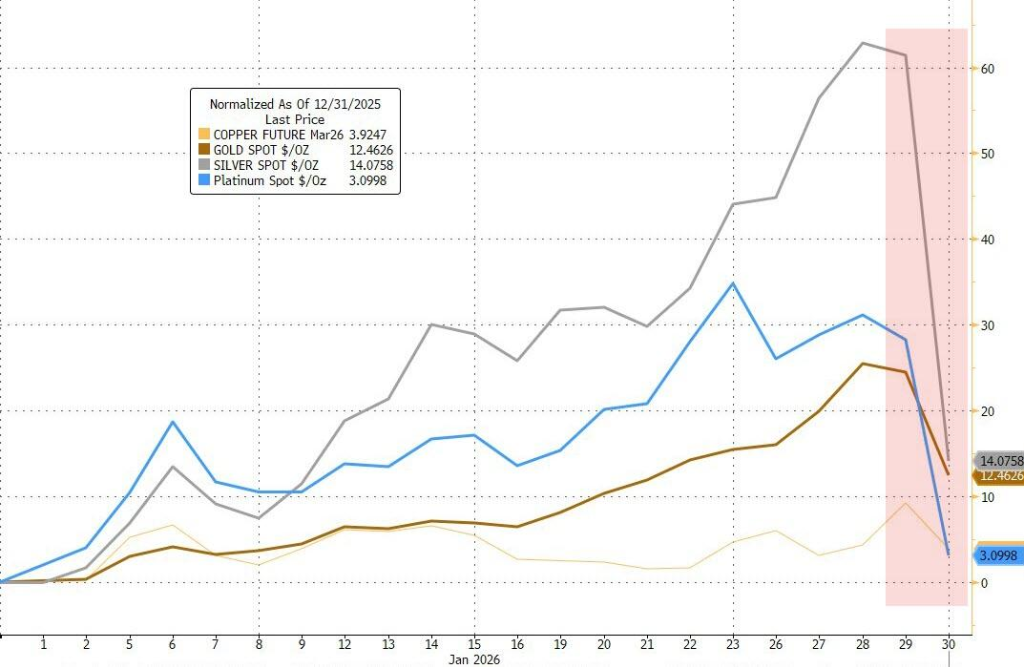
Core Viewpoint - The recent nomination of Walsh as the Federal Reserve Chair by Trump has triggered a significant sell-off in precious metals, leading to a market loss of $5 trillion in just two days, with gold prices plummeting by 10% and silver by 37% [1] Group 1: Market Dynamics - The market for precious metals was already showing signs of being overcrowded, with record levels of bullish positions and extreme leverage, making it susceptible to a "gamma squeeze" [3] - The dollar index experienced its largest single-day increase since May, negatively impacting investors who were shorting the dollar [4] - A significant amount of capital has rapidly flowed through the markets, leaving little room for error in positioning, which could lead to sharp declines [5] Group 2: Overcrowded Trades - A Bank of America survey indicated that being long on gold was the most crowded trade globally, with gold prices exceeding long-term trend lines by 44%, a level not seen since 1980 [8] - The dollar has faced selling pressure for three consecutive months, marking its worst start to the year in eight years, while also reaching its lowest level against other currencies since July 2022 [9] Group 3: Broader Market Implications - The collapse in precious metals serves as a warning for other crowded trades that have remained stable [16] - The MSCI Emerging Markets Index has outperformed the S&P 500 Index to an extent not seen since 2022, while momentum stocks in the U.S. have recently faced corrections [12] - The Russell 2000 Index, after outperforming the S&P 500 for 14 consecutive trading days, has underperformed in the last six days [14] Group 4: Investor Sentiment and Strategy - The recent market volatility has raised questions about the viability of contrarian investors in a momentum-driven market [17] - Some investors, like Rich Weiss, have maintained a contrarian stance despite unfavorable trends, believing that growing profits will allow U.S. companies to outperform their international counterparts [18] - Despite the downturn in gold prices, some investors are hesitant to exit their positions too early, fearing they might miss out on future opportunities if prices rebound [20]


暴涨、火爆、崩盘--金银领衔主演,2026的市场“开年大戏”格外精彩
Hua Er Jie Jian Wen· 2026-01-31 02:04
Core Viewpoint - The recent market volatility highlights the fragility of consensus, as extreme trading positions can lead to significant price swings even with minor fluctuations [1]. Group 1: Market Dynamics - The market experienced a dramatic sell-off in precious metals, with gold dropping 10% and erasing $5 trillion in market value over two days [1]. - Silver saw a sharp decline of 37%, while platinum fell over 16%, and copper reversed all gains from the previous day [1]. - The market is characterized by crowded long positions and record levels of bullish options, creating a potential for "gamma squeeze" [3]. Group 2: Investor Sentiment - A Bank of America survey indicated that being long on gold is currently the most crowded trade globally, with gold prices exceeding long-term trend lines by 44%, a level not seen since 1980 [4]. - The silver sentiment index reached its highest level since 1998, indicating extreme bullish sentiment among investors [4]. Group 3: Broader Market Implications - The dollar index experienced its largest single-day gain since May, negatively impacting investors who were short on the dollar [3]. - Emerging market equities have underperformed relative to U.S. stocks, marking the worst performance since 2022 [3]. - The recent volatility in precious metals serves as a warning for other crowded trades across various markets [10]. Group 4: Investment Strategies - The current market environment raises questions about the viability of contrarian investors, as momentum-driven trading dominates [11]. - Some investors, like Rich Weiss, have maintained a contrarian stance, favoring U.S. equities over international markets despite recent underperformance [11]. - Concerns are growing among investors about whether the recent market fluctuations signal an early warning for exiting crowded trades [11].
分析:黄金和白银价格双双下挫 但不改2025年全年创纪录表现
Xin Lang Cai Jing· 2025-12-31 12:14
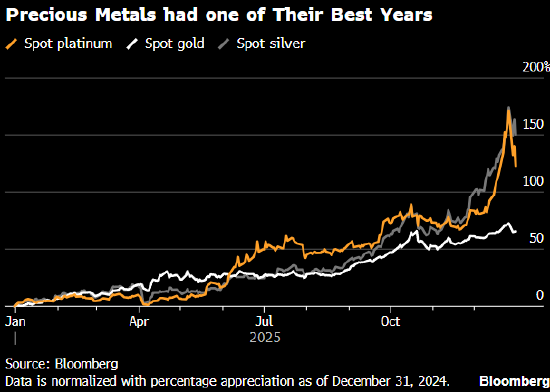
Group 1 - Gold and silver prices experienced a decline on the last trading day of 2025, but both metals are set to achieve record annual gains, marking a strong year for precious metals [1] - Spot gold fell to around $4311 per ounce, while silver dropped to approximately $70 per ounce, following a significant upward trend throughout 2025 [1] - The Chicago Mercantile Exchange raised margin requirements for precious metal futures for the second time in a week, which may dampen market enthusiasm as traders will need to provide more collateral [1] Group 2 - Despite a drop of over 5% in prices for silver, platinum, and palladium, market enthusiasm remains strong [2] - The outlook for 2026 appears favorable due to factors such as interest rate cuts and geopolitical instability, although positions seem to be overextended, indicating potential for a sharp correction [2] - Gold prices decreased by 0.6% to $4311.8 per ounce, while silver prices fell more than 6% to $71.4 per ounce [2]
黄金和白银价格双双下挫 但不改2025年全年创纪录表现
Xin Lang Cai Jing· 2025-12-31 11:22
Group 1 - Gold and silver prices experienced a decline on the last trading day of 2025, but both metals are set to achieve record annual gains, marking a remarkable year for precious metals [1][3] - Spot gold fell to around $4311 per ounce, while silver dropped to approximately $70 per ounce, following a significant upward trend throughout 2025 [1][3] - The volatility in December led to both metals reaching historical highs, with gold achieving its best annual performance since 1979, before investors took profits, resulting in a pullback [1][3] Group 2 - The Chicago Mercantile Exchange raised margin requirements for precious metal futures for the second time in a week, which may dampen market enthusiasm as traders will need to provide more collateral [4] - Despite a drop of over 5% in silver, platinum, and palladium prices, market enthusiasm remains strong, indicating a shift in silver from a safe-haven asset to a momentum trade [6] - The outlook for 2026 appears favorable due to potential interest rate cuts and ongoing fiscal and geopolitical uncertainties, although positions may be overly stretched, suggesting a possible sharp correction [6]
贝莱德智库:金价与股市出现同向波动 但黄金的长期逻辑未变
Jin Rong Jie· 2025-12-26 04:19
Core Viewpoint - Gold prices have reached historical highs, driven by factors such as Federal Reserve interest rate cuts, central bank gold purchases, and geopolitical tensions, raising questions about the investment logic of gold in relation to the stock market [1][2] Group 1: Current Market Dynamics - Gold prices have surged over 70% in less than a year, with recent fluctuations including a brief pullback in mid-October, which has since been recovered [1] - Despite expectations of seasonal volatility in the stock market affecting gold, the actual market behavior showed that gold followed the stock market trends rather than providing diversification [1][2] Group 2: Technical and Investment Trends - Gold has become a momentum trading asset, with a slight positive correlation to the MSCI ACWI index, indicating that it is now part of the trading wave dominated by early growth stocks [2] - The influx of investors into gold has led to its price increase, but it also faced sell-offs when momentum trading was pressured in October [2] Group 3: Long-term Investment Outlook - The long-term rationale for holding gold remains intact, as it serves as an effective tool against a weakening dollar, with a negative correlation of approximately -0.60 to the DXY index over the past five years [3] - Concerns regarding the U.S. fiscal situation, particularly during government shutdowns, continue to support the relevance of gold as a portfolio tool, especially given the unprecedented growth of U.S. government debt outside of wartime and recession periods [3]

Market concern about the Fed is 'well placed', says HSBC's Jose Rasco
Youtube· 2025-11-14 22:01
Core Viewpoint - The current market environment is characterized by a potential unwinding of momentum trades, particularly in AI, and uncertainty surrounding the Federal Reserve's actions, which may lead to volatility and adjustments in valuations [1][2][4]. Market Rotation and Economic Outlook - There is a noticeable rotation in the market, with concerns about the Federal Reserve's decisions impacting investor sentiment. Despite this, there remains a pro-risk stance, particularly towards equities [2][4]. - Earnings growth for the MAG 7 is expected to slow from 18% in Q4 of this year to 14% next year, while the broader market (the forgotten 493) is projected to grow from 2% in Q4 to 15% next year, indicating a broadening market [3]. Earnings Projections and Investment Strategy - Earnings for the S&P 500 are anticipated to increase by approximately 13% in 2026 and over 14% in 2027, with technology leading this growth [6]. - Investors are advised to view potential declines as buying opportunities, with historical data suggesting that pullbacks of 5% to 10% typically recover quickly [13]. Asset Allocation and Hedge Funds - There is a recommendation to consider hedge funds as part of a global asset allocation strategy, especially in a slowing economy, as they tend to perform well under such conditions [8]. - The focus on global AI developments is emphasized, particularly in emerging markets, which presents additional investment opportunities [9]. Investment Approach for Retail Investors - Retail investors are encouraged to maintain a long-term perspective, focusing on buying and holding equities rather than engaging in high-risk strategies like margin trading [12]. - It is suggested that investors should rotate into sectors showing relative strength, such as pure value over pure growth within the S&P 500 [14].


金融工程周报:事缓则圆-20251102
Huaxin Securities· 2025-11-02 09:03
- The report does not contain any specific quantitative models or factors for analysis and construction[1][2][3] - The report primarily focuses on macroeconomic trends, asset allocation strategies, and market outlooks without detailing quantitative models or factors[6][30][7] - No formulas, construction processes, or backtesting results for quantitative models or factors are provided in the report[13][16][20]
美股期指涨跌互现,现货黄金再度站上4100美元,布油涨3%,比特币反弹
Hua Er Jie Jian Wen· 2025-10-23 08:21
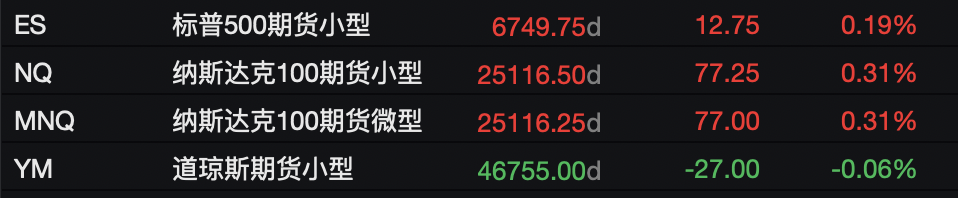
Market Overview - Market sentiment is influenced by corporate earnings and trade tensions, with mixed performance in major stock indices [1] - Investors are closely monitoring earnings reports from US and European companies, which may significantly impact market trends [1] - Concerns over corporate earnings, particularly from growth and tech stocks, could exacerbate current market pullbacks [1] Stock Market Performance - As of the report, S&P 500 futures rose nearly 0.2%, Nasdaq 100 futures increased over 0.3%, while Dow Jones futures fell 0.06% [1][6] - Tesla's pre-market trading showed a decline of over 3%, despite a significant revenue rebound, as profits dropped by 31% [6] - Nokia's stock rose by 9.7% in pre-market trading, while Quantum Computing stocks saw an increase of 13% [6] European Market Trends - European stock indices opened lower but showed recovery, with the UK FTSE 100 index up by 0.93% and Germany's DAX index down by 0.6% [6] - Volvo's stock surged by 29% after reporting better-than-expected third-quarter earnings [6] Commodity Market Movements - Spot gold prices increased by nearly 0.5%, reaching $4,117 per ounce, driven by heightened risk aversion [2][6] - Brent crude oil prices rose over 3.3%, reaching $64.66 per barrel, following US sanctions on Russian oil companies, alleviating concerns over potential supply surplus [5][6] Currency and Bond Market - The US dollar index stabilized around 99, while the 10-year US Treasury yield rose by 2 basis points to 3.96% [6]
Gold's traditional inverse link to stocks has broken down, says Breakout Capital CIO Ruchir Sharma
Youtube· 2025-10-20 15:58
Core Viewpoint - The simultaneous rally of gold and stocks is unusual and may be driven by excessive liquidity in the market, rather than traditional safe-haven dynamics [2][6][12] Group 1: Market Dynamics - Historically, gold and stocks tend to move in opposite directions, but currently, both are rising together, indicating a unique market condition [1][9] - The current market resembles the tech boom of 1999 and the inflationary environment of 1979, with significant liquidity fueling momentum trades across various market segments [2][4] - There is over $1.5 trillion in excess liquidity in money market mutual funds, a remnant of pandemic-era monetary policies [4][15] Group 2: Gold Demand and Investment Trends - Recent demand for gold has shifted towards ETF investments, with the last quarter seeing the highest inflows into gold ETFs ever recorded [3][10] - The increase in gold prices is not solely driven by traditional investors seeking a hedge but rather by retail investors participating in a liquidity-driven speculative frenzy [6][12] - The correlation between gold and stocks may lead to unexpected outcomes if market conditions change, particularly if inflation resurfaces and central banks withdraw liquidity [6][14] Group 3: Future Outlook - If inflation returns and the Federal Reserve raises interest rates, both gold and stocks may decline simultaneously, contrasting with their current upward trend [14][15] - The current market environment is characterized as an "everything rally," where various asset classes are rising together, but this may not be sustainable in the long term [9][15]
高盛客户调查发现,人工智能_FOMO_在年底业绩恐慌中表现超乎寻常_ZeroHedge
Goldman Sachs· 2025-10-09 02:00
Investment Rating - The report indicates a bullish sentiment among investors, with over half of respondents optimistic about the S&P 500 index, marking the highest level of optimism since December 2024 [3]. Core Insights - The "fear of missing out" (FOMO) related to artificial intelligence (AI) is significantly influencing market sentiment, overshadowing concerns about economic slowdown and potential market bubbles [3][12]. - Investors are increasingly focused on AI-related stocks, particularly in infrastructure, while other sub-themes like robotics and quantum computing have not garnered much attention yet [9]. - The momentum index is expected to outperform the S&P 500 by year-end, reflecting the growing integration of AI trading strategies [10]. - Despite a mixed economic outlook, with excitement around AI and a soft labor market, investors are content with the prospect of only one more rate cut this year [12]. - The expectation of a large-scale rate cut cycle has diminished, leading to a shift in focus towards AI-driven market rebounds [14]. - Discussions around high valuations and potential market bubbles are emerging as investors prepare to re-enter the stock market, driven by FOMO sentiment [16]. Summary by Sections - **Investor Sentiment**: Optimism among investors has reached a peak, with a significant portion expecting strong performance from the S&P 500 [3]. - **AI Focus**: The report highlights a strong interest in AI stocks, particularly in infrastructure, while other areas remain less prioritized [9]. - **Momentum Trading**: There is a consensus that momentum trading will outperform traditional indices, indicating a shift towards AI-related strategies [10]. - **Economic Outlook**: Investors are satisfied with the current economic conditions, anticipating only minor adjustments in interest rates [12]. - **Market Dynamics**: The report notes a shift away from expectations of aggressive rate cuts, favoring AI-driven market movements instead [14]. - **Valuation Concerns**: As the market heats up, discussions about high valuations and potential bubbles are becoming more prevalent among investors [16].
