
央行购金需求

Search documents
金价跌破关键支撑 牛市整固考验4340美元
Jin Tou Wang· 2026-01-01 04:32
Core Viewpoint - The gold market is experiencing short-term pressure from bears, leading to a decline in prices, particularly after breaking below the October high of $4381.44, which may result in significant losses for aggressive traders who anticipated a breakout [1] Group 1: Market Trends - In the long-term bullish context, gold prices are expected to undergo several months of consolidation before resuming an upward trend, despite recording a substantial annual increase of approximately 65% in 2025, marking the best annual performance in over 40 years [2] - The market is currently in a correction phase after a steady rise throughout the year, with prices accelerating towards the end of the year before stabilizing [2] Group 2: Future Outlook - For 2026, fundamental factors supporting gold prices are anticipated to regain momentum, including the actual impact of Federal Reserve rate cuts, expectations of new monetary easing, ongoing geopolitical risks, central bank gold purchases, and inflows into gold ETFs [2] - Although rate cut expectations provide support, the market widely recognizes that gold is in a bull market, which may hinder the ability to replicate last year's remarkable price increases [2] Group 3: Technical Analysis - Gold prices have also fallen below the short-term 50% Fibonacci retracement level, transforming the $4350.27-$4381.44 range into a resistance zone, with traders targeting the mid-term 50% retracement level of $4211.60 and the 50-day moving average at $4174.88 as a support area [3] - The 50-day moving average is crucial as it has guided gold prices higher since mid-August; a significant drop below this average could shift market sentiment from "extremely bullish" to "moderately bullish" [3]
【comex黄金库存】12月30日COMEX黄金库较上一交易日增加1.00吨
Jin Tou Wang· 2025-12-31 06:02
Group 1 - COMEX gold inventory recorded at 1127.67 tons on December 30, an increase of 1.00 ton from the previous trading day [1][2] - COMEX gold price closed at $360.10 per ounce on December 30, up 0.17%, with an intraday high of $4420.50 and a low of $4338.80 [1][2] Group 2 - Strong demand for gold from central banks has been noted, influenced by macroeconomic decisions and policy directions [2] - If central banks continue to increase gold holdings, it will provide further support for gold prices; however, a reduction in purchases to below 600-700 tons could suppress price increases [2] - A significant risk identified is gold recycling, particularly in the Indian market, where there is a trend of pledging gold jewelry for loans [2] - A potential economic downturn in India could lead to forced liquidation of pledged gold, increasing market supply and putting downward pressure on gold prices [2]
年末贵金属行情火热,黄金、白银齐创新高
Huan Qiu Wang· 2025-12-28 01:24
Core Insights - Precious metals market is experiencing significant price increases, with gold, silver, and platinum reaching new historical highs as of December 26 [1][3] Price Movements - International gold and silver prices rose by 1.11% and 7.69% respectively, with gold futures reaching $4552.7 per ounce and silver futures climbing to $77.196 per ounce [3] - Platinum futures surged past $2400 per ounce for the first time, with a weekly increase exceeding 22%, while palladium prices rose approximately 13% to $2023.3 per ounce, marking a three-year high [3] Market Trends - Silver has entered an accelerated upward phase, with a monthly increase of over 40% since late November and an annual increase approaching 150% [3] - The correlation between silver and other metals like platinum, palladium, and copper has intensified, driven by liquidity and cyclical factors [3] Future Outlook - Multiple international financial institutions predict that gold prices could reach $5000 per ounce by 2026, supported by central bank purchases and expectations of Federal Reserve easing [4] - For silver, increasing photovoltaic demand and low visible inventories are expected to support prices, although potential pressure from technological substitutes should be monitored [4] - The copper futures market also saw a rise of over 4% on December 26, with optimistic macroeconomic conditions and tightening supply leading to an upward revision of the 2026 copper price target to 120,000 yuan per ton [4]


黄金急跌近2%,失守4060美元/盎司
2 1 Shi Ji Jing Ji Bao Dao· 2025-10-24 09:28
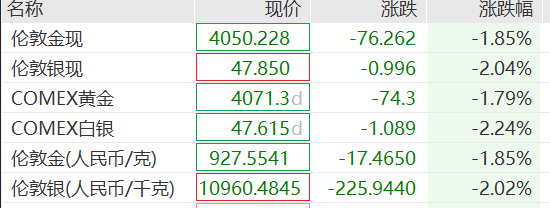
Core Viewpoint - The rapid decline in gold and silver prices is attributed to multiple factors including policy expectations, technical breakdowns, a stronger dollar, and reduced geopolitical risks [3] Price Movements - As of October 24, spot gold fell below $4060 per ounce, dropping over 1.85% during the day [1] - Spot silver touched $47 per ounce, declining over 2% [1] - COMEX gold futures saw a decline of nearly 2%, approaching $4060 per ounce, with a current drop of 1.79% [1] - Current prices include: - London Gold: $4050.228, down $76.262 (-1.85%) [2] - London Silver: $47.850, down $0.996 (-2.04%) [2] - COMEX Gold: $4071.3, down $74.3 (-1.79%) [2] - COMEX Silver: $47.615, down $1.089 (-2.24%) [2] Market Sentiment - U.S. gold stocks fell in pre-market trading, with Coeur Mining down over 4% and both Kinross and Harmony Gold down more than 2% [2] - Citigroup has turned bearish on gold prices, predicting a drop to $4000 within the next three months [3] Long-term Outlook - Despite the short-term decline, long-term support for gold is expected from global economic recession risks and central bank gold purchases, with a projected net increase of over 1000 tons by central banks in 2025 [3] - Investors are advised to closely monitor the upcoming October CPI data (to be released on the 25th) and the Federal Reserve's meeting statements to gauge market direction changes [3]
国际金价、沪银续创历史新高,沪金何时才会跟上?新一轮牛市开启了吗?
Jin Shi Shu Ju· 2025-09-02 10:59
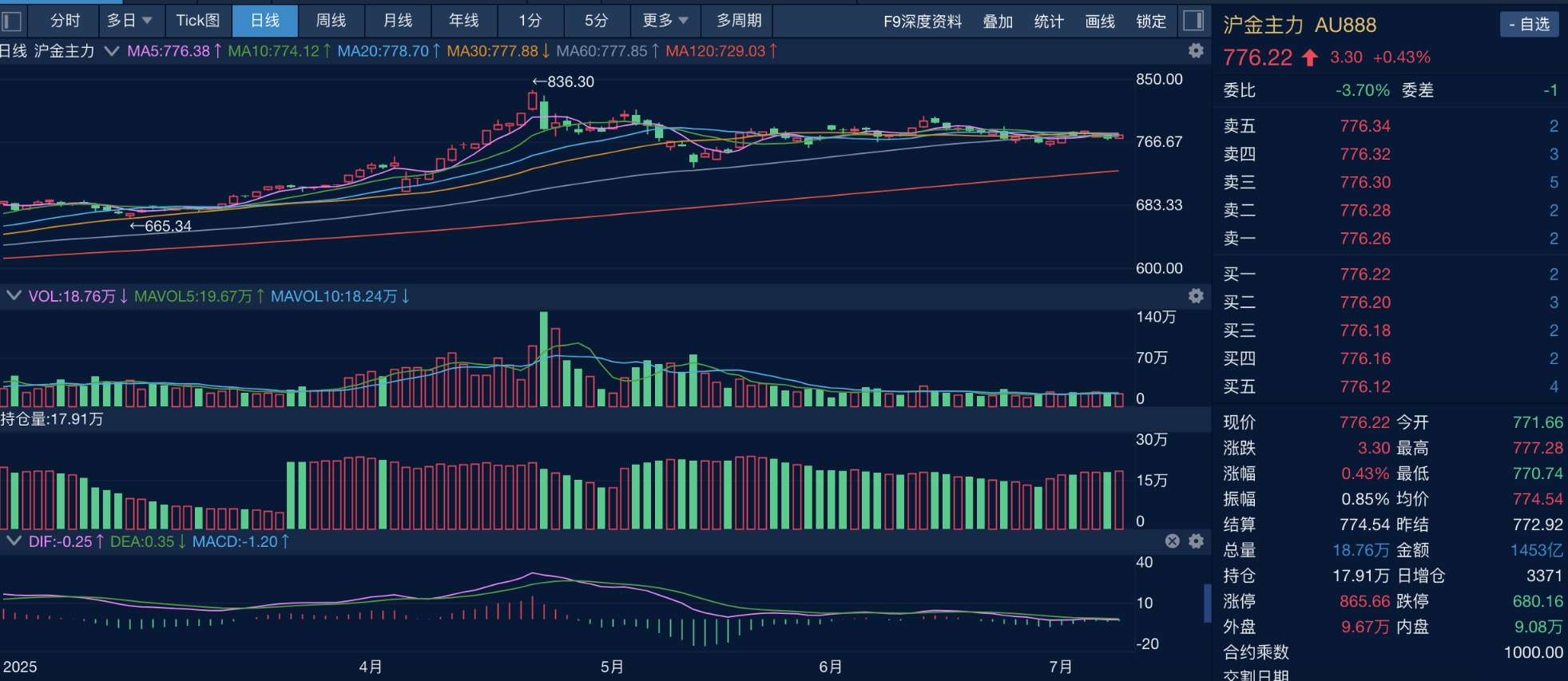
Core Viewpoint - International gold prices have reached a historic high due to strengthened expectations of interest rate cuts in the U.S. and a continued weakening of the dollar, with spot gold peaking at $3508.70 per ounce, reflecting a daily increase of over 0.7% [1][2] Group 1: Economic Factors - Market expectations for interest rate cuts are primarily driven by recent weak U.S. economic data, with a 90% probability of a 25 basis point cut in the September policy meeting according to CME FedWatch [2] - Key economic indicators include a significant drop in July non-farm payrolls to 73,000, the lowest in nine months, and an increase in the unemployment rate to 4.2%, alongside a decline in labor participation rate to 62.2%, the lowest in nearly three years [2] - Manufacturing jobs have seen negative growth for three consecutive months, with a reduction of 11,000 jobs in July [2] Group 2: Geopolitical Risks - Rising geopolitical tensions, particularly in the Middle East, have further supported precious metals, with recent missile attacks by Houthi forces on Israeli oil tankers escalating market risk aversion [2] - Ongoing conflicts such as the Russia-Ukraine war and geopolitical tensions in Thailand and Cambodia continue to influence market sentiment [2] Group 3: Physical Demand - Positive trends in physical demand for gold are noted, with China's central bank increasing its gold reserves to 73.96 million ounces, marking a month-on-month increase of 60,000 ounces for the ninth consecutive month [3] - The Saudi central bank's recent purchase of $4 million in silver ETFs indicates a growing trend in silver investment demand [3] - SPDR Gold ETF holdings have risen to 977.68 tons, up from 967.94 tons, reflecting increased investor interest [3] Group 4: Market Outlook - Multiple futures companies maintain an optimistic outlook for precious metals, with Everbright Futures highlighting strong industrial demand for silver as a key driver for price increases [4] - Hongyuan Futures suggests that the dovish signals from Fed Chairman Powell regarding employment trends, combined with ongoing global central bank purchases of gold, may lead to a bullish trend for precious metals [4] - Shanghai Zhongti Futures emphasizes the potential for increased volatility in gold prices, particularly in light of upcoming economic data releases [4] Group 5: Investor Sentiment - Investors are advised to look for buying opportunities on price dips, as the overall trend for gold and silver remains strong amid expectations of interest rate cuts and geopolitical uncertainties [5] - The market is closely monitoring the upcoming non-farm payroll data, which could significantly influence the Fed's decision on interest rates and, consequently, precious metal prices [5]
秦氏金升:8.14顺势看涨金价,黄金行情走势分析及操作建议
Sou Hu Cai Jing· 2025-08-14 02:35
Group 1 - The core viewpoint is that expectations for a 50 basis point rate cut by the Federal Reserve in September are rising, which, combined with weak economic data and potential policy shifts, is expected to significantly boost gold prices [3] - A rate cut will lower the dollar and real interest rates, enhancing gold's appeal as a non-yielding asset, while economic uncertainty and potential stagflation risks will further increase safe-haven demand [3] - If the Federal Reserve cuts rates more than expected, gold prices may enter a new upward trend; however, if the policy measures fall short of expectations, a short-term technical correction may occur [3] Group 2 - Gold prices experienced a slight rebound, reaching a peak of $3370 per ounce before closing at $3355.90, with a gain of 0.24% [1] - The current trading price of gold is around $3365 per ounce, with a focus on a potential target of $3378, and a strategy of low buying is recommended [5] - The analysis suggests that if gold breaks above $3378, it could continue to rise towards $3385, while a protective stop is advised at $3355 [5]

金价的“重大隐患”:央行买的少了?
Hua Er Jie Jian Wen· 2025-08-08 04:04
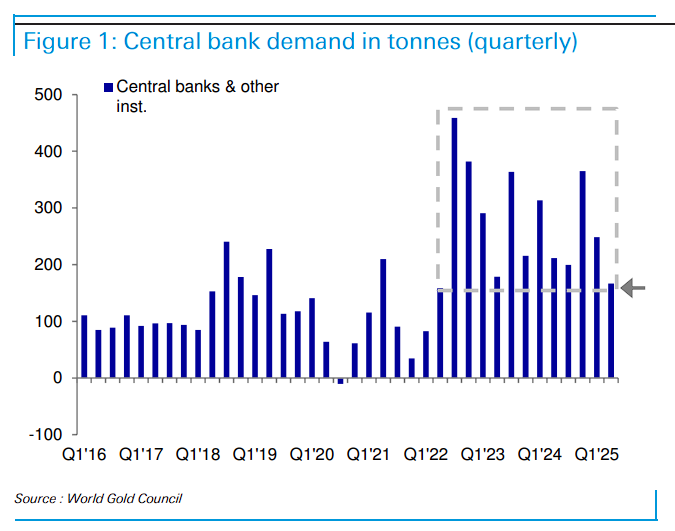
Core Viewpoint - Central bank gold demand has significantly decreased in Q2, raising concerns about the potential impact on gold prices, which may lead to adjustments in future price expectations [2][3][5]. Group 1: Central Bank Demand Trends - Global central bank gold demand fell by one-third in Q2 compared to Q1, reaching the lowest level since Q2 2022 [2][3]. - The decline in central bank demand is particularly alarming as it has been a key driver of rising gold prices in recent years [5]. - Central bank demand's share in the global gold market has increased from 10% in 2021 to 21% in 2024 [6]. Group 2: Implications for Gold Prices - The slowdown in central bank demand suggests a weakening of the crucial support for gold prices, potentially threatening future price stability [2][3]. - Deutsche Bank's analysis indicates that if the current pace of central bank demand continues, gold price forecasts for 2026 may need to be adjusted downwards from $3,700 per ounce to around $3,600 per ounce [14]. - In extreme scenarios, if annual central bank demand drops to 500 tons, gold price predictions could fall to $3,300 per ounce [14]. Group 3: Forecasting Challenges - Deutsche Bank acknowledges that the slowdown in central bank demand poses a downside risk to its gold price forecasting model, which previously assumed a demand of 1,000 tons in 2025 [12]. - The actual demand in the first half of 2025 was only 415 tons, necessitating a significant increase in the second half to meet annual targets [12]. - The bank has set 375 tons per half-year as a critical threshold for maintaining current price forecasts [14]. Group 4: Potential Demand Drivers - Despite the decline in central bank demand, other sources of investment demand may help offset this shortfall [15]. - Recent policy changes in the U.S. could introduce new demand dynamics for gold, such as including precious metal funds in 401(k) retirement plans [15]. - The asymmetric response of jewelry consumption and gold recycling markets may provide additional support for gold prices [15].
央行连续第9个月增持黄金,7月末外汇储备规模近3.3万亿美元
Bei Ke Cai Jing· 2025-08-07 15:19
Group 1: Gold Reserves and Demand - The central bank has increased its gold reserves for the ninth consecutive month, reaching 73.96 million ounces by the end of July, with a month-on-month increase of 60,000 ounces [1][3] - Despite the continuous increase, the increment has remained low for the fifth consecutive month, indicating a cautious approach to gold purchases [3] - Global gold demand in Q2 increased by 3% year-on-year to 1,249 tons, with a significant value increase of 45% to $132 billion [5] Group 2: Central Bank Actions and Market Outlook - Central banks remain a crucial pillar of global gold demand, with official gold reserves increasing by 166 tons in Q2, although the pace of purchases has slowed [6] - UBS expects stable demand from central banks in the second half of the year but has revised its annual purchase forecast down from 950-1,000 tons to 900-950 tons [7] - The Chinese central bank is expected to continue increasing gold reserves to optimize its international reserve structure while gradually reducing U.S. Treasury holdings [8] Group 3: Foreign Exchange Reserves - As of the end of July, China's foreign exchange reserves decreased to $32,922 billion, marking a decline of $25.2 billion or 0.76%, ending a six-month upward trend [2][12] - The decline in foreign reserves is attributed to factors such as exchange rate fluctuations and changes in asset prices, with the U.S. dollar index rising by 3.2% [13][14] - The overall financial asset prices in China's foreign reserves increased, which partially offset the impact of the dollar's appreciation [15]
金市持续高位震荡 黄金还能火多久?
Xin Hua Cai Jing· 2025-07-08 12:36
Core Viewpoint - The gold market is experiencing high volatility and mixed opinions regarding its future trajectory, particularly for the second half of 2025, influenced by geopolitical factors, central bank policies, and economic data [1][5][7]. Group 1: Current Market Conditions - Gold prices have shown a significant upward trend earlier this year but have entered a phase of fluctuation since mid-June, with current prices around $3,330 per ounce [1][3]. - As of July 8, 2023, COMEX gold futures were reported at $3,343 per ounce, while London spot gold was at $3,333 per ounce [1]. Group 2: Influencing Factors - Short-term factors supporting gold prices include expectations of Federal Reserve rate cuts, geopolitical uncertainties, and central bank gold purchases [3][5]. - Conversely, potential downward pressures include technical resistance, increased speculative trading, and weak physical demand [3][7]. Group 3: Central Bank Demand - A recent survey indicated that nearly 43% of central banks plan to increase their gold reserves in the next year, with 95% expecting continued gold accumulation [5][6]. - China's gold reserves increased to approximately 2,298.55 tons as of June, marking the eighth consecutive month of accumulation [6]. Group 4: Economic Data and Predictions - U.S. economic data and market expectations regarding Federal Reserve rate cuts are critical in determining gold price movements [7]. - Analysts from Goldman Sachs and Citigroup express concerns that the anticipated rate cuts may lead to a decrease in gold prices, with Citigroup predicting a drop to between $2,500 and $2,700 per ounce by Q2 2026 [7][8]. Group 5: Long-term Outlook - Despite short-term fluctuations, there is a long-term optimistic view on gold's value as a hedge against currency devaluation and inflation, supported by ongoing central bank purchases and a low-interest-rate environment [8].
【环球财经】美元走软提振 纽约金价30日震荡收复3300美元关口
Xin Hua Cai Jing· 2025-06-30 23:58
Group 1 - The international gold price rebounded on June 30, closing above $3,300 per ounce, driven by a weaker US dollar [1] - The most actively traded gold futures for August 2025 rose by $28.9 to $3,315 per ounce, marking an increase of 0.88% [1] - Despite a rise in US stock indices, the US dollar index fell by 0.54% to 96.875, providing additional upward momentum for gold [2] Group 2 - Gold prices reached a one-month low of $3,250.5 during early electronic trading, indicating volatility in the market [2] - The overall performance of gold in June showed a slight increase of 0.06% compared to the end of May, marking the sixth consecutive month of gains, although the growth rate has significantly narrowed [2] - Analysts suggest that central bank gold purchases, geopolitical uncertainties, and loose monetary policies will continue to support the upward trend in gold prices [2] Group 3 - Silver futures for September rose by 16.5 cents to $36.330 per ounce, reflecting a gain of 0.46% [3]