
宏观调控

Search documents
2025年中国经济的韧性、温度与担当
Qi Huo Ri Bao Wang· 2026-01-23 01:33
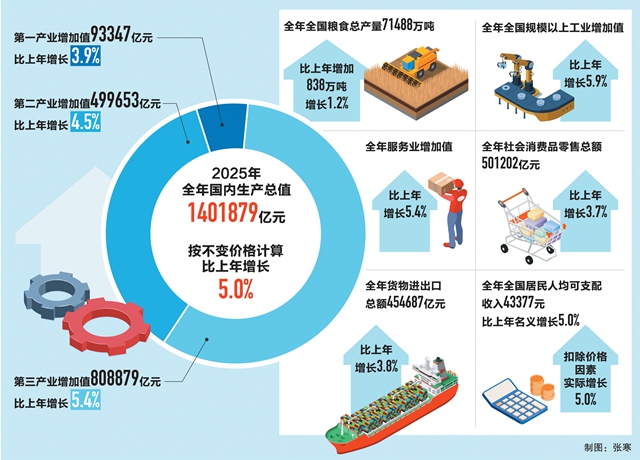
Economic Overview - In 2025, China's GDP reached 140.19 trillion yuan, achieving a year-on-year growth of 5.0%, successfully meeting annual expectations [3] - The growth occurred amidst global economic challenges, with major economies like the US, Eurozone, and Japan experiencing lower growth rates [3] - China's service sector contributed 61.4% to economic growth, highlighting the ongoing optimization of the industrial structure [3] Structural Optimization - New productive forces are becoming the core driver of China's economic growth, with significant increases in value-added from equipment manufacturing (9.2%) and high-tech manufacturing (9.4%) [4] - The digital economy is thriving, with online retail sales of physical goods growing by 5.2%, accounting for 26.1% of total retail sales [4] - High-tech product exports increased by 13.2%, indicating a successful transition from "Made in China" to "Created in China" [4] Policy Coordination - The Chinese government has implemented proactive macroeconomic policies to stimulate market vitality, including a moderately loose monetary policy [5][6] - Despite a 3.8% decline in fixed asset investment, investment in high-tech industries and livelihood sectors remained stable [5] Living Standards - In 2025, the per capita disposable income reached 43,377 yuan, reflecting a nominal growth of 5.0%, which aligns with economic growth [7] - The average urban unemployment rate was 5.2%, indicating stable employment conditions [7] - The Engel coefficient decreased to 29.3%, suggesting an improvement in living standards [7] Domestic and External Demand - Retail sales of consumer goods reached 50.12 trillion yuan, growing by 3.7%, with service retail showing robust growth [8] - Total import and export volume was 45.47 trillion yuan, with exports growing by 6.1% and imports by 0.5% [8] - Private enterprises accounted for 57.3% of total trade, reflecting a diversification in trade [8] Global Positioning - China's economic performance in 2025 is significant amid global economic disparities, providing a stabilizing force in international trade [10] - The country is committed to high-level opening up and reform, enhancing its competitive edge and creating new growth opportunities for global enterprises [10] Future Outlook - Despite external shocks and internal challenges, China's economic fundamentals remain strong, with ongoing technological innovation driving industrial upgrades [11] - The manufacturing PMI rose to 50.1, indicating a return to expansion, suggesting a buildup of internal economic momentum [11] - China's economy is positioned as a reliable stabilizer in the global landscape, contributing to global growth amidst uncertainties [11]


21评论丨贴息政策升级,促消费稳投资意义深远
2 1 Shi Ji Jing Ji Bao Dao· 2026-01-22 03:28
Core Viewpoint - The recent fiscal and financial policies aim to stimulate domestic demand by optimizing interest subsidy policies for various loan types, thereby enhancing consumer spending and private investment [1][2][5]. Group 1: Policy Overview - Five fiscal and financial policies have been released, focusing on personal consumption loans, equipment upgrade loans, loans for small and micro enterprises, loans for service industry entities, and a special guarantee plan for private investment [1][2]. - The personal consumption loan subsidy has been expanded to include credit card installment payments, with an annual subsidy rate of 1% and no upper limit on single consumption subsidy amounts [1][2]. - A new subsidy policy for small and micro enterprise loans has been introduced, offering a 1.5% annual subsidy for fixed asset loans directed at specified key industries, with a maximum limit of 50 million yuan per borrower [2]. Group 2: Implementation and Impact - The policies are designed to enhance the precision of financial support, making it easier for more enterprises to access subsidies, thus increasing the overall effectiveness of the policies [3][5]. - Financial institutions play a crucial role in the implementation of these policies, as they are encouraged to monitor fund flows and improve risk control while expanding their loan offerings [4]. - The combination of these policies is expected to create a synergistic effect, promoting a virtuous cycle of production and consumption, ultimately leading to increased economic growth [5].
杨志勇:推动更加积极的财政政策精准增效
Jing Ji Ri Bao· 2026-01-21 00:01
财政政策是宏观调控的重要手段,通过预算、税收、政府债券、转移支付等工具组合,可以发挥扩 大总需求和定向调结构的双重优势,熨平经济周期性波动,落实国家重大决策部署,促进经济总量平衡 和结构优化。2025年中央经济工作会议提出,要继续实施更加积极的财政政策。2026年财政政策和2025 年财政政策取向一以贯之,这是以习近平同志为核心的党中央审时度势、综合考量作出的重大决策部 署。我们要推动更加积极的财政政策精准增效,助力经济实现质的有效提升和量的合理增长。 更加积极的财政政策成效显著 2025年我国首次实施更加积极的财政政策,为推动完成全年经济社会发展目标任务发挥了重要作 用。通过筹集更加充分的财力,加大支出强度,加快支出进度,优化支出结构,财政政策效果显著。这 也为2026年继续实施更加积极的财政政策提供了强有力支撑,积累了宝贵经验。 支出规模扩大。2025年全国一般公共预算支出规模29.7万亿元,比上年增加1.2万亿元,财政支出强 度明显加大,体现了财政政策的扩张性。财政赤字率从3%提高到4%左右,提高1个百分点,财政赤字 规模达5.66万亿元,比上年增加1.6万亿元,不仅财政可用财力增加,而且向社会发出政策 ...
财政部答一财:更大力度激发民间投资
第一财经· 2026-01-20 12:39
Core Viewpoint - The article discusses the implementation of six new policies aimed at stimulating private investment and promoting consumer spending in China, as announced by the Ministry of Finance and other departments [3][4]. Group 1: Policy Overview - The six policies are designed to enhance domestic demand, focusing on stimulating private investment and consumer spending as key components of internal demand [4]. - The policies are structured around "one goal," "two focuses," "three principles," and "six policies" [4]. Group 2: Specific Policies - The first policy is a loan interest subsidy for small and micro enterprises, providing a 1.5% subsidy on loans for key industries such as new energy vehicles and medical equipment, with a maximum loan amount of 50 million yuan [5]. - The second policy is a special guarantee plan for private enterprises, offering loan guarantees up to 20 million yuan for small and micro enterprises needing medium to long-term loans for business expansion [5]. - The third policy introduces a risk-sharing mechanism for private enterprise bonds, providing credit enhancement support to mitigate investor losses [5]. - The fourth policy expands the scope of existing equipment update loan interest subsidies, now including loans for fixed assets and technological innovation, with a 1.5% subsidy for up to two years [6]. - The fifth policy optimizes the loan interest subsidy for service industry entities, increasing the maximum loan amount from 1 million yuan to 10 million yuan, with a 1% subsidy for one year [6]. - The sixth policy offers a personal consumption loan interest subsidy of 1% for loans used for consumption, now including credit card installment payments, with over 500 financial institutions eligible to provide these loans [6].

宏观纵览 | 财政部答一财:以更大力度激发民间投资
Sou Hu Cai Jing· 2026-01-20 11:44
Core Viewpoint - The State Council has initiated a comprehensive policy package aimed at promoting domestic demand through fiscal and financial collaboration, focusing on stimulating private investment and enhancing consumer spending [2][3]. Group 1: Policy Overview - The policy package includes six key measures: optimization of personal consumption loan interest subsidies, implementation of a special guarantee plan for private investment, and interest subsidies for loans to small and micro enterprises [2][3]. - The fiscal expenditures required for these policies have been adequately planned in the 2026 budget, allowing local and managing institutions to actively engage in business [2][3]. Group 2: Key Objectives and Principles - The primary goal is to "expand domestic demand," aligning with the central economic work conference's directives [3]. - The two main focuses are to "stimulate private investment" and "promote consumer spending," both critical components of domestic demand [3]. - The three guiding principles for execution are: 1. "Convenient and efficient" processes to simplify procedures and ensure direct benefits [3]. 2. "Precise and effective" targeting of key sectors and groups to lower financing costs and enhance consumer capacity [3]. 3. "Standardized and efficient" management to balance efficiency with regulatory compliance [3]. Group 3: Specific Policies - The six policies include four supporting private investment and two aimed at boosting consumption [3]. - The interest subsidy for loans to small and micro enterprises is set at 1.5% of the total loan amount, with a maximum loan limit of 50 million yuan and a subsidy period of up to two years [3][4]. - The special guarantee plan for private enterprises allows eligible small and micro enterprises to access loans up to 20 million yuan for various operational needs [4]. - The updated equipment loan interest subsidy policy expands the scope to include fixed asset loans related to equipment updates and technology innovation, with similar subsidy terms [4]. - The service industry loan interest subsidy policy increases the single loan limit from 1 million yuan to 10 million yuan, with a 1% subsidy for one year [5]. - The personal consumption loan interest subsidy policy now includes credit card installment payments, with a 1% subsidy for loans used for consumption [5].

中国国家发改委:将持续推动物价合理回升
Zhong Guo Xin Wen Wang· 2026-01-20 06:39
Core Viewpoint - The National Development and Reform Commission (NDRC) of China aims to continuously promote a reasonable recovery of prices through a combination of policies, emphasizing the importance of price stability for both economic operation and residents' livelihoods [1][2]. Summary by Relevant Sections Overall Economic Policy - The NDRC plans to implement a more proactive fiscal policy and moderately loose monetary policy, making the promotion of reasonable price recovery a key consideration in monetary policy [1]. - There is an observed upward trend in both the Consumer Price Index (CPI) and the Producer Price Index (PPI), indicating signs of economic recovery [1]. Structural Policy - The NDRC will implement special actions to boost consumption and develop plans to increase income for urban and rural residents [2]. - Policies will be optimized to promote large-scale equipment updates and the replacement of old consumer goods, alongside advancing major national strategies and key area safety capabilities [2]. - Efforts will be made to address "involution" competition and establish a unified national market construction regulation to enhance market efficiency [2]. Reform Policy - The NDRC aims to further clarify price relationships to promote efficient resource allocation and ensure stable supply [2]. - Continuous efforts will be made to stabilize prices and supply of essential goods, ensuring sufficient quantity and stable prices to support basic livelihoods [2].
深度关注丨中国经济向新向优
Zhong Yang Ji Wei Guo Jia Jian Wei Wang Zhan· 2026-01-20 00:37
中央纪委国家监委网站 柴雅欣 1月19日,2025年中国经济成绩单公布:初步核算,全年国内生产总值1401879亿元,按不变价格计算, 比上年增长5.0%。 2025年是"十四五"规划收官之年。在以习近平同志为核心的党中央坚强领导下,中国经济航船无惧风 雨,顶住多重压力,保持稳中有进发展态势,高质量发展取得新成效。但也要看到,外部环境变化影响 加深,国内供强需弱矛盾突出,经济发展中老问题、新挑战仍然不少。翻开这份成绩单,我们应如何看 待经济数据背后的发展成色?面对新的风高浪急,中国经济航船如何继续乘风破浪、勇毅前行? 稳中有进:在风浪中稳住了发展底盘、巩固了发展根基 "稳"是2025年中国经济的突出特点。面对外部环境急剧变化,国内困难挑战增多的复杂严峻形势,我国 实施更加积极有为的宏观政策,不仅有效化解外部环境变化的不利影响,更在风浪中稳住了发展的底 盘、巩固了发展的根基。 "全年社会消费品零售总额突破50万亿元,比上年增长3.7%,比2024年加快0.2个百分点,规模居全球零 售市场前列。"康义说。 "中国经济又一次在爬坡过坎中实现全年5%的增长,完成了年初确定的目标。特别是2025年国内生产总 值首次站上 ...
如何认识5%与140万亿
Sou Hu Cai Jing· 2026-01-19 15:18
Group 1 - China's economy demonstrates resilience, achieving a GDP exceeding 140 trillion yuan with a growth rate of 5% for three consecutive years, supported by strong international competitiveness and diversified export markets [2][3] - The economic scale of 140 trillion yuan enhances China's capacity to respond to risks, providing a robust foundation for future growth and contributing significantly to global economic stability [3] - The transition from old to new economic drivers is evident, with the service sector's contribution to GDP rising from 56.8% in 2024 to 57.7% in 2025, and final consumption's contribution increasing from 44.5% to 52% [4] Group 2 - The high-tech and emerging industries are rapidly growing, with significant increases in value-added output in equipment manufacturing (9.2%) and high-tech manufacturing (9.4%), surpassing the overall industrial growth rate of 5.9% [4] - Challenges remain in the real estate market, requiring policy adjustments to stabilize the sector and address liquidity risks among real estate companies [5] - To boost consumption, a long-term mechanism is needed, focusing on income distribution and social security system optimization, alongside fiscal measures to encourage wage increases [5][6]
铜铝周报:宏观氛围冷却,有色高位回落-20260119
Bao Cheng Qi Huo· 2026-01-19 09:11
Report Summary 1. Report Industry Investment Rating No relevant information provided. 2. Core Views of the Report - Copper: Last week, copper prices rose and then fell, with the open interest continuously decreasing and strong willingness of long - position holders to close their positions. The decline was mainly due to the cooling macro - atmosphere, a rebound in the overseas US dollar index, and an increase in domestic market regulation expectations. In the industrial aspect, the near - month spread weakened, electrolytic copper stocks continued to accumulate, and the downstream showed a strong wait - and - see attitude. As copper prices dropped to the 100,000 - yuan mark, some industries' willingness to replenish inventory increased, potentially providing support. It is advisable to continuously monitor the long - short game at the 100,000 - yuan mark [5][62]. - Aluminum: Last week, aluminum prices also rose and then fell. The main futures price once exceeded the 2021 high, reaching the 25,000 - yuan mark, but then dropped back to the 24,000 - yuan mark due to the weakening macro - atmosphere. The industrial end still resisted high aluminum prices, and the social inventory of electrolytic aluminum continued to rise. As aluminum prices declined, the downstream's willingness to replenish inventory increased, providing support. Technically, attention should be paid to the long - short game at the 24,000 - yuan mark [6][62]. 3. Summary by Directory 3.1 Macro Factors - Last week, the macro - atmosphere cooled, causing most commodities to rise and then fall, which was a major reason for the decline in copper and aluminum prices. Overseas, the US dollar index continued to rise, pressuring overseas - priced commodities; domestically, short - term market regulation increased, and market risk appetite declined [10]. 3.2 Copper - **Quantity and Price Trends**: Copper prices rose and then fell last week, with the open interest continuously decreasing, indicating strong willingness of long - position holders to close their positions [5][62]. - **Copper Ore Shortage**: First Quantum Minerals Ltd. released its 2025 preliminary production data and 2026 - 2028 production, cost, and capital expenditure guidance. It slightly lowered the copper and gold production guidance for 2026 - 2027, mainly due to higher maintenance requirements at Sentinel and lower ore grades at Kansanshi. The 2026 capital expenditure guidance was raised [25]. - **Continuous Accumulation of Electrolytic Copper Stocks**: On January 15, Mysteel's electrolytic copper social inventory was 327,500 tons, a weekly increase of 42,800 tons; on January 8, the overseas futures inventory (COMEX + LME) was 679,800 tons, a weekly increase of 23,800 tons [27]. - **Downstream Primary Sector**: After the holiday, domestic major refined copper rod enterprises resumed production. With a slight decline in copper prices during the week, enterprises' willingness to purchase raw materials increased, and the raw material inventory increased by 2.02% week - on - week. However, downstream enterprises still adopted a cautious wait - and - see attitude, and the finished - product inventory increased by 5.77% week - on - week [29]. 3.3 Aluminum - **Quantity and Price Trends**: Aluminum prices rose and then fell last week. The main futures price once exceeded the 2021 high, reaching the 25,000 - yuan mark, but then dropped back to the 24,000 - yuan mark [6][62]. - **Upstream Industry Chain**: On January 16, the bauxite port inventory was 24.1076 million tons, an increase of 988,400 tons from the previous week and 6.2076 million tons higher than the same period in 2025. Last week, due to the cooling macro - atmosphere, alumina and aluminum prices both declined, and the overall profit of electrolytic aluminum decreased [44][45]. - **Low Inventory of Electrolytic Aluminum**: On January 15, Mysteel's electrolytic aluminum social inventory was 749,000 tons, an increase of 31,000 tons from before the holiday; on January 8, the overseas electrolytic aluminum inventory was 496,400 tons, a decrease of 7,800 tons from the previous week. The overseas and domestic electrolytic aluminum inventories continued to diverge last week [50]. - **Downstream Primary Sector**: As aluminum prices fell from their highs last week, the replenishment willingness of some downstream industries increased, and the processing fees of aluminum rods in some areas rebounded. On January 8, the aluminum rod inventory was 121,600 tons, an increase of 7,500 tons from the previous week. The aluminum rod inventory is about to enter the seasonal accumulation period, and high aluminum prices may suppress downstream demand [56][58]. 3.4 Conclusion - Copper: The decline in copper prices was mainly due to the cooling macro - atmosphere and increased short - term capital closing - out willingness. As copper prices dropped to the 100,000 - yuan mark, some industries' replenishment willingness increased, potentially providing support. Monitor the long - short game at the 100,000 - yuan mark [5][62]. - Aluminum: The decline in aluminum prices was due to the weakening macro - atmosphere. The industrial end resisted high aluminum prices, but as prices declined, downstream replenishment willingness increased, providing support. Monitor the long - short game at the 24,000 - yuan mark [6][62].
中经评论:强化财政金融政策协同
Jing Ji Ri Bao· 2026-01-12 00:01
Group 1 - The core viewpoint emphasizes the synergistic effect of fiscal and financial policies, aiming to direct more financial resources towards supporting employment, entrepreneurship, and small and medium-sized enterprises (SMEs) [1][5] - Recent data indicates that for every 1 billion yuan in central government subsidies for entrepreneurial guarantee loans, approximately 50 billion yuan in new loans can be mobilized, supporting around 17,500 entrepreneurs [1] - The Central Economic Work Conference calls for enhanced macroeconomic governance effectiveness and consistency in macro policy orientation, highlighting the complementary nature of fiscal and financial policies [1] Group 2 - In promoting consumption, the implementation of personal consumption loans and service sector loans since September last year has effectively reduced credit costs for residents and businesses, leading to increased credit flow into the consumption sector [2] - The government financing guarantee plays a crucial role in addressing the financing difficulties faced by micro and small enterprises, particularly in supporting employment and entrepreneurship [2] - Recent joint announcements from multiple departments aim to further leverage the government financing guarantee system to support employment and entrepreneurship, providing much-needed assistance to many individuals [2] Group 3 - The collaboration between fiscal and financial policies extends to various areas, including government investment funds, agricultural insurance, and local government financing platform debt risk resolution [3] - Effective implementation of fiscal and financial policy collaboration requires improved cooperation mechanisms among government departments and financial institutions [4] - Continuous optimization of measures is necessary to enhance policy implementation quality and effectiveness, ensuring that benefits reach individuals and businesses promptly [4]