
成本传导

Search documents
化工日报-20251223
Guo Tou Qi Huo· 2025-12-23 12:28
Report Industry Investment Ratings - Urea: ★☆☆ [1] - Methanol: ☆☆☆ [1] - Styrene: ★☆☆ [1] - Polypropylene: ★☆☆ [1] - Plastic: ★☆☆ [1] - PVC: ★★★ [1] - Caustic Soda: ☆☆☆ [1] - PX: ★★★ [1] - PTA: ★★★ [1] - Ethylene Glycol: ★★★ [1] - Short Fiber: ★★★ [1] - Glass: ★★★ [1] - Soda Ash: ☆☆☆ [1] - Bottle Chip: ★★☆ [1] - Propylene: ★★★ [1] Core Views - The two-olefin futures main contracts fluctuated widely during the day and operated weakly overall. The supply of plastics and polypropylene is relatively abundant, and the demand is weak, with the bear market pattern continuing [2]. - The benzene futures price fell after reaching 5,500 yuan/ton, and the supply and demand pressure may ease. The styrene futures main contract rose, but the supply increase may be greater than the demand increase [3]. - PX prices rose due to strong expectations, but the cost transmission resistance may gradually appear. Ethylene glycol is under long-term pressure, and the new supply concerns have limited impact on the current market [4]. - The raw materials are strong, squeezing the profits of downstream polyester products. Short fibers have a relatively good long-term supply and demand pattern, and bottle chips are driven by cost with overcapacity pressure [5]. - Methanol may operate weakly in the short term and has upward driving force in the medium and long term. The urea market continues to have a pattern of oversupply [6]. - PVC may operate at a low level, and caustic soda will continue to compress profits [7]. - Soda ash faces long-term oversupply pressure, and glass needs to continue to reduce production capacity to reach balance [8]. Summary by Directory Olefins - Polyolefins - The two-olefin futures main contracts fluctuated widely and operated weakly. The supply of plastics and polypropylene is relatively abundant, and the demand is weak, with the bear market pattern continuing [2]. Pure Benzene - Styrene - The benzene futures price fell after reaching 5,500 yuan/ton, and the supply and demand pressure may ease. The styrene futures main contract rose, but the supply increase may be greater than the demand increase [3]. Polyester - PX prices rose due to strong expectations, but the cost transmission resistance may gradually appear. Ethylene glycol is under long-term pressure, and the new supply concerns have limited impact on the current market [4]. - The raw materials are strong, squeezing the profits of downstream polyester products. Short fibers have a relatively good long-term supply and demand pattern, and bottle chips are driven by cost with overcapacity pressure [5]. Coal Chemical Industry - Methanol may operate weakly in the short term and has upward driving force in the medium and long term. The urea market continues to have a pattern of oversupply [6]. Chlor - Alkali - PVC may operate at a low level, and caustic soda will continue to compress profits [7]. Soda Ash - Glass - Soda ash faces long-term oversupply pressure, and glass needs to continue to reduce production capacity to reach balance [8].
华宝期货碳酸锂晨报-20251218
Hua Bao Qi Huo· 2025-12-18 05:37
1. Report Industry Investment Rating - Not provided in the text 2. Core Views of the Report - The price of finished products is expected to move in a range-bound consolidation [2] - The price of lithium carbonate is expected to experience intensified range-bound fluctuations, with a focus on capital movements and attention to marginal changes in supply and demand [3] 3. Summary by Relevant Catalogs Finished Products - Yungui region's short - process construction steel producers will halt production during the Spring Festival from mid - January, resuming around the 11th to 16th day of the first lunar month, affecting a total output of 741,000 tons. In Anhui, 1 out of 6 short - process steel mills stopped production on January 5, and most others plan to stop around mid - January, with a daily output impact of about 16,200 tons [1] - From December 30, 2024, to January 5, 2025, the contracted area of newly - built commercial housing in 10 key cities was 2.234 million square meters, a 40.3% MoM decrease and a 43.2% YoY increase [2] - The price of finished products continued to decline in a volatile manner, reaching a new low. In the context of weak supply and demand and pessimistic market sentiment, the price center continued to shift downward. Winter storage this year is sluggish, providing weak price support [2] Lithium Carbonate - The previous trading day, affected by domestic lithium mine production dynamics, the main contract of lithium carbonate closed at 108,600 yuan/ton, up 7.97%. Trading volume increased by 93.9% to 1.1586 million lots, with a slight 0.4% increase in positions. The net short position of the main contract continued. The spot price was 97,050 yuan/ton, with a basis of - 11,570 yuan/ton, indicating a significant premium of futures over spot [1] - The overall trading activity does not match the price increase, mainly supported by the rigid demand of a small number of enterprises [1] - On the supply side, raw material prices rose slightly, with a significant YoY increase, strengthening cost support. The weekly operating rate was 51.29%, a 0.27% MoM increase, and output was 21,998 tons, a 0.33% MoM increase. The spodumene process was the main growth driver [2] - On the demand side, the production of cathode materials slightly declined, and inventory continued to be depleted. The processing fee of some lithium iron phosphate products will be uniformly increased in 2026 [2] - In the terminal market, in November, the production of new - energy vehicles and automotive lithium - ion batteries increased by 17% and 32.7% YoY respectively. As of December 7, new - energy vehicle sales increased significantly YoY, and the penetration rate increased MoM [2] - As of December 11, the weekly inventory continued to be depleted, and the overall inventory remained tight, supporting prices [2] - Macroeconomic policies such as the Fed's potential interest rate cut, Qinghai Salt Lake industry plan, and the Central Economic Work Conference have positive impacts on the long - term supply - demand pattern of lithium carbonate [3] - Due to factors like the tight supply - demand balance, overseas resource/复产 news, and domestic lithium mine production dynamics, capital speculation has intensified. Considering future capacity release and the net short position of the main contract, short - term price fluctuations may widen [3]
碳酸锂:震荡企稳,聚焦资金博弈与供需边际,成材:重心下移偏弱运行
Hua Bao Qi Huo· 2025-12-17 02:44
Report Industry Investment Rating - Not provided Report Core View - The price of finished steel is expected to move in a sideways and consolidating manner, with its focus shifting downward and showing a weak performance. The price of lithium carbonate is expected to stabilize in a volatile manner, with the market focusing on capital games and marginal supply - demand changes [2][3][4] Summary by Relevant Catalog Finished Steel - Yunnan and Guizhou short - process construction steel producers' shutdown during the Spring Festival is expected to affect 741,000 tons of construction steel output, and 6 short - process steel mills in Anhui will also have production affected. From December 30, 2024, to January 5, 2025, the transaction area of new commercial housing in 10 key cities decreased by 40.3% month - on - month and increased by 43.2% year - on - year [2][3] - The price of finished steel continued to decline yesterday, hitting a new low. In the context of weak supply and demand, market sentiment is pessimistic, and winter storage is sluggish, providing little price support [2][3] Lithium Carbonate - Yesterday, the main lithium carbonate contract LC2605 closed at 100,600 CNY/ton, with a 1.4% decrease in trading volume, increased open interest, and a continued net - short position of the main force. The basis of the main contract narrowed to - 4,750 CNY/ton, with increased upstream selling willingness and decreased downstream purchasing enthusiasm [2] - Supply - side raw material prices rose slightly year - on - year, strengthening cost support. The weekly operating rate of lithium carbonate was 51.29%, a 0.27% increase, and the output was 21,998 tons, a 0.33% increase. The lithium spodumene process was the core growth driver, with new projects being launched. The potential cancellation of Jiangte Motor's Shiziling mining right strengthened short - term bullish sentiment, and the commissioning of Xikeng and Inner Mongolia Veraste projects clarified long - term production capacity release [3] - On the demand side, the output of cathode materials decreased slightly and inventory continued to decline. Some lithium iron phosphate manufacturers will raise processing fees in 2026. In the terminal market, the output of new energy vehicles and automotive lithium - ion batteries increased by 17% and 32.7% year - on - year in November, and new energy vehicle sales increased significantly year - on - year as of December 7, with short - term adjustments but long - term resilience [3] - As of December 11, the weekly inventory of the SMM sample continued to decline, with the overall inventory remaining tight, which supported price [3] - Macroeconomic policies such as the Fed's potential interest - rate cut, the Qinghai Salt Lake industry plan, and the Central Economic Work Conference provided long - term support for lithium carbonate's supply - demand pattern. Market sentiment was affected by supply - demand balance and various production - capacity news, leading to intensified long - short games. Short - term price fluctuations may intensify due to long - term production capacity release and the net - short position of the main force [4]
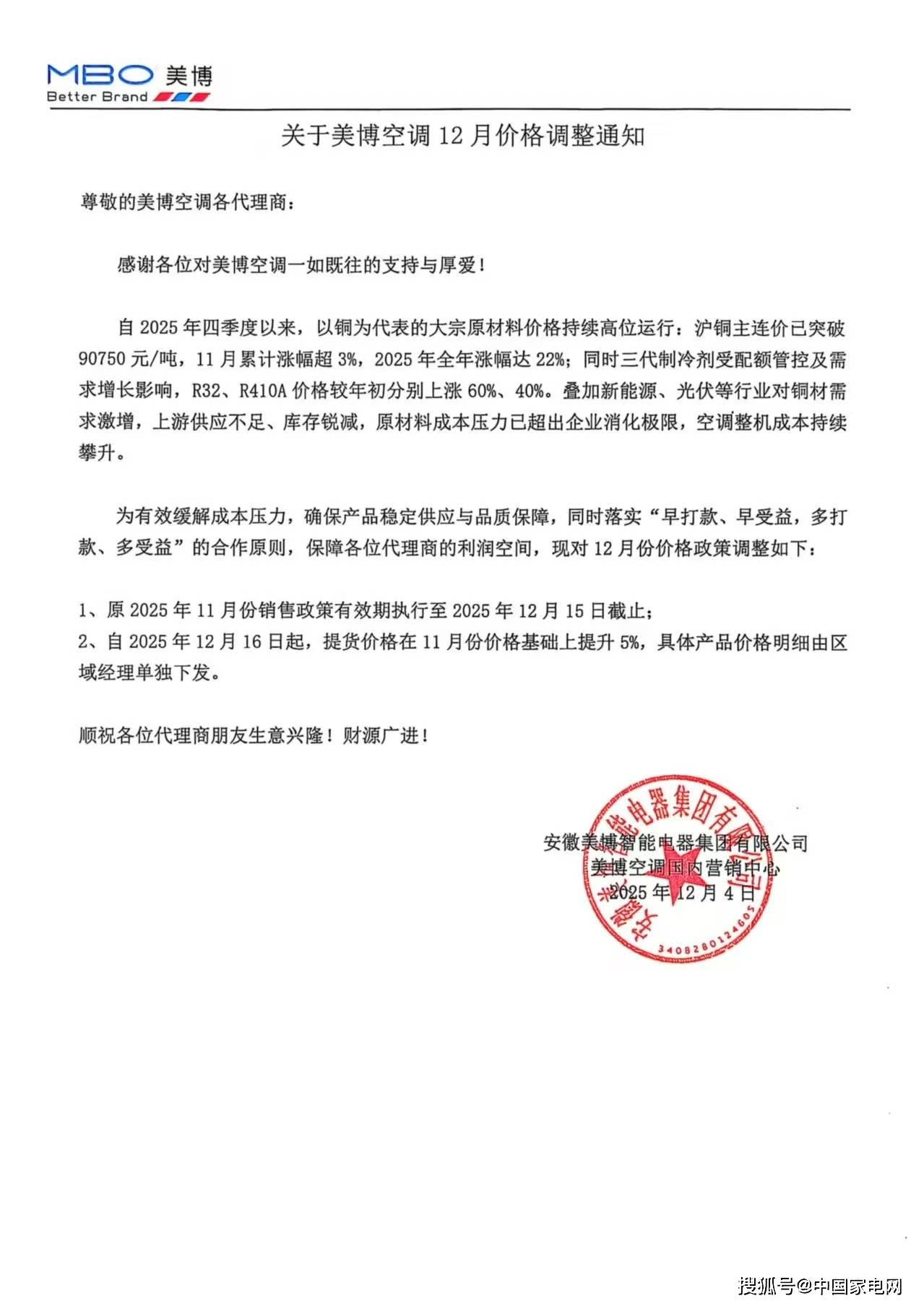
铜价创历史新高,美博空调打响涨价“第一枪”
Sou Hu Cai Jing· 2025-12-08 10:50
Group 1 - Recent copper prices have surged, with the main futures contract on December 3 reaching 90,000 yuan per ton, marking a historical high [4] - The premium of LME spot copper over three-month futures reached $86 per ton, the highest since mid-October, indicating tight supply in the copper market [4] Group 2 - Copper is a crucial raw material for various home appliances, especially air conditioners, and fluctuations in copper prices significantly impact the home appliance industry [6] - Previous increases in copper prices have led to price hikes in air conditioning units, and the current high copper prices are expected to exert direct and severe pressure on the industry [6] - Major brands are likely to respond to rising costs by either launching new products, adjusting product structures, or gradually increasing end prices after the year-end promotional season [6] - The cyclical nature of copper price fluctuations may act as a catalyst for deeper structural adjustments and a new round of reshuffling within the air conditioning industry amid intense competition [6]

硫磺冲上4000元,磷酸铁锂又迎成本压力?
高工锂电· 2025-12-08 09:44
Core Viewpoint - The recent surge in sulfur prices, which have increased by over 300% since mid-2024, is expected to raise the costs of lithium iron phosphate (LFP) and other related materials, potentially impacting the overall cost structure of the lithium battery industry [2][3]. Group 1: Sulfur Price Dynamics - Domestic solid sulfur prices have risen from approximately 915 yuan/ton to around 4100 yuan/ton, with some forecasts predicting prices could reach 6000 yuan/ton [3]. - The price increase is driven by a supply-demand imbalance, with rising contract prices in the Middle East and decreasing domestic port inventories, alongside growing demand from downstream sectors such as phosphate fertilizers and lithium batteries [3][4]. Group 2: Cost Implications for Phosphate Fertilizers - For phosphate fertilizers, a 100 yuan increase in sulfur prices leads to an approximate 50 yuan increase in production costs [6]. - Current estimates suggest that the cost of producing monoammonium phosphate has exceeded 4200 yuan/ton, while the selling price is around 3650 yuan/ton, indicating a loss of nearly 600 yuan per ton [6]. Group 3: Impact on Lithium Iron Phosphate Production - The production of one ton of lithium iron phosphate requires about 0.23 tons of sulfur, translating to a cost increase from approximately 210 yuan to 940 yuan per ton of LFP as sulfur prices rise [10]. - The overall cost structure of LFP shows that raw materials account for over 80% of total costs, with lithium sources and iron phosphate being significant components [11]. Group 4: Market Reactions and Future Considerations - The increase in sulfur costs is seen as a pressure point for LFP producers, who are already facing thin margins due to prolonged price declines and industry losses [16][17]. - The market is currently witnessing a rebound in processing fees for LFP, but the fundamental issues of profitability remain unresolved [16]. - The industry must focus on managing costs and pricing strategies, particularly in light of potential further increases in sulfur prices and their implications for overall production costs [24].

瑞达期货菜籽系产业日报-20251104
Rui Da Qi Huo· 2025-11-04 09:21
1. Report Industry Investment Rating - Not provided in the content 2. Core Viewpoints of the Report - The rapeseed meal market is in a situation of weak supply and demand. The supply is under less pressure due to import restrictions and oil - mill shutdowns, but the demand is also weakening as aquaculture demand decreases and soybean supply is relatively abundant with good substitution advantages [2]. - The rapeseed oil market is supported by the tightening supply of imported rapeseed and the de - stocking mode. However, the demand is mainly for essential needs due to the sufficient supply and good substitution advantage of soybean oil. The near - month contracts of rapeseed oil perform better than the far - month ones, and the price is in a narrow - range fluctuation, suggesting short - term observation [2]. 3. Summary According to Related Catalogs 3.1 Futures Market - The closing price of the active rapeseed oil contract is 9443 yuan/ton, down 27 yuan; the closing price of the active rapeseed meal contract is 2497 yuan/ton, up 6 yuan. The ICE rapeseed closing price is 647.6 Canadian dollars/ton, up 9.7 Canadian dollars; the closing price of the active rapeseed contract is 5130 yuan/ton, down 130 yuan [2]. - The 1 - 5 month spread of rapeseed oil is 363 yuan/ton, down 23 yuan; the 1 - 5 month spread of rapeseed meal is - 85 yuan/ton, up 8 yuan. The net long positions of the top 20 futures holders for rapeseed oil are - 3380 lots, down 5277 lots; for rapeseed meal, they are - 24967 lots, up 13261 lots [2]. - The number of rapeseed oil warehouse receipts is 7540, unchanged; the number of rapeseed meal warehouse receipts is 2955, unchanged. The main - contract positions for rapeseed oil are 213040 lots; for rapeseed meal, they are 375310 lots [2]. 3.2 Spot Market - The spot price of rapeseed oil in Jiangsu is 9770 yuan/ton, down 30 yuan; the spot price of rapeseed meal in Nantong is 2530 yuan/ton, up 10 yuan. The average price of rapeseed oil is 9887.5 yuan/ton, down 30 yuan [2]. - The import cost of rapeseed is 7969.31 yuan/ton, up 150.43 yuan. The spot price of rapeseed in Yancheng, Jiangsu is 5700 yuan/ton, unchanged. The oil - meal ratio is 3.78, down 0.03 [2]. - The basis of the rapeseed oil main contract is 327 yuan/ton, down 3 yuan; the basis of the rapeseed meal main contract is 33 yuan/ton, up 4 yuan. The spot price difference between rapeseed oil and soybean oil is 1360 yuan/ton, down 80 yuan [2]. 3.3 Substitute Spot Prices - The spot price of 24 - degree palm oil in Guangdong is 8570 yuan/ton, down 30 yuan; the spot price difference between rapeseed oil and palm oil is 1200 yuan/ton, unchanged. The spot price of soybean meal in Zhangjiagang is 3050 yuan/ton, up 10 yuan; the spot price difference between soybean meal and rapeseed meal is 520 yuan/ton, unchanged [2]. 3.4 Upstream Situation - The global rapeseed production forecast is 90.96 million tons, up 1.38 million tons; the annual rapeseed production forecast is 13446 thousand tons, up 1068 thousand tons. The total rapeseed import volume is 11.53 tons, down 13.13 tons [2]. - The crushing profit of imported rapeseed is 596 yuan/ton, down 63 yuan. The total rapeseed inventory in oil mills is 2 tons, down 1 ton; the weekly operating rate of imported rapeseed is 1.6%, down 1.33% [2]. 3.5 Industry Situation - The import volume of rapeseed oil and mustard oil is 16 tons, up 2 tons; the import volume of rapeseed meal is 15.77 tons, down 5.57 tons [2]. - The rapeseed oil inventory in coastal areas is 3.8 tons, down 0.4 tons; the rapeseed meal inventory is 0.71 tons, unchanged. The rapeseed oil inventory in the East China region is 47.8 tons, down 1.6 tons; the rapeseed meal inventory is 26.05 tons, down 0.7 tons [2]. - The rapeseed oil inventory in Guangxi is 2.4 tons, down 0.3 tons; the rapeseed meal inventory in South China is 20.7 tons, down 0.6 tons. The weekly rapeseed oil pick - up volume is 1.84 tons, up 1.49 tons; the weekly rapeseed meal pick - up volume is 0.39 tons, up 0.17 tons [2]. 3.6 Downstream Situation - The monthly output of feed is 201.5 tons; the monthly output of edible vegetable oil is 3128.7 tons, up 495 tons. The monthly retail sales of social consumer goods in the catering industry is 4508.6 billion yuan, up 12.9 billion yuan [2]. 3.7 Option Market - The implied volatility of at - the - money call options for rapeseed meal is 23.8%, up 1.31%; the implied volatility of at - the - money put options is 18.97%, down 3.52%. The 20 - day historical volatility is 25.27%, up 4.27%; the 60 - day historical volatility is 26.8%, up 1.45% [2]. - The implied volatility of at - the - money call options for rapeseed oil is 14.42%, down 0.19%; the implied volatility of at - the - money put options is 13%, down 1.6%. The 20 - day historical volatility is 13.77%, up 0.22%; the 60 - day historical volatility is 15.09%, up 0.03% [2]. 3.8 Industry News - On November 3, ICE rapeseed futures closed higher, supported by trade optimism and the spill - over effect of CBOT soybean futures. The January rapeseed futures closed 10.90 Canadian dollars higher at 647.90 Canadian dollars per ton [2]. - The US Treasury Secretary confirmed that China has agreed to purchase 12 million tons of US soybeans this season and at least 25 million tons per year in the next three years, which boosts the US soybean futures price and benefits the domestic meal market [2]. - The Canadian Prime Minister and the Chinese President's meeting in South Korea failed to make a breakthrough on rapeseed tariffs. The harvest of Canadian rapeseed is over, with a large supply and weakening exports, but an agreement with Pakistan provides additional support [2]. - GAPKI expects Indonesia's palm oil production to increase by 10% in 2025, and the B50 biodiesel plan in Indonesia is uncertain, causing concerns about long - term biodiesel demand [2].
轮胎企业齐发涨价函 下游经销商能否买账?
Xin Hua Wang· 2025-08-12 05:48
Core Viewpoint - The tire industry is experiencing a wave of price increases due to rising raw material costs, with over 30 companies announcing price hikes ranging from 1% to 6% in September and early October [1][2]. Group 1: Price Increases - More than 30 tire companies, including Linglong Tire and Triangle Tire, have announced price increases in September and early October, with the hikes generally between 1% and 6% [1]. - Some companies have raised prices on key products by 10% to 20% due to significant increases in raw material costs [2]. Group 2: Raw Material Costs - The prices of key raw materials have surged, with prices for synthetic rubber, carbon black, and anti-aging agents rising significantly; for instance, the price of butadiene rubber has increased by 36% from its low point this year [2]. - As of September 15, the price of natural rubber reached 11,720 yuan per ton, an increase of 11.41% month-on-month and 7.52% year-on-year [2]. Group 3: Market Dynamics - The price increases are intended to transfer cost pressures to downstream distributors and stimulate orders, although the success of these price hikes will depend on the end-market demand [3]. - There may be a differentiation in the effectiveness of these price increases, with established brands likely to succeed in implementing price hikes, while lower-quality competitors may struggle [4].


宗申动力20250406
2025-04-07 05:59
Summary of Conference Call for Zongshen Power Industry Overview - The conference call primarily discusses the impact of increased tariffs on the general machinery industry, particularly focusing on Zongshen Power's operations in the North American market [3][4][9]. Key Points and Arguments - **Tariff Impact**: The U.S. has imposed tariffs as high as 79% on Chinese general machinery products. Zongshen Power had anticipated this and preemptively shifted some production capacity to Vietnam. However, Vietnam also faces a potential increase in tariffs from 16% to 46%, which is still lower than China's [3][4]. - **Client Relationships**: Zongshen Power exports mainly through OEM (Original Equipment Manufacturer) and private label arrangements, serving major brands like Waiting House, POS systems, and Ford. These clients have strong bargaining power and can pass on increased costs to consumers [5][11]. - **Market Demand**: General machinery products, such as lawnmowers and backup generators, are considered essential consumer goods in the U.S. market. Demand remains stable due to factors like unstable power grids and the need for emergency equipment [8][9]. - **Manufacturing Competitiveness**: Despite the tariff increases, China remains the largest base for general machinery production globally. Other countries cannot quickly match China's scale and cost control capabilities, ensuring that the market structure remains largely unchanged [9][10]. - **Pricing Sensitivity**: The end-user prices for Zongshen Power's products range from $300 to $500, with power products nearing $1,000. Consumers show low price sensitivity due to the long replacement cycles and the essential nature of these products [10][11]. - **Cost Transmission**: The company cannot absorb the full impact of increased tariffs (estimated at 30% to 40%), leading to a necessity to pass costs onto customers and ultimately consumers. This will affect short-term market consumption but is not expected to undermine long-term competitiveness [11]. - **Future Outlook**: Zongshen Power expresses confidence in its future development, particularly in the drone sector, which is expected to grow due to global military competition. The company believes that its stable domestic operations will support its competitive position [12]. Additional Important Insights - **Negotiation Efforts**: The Vietnamese government is actively negotiating with the U.S. to lower tariffs, which could provide a competitive edge for Zongshen Power's operations in Vietnam [3][6]. - **Market Structure Stability**: The overall competitive environment is expected to remain stable, as even international brands producing in China will face similar tariff impacts [9]. This summary encapsulates the critical insights from the conference call, highlighting the challenges and strategies of Zongshen Power in the context of increased tariffs and market dynamics.
