
流动性预期

Search documents
黄金持续震荡 还能涨吗?中信证券敖翀:金价上涨趋势并没有完结
2 1 Shi Ji Jing Ji Bao Dao· 2026-02-06 03:20
2026年伊始,黄金行情持续牵动全球投资者的神经。 暴涨——新高——暴跌——回暖——震荡,剧烈的波动之下,市场情绪在狂热与恐慌之间反复切换。有 人止损离场,也有人逢低抄底;也有投资者跑步进场,而后在行情震荡中饱受煎熬…… 截至2月6日11时,国际黄金现货价格约在4850美元/盎司上下,较年初上涨约12%,表现虽超过多数主 流市场指数。然而,与1月29日创下的历史高点相比,金价仍回调超过700美元/盎司。 市场分歧正在加剧。"黄金还能买吗?""该选积存金还是黄金ETF?""这一轮上涨究竟能走多远?"投资 者的疑问纷至沓来。与此同时,已有部分投资者将目光悄然转向其他小金属,试图在金银狂潮之外,提 前捕捉下一个可能起飞的市场。 近日,针对当前黄金市场的剧烈波动与后续走向,21世纪经济报道记者特别对话了中信证券有色金属行 业首席分析师敖翀,试图厘清本轮行情的核心驱动,探寻价格剧烈波动的背后逻辑。 在交流中,敖翀明确指出,当前黄金的上涨趋势尚未完结,流动性预期是当下驱动黄金价格走势的核心 力量。此外,持续的地缘政治冲突也为黄金提供了阶段性的避险动力。 敖翀进一步分析称,随着流动性的持续释放,中国和全球经济有望在未来6- ...

有色及贵金属周报:流动性预期回摆,错杀品修复可期-20260202
Orient Securities· 2026-02-02 12:42
有色金属行业 行业研究 | 行业周报 流动性预期回摆,错杀品修复可期 ——有色及贵金属周报 核心观点 投资建议与投资标的 核心观点:流动性预期回摆,错杀品修复可期。近日特朗普提名沃什为下一任美联储主 席,短期贵金属乐观预期的回摆导致金属价格大幅波动,建议关注错杀品种的修复机 会。 投资标的: 相关标的:山东黄金(600547,未评级)、山金国际(000975,未评级)、中金黄金 (600489,未评级)、赤峰黄金(600988,买入)、紫金矿业(601899,买入)、洛阳钼业 (603993,未评级)、中国铝业(601600,未评级)、西部矿业(601168,未评级)、金诚 信(603979,未评级)。 风险提示 下游需求弱于预期、供给端大量释放、美联储降息进程不及预期等。 国家/地区 中国 行业 有色金属行业 报告发布日期 2026 年 02 月 02 日 看好维持 | 于嘉懿 | 执业证书编号:S0860525110005 | | --- | --- | | | yujiayi1@orientsec.com.cn | | | 021-63326320 | | 兰洋 | 执业证书编号:S0860525120 ...





资讯早班车-2026-01-29-20260129
Bao Cheng Qi Huo· 2026-01-29 02:27
1. Report Industry Investment Rating No relevant content provided. 2. Core Viewpoints of the Report - The Fed maintained the benchmark interest rate at 3.50%-3.75%, pausing after three consecutive 25-basis-point rate cuts, in line with market expectations. The unemployment rate has shown initial signs of stabilizing, inflation remains relatively high, and economic prospects are still highly uncertain [4][13]. - The prices of precious metals and non-ferrous metals have continued to surge, with gold and silver hitting new highs. The gold recycling business has boomed, and the scale of gold-themed funds has grown significantly [5][6]. - The A-share market has seen resource stocks rally, while the photovoltaic industry chain has adjusted. The Hong Kong stock market has also risen, with the Hang Seng Index hitting a new high since August 2021 [31]. 3. Summary by Directory 3.1 Macro Data Overview - GDP growth in Q4 2025 was 4.5% year-on-year, down from 4.8% in the previous quarter and 5.4% in the same period last year [1]. - The manufacturing PMI in December 2025 was 50.1%, up from 49.8% in the previous month and the same as the same period last year [1]. - The non-manufacturing PMI in December 2025 was 50.2%, up from 50.0% in the previous month but down from 52.2% in the same period last year [1]. - Social financing in December 2025 was 2.2075 trillion yuan, down from 3.5299 trillion yuan in the previous month and 2.8537 trillion yuan in the same period last year [1]. - The year-on-year growth rates of M0, M1, and M2 in December 2025 were 10.2%, 3.8%, and 8.5% respectively [1]. - New RMB loans in December 2025 were 910 billion yuan, down from 1.29 trillion yuan in the previous month and 990 billion yuan in the same period last year [1]. - The CPI in December 2025 increased by 0.8% year-on-year, up from -0.3% in the previous month and 0.1% in the same period last year [1]. - The PPI in December 2025 decreased by 1.9% year-on-year, narrowing from -2.3% in the previous month and the same period last year [1]. - Fixed asset investment in 2025 decreased by 3.8% year-on-year, down from -0.5% in the previous period and 3.2% in the same period last year [1]. - Retail sales of consumer goods in 2025 increased by 3.7% year-on-year, down from 4.5% in the previous period but up from 3.5% in the same period last year [1]. - Exports in December 2025 increased by 6.6% year-on-year, down from 8.2% in the previous month and 10.67% in the same period last year [1]. - Imports in December 2025 increased by 5.7% year-on-year, down from 7.4% in the previous month but up from 0.84% in the same period last year [1]. 3.2 Commodity Investment Reference 3.2.1 Comprehensive - Futures exchanges have tightened risk control. The Shanghai Gold Exchange will adjust the margin level of the Ag(T+D) contract to 20% and the daily limit to 19% from the close of trading on January 30 [2]. - The Shanghai Futures Exchange will adjust the daily limit and margin ratio of nickel and other futures contracts from the close of trading on January 30 [2]. - The Chicago Mercantile Exchange has raised the margin requirements for silver, platinum, and palladium [2]. - On January 28, 32 domestic commodity varieties had positive basis, and 36 had negative basis. The basis of Shanghai nickel, live pigs, and eggs was the largest, while that of Shanghai tin, butadiene rubber, and international copper was the smallest [3]. - The Guotou Silver LOF will be suspended from trading from 9:30 to 10:30 on January 29, 2026. If the premium rate of its secondary market trading price does not effectively decline, the fund has the right to take measures such as applying for intraday suspension or extending the suspension time to alert the market to risks [3]. 3.2.2 Metals - On January 29, spot silver and New York silver futures exceeded $119 per ounce, hitting new highs. Spot gold fell below $5,500, dropping more than $100 in the short term. Palladium futures exceeded $2,100 per ounce, rising 11.67% intraday [5]. - On January 28, most London base metals rose. The Fed's decision to keep interest rates unchanged has affected global liquidity expectations, and the long-term demand logic of base metals is being re-evaluated [5]. - The prices of precious metals and non-ferrous metals have continued to surge. On January 28, the gold futures price on the New York Mercantile Exchange exceeded $5,400 per ounce, and the domestic gold futures price approached 1,200 yuan per gram. The precious metals and non-ferrous metals sectors in the A-share market have seen a wave of limit-up stocks [5]. - The gold recycling business has boomed. The scale of gold-themed funds has grown significantly, with the total scale of 53 gold-themed funds approaching 380 billion yuan as of January 28, an increase of nearly 100 billion yuan from the end of last year, a rise of 35.7% [6]. - Russia's Norilsk Nickel expects its nickel production in 2026 to be between 19,300 and 20,300 tons and its palladium production to be between 2.415 and 2.465 million ounces [7]. - As of January 27, lead inventory decreased by 2,000 tons to 209,175 tons; copper inventory increased by 1,575 tons to 173,925 tons, hitting a new high in more than eight months; aluminum inventory decreased by 2,275 tons to 499,975 tons; tin inventory decreased by 25 tons to 7,060 tons; nickel inventory increased by 612 tons to 286,338 tons, hitting a new high in more than seven years and seven months; zinc inventory decreased by 175 tons to 110,375 tons; aluminum alloy inventory remained stable at 1,500 tons, the lowest level in more than four years and ten months; and cobalt inventory remained stable at 121 tons, the lowest level in more than one year and three months [7]. 3.2.3 Coal, Coke, Steel, and Minerals - The EU and Vietnam are expected to deepen cooperation on critical minerals and semiconductors [8]. 3.2.4 Energy and Chemicals - The main contract of U.S. crude oil closed higher. Trump warned Iran to reach an agreement as soon as possible, and U.S. crude oil inventories decreased by 2.295 million barrels last week, more than expected, supporting oil prices [9]. - U.S. Treasury Secretary Bezant said that an increase in Venezuelan crude oil supply means a decrease in natural gas prices [10]. 3.2.5 Agricultural Products - The Ministry of Agriculture and Rural Affairs has deployed work to stabilize beef cattle production and accelerate the relief of the dairy industry. It emphasizes the need to implement relief support policies, stabilize basic production capacity, and promote the high-quality development of the industry [11]. 3.3 Financial News Compilation 3.3.1 Open Market - On January 28, the central bank conducted 377.5 billion yuan of 7-day reverse repurchase operations at a fixed interest rate of 1.40%, with a net investment of 1.4 billion yuan [12]. - On January 28, the Ministry of Finance and the central bank conducted a tender for the first-phase central treasury cash management commercial bank time deposit in 2026, with a winning amount of 150 billion yuan and a winning interest rate of 1.73% [12]. 3.3.2 Important News - The Fed maintained the benchmark interest rate at 3.50%-3.75%, pausing after three consecutive 25-basis-point rate cuts, in line with market expectations. The unemployment rate has shown initial signs of stabilizing, inflation remains relatively high, and economic prospects are still highly uncertain [4][13]. - The "report card" of central state-owned enterprises in 2025 was released. By the end of 2025, the total assets of central state-owned enterprises exceeded 95 trillion yuan, and the total profit in 2025 was 2.5 trillion yuan. The State-owned Assets Supervision and Administration Commission of the State Council will promote the establishment of new central state-owned enterprises and strategic reorganizations and is drafting a document on promoting the cultivation of emerging pillar industries by central state-owned enterprises [13]. - The National Tax Work Conference emphasized the need to strengthen the standardization of tax incentives. During the 14th Five-Year Plan period, the tax department collected more than 156 trillion yuan in taxes and fees, accounting for about 80% of the full-caliber fiscal revenue, and provided more than 10 trillion yuan in tax cuts, fee reductions, and tax refunds [14][15]. - China will host the first senior officials' meeting and related meetings of APEC in Guangzhou from February 1 to 10, 2026 [15]. - The 2026 National Population and Family Development Work Conference emphasized the need to optimize fertility support policies and incentives, promote a positive marriage and childbearing concept, and develop inclusive childcare services [15]. - The "report cards" of China's economic provinces in 2025 were released. Guangdong and Jiangsu both exceeded 14 trillion yuan in GDP, and Shandong became the third province with a GDP exceeding 10 trillion yuan [15]. - Nearly 60% of surveyed U.S. companies plan to increase their investment in China, more than half of the surveyed companies expect to make a profit or a significant profit in 2025, and more than 70% of the companies have not considered moving their production or procurement links outside China [15]. - Many real estate companies have confirmed that they are no longer required by regulatory authorities to report the "three red lines" indicators monthly. However, some troubled real estate companies are still required to report financial indicators such as asset - liability ratios to the special team in their headquarters cities regularly [16]. - In 2025, a total of 27,100 urban old communities and 4.99 million households were renovated, with a total investment of 133.2 billion yuan [16]. - With the decline in deposit interest rates and the maturity of a large number of high - interest fixed deposits, residents' deposits are flowing into the market. There is a trend of seeking "deposit alternatives" [16]. - As of the end of December 2025, the total scale of China's public funds reached 37.7 trillion yuan, a record high. The scale of bond funds increased by more than 410 billion yuan, and the scale of stock funds increased by more than 250 billion yuan [16][17]. - Qinghai Province plans to actively resolve local debt risks and exit the list of key provinces for local debt [17]. - The Hong Kong branch of the China Development Bank successfully issued 5.5 billion yuan of RMB public bonds in the Macao Special Administrative Region, including 3.5 billion yuan of 3 - year special bonds with an issue interest rate of 1.75% and 2 billion yuan of 5 - year special bonds with an issue interest rate of 1.85% [17]. - The Ministry of Finance announced the ranking of spot trading volumes of book - entry treasury bonds in 2025. Ping An Bank, Citic Securities, and Orient Securities ranked among the top three [18]. - Tianjin's bond market has achieved good development, with the issuance of Tianjin's science and technology innovation bonds reaching 12.811 billion yuan, a year - on - year increase of 27.7%, and the issuance of green bonds reaching 18.027 billion yuan, a year - on - year increase of 58.9% [18]. - The bid - to - cover ratio of Japan's 40 - year treasury bond auction reached 2.76, the highest level since March 2025, temporarily alleviating the tension in the bond market [18]. - The minutes of the Bank of Japan's meeting showed that if the outlook is in line with expectations, it is advisable to continue raising interest rates [19]. - There were a series of bond - related events, including equity transfers, bond redemptions, and credit rating changes [20]. 3.3.3 Bond Market Summary - The Chinese bond market warmed up in the afternoon, with the yields of interest - rate bonds generally declining. The 10 - year treasury bond yield reached 1.81%. Bond futures rose across the board, and the money market was stable with little price change. The bond market is expected to remain volatile in the short term [21]. - In the exchange bond market, Vanke's bonds performed strongly, while some other bonds declined. The CSI Convertible Bond Index rose 0.85%, and the money market interest rates mostly declined [22][23]. - The winning yields of Agricultural Development Bank's 1.0356 - year, 3 - year, and 10 - year financial bonds were 1.4720%, 1.6074%, and 1.9650% respectively. The winning yields of Export - Import Bank of China's 2 - year and 3 - year financial bonds were 1.5501% and 1.6044% respectively [24]. - The yields of European government bonds mostly declined, while the yields of U.S. Treasury bonds were mixed [24]. 3.3.4 Foreign Exchange Market - The on - shore RMB closed at 6.9453 against the U.S. dollar, up 123 basis points from the previous trading day. The central parity rate of the RMB against the U.S. dollar was 6.9755, up 103 basis points from the previous trading day [25]. - The U.S. dollar index rose 0.63% to 96.35 in New York trading. Non - U.S. currencies showed mixed performance [26]. 3.3.5 Research Report Highlights - CITIC Construction Investment's research shows that the pricing power of long - duration interest - rate bonds is concentrated in funds, while rural commercial banks are "passive" allocation players. Insurance companies have a small amount of pricing power in ultra - long - term treasury bonds, and large banks have more pricing power in short - duration treasury bonds. The change speed of bond fund duration is a better indicator for short - term timing [27]. - Guosheng Fixed Income believes that there is no need to be overly worried about the current deposit transfer. The transfer of corporate deposits has been occurring since April 2024, and the transfer of residents' deposits is not a major concern for now [27]. - CITIC Securities states that the U.S. private banking industry has a mature system, and the asset allocation of Chinese private banking is shifting from deposits and real estate to functional products and service - based architectures [28]. 3.4 Stock Market News - The A - share market fluctuated, with resource stocks surging and the photovoltaic industry chain adjusting. The Shanghai Composite Index rose 0.27%, the Shenzhen Component Index rose 0.09%, the ChiNext Index fell 0.57%, the North Star 50 Index fell 0.16%, and the Wind All - A Index rose 0.11%. The market turnover reached 2.99 trillion yuan [31]. - The Hang Seng Index rose 2.58% to 27,826.91, hitting a new high since August 2021. The Hang Seng Technology Index rose 2.53%, and the Hang Seng China Enterprises Index rose 2.89%. The precious metals, non - ferrous metals, and petroleum sectors led the gains. Mingming很忙, the "first stock in the bulk snack industry," rose 69% on its first day of listing. Southbound funds sold more than HK$3.4 billion, with net sales for four consecutive trading days [31].
个别机构看多黄金到6600美元,多方提示超买风险
Di Yi Cai Jing· 2026-01-26 23:20
Core Viewpoint - The surge in gold and silver prices is driven by a combination of factors including monetary credit reconstruction, escalating geopolitical risks, and liquidity expectations, with gold prices potentially reaching $6,000 per ounce by 2026 [1][3]. Group 1: Gold and Silver Price Movements - On January 26, London spot gold broke through the $5,000 and $5,100 per ounce thresholds, reaching a historical high of $5,111 per ounce, while silver also hit a new record, surpassing $110 per ounce before settling at $108 [1]. - In the domestic futures market, the main contract for gold rose by 3.67%, reaching a new high of 1,151 yuan per gram, while silver surged nearly 13%, peaking at 28,226 yuan per kilogram [1]. Group 2: Institutional and Investor Sentiment - Various institutions maintain bullish outlooks on gold, with UBS setting a target price of $5,000 per ounce, while Goldman Sachs raised its year-end target from $4,900 to $5,400, citing increased demand from private investors and central banks [3]. - Bank of America has set a target of $6,000 per ounce for gold, predicting a significant price increase based on historical trends [3]. Group 3: Investment Trends and Demand - There is a notable increase in investor interest in gold, with many seeking to diversify their portfolios through various investment vehicles such as gold ETFs and stocks [5]. - The largest gold ETF in China surpassed 100 billion yuan in assets for the first time, reflecting a significant inflow of capital into gold investments [6]. Group 4: Central Bank Activities - Central banks globally continue to increase their gold reserves, with China's central bank reporting a rise in gold holdings, and emerging market central banks actively converting foreign reserves into gold [7]. - The World Gold Council reported that global official gold reserves reached approximately $3.69 trillion, with central banks purchasing gold at a rate significantly higher than in previous years [7]. Group 5: Market Risks and Regulatory Actions - Regulatory bodies have begun to implement measures to cool down the overheated gold market, including adjusting trading limits and increasing risk assessment requirements for gold investment products [8]. - Analysts caution that the current market is driven by emotional factors, and while the long-term outlook for gold remains positive, short-term corrections may be necessary due to overbought conditions [9].
金银价疯涨,全球“氪金”热潮能否持续
Di Yi Cai Jing· 2026-01-26 13:52
Group 1 - The core viewpoint of the articles highlights a bullish sentiment towards gold and silver prices, with predictions of gold potentially reaching $6,000 per ounce by 2026, driven by various economic factors [1][2] - On January 26, London spot gold broke through the $5,000 and $5,100 per ounce levels, reaching a historical high of $5,111 per ounce, while silver also set a new record, surpassing $110 per ounce before settling at $108 [1] - In the domestic futures market, the main contract for gold rose by 3.67%, reaching a historical high of 1,151 yuan per gram, and silver surged nearly 13%, peaking at 28,226 yuan per kilogram [1] Group 2 - The bullish trend in precious metals is attributed to a combination of factors including the reconstruction of monetary credit, escalating geopolitical risks, and liquidity expectations, leading to a global revaluation of precious metal assets [1] - Bank of America has raised its near-term gold price target to $6,000 per ounce, citing historical trends where gold prices have increased by an average of 300% over approximately 43 months during past bull markets [2] - Jefferies Group has an even more optimistic outlook, suggesting that gold prices could reach $6,600 per ounce this year [2]

贵金属强势突破,白银创历史新高|期货周报
2 1 Shi Ji Jing Ji Bao Dao· 2026-01-26 02:40
Group 1: Market Performance - The domestic futures market showed a mixed performance from January 19 to January 23, with strong performance in precious metals and energy chemicals, while the black series experienced a general pullback [2] - In the energy chemical sector, fuel oil rose by 4.01% and crude oil increased by 0.79%. In contrast, the black series saw coking coal decline by 1.07% and iron ore drop by 2.21% [2] - Precious metals saw significant gains, with Shanghai gold up by 6.10% and Shanghai silver up by 8.39% [2] Group 2: Precious Metals Insights - On January 23, international silver prices surpassed $100 per ounce, marking a historical high with an annual increase of over 44%. The rise in gold and silver prices is attributed to geopolitical factors [3] - Silver's price increase is driven by both financial and industrial demand, with ongoing supply shortages exacerbated by tightening export controls and low inventory levels [3][4] - Analysts suggest that the recent price increases in gold and silver are primarily influenced by geopolitical tensions and market liquidity expectations rather than solely by safe-haven demand [4][5] Group 3: Platinum and Palladium Market Trends - On January 23, overseas platinum futures prices exceeded $2,600 per ounce, while palladium prices approached $2,000 per ounce, with platinum futures rising by 10.39% [6] - The platinum market has faced supply shortages for three consecutive years, with a projected supply gap of 69,200 ounces by 2025, leading to low inventory levels [6] - The demand for platinum is expected to be bolstered by the accelerating hydrogen energy industry, while palladium faces long-term pressure due to its reliance on internal combustion engine vehicles [7] Group 4: Regulatory Developments - The China Securities Regulatory Commission announced new guidelines for public fund performance benchmarks, effective March 1, 2026, aimed at enhancing the stability and seriousness of benchmark applications [8][9] - The guidelines emphasize the need for internal controls and management by fund managers, as well as external oversight by custodians and sales institutions [8][9] Group 5: Oil Market Dynamics - International oil prices rose over 3% due to escalating geopolitical tensions and increased U.S. sanctions, with Brent crude and NYMEX crude closing at $65.44 and $61.29 per barrel, respectively [11] - Analysts note that while the oil market currently faces an oversupply, geopolitical uncertainties provide a support base for prices, leading to potential short-term price spikes [11]

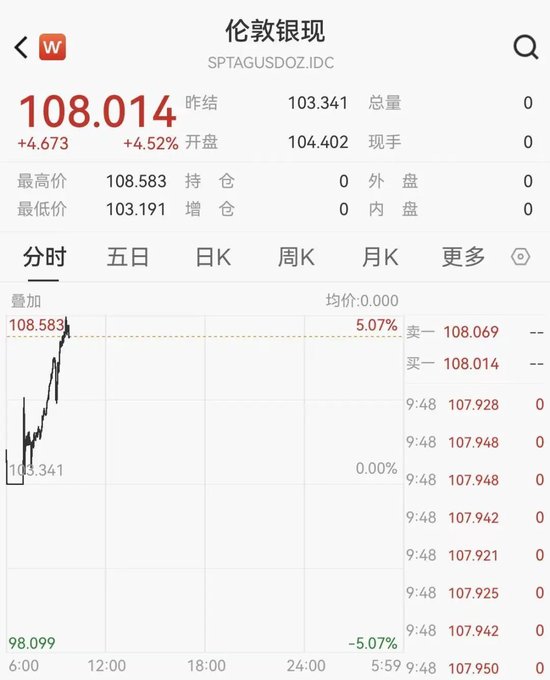
白银涨破108美元关口,A股黄金股集体大涨
Xin Lang Cai Jing· 2026-01-26 02:13
Core Viewpoint - The recent surge in precious metals prices, particularly silver and gold, is driven by geopolitical factors and increasing industrial demand, leading to significant market movements and investment opportunities in related stocks [6][14]. Precious Metals Price Movement - On January 26, silver opened with a significant increase, surpassing $108, with a daily rise of over 4% [9][10]. - Gold prices also saw a notable rise, initially breaking the $5000 mark and continuing to increase, reaching over $5070 [3][11]. Stock Market Reaction - The rise in precious metal prices led to a collective increase in A-share gold stocks, with Hunan Gold hitting the daily limit, and other companies like Xiaocheng Technology, Sichuan Gold, and Hengbang Shares also experiencing gains [4][12]. Supply and Demand Dynamics - Silver's price increase is attributed to its dual role as both a financial and industrial metal, with growing demand in sectors like photovoltaics and new energy contributing to a five-year supply shortage [5][12]. - Factors such as tightening export controls and historically low inventory levels have exacerbated the supply-demand imbalance, resulting in silver's price elasticity being significantly higher than that of gold [5][12]. Analyst Insights - Analysts from Haitong Futures and Jinrui Futures attribute the recent price increases in gold and silver to geopolitical tensions and market reactions to U.S. fiscal policies, which have affected investor confidence in U.S. assets [6][14].


有色及贵金属行业周报:流动性预期升级,白热化交易延续
Orient Securities· 2026-01-25 14:24
Investment Rating - The report maintains a positive outlook on the non-ferrous metals industry [6]. Core Viewpoints - Liquidity expectations have upgraded, leading to intensified trading. Recent optimistic interest rate cut expectations have resurfaced, driving both precious and industrial metals to break through previous levels. In the past week, the negative feedback for copper and aluminum has significantly weakened, and improvements in the real economy may be observed under high price conditions. Overall, the bullish trend for industrial products remains unchanged under the support of domestic and international policies [3][9]. Summary by Sections 1. Cycle Assessment - The report indicates an upgrade in liquidity expectations and a continuation of intense trading. The probability of BlackRock executive Riedel being elected as the Federal Reserve Chairman has surged to 54%. The optimistic expectations for interest rate cuts have reignited, pushing precious and industrial metals to new highs. Although copper and aluminum inventories continue to accumulate, the pace of accumulation has slowed, and the negative feedback from downstream processing has significantly diminished, with operating rates beginning to recover [9][13]. 2. Industry and Stock Performance - The non-ferrous metals sector saw a weekly increase of 6.03%, ranking fourth among all industries [28]. The report lists several investment targets, including Chifeng Jilong Gold Mining (600988, Buy) and Zijin Mining (601899, Buy) [4]. 3. Precious Metals - Precious metals are experiencing intense liquidity trading, awaiting the confirmation of the Federal Reserve Chairman nomination. As of January 23, SHFE gold rose by 8.07% to 1,115.64 CNY per gram, while COMEX gold increased by 7.54% to 4,036.00 USD per ounce. The report notes that the market expects limited upward pressure on precious metals in the short term due to anticipated interest rate stabilization [14][30]. 4. Copper - The report highlights renewed support for copper prices due to supply disruptions. As of January 23, SHFE copper rose by 0.57% to 101,340 CNY per ton, and LME copper increased by 2.44% to 13,115 USD per ton. Supply tightness continues, with recent strikes in Chile affecting copper concentrate availability [17][70]. 5. Aluminum - The report indicates a reduction in negative feedback for aluminum, with demand showing marginal recovery. As of January 23, SHFE aluminum rose by 1.53% to 24,290 CNY per ton, and LME aluminum increased by 1.12% to 3,169 USD per ton. The processing operating rate has risen by 0.7 percentage points to 60.9% [16][83].
有色及贵金属周报:流动性预期升级,白热化交易延续-20260125
Orient Securities· 2026-01-25 11:43
Investment Rating - The report maintains a positive outlook on the non-ferrous metals industry [6] Core Viewpoints - Liquidity expectations have upgraded, leading to intensified trading. Recent optimistic interest rate cut expectations have resurfaced, driving both precious and industrial metals to break through previous levels. The negative feedback for copper and aluminum has notably weakened, and improvements in the real economy may be observed under high price conditions. Overall, the bullish trend for industrial products remains unchanged under the support of domestic and international policies [3][9] Summary by Sections 1. Cycle Assessment - The cycle assessment indicates an upgrade in liquidity expectations and a continuation of intense trading. The probability of BlackRock executive Riedel being elected as the Federal Reserve Chairman has surged to 54%. The optimistic expectations for interest rate cuts have reignited, pushing precious and industrial metals to new highs. Although copper and aluminum inventories continue to accumulate, the pace of accumulation has slowed, and the negative feedback from downstream processing has significantly diminished, with operating rates beginning to recover [9][13] 2. Industry and Stock Performance - The non-ferrous metals sector saw a weekly increase of 6.03%, ranking fourth among all industries [28]. The precious metals sector experienced the highest gains [21]. 3. Precious Metals - For precious metals, trading has become intensely liquid, awaiting the confirmation of the Federal Reserve Chairman nomination. As of January 23, SHFE gold rose by 8.07% to 1,115.64 CNY per gram, while COMEX gold increased by 7.54% to 4,036.00 USD per ounce. The inventory levels for SHFE gold were 102 tons, an increase of 1.96 tons from the previous week [14][30]. 4. Copper - The copper market is experiencing renewed support due to supply disruptions. As of January 23, SHFE copper rose by 0.57% to 101,340 CNY per ton, and LME copper increased by 2.44% to 13,115 USD per ton. The operating rate for refined copper rods was 67.98%, up by 10.51 percentage points [17][29]. 5. Aluminum - The aluminum market shows signs of demand recovery as negative feedback weakens. As of January 23, SHFE aluminum rose by 1.53% to 24,290 CNY per ton, and LME aluminum increased by 1.12% to 3,169 USD per ton. The processing operating rate rose by 0.7 percentage points to 60.9% [16][85].
有色及贵金属行业周报:流动性预期回摆,无碍长多逻辑延续
Orient Securities· 2026-01-19 03:24
Investment Rating - The report maintains a positive outlook on the non-ferrous metals industry [6] Core Viewpoints - The report indicates that negative feedback is intensifying, leading to potential price fluctuations. As industrial product prices rise, domestic downstream negative feedback is increasing, resulting in accelerated inventory accumulation. Recent margin increases by CME and SHFE for certain products may lead to significant short-term price volatility in industrial metals. However, the overall bullish trend for industrial products remains unchanged under the expectation of supportive policies [3][9] Summary by Sections 1. Cycle Assessment - Liquidity expectations are reverting, which does not hinder the long-term bullish logic. Recent statements from Trump favoring Hassett for the National Economic Council position have increased market expectations for the new Fed chair. The probability of a Fed rate cut in April has dropped to 30%. This has led to potential price fluctuations in precious metals due to a weakened narrative around short-term rate cuts [9][13] 2. Industry and Stock Performance - The non-ferrous metals sector rose by 3.03% in the week ending January 16, ranking third among all industries [18] 3. Precious Metals - Short-term narratives around rate cuts are faltering, leading to potential price volatility in precious metals. As of January 16, SHFE gold rose by 2.57% to 1,032.32 CNY per gram, while COMEX gold increased by 2.62% to 4,590.00 USD per ounce. The report notes that the People's Bank of China increased its gold reserves to 7,415 million ounces, marking a continuous increase for 14 months [14][29] 4. Copper - The report highlights that negative feedback is intensifying, leading to increased price volatility for copper. As of January 16, SHFE copper fell by 0.63% to 100,770 CNY per ton, while LME copper decreased by 1.50% to 12,803 USD per ton. The report also notes a significant increase in global visible copper inventory [17][28] 5. Aluminum - The aluminum processing sector shows resilience, with profitability per ton of aluminum expected to remain high. As of January 16, SHFE aluminum fell by 1.66% to 23,925 CNY per ton. The report indicates that the average profit for the aluminum industry is around 7,868 CNY per ton [16][89]