
海洋强国

Search documents
天津冲出一家水下机器人IPO,国防科大80后校友任董事长,预计最早2026年盈利
3 6 Ke· 2025-12-29 13:40
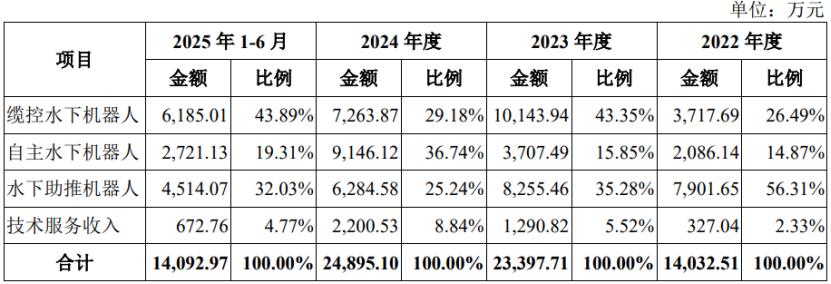
Core Viewpoint - Underwater robots are becoming a significant tool in the digital economy, with the industry expected to grow due to government support and increasing market demand for underwater technology [1][21]. Company Overview - Deep Blue Ocean Technology Co., Ltd. (referred to as "Deep Blue") has submitted its IPO application for listing on the Sci-Tech Innovation Board, with CICC as the sponsor [1]. - The company focuses on the research, production, sales, and service of underwater robot products, projecting revenue of over 250 million yuan in 2024, but is currently operating at a loss [1][21]. Product Breakdown - Deep Blue's main products include cable-controlled underwater robots, autonomous underwater vehicles, underwater gliders, automatic profiling buoys, and underwater propulsion robots [2]. - Revenue contributions from various products in 2024 are as follows: cable-controlled underwater robots (29.18%), autonomous underwater robots (36.74%), underwater propulsion robots (25.24%), and technical services (8.84%) [2]. Financial Performance - Deep Blue's revenue has shown an upward trend, with figures of approximately 141 million yuan in 2022, 235 million yuan in 2023, and a projected 251 million yuan in 2024, but the company has incurred cumulative losses nearing 300 million yuan over three years [9][21]. - The company’s net profit for 2022, 2023, 2024, and the first half of 2025 were approximately -134 million yuan, -92.6 million yuan, -65.8 million yuan, and -2.08 million yuan, respectively [9]. Market Outlook - The global underwater robot market is projected to grow from 9.4 billion USD in 2024 to 12.3 billion USD in 2025, with a compound annual growth rate (CAGR) of approximately 37.29% from 2025 to 2030 [11][12]. - The Chinese underwater robot market is expected to expand from 10.2 billion yuan in 2024 to 14.6 billion yuan in 2025, with a CAGR of about 46.93% from 2025 to 2030 [12]. Competitive Landscape - The underwater robot industry is currently dominated by foreign companies, particularly in high-end cable-controlled and autonomous underwater vehicles, while domestic companies are still in the development phase [15]. - Deep Blue holds advantages in operational scale, product range, and R&D capabilities compared to other domestic private enterprises, leading in the observation and light-duty cable-controlled underwater robot sectors [16]. Management and Structure - Deep Blue was established in 2013 and has a workforce of 444 employees, with 69 in R&D [17][20]. - The company plans to raise approximately 1.5 billion yuan through its IPO to fund the expansion of its underwater robot production base and upgrade its technology research and experimental center [20].


海洋法理论建构的锐意探索
Xin Lang Cai Jing· 2025-12-23 20:11
Core Viewpoint - The field of maritime law in China has rapidly developed and matured, forming a solid academic community and maintaining close ties with relevant national departments, making it a crucial aspect of international law [2] Group 1: Overview of Maritime Law - Maritime law is recognized as a significant area within international law, contributing to the theoretical framework and knowledge landscape of international law [2] - The evolution of maritime law has been influenced by historical scholars, including Grotius, who focused on state rights and actions in maritime domains [2] Group 2: Structure of the Book - The book "Theoretical Research on Chinese Maritime Law" by Professor Jin Yongming is a comprehensive collection of his research and insights on maritime law [2] - The second edition of the book is organized into four sections and 30 themes, reflecting a more systematic and contemporary approach compared to the first edition [2][3] Group 3: Key Themes in Maritime Law - The first section discusses fundamental systems of maritime law, including innocent passage through territorial seas, exclusive economic zones, and the legal status of islands and reefs [3] - The second section focuses on maritime law issues in the East China Sea, including the legal basis for China's rights and the establishment of security mechanisms [3] - The third section examines the South China Sea, analyzing historical policies and international legal frameworks, as well as the potential role of the Belt and Road Initiative in regional security cooperation [3] - The fourth section highlights China's achievements and contributions in maritime law, including its maritime security strategy and the legal framework for becoming a maritime power [3][4] Group 4: Research Characteristics - Professor Jin's research emphasizes a systematic approach, focusing on contemporary issues within the established legal norms of maritime law [5] - The research is grounded in empirical studies, requiring a clear understanding of legal norms and factual conditions related to maritime issues [6] - The research also highlights the importance of historical context in understanding the evolution of maritime law and its current applications [8] Group 5: Policy and Implementation - The book discusses China's historical neglect of maritime issues and the recent strategic shift towards becoming a maritime power and building a maritime community of shared destiny [9] - It emphasizes the need for a balance between hard and soft power in maritime affairs and the importance of legal research in addressing maritime disputes and resource management [9][10]

从“建桥”到“造船” 中铁四局承建7000TEU集装箱船首段成功发运
Ke Ji Ri Bao· 2025-12-22 07:46
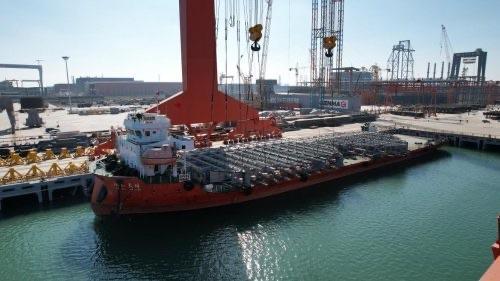
Core Insights - The construction project of a 7000TEU container ship, undertaken by China Railway Fourth Group, has reached a significant milestone with the successful dispatch of the first non-water-tight bulkhead segment, marking the ship's entry into the rapid segment construction phase [1][4] Group 1: Project Details - The dispatched non-water-tight bulkhead segment measures 36 meters in length, 22 meters in width, 1.9 meters in height, and weighs 240 tons, serving as a core component of the container ship's structure [3] - Container ships are designed for efficient loading and unloading, featuring large hatches, gridded cargo holds, and multi-layered deck stacking, making them the mainstay of modern maritime transport [3] Group 2: Technical Innovations - The project team has integrated large-scale steel structure precision control experience from bridge manufacturing into shipbuilding processes, optimizing positioning tools and support settings to achieve precise and rapid positioning of bulkhead components [3] - Various specialized techniques, including flame adjustment, segment flipping, external structural pressure, and ship-specific welding, have been implemented to address technical challenges related to deck flatness and assembly complexity [3] Group 3: Equipment Development - To support large-scale segment hoisting and modular shipbuilding, China Railway Fourth Group has developed a 1000-ton gantry crane at the base, which features a dual main beam design and multiple functionalities for lifting, longitudinal, and lateral movement [4] Group 4: Strategic Implications - The successful dispatch of the first segment reflects advancements in high-value ship manufacturing processes and project management capabilities in China, contributing positively to local industrial upgrades and the aggregation of high-end shipbuilding clusters [4] - This project aligns with national strategies for becoming a "maritime power" and a "manufacturing power," injecting new momentum into the autonomous and modern development of China's shipping logistics equipment [4]
资本疯抢!三个月多轮融资,“水下大疆”世航凭什么霸榜海洋机器人赛道?
Xin Lang Cai Jing· 2025-12-20 11:52
Group 1 - Seha Intelligent has secured three rounds of financing totaling several hundred million yuan within three months, establishing its position as a leader in the marine robotics sector [1] - The investment from top-tier capital firms such as Temasek's Xiangfeng Investment and Jinsha River Ventures indicates strong confidence in Seha's technological advancements and market potential [1] - Seha's core team consists of industry experts with over 300 intellectual property rights, enabling full independent research and development of key components and software algorithms [1] Group 2 - The marine robotics market presents a significant opportunity, with only 1% of the ocean's resources currently developed, highlighting a trillion-dollar market potential [2] - Seha Intelligent's capabilities in overcoming the high technical barriers associated with marine robotics position it as a benchmark in the industry, aligning with national strategies for marine development [2] - The company's integrated system of research, production, sales, and service supports its mature product offerings, which have been validated in various global scenarios [1][2]
福信富通科技股份有限公司(H0227) - 申请版本(第一次呈交)
2025-12-18 16:00
香港聯合交易所有限公司與證券及期貨事務監察委員會對本申請版本的內容概不負責,對其準確性 或完整性亦不發表任何聲明,並明確表示概不就因本申請版本全部或任何部分內容而產生或因倚賴 該等內容而引致的任何損失承擔任何責任。 Fortunetone Technology Co., Ltd.* 福信富通科技股份有限公司 (於中華人民共和國註冊成立的股份有限公司) 的申請版本 警告 本申請版本乃根據香港聯合交易所有限公司(「聯交所」)及證券及期貨事務監察委員會(「證監會」)的 要求而刊發,僅用作提供資料予香港公眾人士。 本申請版本為草擬本,其內所載資料並不完整,亦可能會作出重大變動。 閣下閱覽本文件,即表 示 閣下知悉、接納並向本公司、其獨家保薦人、整體協調人、顧問或包銷團成員表示同意: 本公司招股章程根據香港法例第32章公司(清盤及雜項條文)條例呈交香港公司註冊處處長登記前, 本公司不會向香港公眾人士提出要約或邀請。倘於適當時候向香港公眾人士提出要約或邀請,有意 投資者務請僅依據於香港公司註冊處處長註冊的本公司招股章程作出投資決定。招股章程的文本將 於發售期內向公眾發佈。 * 僅供識別 (a) 本文件僅為向香港公眾人士提 ...
中方通告全球:国内发现巨型海底金矿,储量3900余吨,亚洲最大,引发高度关注
Sou Hu Cai Jing· 2025-12-18 12:42
Core Insights - China has officially announced the discovery of Asia's largest underwater gold mine, located in the northern waters of Sanshan Island, Laizhou, with reserves exceeding 3,900 tons, making Yantai a leader in gold mining in China, accounting for over a quarter of the country's total reserves [1][3] - This discovery is not just about wealth; it represents a strategic move in the context of global geopolitical dynamics, showcasing China's capability to secure resources for its future [2][10] Group 1: Economic and Strategic Value - The 3,900 tons of gold is equivalent to the total output of all global gold mines over two years, significantly enhancing China's economic security and reducing dependence on foreign resources [3][7] - The discovery strengthens China's position in the global gold supply chain, allowing for greater self-sufficiency and the ability to stabilize the economy during international financial turmoil [7][10] Group 2: Technological Advancements - The successful discovery of the underwater gold mine is attributed to advanced technology and a dedicated research team, utilizing high-precision geophysical detection and AI systems for data analysis [5][9] - This achievement marks a significant advancement in China's deep-sea exploration capabilities, previously dominated by Western companies, and sets the stage for future resource exploration [5][9] Group 3: Regional Impact - Yantai's gold reserves now account for 26% of the national total, positioning the city as a strategic resource hub and enhancing local employment and industry development [7][9] - The discovery is expected to lead to the development of green mining practices, balancing resource extraction with environmental protection, thus setting a precedent for sustainable practices in resource management [9][12] Group 4: Global Implications - The announcement has caused significant reactions in international markets, with mining companies adjusting their forecasts, indicating a potential shift in the global resource balance [10][12] - China's increased gold reserves may enhance its influence in global pricing and market regulations, reflecting its growing economic power and strategic autonomy [10][12]

学子创演科学家剧目 课堂搬到生态实验室 沪上高校“大思政”持续上新
Jie Fang Ri Bao· 2025-12-12 01:36
Group 1 - The core theme of the news revolves around the commemoration of Qian Xuesen's 114th birthday and the 70th anniversary of his return to China, highlighting the importance of his contributions to science and education [1][2] - A new theatrical production titled "The Transoceanic Return of the Wall Breaker" was performed by students, showcasing the spirit of Qian Xuesen and integrating ideological education with artistic expression [1][2] - The event included the donation of 33 albums and over 2,400 historical photographs by Qian Xuesen's son, enriching the resources of the Qian Xuesen Library and supporting research on the spirit of the scientist [2] Group 2 - The integration of ideological education into laboratory settings was exemplified by a class at Shanghai Ocean University, where students engaged with marine geology and its implications for future clean energy [3] - The "Integrity Growth Power" course initiative was launched, featuring online micro-courses and offline thematic classes, with contributions from nearly 30 educational institutions covering various disciplines [3] - The "Big Ideological and Political Course" showcased digital and intelligent practices in education, with presentations from various departments at Shanghai Film Art Vocational College [4]
青春华章 向海图强|这堂“大思政课”别样生动
Zhong Guo Jing Ji Wang· 2025-12-11 06:59
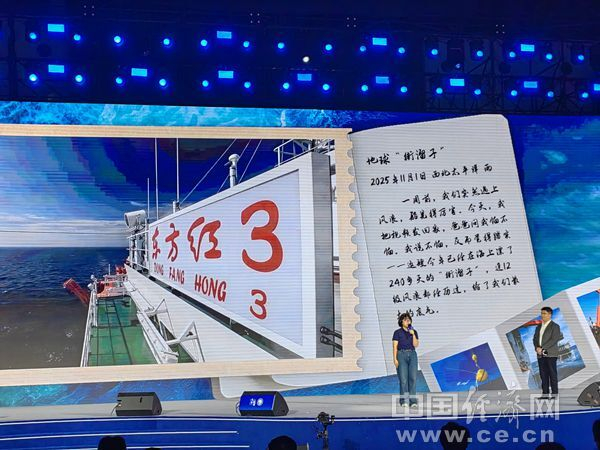
中国经济网青岛12月11日讯(记者 年巍)10日晚,"青春华章 向海图强"大思政课网络主题宣传和互动 引导活动在中国海洋大学举行。 活动紧扣青春爱国奋斗主题,结合新时代海洋强国的伟大实践,通过主题演讲、情景演绎、音乐舞蹈、 互动分享等多种形式,网上网下同上一堂大思政课。 授董跃和"东方红3号"深远海科考队员刘琬馨共讲海洋思政课。(中国经济网记者 年巍/摄) 《七子之歌·威海卫》情景演绎与邓世昌AI形象的跨时空对话,激荡起深沉的家国情怀;时代楷模与英 雄后代共述坚守故事,诠释了平凡中的伟大。随后,青岛港"连钢创新团队"以京剧融合形式展现"东方 大港"的气魄,全运会冠军队伍则彰显出澎湃的青春风采。歌曲《追光者》《我和我的祖国》等节目将 现场氛围推向高潮。 中国海洋大学教 歌曲《我和我的 祖国》将现场氛围推向高潮。(中国经济网记者 年巍/摄) 中国海洋大学校长张峻峰结合100多年来中国海洋大学的办学实践,深情讲述"谋海济国"的接续奋斗。 中国海洋大学教授董跃、中国首位登临南北两极科学家赵进平、"东方红3号"深远海科考队员刘琬馨等 共讲海洋思政课。 中国海洋大学教授于广利、张沛东、陈旭光,青年教师刘欣缘与中国船舶集团 ...
专家汇聚通州湾研讨海洋经济发展
Xin Hua Ri Bao· 2025-12-06 21:52
Core Viewpoint - The conference held on December 6 focused on promoting high-quality development in Jiangsu's coastal areas during the "14th Five-Year Plan" period, emphasizing the importance of marine economic development and innovation [1] Group 1: Marine Economic Development - The "14th Five-Year Plan" aims to enhance marine capabilities and promote high-quality development of the marine economy, aligning with the goals set by the 20th National Congress of the Communist Party of China [1] - Experts from various universities and think tanks discussed diverse pathways and regional explorations for marine economic development, including marine technology innovation and advanced manufacturing clusters [1] Group 2: Jiangsu Coastal Development Initiatives - A new research and practice base was established by Nantong University and the Jiangsu Provincial Tongzhou Bay Integrated Development Demonstration Zone to study marine economic development in Jiangsu [1] - The Tongzhou Bay Integrated Development Demonstration Zone has seen significant growth, with over 3,200 tax-paying enterprises, including 12 central enterprises and 28 listed companies [1]
当好自然资源“大管家”和美丽中国“守护者”
Ren Min Ri Bao· 2025-11-29 01:05
Core Viewpoint - The construction of a beautiful China is a crucial goal for the comprehensive modernization of the socialist nation, emphasizing the harmonious coexistence of humans and nature [1] Group 1: Regional Economic Layout and Land Space System - The natural resources department aims to optimize the land space development pattern by balancing population, resources, and environmental factors [2] - Policies will be refined to enhance the implementation of the main functional area strategy, promoting differentiated development based on local advantages [2][3] - The department will maintain stability in urbanization areas, agricultural production zones, and key ecological function areas while optimizing specific functional areas [2] Group 2: Land Space Planning and Protection - The focus will be on dynamic assessment and optimization of land space planning, integrating major projects into a unified management system [3] - Strict adherence to the three control lines: farmland protection, ecological protection red lines, and urban development boundaries will be enforced [3] - The goal is to ensure the preservation of 1.865 billion acres of arable land and 1.546 billion acres of permanent basic farmland [3] Group 3: Resource Allocation and Support - The department will enhance the quality and efficiency of natural resource allocation, promoting comprehensive land supply and redevelopment of inefficient land [4] - Provincial governments will be granted greater autonomy in land use management, with a focus on integrated approval processes for various land uses [4] Group 4: Marine Economy and Ecological Protection - The "14th Five-Year" plan emphasizes strengthening marine development and protection, with a focus on high-quality marine economic growth [5] - The department will promote innovation in marine technology and establish platforms for marine research and development [6] - Collaborative efforts will be made to balance marine resource utilization with ecological protection, including the development of marine ecosystems [6] Group 5: Resource Security and National Safety - The natural resources sector is integral to national security, focusing on food, energy, and supply chain security [7] - Emphasis will be placed on protecting farmland and enhancing the quality of agricultural land through strategic planning [7] - The department will implement a new round of mineral exploration strategies to ensure resource security [7] Group 6: Geographic Information and Disaster Management - A new national spatial reference system will be established to support digital China initiatives and enhance disaster monitoring and response capabilities [8] - The department will focus on geological disaster prevention and response, particularly in high-risk areas [8] Group 7: Ecological Protection and Restoration - The department will prioritize the establishment of a natural protection area system, focusing on national parks and ecological restoration [9] - Efforts will be made to enhance the quality of forests and grasslands through large-scale greening initiatives [10] - The development of a market mechanism for ecological compensation and resource rights will be explored to promote sustainable resource management [10]