科技自立

Search documents
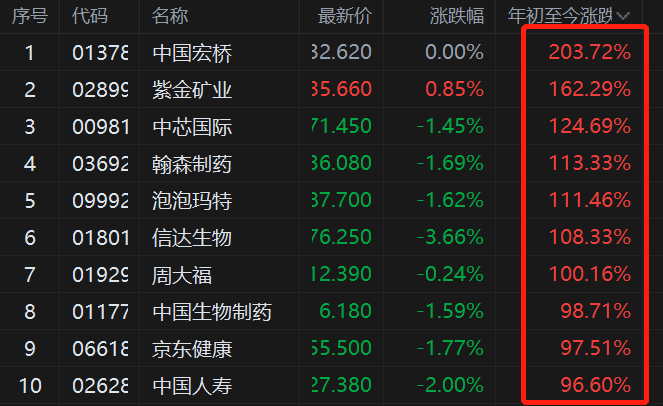
25年恒指累涨近28%:中国宏桥暴涨203.72%居成份股榜首,近10只个股翻倍
Ge Long Hui A P P· 2025-12-31 06:39
Core Insights - The Hong Kong stock market closed 2025 with the Hang Seng Index rising by 27.77%, marking its best annual performance since 2017 [1] - Among the constituents of the Hang Seng Index, China Hongqiao surged by 203.72%, leading the gains, followed by Zijin Mining at 162.29%, and SMIC at 124.69% [1][2] Group 1: Performance Highlights - China Hongqiao's stock price reached 32.620 with a year-to-date increase of 203.72% [2] - Zijin Mining's stock price was 35.660, reflecting a year-to-date rise of 162.29% [2] - SMIC's stock price stood at 71.450, with a year-to-date increase of 124.69% [2] - Hansoh Pharmaceutical increased by 113.33% year-to-date, with a stock price of 36.080 [2] - Pop Mart's stock price was 37.700, showing a year-to-date rise of 111.46% [2] - Innovent Biologics saw a year-to-date increase of 108.33%, with a stock price of 76.250 [2] - Chow Tai Fook's stock price was 12.390, reflecting a year-to-date increase of 100.16% [2] - China Biologic Products had a stock price of 6.180, with a year-to-date rise of 98.71% [2] - JD Health's stock price was 55.500, showing a year-to-date increase of 97.51% [2] - China Life's stock price stood at 27.380, with a year-to-date increase of 96.60% [2] Group 2: Sector Analysis - The performance of the top stocks reflects four main themes: cyclical resources, hard technology, innovative pharmaceuticals, and niche consumption [1] - Stocks like China Hongqiao and Zijin Mining benefited from global inflation and industrial demand [1] - SMIC represents the core of domestic substitution and technological self-reliance [1] - Companies like Hansoh and Innovent are being valued for genuine innovation and international pricing [1] - Niche consumption sectors, represented by Pop Mart, Chow Tai Fook, and JD Health, demonstrate strong vitality even in a weak recovery environment [1]




银河证券:2026年1月十大金股出炉
Xin Lang Cai Jing· 2025-12-31 01:11
Group 1 - The A-share and Hong Kong stock markets showed a growth style leading the rally in December, with the ChiNext and North Star 50 indices rising over 5% [1] - The core drivers for the cyclical sector include economic recovery expectations and the revaluation of strategic resources, particularly benefiting from global manufacturing recovery and resource security themes [1][2] - The growth style focuses on technological self-reliance and new productivity, with capital concentrating on sectors like defense, communication, and AI-related high-end manufacturing [1][2] Group 2 - In January, the A-share market will enter a critical data verification period, influenced by policy effects, macro data, corporate performance, and liquidity changes, leading to potential increased volatility [2] - Key sectors such as defense, 6G, and satellite internet will require performance or order validation to digest previous gains, while commercial aerospace and AI computing sectors may still present active opportunities [2] - Strategic resource segments, especially rare metals like antimony, tungsten, and rare earths, are being revalued by the market due to their essential role in advanced technology breakthroughs [2] Group 3 - The company has excellent asset allocation in mineral resources, with a projected CAGR of 24% for copper production and 12% for gold production from 2020 to 2024, leading in growth among major copper/gold mining companies [6] - The company has successfully completed several significant acquisitions, contributing to production and profit, with ongoing projects expected to support sustainable growth in copper and gold businesses [6][8] - The company has effectively controlled costs, with production costs for copper and gold remaining competitive, positioning it within the top 20% globally [7] Group 4 - The company is benefiting from a stable coal production capacity of 48 million tons/year and has seen an increase in profitability due to low extraction costs and high long-term contracts [18] - The company is expanding its electrolytic aluminum capacity, with a projected increase to 121,000 tons/year by the end of 2025, supported by cost advantages from proximity to coal sources [19] - The company is actively promoting clean energy transition, with significant growth in renewable energy installations, aiming for 700,000 kW by the end of the 14th Five-Year Plan [19] Group 5 - The company is a leading supplier of air conditioning refrigeration valves, with rapid growth in automotive and humanoid robot businesses, actively developing new growth curves [47] - The company achieved a revenue of 240.29 billion yuan in the first three quarters of 2025, with a year-on-year increase of 16.86%, and a net profit of 32.42 billion yuan, up 40.85% [47] - The company is focusing on the development of robotic components, with plans for overseas mass production to strengthen its position in the global supply chain [49]



招商证券首席策略分析师张夏:市场驱动力切换 布局顺周期与科技自立双主线
Mei Ri Jing Ji Xin Wen· 2025-12-25 17:40
Core Viewpoint - The year 2026 will mark a critical turning point for the A-share market, transitioning from liquidity-driven to profit-driven growth, driven by a rebound in PPI and a dual focus on domestic demand recovery and technological self-reliance [1] Group 1: Macroeconomic Environment - The growth model reliant on real estate and infrastructure credit expansion has weakened, with government spending becoming the core marginal force for total demand fluctuations since 2022 [2] - The "14th Five-Year Plan" is expected to maintain an expansionary fiscal policy, with infrastructure and major projects driving investment and countering export decline [2] - The year 2026 coincides with the U.S. midterm elections, historically leading to expansionary fiscal and monetary policies in the U.S., which will resonate with China's policies, potentially boosting global demand for industrial metals [2] Group 2: Market Transition - The A-share market is transitioning from a liquidity-driven phase to a profit-driven phase, with PPI recovery being a key variable indicating substantial improvement in corporate profits [4] - Historical patterns show that industries like oil, non-ferrous metals, coal, and basic chemicals are highly correlated with PPI and commodity prices [4] - The market is expected to enter a profit-driven phase, with small-cap growth stocks likely to outperform as PPI improves [4] Group 3: Investment Opportunities - Investment strategies should focus on the dual drivers of domestic demand recovery and technological self-reliance, particularly in the domestic computing power industry [5] - The recovery of the consumer services sector is anticipated to be driven by multiple factors, including policy goals to enhance consumer spending and structural trends like aging populations and the rise of younger consumers [6] - The domestic AI chip market is expected to gain historical market share against foreign competitors, with key areas including integrated circuits and foundational software [6] Group 4: Industry Focus - Recommended sectors for investment include cyclical industries, technology innovation, and consumer recovery, with a focus on non-ferrous metals, machinery, power equipment, electronics, media, and social services [6]

招商证券首席策略分析师张夏:市场驱动力切换,布局顺周期与科技自立双主线
Mei Ri Jing Ji Xin Wen· 2025-12-25 17:28
Core Viewpoint - The year 2026 is expected to be a pivotal moment for the A-share market, transitioning from liquidity-driven growth to profit-driven growth, with a focus on domestic demand recovery and technological self-reliance as the main investment themes [1][4]. Group 1: Macroeconomic Environment - The previous growth model reliant on real estate and infrastructure credit expansion has diminished, with government spending becoming the core marginal force driving total demand fluctuations since 2022 [4]. - The "14th Five-Year Plan" is set to initiate a positive policy tone, with expected fiscal spending expansion and infrastructure projects boosting investment, particularly in infrastructure, which will counterbalance export decline and promote domestic demand recovery [4]. - The year 2026 coincides with the U.S. midterm elections, historically leading to expansionary fiscal and monetary policies in the U.S., which may resonate with China's economic policies and boost global demand for industrial metals and commodities [4]. Group 2: Price Trends and Market Dynamics - Price increases are anticipated to be a dominant theme from Q4 2025 to 2026, reflecting both the recovery in demand and the cumulative effects of global monetary expansion since 2020 [5]. - The purchasing power of fiat currencies has significantly declined since 2020, leading to potential price surges in products experiencing supply-demand gaps [5]. - The A-share market is currently transitioning from a liquidity-driven phase to a profit-driven phase, with PPI recovery being a key variable indicating substantial improvement in corporate profits, particularly in cyclical sectors [6]. Group 3: Investment Opportunities - Investment strategies for the upcoming year should focus on the dual themes of domestic demand recovery and technological self-reliance, particularly in the domestic computing power industry, which is expected to accelerate commercialization and market share growth [7]. - The recovery of the consumer services sector is anticipated to be driven by multiple factors, including policy support and structural trends such as aging populations and the rise of younger consumer groups [7]. - Concerns regarding the valuation levels of the technology sector are deemed premature, with the belief that the current AI bubble is still manageable, suggesting that technology will remain a primary market theme in 2026 [7].


浙商证券浙商早知道-20251225
ZHESHANG SECURITIES· 2025-12-24 23:30
Market Overview - On December 24, the Shanghai Composite Index rose by 0.53%, the CSI 300 increased by 0.29%, the STAR 50 climbed by 0.9%, the CSI 1000 went up by 1.54%, the ChiNext Index gained 0.77%, and the Hang Seng Index rose by 0.17% [4] - The best-performing sectors on December 24 were defense and military industry (+2.88%), electronics (+2.12%), building materials (+1.72%), light industry manufacturing (+1.69%), and machinery equipment (+1.49%). The worst-performing sectors were agriculture, forestry, animal husbandry, and fishery (-0.85%), coal (-0.7%), food and beverage (-0.36%), banking (-0.3%), and media (+0.01%) [4] - The total trading volume for the entire A-share market on December 24 was 1,897.242 billion yuan, with a net outflow of 1.175 billion Hong Kong dollars from southbound funds [4] Key Insights Non-Bank Financial Sector - The non-bank sector is expected to see a rebound in 2026, offering both high probability and favorable odds [5] - Market expectations for the non-bank sector are low due to the high base in 2025 [5] - Factors driving this outlook include a long-term "slow bull" market in equities and optimization of the liability side [5] Industry Rotation Strategy - The top five industry indices from the 2025 Annual Industry Scoring Table yielded a cumulative return of 44.8% as of December 23, 2025, outperforming the CSI 300 by 22.2%, with positive excess returns in 11 out of 12 months [6][7] - In a bull market, focusing on industry fundamentals is deemed more important than trading comparisons, with a strategy of identifying and holding onto sectors with strong economic logic being favored over rotation trading [6][7] - Key sectors to watch in 2026 include cyclical and technology sectors, closely aligned with top-level policy themes such as technological self-reliance, domestic demand, and anti-involution [6][7] Automotive Parts Industry - The automotive lightweight trend presents significant opportunities for substituting steel with plastics, as modified plastics are lighter and stronger, making them ideal materials for automotive lightweighting [8] - The increase in the usage of modified plastics serves as a catalyst for this trend [8] - Risks include rising raw material costs and the potential for new material substitution [8]
2025年行业打分表结论回顾与策略反思:行业轮动如何做到既敏锐又不丢主线?
ZHESHANG SECURITIES· 2025-12-24 08:51
Core Insights - The 2025 industry scoring report identified the top five sectors as Electric New Energy, Military Industry, Nonferrous Metals, Machinery, and Chemicals, which showed a strong correlation with actual annual performance [1][3][18] - A simulated equal-weighted portfolio of the top five sectors yielded a cumulative return of 44.8% by December 23, 2025, outperforming the CSI 300 by 22.2%, with a monthly success rate exceeding 90% [1][3][12] - The report emphasizes that in a bullish market, focusing on industry fundamentals is more effective than trading strategies, advocating for a buy-and-hold approach based on economic cycles [1][5][21] 2025 Industry Review - The Shanghai Composite Index rose over 16% in 2025, marking the largest increase since 2020, with Nonferrous Metals and Communication sectors leading the gains at 89.9% and 89% respectively [2][13] - The report highlights that the performance of Nonferrous Metals and Communication significantly outpaced the CSI 300's 17.4% increase [12][13] 2025 Annual Industry Scoring Conclusions and Performance Review - The annual scoring report, published in November 2024, ranked Electric New Energy, Military Industry, Nonferrous Metals, Machinery, and Chemicals as the top five sectors, correlating well with actual performance [3][18] - The top five sectors' simulated portfolio achieved a cumulative return of 44.8%, with 11 out of 12 months showing positive excess returns [3][20] 2025 Monthly Industry Scoring Conclusions and Performance Review - The monthly scoring report indicated a sample return of 34.7% since 2025, outperforming the CSI 300 by 14.8%, although this was lower than the annual scoring report's performance [4][12] - Key insights from the monthly performance include successful allocations in Communication and Nonferrous Metals, while frequent trading led to missed opportunities [4][5] Summary and Reflections - The analysis suggests that in a bullish market, prioritizing industry fundamentals over trading strategies is crucial, with a focus on tracking industry prosperity differences [5][21] - For 2026, sectors that should receive higher fundamental scores include those aligned with cyclical and technological trends, particularly in areas like Electronics, Communication, Military, Consumer Services, Agriculture, Trade, Pharmaceuticals, Electric New Energy, Chemicals, and Automotive [5][21]
AI开花、科技自立,计算机拐点将至
Haitong Securities International· 2025-12-22 14:23
22 Dec 2025 Presentation:AI开花、科技自立,计算机拐点将至 AI Blossoms, Tech Independence, Computer Turning Point Approaches 杨林Lin Yang lin.yang@htisec.com Equity – Asia Research 本研究报告由海通国际分销,海通国际是由海通国际研究有限公司,海通证券印度私人有限公司,海通国际株式会社和海通国际证券集团其他各成员单位的证券 研究团队所组成的全球品牌,海通国际证券集团各成员分别在其许可的司法管辖区内从事证券活动。关于海通国际的分析师证明,重要披露声明和免责声明,请 参阅附录。(Please see appendix for English translation of the disclaimer) APPENDIX 2 重要信息披露 本研究报告由海通国际分销,海通国际是由海通国际研究有限公司(HTIRL),Haitong Securities India Private Limited (HSIPL),Haitong International Japan K.K. ( ...
轮到中国卡脖子了!该技术被列入禁止出口清单,美国3次求购遭拒
Sou Hu Cai Jing· 2025-12-22 13:09
Core Viewpoint - The article highlights the significant advancements in metal 3D printing technology developed by Huazhong University of Science and Technology, which integrates casting, forging, and milling into a single process, leading to increased efficiency, reduced costs, and enhanced material utilization in aerospace applications [1][3][5]. Group 1: Technological Innovation - The research team began exploring metal 3D printing in the late 1990s, initially facing challenges with strength and internal defects but eventually developed a method that combines casting and forging using electric arc as a heat source [3][5]. - The integrated technology allows for a material utilization rate exceeding 90%, drastically reducing costs to a fraction of previous methods, and enables the production of complex internal structures that traditional forging cannot achieve [7][9]. Group 2: Market Impact and Recognition - The technology gained international attention after being recognized as leading globally by nine academicians in 2018, and it has been applied in the production of critical aerospace components such as titanium alloy frames and rocket storage tanks [9][11]. - The technology has shifted China from being dependent on foreign suppliers for large titanium alloy components to achieving self-sufficiency, enhancing design freedom and stability for military and civilian applications [11][13]. Group 3: Export Control and Strategic Importance - The Chinese government has implemented strict export controls on this technology due to its dual-use nature, preventing foreign acquisition attempts, including multiple high-value offers from U.S. companies [13][15]. - The protective measures include patenting and regulatory listings to safeguard the technology's core processes and equipment, emphasizing its critical role in national security and industrial independence [15][17]. Group 4: Future Developments and Applications - The technology has been rapidly adopted in various applications, including high-speed maglev train components and military aircraft, with ongoing upgrades to equipment that enhance flexibility and efficiency [18][20]. - Future iterations of the technology are expected to produce larger components at faster speeds, further solidifying China's leading position in aerospace and nuclear power sectors, while also fostering talent and technology transfer to enterprises [24].
美媒承认特朗普输给中国,4大证据摆在眼前,由不得美国人不信!
Sou Hu Cai Jing· 2025-12-21 04:32
Core Viewpoint - The article argues that the United States is losing the trade war initiated by Trump against China, highlighting four key pieces of evidence that demonstrate China's economic resilience and strategic advantages in the conflict [1]. Group 1: Trade War Initiation and Progress - The trade war began in January 2025 shortly after Trump took office, with tariffs imposed on Chinese goods under the pretext of the fentanyl issue [3]. - By April 2025, tariffs were significantly increased to cover nearly all Chinese exports to the U.S., prompting China to retaliate with tariffs on U.S. agricultural products and key raw materials [3]. - The trade negotiations between the two countries began mid-year, with multiple rounds held in London and Stockholm, but significant progress was not made until October [3]. Group 2: Economic Impact and Data Comparison - Despite the U.S. collecting over $200 billion in tariffs, the trade war did not achieve its initial goals, as evidenced by China's GDP growth of 5.3% in the first half of 2025, surpassing the IMF's forecast of 4.8% [5]. - In contrast, the U.S. experienced a mere 1.25% economic growth, significantly below expectations, with high tariffs leading to increased import costs and reduced agricultural exports [5]. - The volatility in U.S. agricultural markets, particularly in soybean futures, resulted in substantial losses for American farmers [5]. Group 3: China's Strategic Position and U.S. Concessions - China maintained its stance against unilateralism and trade bullying, refusing to make significant concessions despite U.S. pressure [7]. - As the trade war progressed, Trump was forced to lower tariffs and agree to a preliminary framework agreement without a formal comprehensive deal [9]. - The U.S. decision to resume exports of H200 chips to China was made to alleviate inventory pressures on American tech companies [9]. Group 4: Global Perception and Long-term Implications - Since Trump's administration began, China's favorability in international polls increased by 8.8%, while the U.S. saw a decline of 1.5% [13]. - Countries like India, Japan, South Korea, and Australia expressed concerns over U.S. tariff policies disrupting regional supply chains, leading to strengthened cooperation with China [13]. - The overall evidence suggests that the trade war has not weakened China but rather exposed vulnerabilities in the U.S. and enhanced China's influence in global markets [13].

中方通告全球:国内发现巨型海底金矿,储量3900余吨,亚洲最大,引发高度关注
Sou Hu Cai Jing· 2025-12-18 12:42
Core Insights - China has officially announced the discovery of Asia's largest underwater gold mine, located in the northern waters of Sanshan Island, Laizhou, with reserves exceeding 3,900 tons, making Yantai a leader in gold mining in China, accounting for over a quarter of the country's total reserves [1][3] - This discovery is not just about wealth; it represents a strategic move in the context of global geopolitical dynamics, showcasing China's capability to secure resources for its future [2][10] Group 1: Economic and Strategic Value - The 3,900 tons of gold is equivalent to the total output of all global gold mines over two years, significantly enhancing China's economic security and reducing dependence on foreign resources [3][7] - The discovery strengthens China's position in the global gold supply chain, allowing for greater self-sufficiency and the ability to stabilize the economy during international financial turmoil [7][10] Group 2: Technological Advancements - The successful discovery of the underwater gold mine is attributed to advanced technology and a dedicated research team, utilizing high-precision geophysical detection and AI systems for data analysis [5][9] - This achievement marks a significant advancement in China's deep-sea exploration capabilities, previously dominated by Western companies, and sets the stage for future resource exploration [5][9] Group 3: Regional Impact - Yantai's gold reserves now account for 26% of the national total, positioning the city as a strategic resource hub and enhancing local employment and industry development [7][9] - The discovery is expected to lead to the development of green mining practices, balancing resource extraction with environmental protection, thus setting a precedent for sustainable practices in resource management [9][12] Group 4: Global Implications - The announcement has caused significant reactions in international markets, with mining companies adjusting their forecasts, indicating a potential shift in the global resource balance [10][12] - China's increased gold reserves may enhance its influence in global pricing and market regulations, reflecting its growing economic power and strategic autonomy [10][12]