结构性分化

Search documents
乳业步入存量竞争新阶段“结构性分化”成为标志
Zhong Guo Chan Ye Jing Ji Xin Xi Wang· 2026-01-13 00:13
Core Insights - The dairy industry is entering a new phase characterized by "structural differentiation" as liquid milk business growth slows down, leading to intensified competition focused on technology, supply chain, and brand value [1][2][4] Group 1: Industry Performance - In the first three quarters of 2025, 13 out of 19 listed dairy companies in A-shares reported revenue declines, primarily due to the slowdown in liquid milk business [2] - For example, Yili's liquid milk revenue fell to 54.939 billion yuan in the first three quarters of 2025, a year-on-year decrease of 4.44% [2] - The overall sales of liquid milk in China dropped by 7.5% year-on-year from January to May 2025, with a further decline to 9.6% in June [2] Group 2: Market Dynamics - The market is experiencing intensified price wars, with significant price reductions observed in various milk products, leading to profit erosion for companies [3] - In the first three quarters of 2025, the total revenue of 19 listed dairy companies reached 140.852 billion yuan, with Yili, Guangming, and New Dairy accounting for 83.07% of this total [3] Group 3: Strategic Shifts - The industry is shifting from a focus on volume growth to quality and structural improvements, with companies emphasizing diversified and refined consumer needs [4] - Companies are increasingly investing in product innovation and new consumption scenarios to adapt to changing market demands, indicating a potential structural improvement in the liquid milk market by 2026 [4] Group 4: Capital Market Activity - In 2025, niche dairy companies and regional brands are increasingly pursuing IPOs, with companies like Baifei Dairy and Yipin Nutrition making significant moves in the capital market [5][6] - The trend indicates a growing interest in high-value segments such as water buffalo milk and goat milk powder, as well as regional brands with local supply chain advantages [6] Group 5: Mergers and Acquisitions - The dairy industry is witnessing accelerated mergers and acquisitions as companies seek to optimize asset portfolios and enhance efficiency amid increasing competition [8][10] - Notable transactions include Mengniu's sale of its New Zealand factory and Guangming's asset sale to Abbott, reflecting strategic adjustments to market changes [8][10] - Analysts suggest that the consolidation trend will continue, focusing on acquiring quality milk sources and enhancing regional distribution channels [10]


野村-结构分化进入下半场
野村· 2025-12-29 15:51
Investment Rating - The report maintains a structural investment focus, emphasizing opportunities in high-value manufacturing, aesthetic exports, and passive fund inflows, particularly in the context of improving liquidity in the market [1][6][24]. Core Insights - The A-share market is expected to continue its structural differentiation into 2026, driven by industry prosperity, corporate profitability, and internal and external demand dynamics [1][3][9]. - The profitability forecast for the CSI 300 index has been raised to 7.2% for 2026 and 8.4% for 2027, indicating that market growth will increasingly rely on fundamental factors rather than valuation expansion [4][22]. - The TMT sector has maintained high trading activity, becoming a significant market driver, with passive funds contributing to increased liquidity [8][26]. Summary by Sections Market Performance and Trends - The A-share market is projected to be driven by breakthroughs in AI technology and geopolitical developments, with a focus on a "barbell strategy" that balances growth and dividend assets [2][3]. - Structural differentiation is anticipated to manifest in three areas: industry prosperity, corporate profitability, and internal/external demand dynamics [3][9]. Profitability Forecast - The profitability of the CSI 300 index has been adjusted upward, with forecasts of 7.2% and 8.4% for 2026 and 2027, respectively, indicating a reliance on fundamental growth rather than valuation expansion [4][22]. Capital Flow Characteristics - Key capital flow characteristics include the export of high-value manufacturing goods, aesthetic exports, and the passive nature of incremental capital, particularly following the implementation of the OCI policy [6][24]. - The total scale of OCI accounts for major insurance companies increased by nearly 41 billion yuan in the first half of 2025 compared to the end of 2024, highlighting the growing appeal of dividend-centric state-owned enterprises [6]. Sectoral Performance - The technology sector's net profit share has been increasing, while the financial and real estate sectors have seen declines in revenue and profit shares [10][11][12]. - Companies with over 20% of revenue from overseas have shown significant growth in both revenue and net profit, reflecting the impact of external demand on A-share performance [14][15]. Future Market Expectations - The market is expected to continue exhibiting fundamental differentiation, influenced by technological innovation, corporate leadership disparities, and enhanced external demand [16][20]. - The baseline scenario includes a neutral to accommodative stance from the Federal Reserve and ongoing structural adjustments in domestic policy [17]. Recommended Investment Directions - Three key areas for investment are identified: high-end manufacturing, globalization of Chinese consumer products, and the passive inflow of incremental capital [24][25]. - High-end manufacturing is expected to leverage global R&D and capital advantages, while Chinese consumer products are anticipated to gain traction in overseas markets through effective marketing strategies [25].
公募ETF多元化时代在路上
Guo Ji Jin Rong Bao· 2025-12-27 03:56
Core Insights - The market recognition of index investment has significantly increased this year, with public ETFs experiencing substantial growth in both product quantity and scale, driven by heightened market attention and innovation from fund companies [1] Group 1: Market Trends - The ETF market is witnessing structural differentiation, particularly highlighted by the explosive growth of bond ETFs, which saw a net inflow of 418.9 billion yuan from April 15 to December 15, 2025, indicating a strong underlying demand [3] - The current market is characterized by a preference for technology growth styles, with industry and thematic ETFs expanding rapidly while broad-based ETFs are experiencing net outflows [3] Group 2: Competitive Landscape - The ETF market is becoming increasingly competitive, with numerous companies filing for similar products, leading to a saturation of ETF offerings [5] - Fund companies are focusing on quality competition, enhancing liquidity for smaller products and innovating service offerings to provide comprehensive support for investors [5] Group 3: Future Innovations - The diversification of ETF products is expected to increase, catering to various investor needs, including those focused on emerging industries and specific investment strategies [7] - Potential future innovations in ETFs may include leveraging new industries or themes, expanding into emerging markets, and introducing leveraged, inverse, or actively managed ETFs [8]
当亚马逊被“围猎”,谁在瓜分新的万亿蛋糕?
3 6 Ke· 2025-12-22 11:44
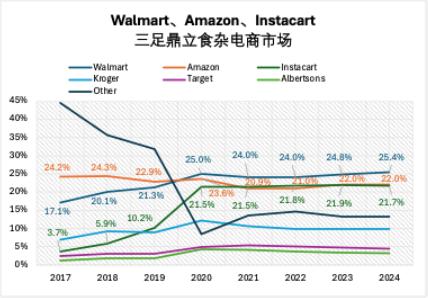
Group 1: Core Insights - The disparity in online retail penetration between China (30%) and the U.S. (16%) is significant, indicating different market dynamics and maturity levels [1][2] - U.S. e-commerce is not merely lagging behind but is in a mature market with strong offline competitors like Walmart and Costco, leading to structural differentiation rather than total growth [2][3] - The U.S. retail landscape is characterized by a robust offline infrastructure that complicates the growth of e-commerce, as traditional retailers provide high efficiency and experience [4][5] Group 2: Market Dynamics - The U.S. e-commerce market, valued at over $1.1 trillion, is supported by a $7 trillion retail base, despite a lower penetration rate [4] - The competition in the U.S. e-commerce space is shifting towards specific niches where traditional retailers cannot compete, such as extreme low pricing, traffic stimulation, and fresh food delivery [4][10] - Amazon, while still a leader, faces challenges from low-cost competitors and content-driven e-commerce platforms like TikTok Shop, which leverage social media for sales [5][9] Group 3: Competitive Landscape - Companies like Temu and Shein are disrupting the U.S. market by utilizing Chinese supply chains to offer low prices without the burden of high logistics costs [7][8] - TikTok Shop is transforming its video content into e-commerce opportunities, presenting a new avenue for merchants seeking alternatives to Amazon [9] - Walmart has successfully adapted to the e-commerce landscape by utilizing its extensive store network for efficient fresh food delivery, surpassing Amazon in this segment [12] Group 4: Key Companies - **Amazon (AMZN)**: Despite facing competition, Amazon maintains a strong retail market share of approximately 37% and continues to perform well in core categories like consumer electronics [13][14] - **Walmart (WMT)**: Walmart is evolving into a full-channel giant, with its e-commerce business growing over 20% for seven consecutive quarters, driven by its fresh food offerings [15] - **PDD Holdings (PDD)**: Temu is transitioning to a model that enhances its pricing power and logistics efficiency, targeting Amazon's mid-tier merchant ecosystem [16] - **Shopify (SHOP)**: Shopify is leveraging AI to enhance traffic distribution and improve monetization rates, moving beyond its initial role as a platform provider [17] - **Instacart (CART)**: Instacart dominates the U.S. third-party fresh food delivery market, with a significant portion of its revenue coming from high-margin advertising [18]


当亚马逊被“围猎”,谁在瓜分新的万亿蛋糕?
格隆汇APP· 2025-12-22 11:12
Core Viewpoint - The article discusses the significant disparity in online retail penetration between China and the U.S., with China's online retail sales approaching 30% while the U.S. remains around 16%. This difference is attributed to the maturity of the U.S. retail market, which is dominated by strong offline players like Walmart and Costco, leading to a more complex competitive landscape for e-commerce in the U.S. [4][5][6] Group 1: Market Dynamics - The U.S. e-commerce market is not simply lagging behind China but is characterized by a mature offline retail system that provides high efficiency and experience, making it difficult for e-commerce to replace traditional retail. Instead, e-commerce serves as a supplement to offline shopping [5][6]. - The U.S. retail market, valued at $7 trillion, supports a substantial e-commerce sector worth over $1.1 trillion, despite a lower penetration rate [6]. - The competitive landscape in the U.S. is shifting from total growth to structural differentiation, focusing on specific niches where traditional retailers cannot compete effectively, such as extreme low prices, traffic stimulation, and fresh food delivery [6][13]. Group 2: Competitive Challenges - Amazon, while still a leader in infrastructure, faces significant challenges from low-cost competitors and new traffic sources, particularly from companies like Temu and Shein, which leverage Chinese supply chains to offer lower prices without the need for expensive logistics in the U.S. [8][10][11]. - TikTok Shop is emerging as a powerful player in the e-commerce space, converting its vast short video traffic into purchasing power, contrasting with Amazon's traditional search-based model [12]. - In the fresh grocery segment, Walmart has overtaken Amazon with a 25% market share compared to Amazon's 22%, due to Walmart's effective use of its extensive store network to reduce delivery costs and enhance customer experience [15]. Group 3: Key Companies - **Amazon (AMZN)**: Despite facing competition, Amazon maintains a strong retail market share of around 37% and continues to perform well in core categories, such as consumer electronics [17]. - **Walmart (WMT)**: Walmart is transforming from a traditional supermarket to a full-channel giant, with its e-commerce business growing over 20% for seven consecutive quarters, now accounting for 20% of its total retail sales [20]. - **PDD Holdings (PDD)**: Temu is evolving from a fully managed model to a semi-managed one, enhancing its supply chain capabilities and integrating local inventory to compete with Amazon [21]. - **Shopify (SHOP)**: Shopify is shifting its growth narrative, focusing on AI-driven traffic distribution and financial services to enhance its revenue model [22]. - **Instacart (CART)**: Instacart dominates over 70% of the U.S. third-party grocery delivery market, with a growing high-margin advertising business contributing to its revenue [23].

交银国际:明年内地消费市场有望延续温和增长趋势 建议采取攻守兼备策略
Jin Rong Jie· 2025-12-03 08:28
Core Viewpoint - The report from交银国际 indicates that the mainland consumer market is expected to continue a moderate growth trend towards 2026, with slow overall demand growth but structural differentiation driven by rational consumption and demand upgrading [1] Group 1: Market Trends - The consumer market is undergoing a multi-dimensional transformation, evolving to be more consumer-centric [1] - There is a gradual construction of a new balance in the market, focusing on consumer demand and emphasizing operational efficiency improvements [1] Group 2: Investment Strategy - The report suggests a balanced investment strategy in the consumer sector, combining defensive sectors with stable cash flow and resilient demand as a foundation, while also actively seeking high-growth structural opportunities [1] - Close attention should be paid to new consumption trends and the potential for industry reshaping brought about by technological changes [1] Group 3: Focus Areas - Three categories of companies are highlighted for investment focus: 1. Companies benefiting from supply-demand improvements and expected to release profit elasticity through efficiency gains, such as申洲国际 and伊利 [1] 2. Segment leaders that are quick to capture consumption trends and have rapid growth potential, such as泡泡玛特 and名创优品 [1] 3. Industry leaders with solid growth foundations, strong moats, and cyclical resilience, such as安踏 and华润啤酒 [1]


【财经分析】结构性分化主导市场 产业园REITs投资仍需紧盯“基本面”
Xin Hua Cai Jing· 2025-12-01 11:53
Core Viewpoint - Since 2025, the domestic infrastructure public REITs in the industrial park sector have shown a "rise and fall" trend, with significant structural differentiation. Analysts predict that in 2026, the operation of various public REIT projects will continue to fluctuate and differentiate, suggesting that institutions should cautiously allocate resources and focus on projects with strong fundamentals while seizing opportunities after valuation corrections [1][2][6]. Group 1: Performance and Market Dynamics - The industrial park REITs have faced pressure due to an imbalance between supply and demand, leading to a mixed performance where some projects suffer losses while others show resilience. For instance, the net profit of the Jianxin Zhongguancun Industrial Park REIT was -8.55 million yuan, while the Dongwu Suyuan Industrial REIT achieved a net profit of 28.47 million yuan [2][4]. - The market for industrial park REITs remains active, with new projects like the Huaxia Jinyu Zhizao Factory REIT attracting significant investment, raising 40.39 billion yuan with a subscription multiple of 288.78 times, indicating strong demand for quality assets [2][4]. Group 2: Structural Differentiation - The core characteristic of the industrial park REITs market in 2025 is structural differentiation across various dimensions, including regional layout, asset quality, and operational capability. Projects in core areas, such as Beijing's Haidian District, maintain stable occupancy rates, while non-core areas face high vacancy rates [4][5]. - The demand from tenants is evolving, shifting from a cost-centric approach to a comprehensive evaluation of support for industrial chains, policy backing, and resource integration, making parks that focus on innovation and smart manufacturing more competitive [5][6]. Group 3: Future Outlook and Investment Strategy - The performance differentiation in industrial park REITs is expected to continue, but there is a long-term optimistic outlook for the sector. By the end of 2025, the total market size of public REITs is projected to reach 245 billion yuan, with industrial park REITs benefiting from industrial upgrades and the revitalization of existing assets [6][7]. - Investment strategies should focus on "quality, stability, and adaptability," prioritizing projects in core urban areas with high tenant quality and stable operations, while also considering reasonable valuation windows for entry [8].
上海565万的房子,挂17天成交,卖了多少钱?
Sou Hu Cai Jing· 2025-11-14 03:48
Core Insights - The article highlights a significant shift in the Shanghai real estate market, where properties are being sold based on genuine living needs rather than speculative investments [1][14] - The rapid sale of a property in just 17 days illustrates the importance of "certainty" over price in the current market dynamics [3][6] Property Details - The property in question is a 110 square meter, three-bedroom apartment located near Shanghai's outer ring, listed at 5.65 million yuan, with a price per square meter of 51,000 yuan [3] - This price is competitive compared to the average new home price of 53,000 yuan and the average second-hand home price of 48,000 yuan in the same area [3] Market Dynamics - The average transaction cycle for second-hand homes in Shanghai is 45-60 days, making the 17-day sale a notable exception that indicates a strong alignment with market demand [3][6] - The buyer profile consists of a young couple needing stable schooling options and convenient transportation, reflecting a shift towards practical living requirements [3][10] Seller Strategy - The seller adjusted the listing price from 5.8 million yuan to 5.65 million yuan based on market observations, demonstrating a rational pricing strategy that builds buyer trust [5] - The final sale price of 5.65 million yuan is higher than previous sales in the same area, indicating a structural differentiation in the market where quality properties are experiencing slight price increases [6] Policy Impact - Recent policy changes in Shanghai, such as the "沪七条," have favored first-time homebuyers and self-occupiers while tightening conditions for investment purchases, further supporting genuine housing demand [6][10] - The increase in the proportion of "sell old to buy new" transactions to 65% indicates a growing trend of upgrading living conditions among buyers [10] Market Trends - The article notes a significant increase in the number of listings, with over 150,000 properties available, leading to a competitive environment where sellers may resort to price cuts to attract buyers [10][12] - The concept of "rational prosperity" is emerging, where buyers are increasingly discerning, focusing on comprehensive value rather than just location [12][14] Conclusion - The transaction serves as a reflection of the evolving Shanghai real estate landscape, where multiple factors such as location, product quality, policy, and demand structure collectively influence property prices [14][16] - The market is transitioning from a speculative to a more stable environment, emphasizing genuine living needs and rational purchasing decisions [14][16]

价格全方位多维跟踪体系(2025.11):成本高企与利润分化并存
Guoxin Securities· 2025-11-07 12:15
Core Insights - The report highlights a structural divergence in the prices of major production materials, with 23 out of 49 materials experiencing price increases, while 24 saw declines, indicating a mixed market environment [1][2][3] - Key price increases are observed in upstream coal and non-ferrous metals, particularly copper and aluminum, driven by replenishment demand and cost support [1][2] - Conversely, significant price drops are noted in agricultural products and certain chemicals, reflecting weak downstream consumption and excess supply pressures [1][2] Price Tracking of Major Production Materials - As of October 2025, coal prices have slightly rebounded to 670-680 RMB/ton, while WTI crude oil has decreased to 57 USD/barrel [3] - Non-ferrous metals, including copper and aluminum, have shown strong performance, with copper prices reaching 86,430 RMB/ton and aluminum prices exceeding 21,000 RMB/ton [1][3] - The chemical sector exhibits notable price differentiation, with sulfuric acid prices surging over 700 RMB/ton, while other chemical products like plastics and fertilizers continue to decline [1][2][3] Year-on-Year Price Changes - Year-on-year comparisons reveal that coal prices have decreased by approximately 10%-25%, with the decline rate narrowing, indicating a marginal improvement in supply-demand dynamics [2] - Agricultural products, particularly live pigs, have seen a significant price drop of around 37%, negatively impacting the overall agricultural sector [2] - The non-ferrous metals sector has shown resilience, with electrolytic copper and aluminum prices increasing by 17.4% and 7.3% respectively, reflecting strong international metal market conditions and domestic demand recovery [2] Industry Price Trends - The report indicates that industries such as new energy, new materials, and high-end equipment are experiencing high material price levels and ongoing cost pressures, while traditional sectors like textiles and construction are facing low output prices due to weak downstream demand [4] - Profit margins remain robust in sectors like new energy vehicles and high-end manufacturing, while industries such as chemical fibers and construction materials are under pressure due to high input costs and weak output [4]
海外买家退场、利率重压,澳大利亚楼市还值得投资吗?
Di Yi Cai Jing· 2025-10-31 11:21
Core Insights - The Australian real estate market is experiencing a "slow bull" trend characterized by moderate price increases, influenced by high costs and interest rates [1][7] - Auction activity has surged, with 3,253 auctions held in major capital cities, the highest since last spring, and over 60% of Australians expect prices to rise in the next year [1][7] - However, not all homeowners are benefiting, as some high-end properties in Sydney and Melbourne are selling at a loss, particularly in the off-the-plan segment [1][2][4] Market Dynamics - The apartment market is undergoing structural differentiation, with "investment-oriented apartments" facing the most pressure, while mid-density owner-occupied apartments are recovering steadily [2][6] - The shift in market dynamics is attributed to rising interest rates, which have increased mortgage costs, and a recent ban on foreign buyers, impacting the off-the-plan segment that previously catered to overseas investors [4][5] Financial Pressures - High interest rates and tightened credit conditions are raising financing and settlement costs, leading to forced sales and price corrections among highly leveraged buyers [5][6] - The burden of holding costs, including vacancy taxes for overseas owners, is prompting some investors to accept short-term losses [5][6] Long-term Trends - The Australian housing market is expected to see a gradual recovery, with a focus on self-occupier demand and long-term investment strategies rather than short-term speculation [6][7] - The supply-demand mismatch remains a key issue, with construction costs and financing pressures slowing new project launches, particularly in Sydney and Melbourne [7][8] Demographic Shifts - An emerging buyer group, the downsizers, is gaining attention as older homeowners sell suburban houses for more manageable apartments in prime locations [8][9] - The aging population, with over 17% aged 65 and above, is expected to drive this trend, influencing market dynamics for years to come [9]