
结汇

Search documents
美元周期还在探底,人民币升值顺风未尽
Orient Securities· 2026-01-05 08:24
External Factors - The primary driver for the RMB appreciation in 2025 is the weakening of the USD, which has declined by nearly 10% this year due to three rate cuts by the Federal Reserve[1] - The USD index fell to around 97 in December after failing to break the 100 resistance level, confirming a downward trend[19] - The expected mild depreciation of the USD is projected to be around 3% in 2026, with a "low first, high later" pattern anticipated[24] Internal Factors - The internal economic and policy environment in China is stabilizing, contributing to the RMB's appreciation[1] - China's exports have shown robust growth, exceeding expectations, particularly after tariff adjustments, leading to a steady appreciation channel for the USD/CNY exchange rate[14] - The internal economic surprise indices for both China and the US are trending downward, indicating limited support for the RMB from internal factors in the short term[27] Supply and Demand Factors - The supply and demand dynamics have not fully played out this year, with a decrease in market settlement willingness under a strong dollar environment[16] - Seasonal increases in foreign income in December may lead to higher settlement rates, potentially supporting RMB appreciation[21] - The rising implied volatility of the RMB and the risk reversal options favoring RMB appreciation indicate a market expectation of a wider trading range for the currency[27] Market Implications - The RMB's appreciation is expected to benefit foreign capital inflows into A-shares and Hong Kong stocks, favoring quality and growth styles[32] - The report emphasizes that the stock market's performance and fundamental improvements are more likely to drive RMB appreciation rather than the exchange rate itself influencing the stock market[32]
贸易顺差超过1万亿美元,为何体感不明显?
Sou Hu Cai Jing· 2025-12-26 13:16
Group 1: Trade Surplus Overview - In the first 11 months of 2025, China's goods trade surplus reached $1.08 trillion, marking the first time any country has surpassed the $1 trillion mark in trade surplus [2] - The strong export performance is driven by key categories such as electromechanical products, which account for approximately 59% of total exports, and new growth areas like electric vehicles and lithium batteries, which continue to see double-digit growth despite overseas tariff pressures [3][4] Group 2: Export and Import Dynamics - The import demand in 2025 is weak, with nearly zero growth (0.2%), contributing to the maximum trade surplus [4] - Many export enterprises are holding onto foreign currency earnings instead of converting them into RMB, leading to a "funds external circulation" phenomenon [5] - A portion of profits from manufacturing is being used to pay off debts rather than being reinvested domestically, indicating a trend towards deleveraging [5] Group 3: Industry-Specific Insights - The automotive sector is highlighted as a profitable industry, with significant profits from exports that can cover costs associated with tariffs and logistics [5] - The distribution of wealth from the trade surplus is concentrated among leading technology firms and automated factories, contrasting with the declining value of real estate, which affects the perceived wealth of ordinary citizens [7] Group 4: Service Trade Developments - China's service trade has historically shown a significant deficit, but in 2025, the deficit narrowed to approximately $108 billion, a reduction of about 26% year-on-year [12][13] - Knowledge-intensive service trade constitutes about 38% of the total, with rapid growth in exports driven by international travel demand and foreign tourists spending in China [13] Group 5: Future Outlook - The trade surplus reflects the efficiency of the production system and external structures rather than a direct increase in resident income [14] - As trade tensions stabilize and high-tech breakthroughs occur, the surplus is expected to gradually benefit the domestic economy and convert into disposable wealth for the population [14]

贸易顺差超过1万亿美元,为何体感不明显?
首席商业评论· 2025-12-26 12:00
Group 1: Trade Surplus Overview - In the first 11 months of 2025, China's goods trade surplus reached $1.08 trillion, marking the first time any country has surpassed the $1 trillion mark in trade surplus [2] - The strong export performance is driven by key categories such as electromechanical products, which account for approximately 59% of total exports, and new growth areas like electric vehicles and lithium batteries, which continue to see double-digit growth [3][4] - The import demand in 2025 is weak, with nearly zero growth (0.2%), contributing to the maximum trade surplus [4] Group 2: Factors Affecting Perception of Surplus - The perception of the surplus not translating into noticeable benefits for the public can be attributed to several factors, including the "external circulation" of funds where companies are hesitant to convert foreign earnings into RMB [5] - A portion of profits is used to pay off debts rather than being reinvested domestically, indicating a deleveraging trend in the manufacturing sector [5] - Price wars in certain industries lead to profit dilution, making it difficult for companies to significantly increase employee wages despite high export volumes [5] Group 3: Sector-Specific Insights - The automotive sector is highlighted as a profitable area, with a mid-range electric vehicle sold in Europe generating significant revenue for Chinese manufacturers, despite various costs such as tariffs and logistics [5] - The future potential for higher-value exports, particularly in sectors like semiconductors, could lead to more substantial profits for Chinese companies [6] Group 4: Service Trade Developments - China's service trade has historically shown a significant deficit, but in 2025, the deficit narrowed to approximately $108 billion, a reduction of about 26% year-on-year [12][13] - Knowledge-intensive service trade constitutes about 38% of the total, with rapid growth in exports driven by international travel demand and foreign tourists visiting China [13] - The overall trend suggests that service trade may move towards a more balanced state in the future [14] Group 5: Economic Implications - The $1 trillion trade surplus reflects the efficiency of the production system and external structures rather than a direct increase in household income [15] - A portion of the foreign exchange earnings is allocated for stabilizing the currency, addressing external sanctions, and supporting essential imports, which delays immediate benefits to the domestic economy [15]
国联民生:人民币涨多了吗?
Xin Lang Cai Jing· 2025-12-26 01:00
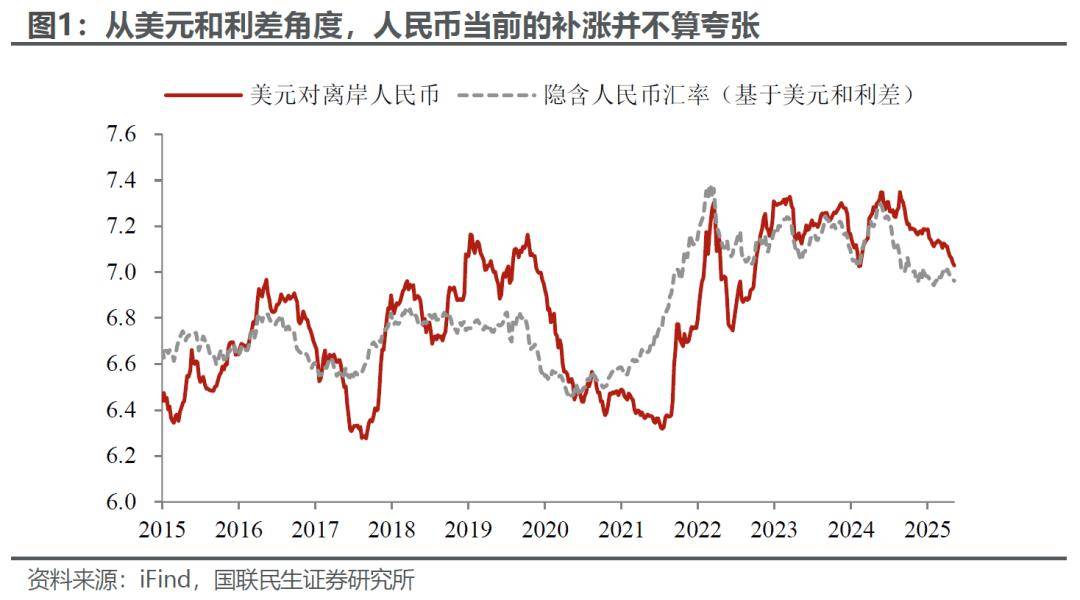
Core Viewpoint - The recent appreciation of the Renminbi (RMB) against the US dollar, breaking the 7 mark for the first time in 14 months, is attributed to a combination of factors including a weaker dollar, changing market expectations, and seasonal trends in currency settlement [3][22]. Financial Market and Asset Prices - The current appreciation of the RMB is viewed as a corrective move rather than excessive, with the increase being justified from the perspectives of the dollar and interest rate differentials [3][22]. Trade Perspective - China's trade surplus has reached historical highs, suggesting that the RMB may have been undervalued prior to its recent appreciation [6][24]. Inflation Considerations - The widening gap between nominal and real RMB exchange rates indicates that the currency has depreciated less than expected, with domestic low inflation compensating for this [9][27]. Short-term Market Dynamics - The influence of trade and inflation on the economy is considered less significant in the short term, with the need for further observation of the RMB's impact on economic variables [10][28]. Risks of Panic Settlement - There is concern regarding the potential for "panic settlement" leading to excessive appreciation of the RMB, which could create self-reinforcing market expectations [10][28]. Future Outlook on Exchange Rate - Projections suggest that a reasonable level for the USD/RMB exchange rate in the coming year could be around 6.8, factoring in more flexible central bank controls [12][30]. Central Bank Management - The recent adjustments to the RMB's midpoint rate indicate the central bank's intention to temper appreciation, with tools available for managing exchange rate stability [15][33]. Additional Monetary Tools - The central bank may also consider necessary measures such as reserve requirement ratio cuts or interest rate reductions to counterbalance appreciation pressures [16][34].


人民币涨多了吗?
Sou Hu Cai Jing· 2025-12-26 00:14
Core Viewpoint - The recent appreciation of the Renminbi (RMB) against the US dollar, breaking the 7 mark for the first time in 14 months, is seen as a reasonable adjustment influenced by a weaker dollar and changing market expectations, despite concerns about potential overvaluation [1][6]. Financial Market and Asset Prices - The current appreciation of the RMB is viewed as a corrective move rather than excessive, with the rise in value being justified from the perspectives of the dollar and interest rate differentials [1]. Trade Perspective - China's trade surplus has reached a historical high, suggesting that the RMB may have been undervalued prior to its recent appreciation [3]. Inflation Perspective - There is an increasing gap between the nominal and real exchange rates of the RMB, indicating that the currency has depreciated less than expected, with the shortfall being compensated by low domestic inflation [5]. Factors Influencing RMB Appreciation - The RMB's recent appreciation is attributed to three main factors: the weakening of the dollar, changes in market expectations following a trade easing period between China and the US, and seasonal patterns of net settlement at year-end [6]. Short-term Market Dynamics - While the exchange rate is a significant macroeconomic variable, its impact on the economy takes time to materialize, and policy responses may adjust accordingly to manage the effects of exchange rate fluctuations [8]. Concerns about Overvaluation - There is a concern regarding the risk of "panic settlement" leading to excessive appreciation of the RMB, which could create a self-reinforcing cycle of expectations and market behavior [8]. Future Outlook on Exchange Rate - The potential reasonable level for the USD/RMB exchange rate is estimated to be around 6.8, considering the central bank's more flexible management of the currency [12]. Central Bank's Management Approach - The recent adjustments in the RMB's midpoint rate indicate the central bank's intention to cool down the appreciation, with tools available for managing exchange rate stability, including market interventions and monetary policy adjustments [15].
人民币创14个月来新高
Sou Hu Cai Jing· 2025-12-23 04:19
Core Viewpoint - The continuous appreciation of the RMB is prompting foreign trade companies to expedite their currency settlement to mitigate losses from exchange rate fluctuations, which poses challenges for small and medium-sized enterprises in maintaining their price competitiveness [1][3]. Group 1: Currency Settlement Practices - Many foreign trade operators are adopting a strategy of settling currency immediately upon receipt of funds to avoid losses due to RMB appreciation [1][3]. - Small and medium-sized enterprises prefer timely currency settlement to maintain cash flow, often avoiding hedging strategies like locking in exchange rates [1][3]. - The recent trend of RMB appreciation has led to immediate currency settlement becoming a common practice among exporters, as they seek to minimize potential losses [1][3]. Group 2: Impact of RMB Appreciation - The RMB has reached a 14-month high, which is negatively impacting export companies by reducing the amount of RMB received from USD settlements [1][3]. - Companies may face immediate exchange losses, and raising product prices to protect profit margins could weaken their competitive pricing in the manufacturing sector [1][3]. - Increased demand for currency settlement at year-end may further drive RMB appreciation, creating additional pressure on exporters [1][3]. Group 3: Market Trends and Predictions - Analysts predict that the RMB may enter a "6 era" in the long term, with expectations of continued appreciation driven by seasonal capital flows and increased currency settlement needs as the Chinese New Year approaches [5][6]. - The RMB's recent strength is attributed to a decline in the USD index and increased settlement demand from companies as the year-end approaches [6][10]. - The Chinese government is focusing on stabilizing the RMB exchange rate to create a favorable trading environment for foreign trade enterprises, rather than allowing rapid appreciation [9][10]. Group 4: Trade and Economic Growth - China's goods trade maintained positive growth, with exports increasing by 6.2% and imports by 0.2% in the first eleven months of the year [7]. - The shift from price competition to brand and technology diversification is expected as companies adapt to exchange rate pressures, aligning with government initiatives to support service exports and digital trade [7][9]. - The overall economic strategy emphasizes boosting domestic consumption and enhancing the supply of quality goods and services, which is supported by a stronger RMB [6][7].
如何看待近期人民币汇率的变化︱重阳问答
重阳投资· 2025-12-05 07:32
Core Viewpoint - The recent appreciation of the Renminbi (RMB) against the US dollar is attributed to a weakening dollar index and improved market sentiment towards the RMB, following a period of trade tensions and policy adjustments [2][3][4]. Group 1: RMB Exchange Rate Changes - Since late November, the offshore RMB has appreciated over 550 pips, while the onshore RMB has appreciated over 400 pips, indicating a return to an appreciation trend [2]. - The RMB's appreciation is supported by a weakening dollar index, which has declined by 1% from its peak, aligning with the RMB's appreciation [2][4]. Group 2: Factors Influencing RMB Appreciation - The driving force behind the RMB's appreciation is the increase in foreign exchange settlement (结汇) by exporters, which had been low earlier due to tariff impacts and unstable exchange rate expectations [3]. - Since the third quarter, there has been a notable improvement in the willingness to settle foreign exchange, leading to a compensatory settlement that supports RMB appreciation [3]. Group 3: Future Outlook for RMB - Looking ahead, the RMB is expected to continue appreciating slowly, contingent on a further weakening of the dollar index [4]. - The central bank's policy aims for a gradual appreciation of the RMB, with recent indicators suggesting a shift towards preventing rapid appreciation to avoid negative impacts on exports [4]. - The market has priced in three potential interest rate cuts by the Federal Reserve next year, limiting the scope for further declines in long-term US Treasury yields and maintaining the interest rate differential between China and the US [4].

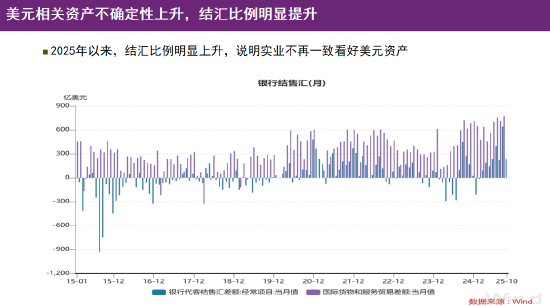
李蓓曝关键信号:美元相关资产不确定性上升,结汇比例明显提升,说明实业不再一致看好美元资产
Xin Lang Zheng Quan· 2025-11-30 01:50
Core Insights - The 2025 Analyst Conference highlighted a significant shift in asset allocation preferences among high-net-worth individuals and business owners in China, driven by increasing uncertainty in U.S. policies and concerns over the long-term credibility of the U.S. dollar [1] Group 1: Asset Allocation Trends - Since the Trump administration, there has been a noticeable decline in the preference for U.S. dollar assets among Chinese high-net-worth individuals and business owners, with a marked increase in the willingness to convert currency back to yuan [1] - Historical data indicates that over the past decade, particularly before 2024, China's monthly current account surplus (including trade and services) exceeded actual currency conversion amounts by approximately $20 billion, leading to an accumulation of over $2 trillion in unconverted funds [1] - In 2025, a significant change occurred where the willingness to convert currency has risen, although full conversion has not yet been achieved [1] Group 2: Driving Factors - The two main drivers behind this shift are the ongoing uncertainty in U.S. policies since Trump's presidency and growing concerns regarding the long-term credibility of the U.S. dollar [1] - This change in asset allocation preferences is interpreted as an important indicator of global capital flows, reflecting a diminishing attractiveness of U.S. dollar assets [1]
美元理财收益优势减弱 外贸企业结汇升温
经济观察报· 2025-10-19 07:30
Core Viewpoint - The article discusses the shift in foreign trade enterprises' currency exchange strategies in response to the Federal Reserve's interest rate cuts and the changing dynamics of the USD and RMB exchange rates, leading to increased willingness to convert USD to RMB [3][12][17]. Group 1: Currency Exchange Trends - Since late September, many foreign trade companies have increased their currency exchange efforts due to the Federal Reserve's resumption of interest rate cuts, which has diminished the yield advantage of USD investments [3][12]. - The RMB/USD exchange rate has risen above the 7.15-7.30 range, prompting expectations of further appreciation of the RMB, leading companies to act early to secure favorable exchange rates [3][12][17]. - The average exchange rate for foreign trade enterprises was 53.7% in the first eight months of the year, a slight increase of 0.5 percentage points from the previous year, indicating a cautious approach to currency conversion prior to the recent changes [11]. Group 2: Impact of Interest Rates on Investment Decisions - Prior to the Fed's interest rate cuts, many companies preferred to keep USD in offshore accounts for higher returns from USD-denominated investments, which yielded around 4.6% annually, significantly higher than domestic RMB rates [11][12]. - The shift in strategy is evident as companies like Chen Qi's have begun to convert a portion of their USD receivables to RMB, with plans to invest in domestic financial products that offer competitive returns [13][15]. - The article highlights that the recent interest rate cuts have led to a 180-degree change in the investment landscape, with companies now prioritizing currency conversion over holding USD assets [12][17]. Group 3: Risk Management Strategies - Companies are adjusting their risk management strategies for currency fluctuations, with some opting to hedge against exchange rate risks by betting on RMB appreciation for future imports [8]. - The article notes that the use of forward foreign exchange tools is becoming more common among foreign trade enterprises to lock in favorable exchange rates, although challenges such as high costs and collateral requirements remain [18][19]. - The central bank's data indicates that the foreign exchange hedging ratio for enterprises has increased to approximately 30%, up from 17% in 2020, reflecting a growing awareness of currency risk management [20].
人民币汇率能否升破7
2025-09-02 00:42
Summary of Key Points from the Conference Call Industry Overview - The discussion revolves around the Chinese currency, Renminbi (RMB), and its exchange rate dynamics against the US dollar, particularly focusing on the implications of recent monetary policy adjustments by the People's Bank of China (PBOC) [2][3][5]. Core Insights and Arguments 1. **PBOC's Policy Adjustments**: The PBOC has raised the RMB's central parity rate by over 1,000 basis points to stabilize market expectations and prevent significant fluctuations in the exchange rate [2][3]. 2. **Stability in US-China Negotiations**: The PBOC aims to avoid large-scale depreciation or appreciation of the RMB to maintain stability during critical negotiations with the US, particularly ahead of the APEC meeting [2][3]. 3. **Market Reactions**: The market has responded to the PBOC's guidance, with the spot exchange rate aligning with the central parity, allowing exporters time to hedge against risks [2][3][4]. 4. **Carry Trade Resurgence**: A new wave of carry trades has emerged in the RMB market, driven by low volatility and favorable interest rate differentials, further supporting RMB appreciation [4][6]. 5. **Future Exchange Rate Trends**: The RMB's future trajectory will depend on the central parity adjustments. If it falls below 7.10, it may signal accelerated appreciation, although the process is expected to be gradual [5][12]. 6. **Impact of Exporters**: Exporters play a crucial role in the foreign exchange market, holding approximately $421.1 billion in pending settlements, which could influence RMB appreciation if they convert their dollar holdings [8][9][11]. 7. **Risk Management by Exporters**: Exporters have become more cautious in managing foreign exchange risks, with 30% of their pending settlements hedged against currency fluctuations, a significant improvement from previous years [10][11]. 8. **Potential for Exchange Rate Peaks**: If the spot exchange rate drops below 7.10, it could trigger a wave of conversions from dollars to RMB, leading to further appreciation [11][12]. 9. **Long-term Outlook**: The RMB is expected to appreciate gradually over the next few months, with market expectations aligning with a long-term upward trend against the backdrop of a depreciating dollar [12][13]. 10. **Cross-Border Capital Flows**: The RMB's appreciation may attract cross-border capital back into Chinese financial assets, despite short-term volatility [14][18]. Other Important but Overlooked Content - **Volatility Trends**: Recent increases in volatility (3.5% to 4%) could lead to forced unwinding of carry trades, potentially pushing the RMB higher [7][16]. - **Market Sentiment**: The sentiment around the RMB's appreciation is influenced by broader market conditions, including the performance of the US dollar and the PBOC's ongoing policy adjustments [5][17]. - **Technical Factors**: Technical aspects such as settlement and carry trades will also play a role in shaping the RMB's future exchange rate movements [5][12].