美国经济韧性

Search documents
摩根大通CEO:尽管劳动力市场有所放缓 美国消费支出仍得以维持
Sou Hu Cai Jing· 2026-01-13 12:41
Core Viewpoint - Despite potential risks, the overall resilience of the U.S. economy is highlighted by JPMorgan CEO Jamie Dimon, who notes that the labor market has slowed but not deteriorated, with consumers continuing to spend and businesses remaining healthy [1] Economic Conditions - The current economic situation may persist due to ongoing fiscal stimulus, regulatory easing, and support from recent Federal Reserve monetary policy [1] - Dimon emphasizes the importance of remaining vigilant as the market may be underestimating potential risks [1] Potential Risks - Key risks identified include complex geopolitical situations, persistent inflation risks, and elevated asset prices [1]

宋清辉:美国尚未出现系统性失业风险,美联储年内预计降息2至3次
Sou Hu Cai Jing· 2026-01-11 09:33
Group 1 - The latest data indicates that the U.S. job market momentum is declining, but the drop in the unemployment rate suggests that labor participation and job matching conditions remain healthy, indicating no systemic unemployment risk in the U.S. [1][6] - The non-manufacturing data reflects that the service sector, which constitutes the largest share of the U.S. economy, remains prosperous, and the recent peak in consumer confidence is a crucial underlying logic supporting the fundamentals of the U.S. stock market [1][6] - In December 2025, the U.S. non-farm employment increased by 50,000, which was below the previous value of 64,000, while the unemployment rate fell by 0.2 percentage points to 4.4%, better than market expectations [3][4] Group 2 - The private sector added 37,000 jobs in December 2025, which was below the market expectation of 68,000, with notable declines in construction and manufacturing jobs, while private service sector employment increased by 58,000 [4] - The ISM non-manufacturing index rose to 54.4, an increase of 1.8 percentage points from the previous value, indicating strong economic demand [4] - Major banks predict that the Federal Reserve may implement at least two rate cuts this year, with expectations shifting towards cuts in June and September rather than earlier in the year [7]


美联储博斯蒂克:在许多方面 美国长期以来一直存在K型经济
Sou Hu Cai Jing· 2026-01-09 17:17
Core Viewpoint - The U.S. economy has shown resilience, with high-end consumers continuing to spend, indicating a long-standing K-shaped economic recovery in the country [1] Group 1 - The Federal Reserve's Bostic highlighted the ongoing strength of high-end consumer spending [1] - The concept of a K-shaped economy suggests that different segments of the economy are recovering at different rates, with some benefiting significantly while others lag behind [1]
铸造铝合金期货反弹走强,现货交投温和
Xin Lang Cai Jing· 2026-01-09 08:21
Group 1 - The core viewpoint of the articles indicates that the casting aluminum market is experiencing price fluctuations influenced by macroeconomic factors and seasonal demand changes [1][2]. - The main contract for casting aluminum alloy (2603) opened lower but rebounded, closing at 22,985 yuan, up 165 yuan, with a trading volume of 20,035 lots and an open interest of 21,648 lots [1]. - The average price for various types of casting aluminum ingots remained stable, with A356.2 at 25,600 yuan/ton, A380 at 24,800 yuan/ton, ADC12 at 23,400 yuan/ton, ZL102 at 25,000 yuan/ton, and ZLD104 at 24,900 yuan/ton [1]. Group 2 - The macroeconomic environment shows that U.S. unemployment claims are at a low level, indicating resilience in the economy, although there are signs of structural weakness in the labor market [1]. - Domestic stock indices rose, supported by favorable macro policies and a rebound in aluminum prices, which positively impacted casting aluminum prices [2]. - The supply of raw materials, including imported and domestic scrap aluminum, is tight, providing strong support for casting aluminum prices, while demand remains weak due to seasonal factors [2].

美国经济:强劲服务业支撑经济韧性
Zhao Yin Guo Ji· 2026-01-08 11:18
Group 1: Economic Indicators - The ISM Services PMI rose from 52.6 in November to 54.4 in December, exceeding market expectations of 52.2, marking 10 consecutive months of expansion[2] - The Services PMI corresponds to an annualized GDP growth rate of 1.9%[2] - The Manufacturing PMI decreased from 48.2 in November to 47.9 in December, below the market expectation of 48.4, indicating continued contraction[2] Group 2: Employment and Inflation - The Employment Index in the Services sector increased from 48.9 to 52, indicating a rebound in the job market for the first time since the implementation of tariffs[2] - The Prices Index in the Services sector decreased from 65.4 to 64.3, returning to pre-tariff levels while still indicating rapid expansion[2] - Inflation is expected to decline slightly in the short term due to falling oil prices and slowing rent increases, but may rise again in the second half of the year[1] Group 3: Market Outlook - The U.S. economy is projected to maintain a robust growth rate of 4.3% in Q3, driven by strong consumer spending and a rebound in net exports[2] - The Federal Reserve is anticipated to cut interest rates by 25 basis points in June, adjusting the target federal funds rate from 3.5%-3.75% at the end of 2025 to 3.25%-3.50% by the end of 2026[1] - Risk asset prices may experience volatility as expectations for tighter dollar liquidity increase in the latter half of the year[1]
国际银走势“大起大落” 市场对ADP初步反应平淡
Jin Tou Wang· 2026-01-08 03:28
Group 1 - The international silver market is currently trading below $78.17, with a recent price of $78.05, reflecting a decrease of 0.15% [1] - Market sentiment shows a reduction in concerns over geopolitical issues, leading to a marginal recovery in risk appetite and a temporary weakening of safe-haven buying [1] - Investors are entering a wait-and-see mode ahead of the release of key U.S. macroeconomic data, with expectations of approximately 60,000 new jobs added in December and a slight decrease in the unemployment rate to 4.5% [1] Group 2 - The silver market opened at $81.256, reached a high of $82.764, and then fell to a low of $76.323 before closing at $78.146, indicating a significant bearish trend [2] - Technical adjustments are noted, with key support levels identified at $37.8, $50.75, and $52.7, while stop-loss levels are set at $68 [2] - Today's trading strategy suggests a short position at $81 with a stop-loss at $81.3, targeting levels of $80, $79.2, $78.5, and $78, with further breakdown levels at $77.3 and $76.3 [2]
今年首个交易日延续升势:人民币对美元即期汇率升破6.98
Sou Hu Cai Jing· 2026-01-05 10:20
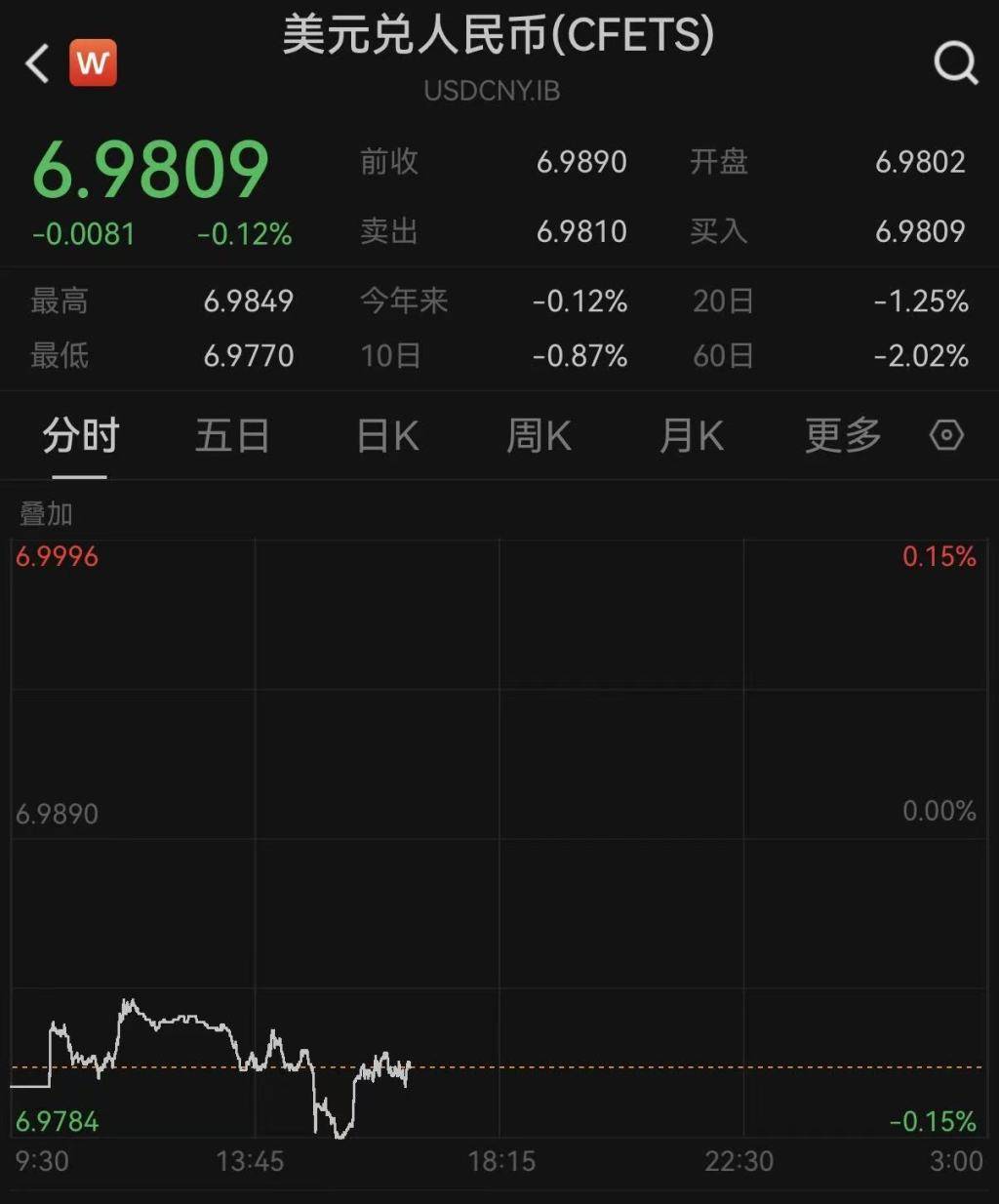
Core Viewpoint - The Chinese Yuan (CNY) continues to appreciate against the US Dollar (USD), reaching a new high since mid-May 2023, with the closing exchange rate at 6.9806 on January 5, 2026, marking an increase of 84 basis points from the previous trading day [1]. Exchange Rate Summary - On January 5, the CNY/USD exchange rate peaked at 6.9770, the highest since May 2023, and closed at 6.9806, up 84 basis points from the previous day [1]. - The central parity rate for CNY against USD was reported at 7.0230, an increase of 58 basis points [2]. Economic Context - The USD index strengthened for the second consecutive trading day, reaching a high of 98.7984 on January 5, amid rising geopolitical risks [3]. - The chief economist at China Minsheng Bank, Wen Bin, anticipates that the CNY will maintain a stable two-way fluctuation pattern in January, despite the USD's recent stabilization [3]. - The US economy shows resilience, with a third-quarter GDP growth rate of 4.3%, up from 3.8% in the second quarter, indicating potential for a gradual increase in non-farm employment [3]. Future Outlook - Seasonal demand for currency settlement in January may support further appreciation of the CNY, although the central parity rate is diverging towards depreciation compared to the closing spot rate, suggesting some cyclical behavior in the forex market [4]. - Overall, while the CNY may exhibit a strong performance in January, it is expected to fluctuate within the 6.9-7 range, reflecting the regulatory stance to maintain stability in the exchange rate [4].
白银整体趋势仍看涨 今年美经济保持韧性
Jin Tou Wang· 2025-12-26 01:36
Group 1 - The core viewpoint indicates that despite facing multiple pressures, the US economy is showing resilience in 2025, contrasting earlier predictions of potential recession and severe inflation due to tariff policies [1] - Inflation has decreased from its peak in 2022, yet prices remain high, impacting the ability of many Americans to cover basic expenses [1] - Consumers are facing challenges not only in daily shopping but also in achieving financial goals such as buying a first home, saving for retirement, or paying off debt [1] Group 2 - Silver prices are maintaining a bullish trend, supported by clear high and low points, with current prices above the breakout area of $70.65 [2] - The 50EMA has risen to around $66.90, confirming the strength of the trend, while the 100EMA remains significantly lower, indicating no exhaustion of the trend [2] - As long as silver prices stay above $70.65, there is an upward risk towards $73.80 and $75.30, with a trading strategy suggested to buy near $70.70 and target $75.00 [2]
2025 年三季度美国经济数据点评:美国经济的韧性与三重“K”型分化
Haitong Securities International· 2025-12-25 08:11
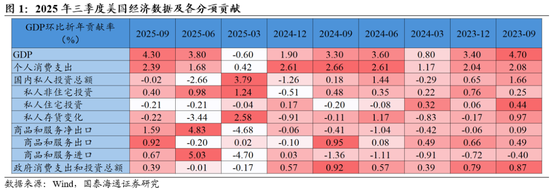
Economic Performance - The US GDP growth rate for Q3 2025 was 4.3%, exceeding expectations of 3.3% and the previous value of 3.8%[3] - Personal consumption contributed 2.39% to GDP growth, with overall personal consumption increasing by 2.8% year-on-year[8] - Government consumption and investment grew by 0.55% in Q3 2025, rebounding from previous contractions[8] Export and Trade - US exports increased by 2.13% in Q3 2025, compared to 0.04% in Q1 and -0.46% in Q2, driven by global economic recovery and new trade agreements[8] - The net export contribution to GDP was positive, with imports decreasing by 1.2% in Q3 2025[8] K-Shaped Divergence - Income disparity is evident, with personal disposable income growth stabilizing at 4.35% by September 2025, but unemployment rates for Black or African American individuals rose to 8.3%[15] - Large enterprises maintain a favorable economic outlook, reflected in the S&P Global Composite PMI remaining above the growth threshold, while the NFIB small business optimism index declined[17] - Investment growth is uneven, with private non-residential investment showing resilience at 3.9% year-on-year, while construction investment fell by 6.3%[19] Future Outlook - The US economy is expected to face short-term impacts from the government shutdown, but resilience is anticipated in 2026, with a potential recovery in Q1[23] - The Federal Reserve is projected to implement 2-3 interest rate cuts in 2026, despite strong economic performance, due to structural weaknesses in the labor market[24]
国泰海通:美国经济的韧性与三重“K”型分化
Xin Lang Cai Jing· 2025-12-24 10:59
Core Viewpoint - The U.S. economy showed resilience in Q3 2025, driven by strong personal consumption, increased public spending, and enhanced export contributions, despite exhibiting a "K"-shaped divergence in income, business performance, and economic sectors [1][2][3][4]. Economic Performance - The U.S. GDP annualized growth rate for Q3 2025 was 4.3%, exceeding expectations of 3.3% and the previous value of 3.8%, indicating overall economic resilience [5][26]. - Key contributors to this economic resilience included personal consumption, public spending growth, and increased exports [2][23][27]. Personal Consumption - Capital market wealth effects significantly supported high growth in personal consumption, with a contribution rate of 2.39% to GDP in Q3 2025. Year-on-year, personal consumption grew by 2.8%, with goods consumption up 3.3% and services consumption up 2.5% [6][27]. - The performance of the capital markets, with major indices reaching historical highs, was closely linked to consumer spending [6][27]. Public Spending - Government consumption and investment saw a rebound, with a 0.55% increase in Q3 2025 compared to previous quarters' contractions. Notably, defense spending rose by 1.43% [6][27][28]. - The U.S. Treasury significantly raised its borrowing plan for Q3 2025 from an estimated $554 billion to $1.01 trillion, providing additional funding for government spending [6][27]. Export Growth - U.S. exports increased by 2.13% in Q3 2025, a significant rise compared to previous quarters, supported by a recovery in global economic activity and new trade agreements that reduced tariffs [7][28][29]. "K"-Shaped Divergence - The economy displayed a "K"-shaped divergence characterized by: - **Individual Level**: Income disparity led to consumption differences, with higher unemployment rates among minority groups and wealth concentration in the top 10% of households [3][11][32]. - **Business Level**: Large enterprises maintained a positive outlook, reflected in the S&P Global Composite PMI, while small businesses showed weaker performance as indicated by the NFIB optimism index [3][13][34]. - **Sector Level**: Investment and growth disparities were evident, with strong performance in private non-residential investments, particularly in equipment and intellectual property, while construction investment declined [3][15][35]. Future Outlook - The U.S. economy is expected to face short-term impacts from the government shutdown in Q4 2025, but overall resilience is anticipated to remain strong into 2026, with a likely recovery in Q1 2026 [4][18][25][37]. - The Federal Reserve is projected to implement 2-3 rate cuts in 2026, despite the economy's strength, due to structural weaknesses in the labor market and potential influences from leadership changes at the Fed [4][19][38].