
行业周期

Search documents
周期共振下的新生:洋河2026年破局增长的三重逻辑
Xin Hua Wang· 2026-01-26 10:29
当洋河股份2025年业绩预告披露净利润阶段性下滑时,外界的担忧之声不绝于耳,但深入剖析其在行业 调整期的主动变革举措便会发现,这份"阵痛"实则是筑底蓄力的必经之路。 2026年,白酒行业正迎来政策底、行业周期底、估值底的三重共振。三重底部的共振叠加,为行业复苏 增长提供了绝佳的时间窗口。对于洋河而言,行业的整体性机遇并非被动等待的"东风",而是其前期变 革成果落地的"催化剂"。通过产品品牌的协同革新、渠道生态的深度修复、内生能力的系统升级,洋河 在周期底部完成的一系列布局,终将在行业复苏期释放巨大能量。这种主动破局的变革,更能体现企业 在周期波动中的长期价值韧性。 价格管控的刚性化是渠道生态稳定的前提。针对前期串货、低价倾销等乱象,洋河对梦之蓝、海之蓝等 主导产品实施"厂价直供+终端限价+配额管控"三重机制,在库存高企时主动缩量帮渠道去化,在消费 回暖时适度放量满足需求,形成"价格稳定-利润保障-动销提升"的良性循环。数据显示,经过调整,新 版海之蓝终端价稳定在130元,M3水晶版批价维持在350-360元,价格体系修复态势明确,为渠道信心 重建奠定了基础。 利润优化与终端赋能则进一步激活了渠道活力。洋河通过 ...

兰花科创发预亏,预计2025年度归母净亏损4.4亿元至5.5亿元
Zhi Tong Cai Jing· 2026-01-26 10:18
Core Viewpoint - Lanhua Ketech (600123.SH) is expected to report a net loss attributable to shareholders of the parent company ranging from 440 million to 550 million yuan for the fiscal year 2025 due to various adverse factors [1] Group 1: Financial Performance - The company anticipates a significant net loss for 2025, estimated between 440 million and 550 million yuan [1] - The primary reason for the loss is the continuous decline in market prices for key products, including coal and chemical fertilizers, which has severely impacted the main business profits [1] Group 2: Operational Challenges - The company is undergoing capacity integration and upgrades in its coal chemical industry to promote energy conservation and environmental protection, leading to asset impairment provisions for some outdated facilities [1] - A significant decline in investment income is attributed to the suspension of operations at the company's equity investee, Yamei Danning Energy Company, which ceased operations in mid-May due to the expiration of its operating period [1]

“金饭碗”端不住了!科思股份:业绩预降8成,实控人低位仍减持
市值风云· 2026-01-26 10:15
防晒市场需求增长放缓,苦日子恐怕得再熬一阵子。 | 作者 | | 白猫 | | --- | --- | --- | | 编辑 | | 小白 | 风云君以前常说,在化工圈子里,给国际巨头打工是门好生意。只要下游的老板们吃肉,作为上 游"打工皇帝"的科思股份(300856.SZ),日子就能过得相当滋润。 但最近的成绩单却给市场泼了一盆冷水:老板不仅要在寒风中缩衣节食,还在消化肚子里的存货,科 思股份这碗汤,眼看是端不稳了。 业绩"深蹲":从高 光时刻 到至暗时刻 就在1月21日,科思股份抛出了一份令人咋舌的业绩预告。公司预计2025年全年的归母净利润只有0.9 亿到1.2亿元。这个数字意味着什么?意味着相比2024年,它的净利润暴跌了78.7%至84.0%。 ( 2025 年半年报) 曾几何时,科思股份是著名的"现金奶牛"。2023年,它的综合毛利率高达48.8%,是妥妥的暴利生 意。到了2024年,虽然微降至44.4%,依然傲视群雄。但到了2025年三季度,这个数字直接击穿了3 0%的心理防线,跌到了29.6%。 短短两年不到,毛利率蒸发了近20个百分点。 ( 2025 年业绩预告) 再翻看最新的财务报表,惨烈 ...



立华股份(300761):Q4黄鸡价格回升,盈利环比改善
Donghai Securities· 2026-01-21 07:43
Investment Rating - The investment rating for the company is "Buy" (maintained) [2][7]. Core Views - The report highlights that the price of yellow chickens has rebounded in Q4, leading to an improvement in profitability compared to the previous quarter [2][5]. - The company is a leading player in the yellow feathered chicken breeding industry, with a target annual growth rate of 8-10% for yellow feathered chicken output [5]. - The report anticipates a rebound in pig and chicken prices in 2026, which is expected to release profit elasticity for the company [5]. Summary by Relevant Sections Financial Performance - The company expects to achieve a net profit attributable to shareholders of 5.5-6 billion yuan in 2025, a year-on-year decline of 60.55%-63.84% [5]. - In Q4, the company sold 567 million meat chickens, a year-on-year increase of 9.9%, with an average selling price of 11.40 yuan/kg, down 11.9% year-on-year [5]. - The company sold 211.16 million live pigs in 2025, a year-on-year increase of 62.7%, with an average selling price of 13.85 yuan/kg, down approximately 19.94% year-on-year [5]. Profitability and Cost Management - The report indicates that the company has maintained cost advantages through refined management across various segments, leading to improved profitability in the yellow chicken segment in Q4 [5]. - The company’s production efficiency for pigs has improved, with the total cost in Q3 dropping to approximately 12.6 yuan/kg, and further improvements expected in Q4 [5]. Future Outlook - The report projects net profits for 2025-2027 to be 5.75 billion, 12.02 billion, and 13.03 billion yuan respectively, with corresponding EPS of 0.69, 1.44, and 1.56 yuan [5]. - The company is expected to benefit from a decrease in the supply of yellow feathered chickens and sows, which may lead to higher prices in 2026 [5].

“矿业双雄”的掘金密码
Zhong Guo Jing Ying Bao· 2026-01-18 10:48
Core Insights - In 2025, Zijin Mining and Luoyang Molybdenum both achieved record-high profits and market valuations, driven by strategic positioning in the global commodity market and effective operational management [1][2][4]. Financial Performance - Zijin Mining expects a net profit of 51-52 billion yuan for 2025, marking a year-on-year increase of 59%-62%, with core mineral products seeing significant price and volume growth [2][3]. - Luoyang Molybdenum anticipates a net profit of 20-20.8 billion yuan, representing a year-on-year growth of 47.8%-53.71%, and is entering the 20 billion yuan profit range for the first time [2][3]. Production and Market Position - Zijin Mining's production includes approximately 90 tons of gold, 1.09 million tons of copper, and 437 tons of silver, positioning it as the fourth-largest metal mining company globally and the largest gold mining company [2][3]. - Luoyang Molybdenum's copper production reached 741,100 tons, with cobalt, molybdenum, tungsten, and niobium also hitting historical highs [3][4]. Strategic Initiatives - Luoyang Molybdenum's success is attributed to its long-term strategic focus on the energy transition and early investments in overseas copper assets, alongside capitalizing on the current metal price upcycle [1][4]. - The company is advancing its KFM Phase II project, expected to add 100,000 tons of copper production annually by 2027, and is planning further expansions to reach a target of 1 million tons of copper by 2028 [4]. Management Changes - Zijin Mining has undergone a leadership transition, with a new management team emphasizing stability and internal promotion, which is seen as crucial for maintaining strategic continuity [5][6]. - Luoyang Molybdenum has introduced a new management team with significant external experience, aiming to enhance global management capabilities and adapt to evolving industry demands [7][8]. Industry Trends - The contrasting management strategies of Zijin Mining and Luoyang Molybdenum reflect broader trends in the mining industry, with Zijin focusing on internal stability and Luoyang on external talent acquisition to drive innovation and digital transformation [9].


维远股份:预计2025年年度净利润约为-9.5亿元到-10.5亿元
Mei Ri Jing Ji Xin Wen· 2026-01-16 10:01
Group 1 - The company, Weiyuan Co., Ltd., forecasts a net profit attributable to shareholders of between -9.5 billion to -10.5 billion yuan for the year 2025, indicating a significant loss compared to the previous year [1] - The expected loss is primarily due to the impairment provisions for long-term assets and inventory, which will impact the net profit by approximately -6.3 billion yuan [1] - The decline in average prices for key products such as phenol, acetone, isopropanol, bisphenol A, and polycarbonate in 2025 compared to 2024 is a major factor contributing to the decrease in gross profit margins [1] Group 2 - Increased costs associated with equipment maintenance and the trial production of new projects have also contributed to the financial outlook [1] - During the reporting period, maintenance was conducted on several facilities, including propane dehydrogenation, bisphenol A, polycarbonate, and propylene oxide, which has led to higher operational costs [1] - The segmented trial production of the electrolyte solvent facility has further exacerbated the cost issues faced by the company [1]

维远股份:预计2025年净利润亏损9.5亿元—10.5亿元,同比转亏
Zheng Quan Shi Bao Wang· 2026-01-16 09:20
Core Viewpoint - The company, Weiyuan Co., Ltd. (600955), is expected to report a net loss attributable to shareholders of approximately 9.5 billion to 10.5 billion yuan for the fiscal year 2025, indicating a significant decline compared to the previous year [1] Group 1: Financial Performance - The anticipated net loss includes an impact of about 6.3 billion yuan from impairment provisions on certain long-term assets and inventory [1] - The company is expected to experience a decline in gross profit margins for its main products, including phenol, acetone, isopropanol, bisphenol A, and polycarbonate, due to a significant decrease in average prices in 2025 compared to 2024 [1]
温氏股份增量不增利 归母净利大降40亿 股价萎靡市值比牧原股份少1562亿
Chang Jiang Shang Bao· 2026-01-13 00:01
Core Viewpoint - The company, Wens Foodstuff Group, is facing significant pressure on its operating performance for the fiscal year 2025, with expected net profit declines of 40.73% to 46.12% compared to the previous year [1][4]. Financial Performance - For 2025, Wens expects a net profit of 5 billion to 5.5 billion yuan, down from 9.28 billion yuan in the previous year, indicating a decrease of approximately 42.8 billion to 37.8 billion yuan [4]. - In the first three quarters of 2025, the company reported revenue of approximately 758 billion yuan, which is nearly flat year-on-year, but net profit fell by about 18% to 5.256 billion yuan [1][4]. - The fourth quarter is projected to be particularly challenging, with a potential net loss if the lower end of the profit forecast is realized [5][6]. Sales and Pricing - Despite an increase in product sales, with 40.4769 million pigs and 1.303 billion chickens sold in 2025, the company is experiencing a decline in net profit due to falling sales prices [6][7]. - The average selling price for pigs decreased by 17.95% to 13.71 yuan per kilogram, while the average price for chickens fell by 9.80% to 11.78 yuan per kilogram [6]. Industry Context - The livestock industry is characterized by significant cyclical fluctuations, and Wens has struggled to mitigate these cycles effectively [8]. - The company has been implementing cost-cutting measures, but the reduction in sales prices has led to a decline in profitability despite lower production costs [9][10]. Competitive Landscape - Wens Foodstuff Group's market performance has lagged behind its competitor, Muyuan Foods, which reported a net profit of 14.779 billion yuan in the first three quarters of 2025, a 41.01% increase year-on-year [11][13]. - The gap in market capitalization between Wens and Muyuan has widened, with Wens's market value at 113.4 billion yuan, which is 156.2 billion yuan less than Muyuan's [3][13].


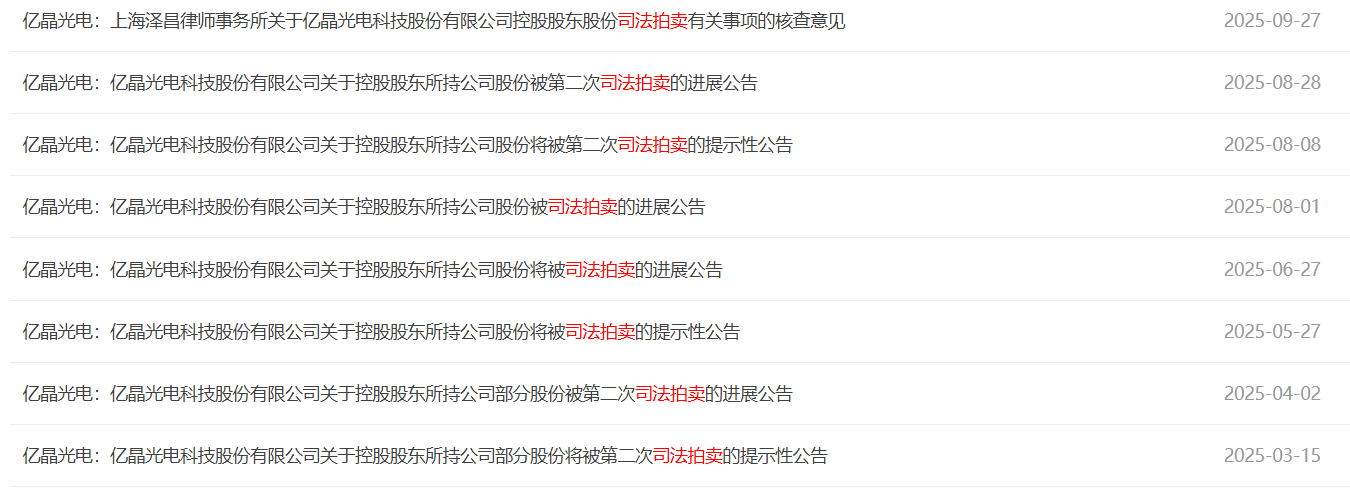
亿晶光电“90后”前证代当上董事长,低薪任要职遭遇20.9亿元巨亏后再面临“*ST”风险
Mei Ri Jing Ji Xin Wen· 2026-01-09 08:03
Core Viewpoint - Yichin Photovoltaic is expected to report a significant loss in 2025, potentially exceeding its net assets from the previous year, which raises concerns about the risk of delisting from the stock exchange [1][5]. Group 1: Company Performance and Financial Outlook - The company anticipates a net profit loss for 2025, which may lead to negative net assets by year-end [1]. - The projected loss for 2024 is reported at 2.09 billion yuan [3]. - As of the end of 2023, the company's equity attributable to shareholders was 2.524 billion yuan, indicating a complete erosion of its financial base within two years if the losses materialize [5]. Group 2: Leadership and Governance Issues - Chen Jiangming, born in 1991, rapidly ascended from a securities representative to the position of Chairman and Secretary of the Board, signing off on the company's significant losses shortly after his appointment [2][3]. - His salary as Secretary of the Board in 2024 was only 416,000 yuan, significantly lower than his predecessor and below the industry average for similar positions [3]. - The company is currently without a controlling shareholder due to the previous major shareholder's shares being judicially auctioned off [3]. Group 3: Legal and Operational Challenges - Yichin Photovoltaic is involved in multiple legal disputes, with 23 cases reported, including 10 currently under trial [5]. - The company faces accountability from local state-owned assets for failing to fulfill prior agreements, which could lead to the termination of investment agreements and the recovery of 140 million yuan [5]. - The dual role of Chen Jiangming as both Chairman and Secretary of the Board raises concerns about governance and the effectiveness of oversight within the company [6].

天风·遇见首席|刘洁铭:Stay hungry,stay foolish
Sou Hu Cai Jing· 2026-01-06 07:05
Core Viewpoint - The article highlights the journey and insights of Liu Jieming, a senior analyst in the food and beverage industry, emphasizing the cyclical nature of the industry and the importance of deep research and understanding to identify investment opportunities and risks [4][5]. Group 1: Industry Insights - The food and beverage industry has experienced significant fluctuations, with the liquor sector witnessing a peak in 2010 followed by a downturn starting in 2012, leading to a prolonged bear market [4]. - The liquor industry began to recover in 2016, resulting in a five-year bull market, but faced another downturn post-2021, characterized by valuation and performance declines [4]. - The analyst emphasizes the need for a calm mindset when facing market volatility, suggesting that pessimism can present investment opportunities [7]. Group 2: Research Philosophy - The analyst's approach to food and beverage research is rooted in the belief that understanding the nuances of the industry requires extensive experience and attention to detail, as market dynamics can be complex and misleading [5]. - The goal is to provide forward-looking and differentiated research by identifying subtle industry changes that may lead to significant investment opportunities [6]. - The analyst values reliability and objectivity, aiming to maintain a consistent judgment regardless of market sentiment [8]. Group 3: Personal Insights - The analyst expresses a passion for the food and beverage sector, viewing work as an extension of personal interests, which contributes to a positive and optimistic outlook [9].
