通胀上行风险

Search documents
策略日报:轮动下的高低切-20250904
Tai Ping Yang Zheng Quan· 2025-09-04 15:33
Group 1: Major Asset Tracking - The bond market is experiencing a fluctuation with long-term bonds outperforming short-term ones, indicating a potential risk of continued decline in interest rate bonds in the short term [14][18] - The A-share market is seeing a downward trend, with the ChiNext index dropping over 4%, and over 2900 stocks declining, suggesting a market adjustment phase [2][18] - The commodity market is showing signs of a potential upward trend, particularly in crude oil and precious metals, with the Wenhua Commodity Index nearing a critical support level [5][36] Group 2: Investment Strategy - The strategy suggests avoiding high volatility stocks and focusing on low-position large-cap stocks for better value [2][19] - The report indicates a bullish outlook on commodities, particularly precious metals and crude oil, as they are expected to resonate upward with the stock market's style shift [5][36] - The report emphasizes the importance of monitoring the dollar index for potential upward movement, suggesting that shorting the dollar may not be cost-effective [32][33] Group 3: Important Policies and News - Domestic policies are increasingly focusing on supporting key enterprises in the supply chain, indicating a shift towards enhancing domestic consumption and economic recovery [39][42] - Internationally, India is reducing consumption taxes to stimulate domestic demand amid rising economic risks, reflecting a proactive approach to economic management [42][45] - The report highlights the optimistic tone from the July Politburo meeting regarding overseas risks, suggesting a favorable outlook for US-China trade negotiations [2][18]
2025年9月大类资产配置月报:Q4:看好金铜共振-20250904
ZHESHANG SECURITIES· 2025-09-04 02:30
Quantitative Models and Construction 1. Model Name: Macro Scoring Model - **Model Construction Idea**: The model evaluates macroeconomic factors to generate scores for various asset classes, reflecting their relative attractiveness under current macroeconomic conditions [16][18]. - **Model Construction Process**: - The model incorporates global macroeconomic factors such as global monetary conditions, global inflation, and global economic sentiment. - Each factor is scored based on its current trend (e.g., uptrend or downtrend) and its historical relationship with asset performance. - The scores are aggregated to produce a final macro score for each asset class, including equities, commodities, and bonds [16][18]. - **Model Evaluation**: The model is effective in identifying asset classes with higher expected returns under specific macroeconomic conditions. For example, it currently favors commodities like copper and gold over equities due to the upward trend in global inflation and monetary easing [16][18]. 2. Model Name: US Equity Timing Model - **Model Construction Idea**: This model assesses the timing for US equity investments based on macroeconomic and market-specific indicators [19]. - **Model Construction Process**: - The model uses three sub-indicators: economic sentiment, capital flows, and financial stress. - Each sub-indicator is scored, and the aggregated score determines the model's outlook (e.g., bullish, neutral, or bearish) for US equities [19]. - **Model Evaluation**: The model has shifted its outlook to "bullish" due to improving economic sentiment and capital flows, suggesting a favorable environment for US equities [19]. 3. Model Name: Gold Timing Model - **Model Construction Idea**: This model evaluates the timing for gold investments based on fiscal and inflationary conditions [21]. - **Model Construction Process**: - The model incorporates indicators such as fiscal deficit expansion, inflation trends, and central bank policies. - The latest reading of the timing indicator is -0.53, reflecting a cautious signal. However, the model acknowledges potential distortions due to lagging data on fiscal expansion [21]. - **Model Evaluation**: Despite the cautious signal, the model suggests that gold remains a strong investment under the anticipated fiscal deficit expansion and rising inflation [21]. 4. Model Name: Crude Oil Timing Model - **Model Construction Idea**: This model predicts crude oil price trends based on macroeconomic and market-specific factors [26]. - **Model Construction Process**: - The model uses a "Crude Oil Sentiment Index," which aggregates factors such as demand, inventory levels, the US dollar index, investor expectations, and macroeconomic risks. - The latest index reading is 0.56, indicating a positive outlook for crude oil prices [26][27]. - **Model Evaluation**: The model maintains a bullish view on crude oil, supported by improving demand and reduced macroeconomic risks [26][27]. --- Backtesting Results of Models 1. Macro Scoring Model - **Copper**: When the macro score for copper reaches 4, the next month's annualized return for LME copper is 29% [12][16]. - **Gold**: The model indicates a positive outlook for gold under current macroeconomic conditions, though specific return metrics are not provided [16][18]. 2. US Equity Timing Model - **Outlook**: The model has upgraded its view on US equities to "bullish," supported by improving economic sentiment and capital flows [19]. 3. Gold Timing Model - **Indicator Value**: The latest timing indicator value is -0.53, signaling caution, though the model suggests potential upside due to fiscal and inflationary trends [21]. 4. Crude Oil Timing Model - **Indicator Value**: The Crude Oil Sentiment Index is at 0.56, reflecting a positive outlook for crude oil prices [26][27]. --- Quantitative Factors and Construction 1. Factor Name: Global Monetary Factor - **Factor Construction Idea**: Tracks global monetary policy trends to assess their impact on asset prices [16]. - **Factor Construction Process**: - The factor is derived from central bank policy rates, liquidity measures, and monetary easing/tightening cycles. - It is used as an input in the macro scoring model to evaluate the attractiveness of risk assets [16]. 2. Factor Name: Global Inflation Factor - **Factor Construction Idea**: Measures global inflationary pressures and their implications for asset performance [16]. - **Factor Construction Process**: - The factor aggregates inflation data from major economies and evaluates its trend (e.g., accelerating or decelerating). - It is used to assess the relative attractiveness of inflation-sensitive assets like commodities [16]. 3. Factor Name: Economic Sentiment Factor - **Factor Construction Idea**: Captures the overall economic sentiment to predict asset class performance [19]. - **Factor Construction Process**: - The factor is based on leading indicators such as PMI data, new orders, and consumer confidence indices. - It is a key input in the US equity timing model [19]. --- Backtesting Results of Factors 1. Global Monetary Factor - **Impact**: The upward trend in this factor supports a positive outlook for risk assets, particularly commodities [16]. 2. Global Inflation Factor - **Impact**: The rising trend in this factor favors inflation-sensitive assets like copper and gold [16]. 3. Economic Sentiment Factor - **Impact**: The improvement in this factor supports a bullish outlook for US equities [19].
美债周二走势分化 投资者抛售长期债券
Sou Hu Cai Jing· 2025-08-26 13:58
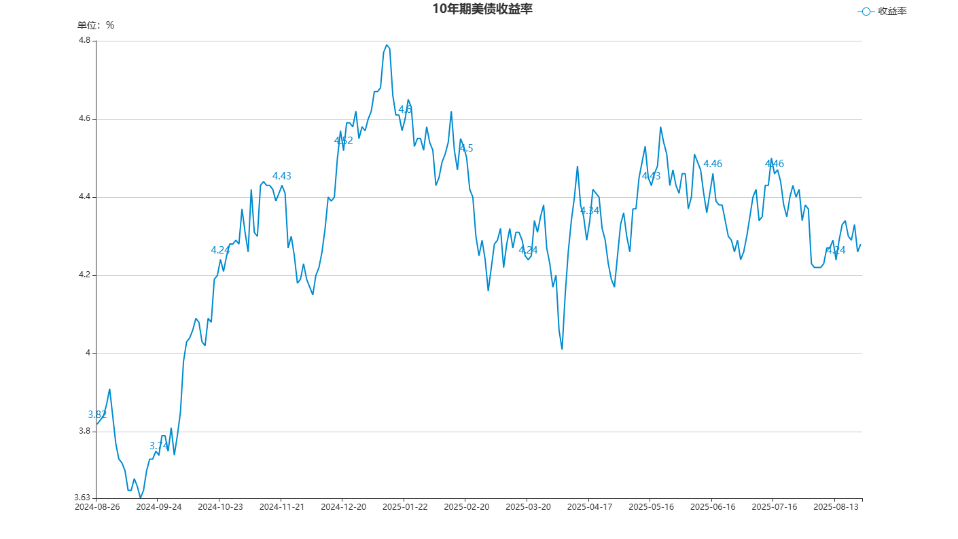
Group 1 - The announcement of the dismissal of Federal Reserve Governor Lisa Cook by President Trump raises concerns about the future independence of the Federal Reserve among investors [1][5] - Following the announcement, there was a mixed reaction in the bond market, with long-term bond yields rising while short-term yields mostly fell [1][3] - The yield on the 2-year Treasury bond decreased by 3.2 basis points to 3.698%, while the 10-year yield increased by 0.4 basis points to 4.279% [1] Group 2 - Economists warn that further political interference in the Federal Reserve could pose significant risks [7] - Elizabeth Warren, a senior member of the Senate Banking Committee, criticized the dismissal as an illegal attempt by the president to find a scapegoat for rising costs, calling it a violation of the Federal Reserve Act [6] - The potential for further dismissals of Federal Reserve officials could increase inflation risks, leading investors to speculate that the Fed may become less focused on inflation [5]

7月美联储议息会议点评2025年第5期:资产配置快评为潜在通胀上行风险做准备
Huachuang Securities· 2025-07-31 02:44
Group 1: Federal Reserve's Monetary Policy - In July, the Federal Reserve maintained the federal funds rate in the range of 4.25%-4.5%, citing a "tight balance" in the labor market and potential inflation risks from high tariffs[3][6] - The Fed's assessment of economic uncertainty focuses on rising inflation impacting real GDP growth rather than nominal output or employment issues[3][6] - The threshold for rate cuts remains high, with no clear indication of a September rate cut despite market speculation[3][10] Group 2: Inflation and Economic Outlook - Inflation risks are primarily driven by tariffs, which are seen as a short-term shock, but the long-term impact on the economy requires further evaluation[3][9] - The Fed acknowledges that the current inflationary pressures may just be the beginning of the effects from tariffs on goods inflation[3][9] - The labor market remains solid, with no signs of weakness, but there are downside risks to economic growth[3][11] Group 3: Market Implications - Improved risk appetite and economic outlook may continue to support U.S. equities and long-term Treasury yields, with the dollar index potentially returning to the 100 mark[3][12] - Emerging market assets, excluding China, may face valuation risks due to high tariffs and external demand pressures, despite some trade agreements[3][12]
前日本央行副行长Nakaso:日本央行必须警惕通胀上行风险,因为食品价格上涨可能导致通胀预期失控。
news flash· 2025-07-29 03:07
Core Viewpoint - The former Deputy Governor of the Bank of Japan, Nakaso, emphasizes the need for the Bank of Japan to remain vigilant regarding the risks of rising inflation, particularly due to increasing food prices which could lead to a loss of control over inflation expectations [1] Group 1 - Nakaso warns that rising food prices may trigger inflation expectations to spiral out of control [1]
7月29日电,前日本央行副总裁中曾宏表示,日本央行必须警惕通胀的上行风险,因食品价格上涨可能导致通胀预期超出目标。
news flash· 2025-07-29 03:04
Core Viewpoint - The former Deputy Governor of the Bank of Japan, Nakaso Hiroshi, emphasizes the need for the Bank of Japan to be cautious about the upward risks of inflation due to rising food prices, which may lead to inflation expectations exceeding targets [1] Group 1 - The Bank of Japan is warned about the potential for inflation to rise beyond its target [1] - Rising food prices are identified as a significant factor contributing to inflationary pressures [1] - The statement reflects concerns regarding the broader economic implications of sustained inflation [1]
欧洲央行管委Kazimir:不认为有任何因素会迫使欧洲央行在9月就提前降息。预先承诺政策路径将是愚蠢的错误。贸易协定是利好消息,有助于消除不确定性。劳动力市场若遭受重大冲击,或迫使欧央行采取行动。通胀上行风险持续存在,需保持高度警惕。
news flash· 2025-07-28 09:38
Core Viewpoint - The European Central Bank (ECB) is not expected to lower interest rates prematurely in September, as there are no compelling factors to warrant such a move [1] Group 1: Monetary Policy - The commitment to a predetermined policy path is deemed a foolish mistake [1] - The ongoing risks of rising inflation necessitate a high level of vigilance [1] Group 2: Economic Conditions - Trade agreements are viewed as positive news that can help reduce uncertainty [1] - A significant shock to the labor market could compel the ECB to take action [1]
德银:欧洲央行暂停降息背后仍存通胀上行与政策分歧风险
news flash· 2025-07-24 12:55
Core Viewpoint - Deutsche Bank's chief European economist Mark Wall indicates that the European Central Bank (ECB) has paused its easing cycle in July, raising questions about whether this is a temporary halt or a long-term observation, with significant uncertainty remaining [1] Group 1: ECB Policy and Economic Outlook - The ECB's decision to pause is seen as a reasonable approach to maintain policy flexibility amid high uncertainty [1] - There is a potential risk of rising inflation due to strong economic resilience combined with large-scale fiscal stimulus if trade uncertainties diminish [1] - The market may soon shift its focus from the "last rate cut" to the timing of the "first rate hike" [1]

美联储会议纪要:投资者对经济增长下行风险和通胀上行风险的看法有所减弱
news flash· 2025-07-09 18:08
Core Viewpoint - The latest Federal Reserve meeting minutes indicate a reduction in investor concerns regarding the risks of economic growth downturn and inflation increase [1] Economic Indicators - During the two meetings, policy expectations and U.S. Treasury yields have risen moderately, while credit spreads have narrowed and stock prices have increased [1] - Economic data has generally fallen short of expectations, with the May employment report being a notable exception [1] Market Sentiment - Investors are focusing on the easing of trade tensions and the prospects of fiscal expansion, contributing to a more optimistic outlook [1]
短线下挫!
中国基金报· 2025-07-09 01:21
Market Overview - The Japanese stock market showed mixed results, with the Nikkei 225 index experiencing a slight decline of 0.02% as of the report [3] - The South Korean KOSPI index increased by 0.29%, reaching 3124.07 points [9] Individual Stock Performance - Sumitomo Pharma saw a significant increase of over 8%, while Omron, Seiko, and Casio rose by more than 5% [5] - Notable declines were observed in companies such as Fujitsu, Nintendo, and Mitsubishi Heavy Industries [5] - Specific stock performance data includes: - Sumitomo Pharma: 987.0 JPY, up 8.82%, market cap 392.7 billion JPY [6] - Omron: 4048.0 JPY, up 6.86%, market cap 834.9 billion JPY [6] - Seiko: 1180.5 JPY, up 5.54%, market cap 413.4 billion JPY [6] - Casio: 1161.5 JPY, up 5.50%, market cap 276.1 billion JPY [6] - Nissan Motor experienced a sharp decline, dropping over 3% [5] Economic Insights - Former Deputy Governor of the Bank of Japan, Nakaso Hiroshi, emphasized the need for vigilance regarding inflation risks, suggesting that there is still room for further interest rate hikes [7] - New Bank of Japan committee member, Junko Koizumi, hinted at a possible upward adjustment of inflation expectations this month, which could pave the way for another interest rate increase this year [8] Trade and Export Concerns in South Korea - A trade expert in South Korea predicted a significant reduction in exports of major products if the U.S. tariff policy is implemented as planned [9] - Forecasts indicate that exports in the automotive and steel sectors may decline by 7.1% and 7.2%, respectively, from July to December [10] - The expert urged South Korean companies to consider relocating production bases overseas or adjusting export prices to mitigate the impact of high tariffs [10] - There is a call for the South Korean government and industries to reduce reliance on the U.S. market and expand exports to regions such as the EU, ASEAN, and India, while accelerating the transition to high-tech industries [10]