
全球化

Search documents
安踏体育:收购 PUMA 29%股权,全球化布局注入新动力-20260128
GUOTAI HAITONG SECURITIES· 2026-01-28 04:25
Investment Rating - The report maintains a "Buy" rating for the company, with a target price of 104.1 HKD based on a PE of 20X for 2025 [10]. Core Insights - Anta Sports has acquired a 29% stake in PUMA for 1.5 billion euros, becoming the largest shareholder. This acquisition is seen as a strategic move to enhance Anta's "single focus, multi-brand, globalization" strategy [2][10]. - PUMA is currently facing short-term performance pressures, undergoing inventory clearance. The management anticipates a low double-digit decline in sales for 2025, defining it as a "reset year" [10]. - The acquisition is expected to leverage Anta's insights and supply chain advantages in the Greater China region, enhancing PUMA's operational efficiency in emerging e-commerce and retail [10]. Financial Summary - Total revenue projections (in million RMB) for Anta Sports are as follows: - 2024: 70,826 (+13.6%) - 2025E: 78,410 (+10.7%) - 2026E: 85,846 (+9.5%) - 2027E: 95,707 (+11.5%) [4] - Net profit projections (in million RMB) are: - 2024: 15,596 (+52.4%) - 2025E: 13,106 (-16.0%) - 2026E: 14,124 (+7.8%) - 2027E: 15,845 (+12.2%) [4] - The company's PE ratios are projected to be: - 2024: 14.10 - 2025E: 16.62 - 2026E: 15.43 - 2027E: 13.75 [4] Market Data - The current market capitalization of Anta Sports is 217,859 million HKD, with a stock price range over the past 52 weeks between 75.50 and 104.40 HKD [7].
安踏体育(02020):收购 PUMA 29%股权,全球化布局注入新动力
GUOTAI HAITONG SECURITIES· 2026-01-28 02:43
股票研究 /[Table_Date] 2026.01.28 收购 PUMA 29%股权,全球化布局注入 新动力 | [姓名table_Authors] | 电话 | 邮箱 | 登记编号 | | --- | --- | --- | --- | | 盛开(分析师) | 021-23154510 | shengkai@gtht.com | S0880525040044 | | 钟启辉(研究助理) | 021-23185686 | zhongqihui@gtht.com | S0880125042254 | 本报告导读: 安踏出资 15 亿欧元收购 PUMA 29%股份,成为最大股东。PUMA 业绩面临短期压 力,当前正处清货节奏。我们认为此次收购是安踏推进"单聚焦、多品牌、全球化" 战略的关键一步。 投资要点: | 财务摘要(百万人民币) | 2024 | 2025E | 2026E | 2027E | | --- | --- | --- | --- | --- | | 营业总收入 | 70826 | 78410 | 85846 | 95707 | | (+/-)% | 13.6% | 10.7% | 9.5% | ...

东方雨虹:预期差中的市场共识重塑
Ge Long Hui· 2026-01-28 00:14
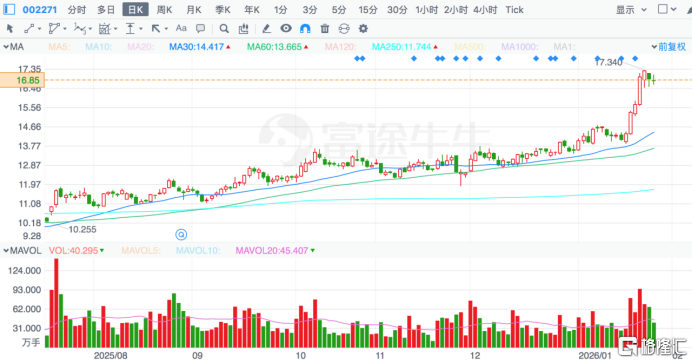
Core Viewpoint - The stock price of Dongfang Yuhong (002271.SZ) has shown strong performance, with a cumulative increase of approximately 24% since the beginning of the year, and its market capitalization has surpassed 40 billion [1][3]. Group 1: Company Developments - The controlling shareholder has announced a plan to reduce holdings by up to 3% of the total share capital, which will be used to fulfill employee stock ownership commitments and repay personal pledged loans [3]. - This reduction is seen as a move to stabilize the governance structure and reduce potential risks to the company, aligning with recent strategic actions such as selling multiple real estate assets and liquidating holdings in Jinke Services [3]. - The company is optimizing its asset structure to focus more on its core business, preparing for strategic initiatives in 2026 and beyond [3]. Group 2: Industry Trends - The construction materials industry is at a turning point, transitioning from a high-growth model reliant on real estate development to new structural opportunities [4]. - The industry is expected to reach a bottom in fundamentals by 2024-2025, with potential for growth in 2026 as supply-side improvements stabilize prices [5]. - The demand structure is fundamentally changing, with a significant shift towards renovation needs, which currently account for about 50% of demand and are expected to rise to nearly 70% by 2030 [5]. Group 3: Company’s Strategic Positioning - Dongfang Yuhong is undergoing a strategic transformation from a high accounts receivable model to a healthier development model focused on retail and engineering channels, with a projected revenue contribution from these channels reaching 84.06% by mid-2025 [8]. - The company is also expanding its sand powder and overseas businesses, with sand powder production expected to exceed 12 million tons in 2025, marking a 50% increase from 2024 [10]. - Recent acquisitions, such as the purchase of Construmart in Chile, are part of a strategy to establish an international retail platform and enhance global distribution capabilities [12]. Group 4: Market Expectations and Recovery Signals - There are three significant expectation gaps regarding Dongfang Yuhong: the market underestimates the depth of its strategic transformation, overlooks the reality of its new business growth engines, and focuses on overall industry lows while ignoring positive turning points [7][10][13]. - The company has shown a revenue growth of 8.51% year-on-year in Q3 2025, marking the first positive growth in recent years, indicating a shift in growth momentum [13]. - The competitive environment is improving, with supply-side adjustments and price stabilization signaling an end to the most intense phases of price competition, suggesting a recovery in profitability for leading companies in 2026 [13][14].


东方雨虹(002271.SZ):预期差中的市场共识重塑
Ge Long Hui· 2026-01-28 00:12
Core Viewpoint - The stock price of Dongfang Yuhong (002271.SZ) has shown strong performance, with a cumulative increase of approximately 24% since the beginning of the year, and its market capitalization has surpassed 40 billion [1] Group 1: Company Developments - The controlling shareholder has announced a plan to reduce holdings by no more than 3% of the total share capital, which has attracted market attention [2] - The funds from the reduction will primarily be used to fulfill employee stock ownership plan commitments and repay personal pledged loans, which will help stabilize the core team and reduce potential risks to the company [2] - The company has been optimizing its asset structure by selling multiple real estate properties and liquidating its holdings in Jinke Services, indicating a focus on its core business for future strategic initiatives [2][4] Group 2: Industry Trends - The construction materials industry is at a crossroads, transitioning from a high-growth model reliant on real estate development to new structural opportunities [4] - The industry is expected to reach a bottom in fundamentals by 2024-2025, with potential for growth in 2026 [5] - The demand structure is fundamentally changing, with a significant shift towards renovation needs, which currently account for about 50% of demand and are expected to rise to nearly 70% by 2030 [7] Group 3: Market Dynamics - The most intense phase of price competition in the industry appears to be over, with leading companies expected to see profit recovery in 2026 [7][8] - The global market presents a second growth opportunity for the industry, driven by initiatives like the Belt and Road and the wave of Chinese manufacturing going abroad [8] Group 4: Company-Specific Expectations - Dongfang Yuhong has significant potential for profit and valuation recovery, with three key expectation gaps identified [10] - The first gap is the market's underestimation of the depth and long-term value of the company's strategic transformation from a high receivables model to a healthier retail and engineering channel model [11] - The second gap is the market's perception of new business ventures as long-term stories, while they are already becoming significant growth engines, particularly in the sand powder and overseas markets [13][14] - The third gap is the market's focus on overall industry lows, overlooking multiple signals of recovery, including a revenue growth of 8.51% year-on-year in Q3 2025, marking the first positive growth in recent years [16]
紫金矿业280亿大手笔并购
2 1 Shi Ji Jing Ji Bao Dao· 2026-01-27 23:16
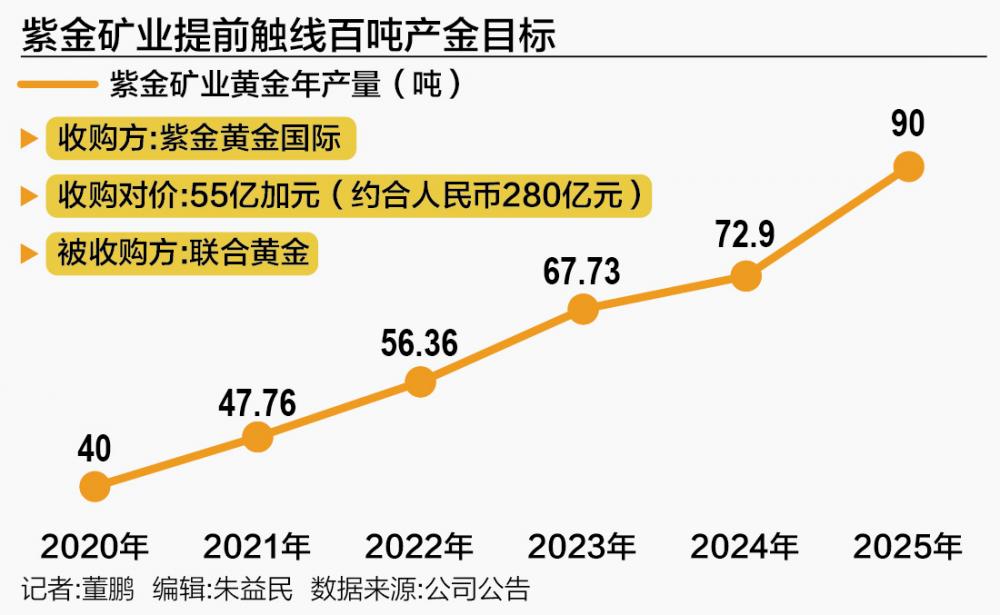
紫金矿业(601899.SH)开年首单并购,选择了加拿大的金矿企业。 1月26日,紫金矿业公告,计划通过其控股子公司紫金黄金国际,以44加元/股的现金价格,收购联合黄金全部已发行的普通股,收购对价共计 约55亿加元(约合人民币280亿元)。 后者核心资产,为位于非洲马里、科特迪瓦与埃塞俄比亚的多个金矿,相关项目预计2025年产金11.7~12.4吨,后续经过改扩建及新建产能释 放,到2029年产金将提升至25吨。 紫金矿业2024年调整后的五年产量规划为,2028年矿产金目标为100-110吨,而在2025年公司矿产金已经达到90吨。 后续,一旦对联合黄金的收购完成并实现并表,紫金矿业将提前两年达成百吨产金目标。 此外,近两年随着金、铜价格的上涨,该公司外部并购也呈现出了明显的"项目大型化"特点,新购金矿项目预期产量普遍在5吨/年以上,并且 百亿级收购案明显增加。 根据21世纪经济报道记者此前不完全统计,截至2025年12月下旬,包括紫金矿业、洛阳钼业、江西铜业等在内的多家企业,全年海外金矿资产 收购总额达到297亿元。 而紫金矿业上述单笔并购金额,便已经与去年中资矿企海外"购金"规模基本相当。 高达280亿 ...

股市必读:万孚生物(300482)1月27日董秘有最新回复
Sou Hu Cai Jing· 2026-01-27 17:27
Core Viewpoint - The company is focusing on expanding its market presence in the fields of infectious diseases and chronic disease management, leveraging policy benefits to promote key products like glycosylated hemoglobin testing and respiratory multiplex testing products [2][3]. Group 1: Financial Performance - As of January 27, 2026, the company's stock closed at 24.72 yuan, down 3.29%, with a turnover rate of 13.46%, trading volume of 579,400 lots, and a transaction value of 1.397 billion yuan [1]. Group 2: Product Development and Market Strategy - The company is actively working on the domestic market launch of its respiratory multiplex testing products, which cover common respiratory pathogens and are designed for rapid screening of infectious diseases [2]. - The company has successfully launched the first domestic MSI testing kit based on fluorescent PCR melting curve method, addressing existing pain points in MSI testing and aiming to enhance the efficiency and quality of cancer patient diagnosis and treatment [3]. - The company is committed to maintaining a balance between R&D investment and cash flow management, focusing on high-output and high-barrier technology areas to drive operational quality [3]. Group 3: International Expansion and Local Operations - The company is establishing subsidiaries in Russia and the Philippines to promote localized operations, although specific progress on construction, registration, production plans, and initial sales targets has not been detailed [4][5]. - The company aims to become a globally influential IVD enterprise, with a multi-dimensional development strategy that includes increasing overseas revenue and AI-related income [5]. Group 4: Market Penetration and Channel Strategy - The company plans to leverage its advantages in the POCT field to enhance penetration in grassroots medical institutions and regional health centers, aligning with policies encouraging community healthcare [6][7]. - The company is exploring partnerships with chain pharmacies to expand its retail presence and is considering strategies for product differentiation across various channels [6][7]. Group 5: Future Outlook and Key Performance Indicators - The company is focused on measuring the success of its transformation into a global IVD solution provider through key quantitative indicators, including the proportion of overseas revenue and AI-related income [5].

安踏集团拟斥资15亿欧元收购彪马29.06%股权
Zheng Quan Ri Bao· 2026-01-27 16:48
Core Viewpoint - Anta Group has reached an agreement to acquire a 29.06% stake in Puma SE for €1.5 billion, positioning itself as Puma's largest single shareholder, with the transaction expected to complete by the end of 2026, pending regulatory approvals [1][2]. Group 1: Acquisition Details - The acquisition will be funded entirely from Anta Group's internal cash reserves [1]. - Anta Group aims to enhance its global competitiveness and broaden its customer base and product lines through this acquisition [2][3]. Group 2: Puma's Current Performance - Puma is facing significant operational challenges, with a 10.4% year-on-year decline in sales to €1.9557 billion for Q3 2025, and a net loss of €62.3 million [3]. - The gross margin has decreased to 45.2%, and inventory has increased by 17.3% to €2.1241 billion [3]. Group 3: Strategic Implications - The acquisition is seen as a strategic move to optimize Anta Group's brand matrix and reflects its ambition for international expansion [2][3]. - Anta Group respects Puma's management culture and governance structure, planning to appoint a representative to Puma's supervisory board post-transaction [4].
战略升维 吉利锚定2030年:跻身全球前五大车企、向万亿营收迈进
2 1 Shi Ji Jing Ji Bao Dao· 2026-01-27 16:17
Core Insights - The automotive industry is undergoing a transformation towards electrification and intelligence, with Geely Holdings transitioning from a traditional car manufacturer to a smart mobility technology company [2] - Geely's strategic goals for 2030 include achieving annual sales of over 6.5 million vehicles, revenue exceeding 1 trillion yuan, and becoming one of the top five global automakers, with 75% of sales from new energy vehicles [2][3] Group 1: Strategic Goals and Achievements - In 2025, Geely's total global sales reached 4.116 million vehicles, a 26% increase year-on-year, marking its entry into the top seven global automakers [2] - The company aims for an annual compound growth rate of approximately 9.5% to reach its 2030 sales target of 6.5 million vehicles [4] - Geely's new energy vehicle sales reached 2.293 million units in 2025, a 58% increase, with a penetration rate of 56% [2][7] Group 2: Strategic Framework - Geely's strategy focuses on a "six-in-one" capability system, emphasizing brand, technology, vehicle, ecology, talent, and sustainable development [4][5] - The company is enhancing its brand matrix by integrating its sub-brands into a cohesive global strategy, ensuring clear positioning and complementary strengths [5][6] Group 3: Technological Advancements - Geely is building a comprehensive technology ecosystem covering smart driving, smart cockpit, electronic architecture, battery, and electric drive systems [8][11] - The company has introduced the "Qianli Haohan" smart driving solution, which includes multiple levels of autonomous driving capabilities, with plans for L3 and L4 functionalities [10][12] Group 4: International Expansion - Geely's overseas sales reached 420,000 units in 2025, with over 1200 sales outlets established in 88 countries [12][13] - The company is pursuing a localized approach to international markets, exemplified by its collaboration with Renault in Brazil and the AHTV project in Malaysia [14][15]

安踏体育(02020):拟收购PUMA,“单聚焦、全球化、多品牌”战略深化
GOLDEN SUN SECURITIES· 2026-01-27 11:54
Investment Rating - The investment rating for Anta Sports is "Buy" [4] Core Views - Anta Sports plans to acquire 29.06% of PUMA SE shares at a cash price of €35 per share, representing a 62% premium over PUMA's previous closing price, with a total transaction value of €1.506 billion (approximately ¥12.278 billion) [1] - The acquisition aims to enhance Anta's brand matrix and strengthen its global presence, particularly in markets where PUMA has significant influence, such as Europe, Latin America, Africa, and India [1] - PUMA is currently experiencing a performance downturn, with a projected revenue decline of low double digits for the full year 2025, and a reported EBIT loss of €10.7 million for the first three quarters of 2025 [2] - Despite short-term challenges, the long-term outlook for PUMA is positive due to its strong brand assets and global influence, with expectations for performance improvement post-acquisition [2] Financial Performance Summary - Anta's main brand experienced slight fluctuations in performance due to a weak consumer environment, with Q4 revenue declining in low single digits, while Fila and other brands showed strong growth [3] - For 2025, Anta expects a revenue growth of 10.9% to ¥78.564 billion and a net profit of approximately ¥13.2 billion, reflecting an 11% increase compared to 2024 [3] - The company anticipates a revenue growth of over 10% for 2026, with a slight decrease in net profit margin [3] Financial Projections - Revenue projections for Anta Sports are as follows: - 2025: ¥78.564 billion - 2026: ¥87.019 billion - 2027: ¥96.465 billion [9] - Net profit projections are as follows: - 2025: ¥13.194 billion - 2026: ¥14.035 billion - 2027: ¥15.937 billion [9] - The expected P/E ratio for 2026 is 14 times [8]
安踏体育全球化布局再落一子 拟斥资15亿欧元收购彪马29%股权成为最大股东
Xin Lang Cai Jing· 2026-01-27 10:29
Core Viewpoint - Anta Sports has signed an agreement to acquire a 29.06% stake in Puma SE for €1.506 billion (approximately ¥12.278 billion), positioning itself as Puma's largest single shareholder while not initiating a takeover bid [1][4]. Group 1: Transaction Details - The acquisition price is set at €35 per share, with the total amount of €1.506 billion funded entirely from Anta's cash reserves [1][5]. - The transaction is expected to be completed by the end of 2026, pending antitrust reviews and shareholder approvals in multiple regions, including China and the EU [1][5]. - If the deal is not finalized by December 31, 2026, Anta will owe the seller a compensation of €100 million [1][5]. Group 2: Strategic Implications - This acquisition is a key step in Anta's "single focus, multi-brand, globalization" strategy, complementing its existing brand matrix with Puma's strong presence in football, running, and basketball [1][5]. - Anta aims to leverage Puma's established channels in Europe and Latin America to overcome regional and category bottlenecks in its global expansion [2][5]. - The collaboration is expected to create a synergistic effect where Anta leads the Chinese market while Puma enhances overseas expansion [2][5]. Group 3: Market Context and Challenges - Puma has experienced significant revenue growth slowdown and net profit decline, making it a strategic acquisition target for Anta [2][6]. - In Q3 2025, Puma's revenue fell by 8.49% to €5.974 billion, with a net loss of €309 million, highlighting the urgency for a turnaround [2][6]. - The global sports brand landscape may be reshaped if Anta successfully integrates Puma, potentially challenging the dominance of Nike and Adidas [3][6]. Group 4: Operational Considerations - Anta's experience in operating international brands, such as the successful integration of FILA and Amer Sports, provides confidence in managing this acquisition [2][6]. - Anta plans to appoint representatives to Puma's supervisory board while supporting its existing management team in strategic transitions [2][6]. - The transaction faces challenges, including Puma's uncertain recovery, complex cross-cultural integration, and lengthy regulatory approval processes [3][6][7].