成本管控

Search documents
宝钢股份(600019):2025H1产量同比微降 吨毛利同比改善
Xin Lang Cai Jing· 2025-08-29 09:02
Core Viewpoint - The company experienced a slight decline in production and sales volume in the first half of 2025, but significantly improved gross profit per ton of steel due to a larger decrease in raw material prices compared to steel prices and ongoing cost control efforts [1][2]. Financial Performance - In the first half of 2025, the company achieved revenue of 151.37 billion yuan, a year-on-year decrease of 7.28%, while net profit attributable to shareholders was 4.879 billion yuan, an increase of 7.36% [2]. - The company's steel production and sales volumes were 25.46 million tons and 25.31 million tons, respectively, reflecting a slight year-on-year decline of 0.62% and 0.78% [2]. - The average selling price of steel was 4,293 yuan per ton, down 8.7% year-on-year, while the gross profit per ton of steel improved to 270.64 yuan, an increase of 56.49% [2]. Product Structure Optimization - The company’s differentiated product sales under the "2+2+N" strategy reached 16.58 million tons, a year-on-year increase of 9.9%, accounting for approximately 66% of total sales [3]. - Future expansions include an additional 738,000 tons per year of non-oriented silicon steel capacity and 440,000 tons per year of oriented silicon steel capacity at the Baoshan and Qingshan bases [3]. Dividend Policy - The company plans to maintain stable dividends, committing to a minimum annual dividend of 0.20 yuan per share from 2024 to 2026 [4]. - In the first half of 2025, the company proposed a cash dividend of 0.12 yuan per share, with a payout ratio of 52.58%, reflecting a commitment to shareholder returns [4].

潞安环能20250828
2025-08-28 15:15
Summary of Lu'an Huaneng Conference Call Company Overview - **Company**: Lu'an Huaneng - **Industry**: Coal Industry Key Financial Metrics - **Revenue**: 14 billion CNY, a decrease of 3.6 billion CNY year-on-year, but stable quarter-on-quarter [2][3] - **Net Profit**: 1.348 billion CNY, a decline of 39% year-on-year, with slight growth quarter-on-quarter, primarily impacted by coal prices [2][3] - **Coal Production Target**: 50 million tons for the year, expected to be on par with last year, with no new production capacity [2][9] Production and Sales Insights - **Coal Production**: 28.63 million tons in the first half, an increase of approximately 960,000 tons year-on-year, and a quarter-on-quarter increase of 1.49 million tons [3] - **Coal Sales**: 25.3023 million tons, an increase of 700,000 tons year-on-year, and a quarter-on-quarter increase of 1.49 million tons [3] - **July Production Decline**: Mainly due to mine maintenance and rainy season safety measures, with limited impact from overproduction checks [4] Cost Management - **Cost Reduction**: Achieved through strict cost control measures, with expectations to maintain low costs in the second half, though uncertainty exists for Q4 [5][13] - **Employee Compensation**: Decrease in employee salaries contributed to cost reduction, but this is not sustainable; costs may rise in the second half [5][17][18] Inventory and Pricing - **Coal Inventory**: Currently low, particularly for injection coal, leading to supply shortages [10][19] - **Coal Prices**: - Long-term supply coal price: 570 CNY/ton - Market metallurgical red mixed coal price: approximately 750 CNY/ton - Standard injection coal price: 1,050-1,070 CNY/ton - Long-term supply mixed coal accounts for about 20% of total sales, with metallurgical red mixed coal at about 30% [12] Future Outlook - **Coal Price Outlook**: Sales department feedback indicates multiple price increases in July and early August, with a cautiously optimistic outlook for future coal prices [8] - **Project Development**: No current construction projects; two planned projects totaling approximately 8 million tons are in the early stages [6] - **Dividend Policy**: Management aims to maintain stable dividend levels, though no specific commitments were made [7] Market Dynamics - **Impact of Steel Industry**: The steel industry significantly influences the demand for injection coal, which remains in short supply [19] - **Industry Trends**: Large-scale acquisitions, such as those by Shenhua Group, may influence the coal industry, with potential for asset injections and mergers in the future [19] Corporate Strategy - **Reorganization**: Following the 2020 reorganization, Lu'an Group is positioned as a dual-focused enterprise on chemicals and coal, with the listed company primarily focusing on coal [20]

辽港股份上半年净利润9.56亿元 同比增长110.78%
Zheng Quan Ri Bao Wang· 2025-08-28 12:45
Core Insights - Liaoning Port Co., Ltd. reported a significant increase in net profit for the first half of 2025, achieving a net profit of 956 million yuan, a year-on-year increase of 110.78% [1][2] - The company’s total revenue reached 5.693 billion yuan, reflecting a year-on-year growth of 5.93% [1] Business Performance - The company is the largest comprehensive terminal operator in Northeast China, with a diverse business portfolio including oil products, containers, bulk cargo, grains, automobiles, and roll-on/roll-off services [1] - The oil products segment generated revenue of 1.101 billion yuan, marking a substantial year-on-year increase of 112.5%, with a gross margin improvement of 49 percentage points [1] - Container throughput reached 5.475 million TEUs, representing a 4% increase compared to the previous year, driven by enhanced market development and operational efficiencies [1] - The bulk grain business saw throughput of 9.306 million tons, a year-on-year increase of 17.4%, with revenue of 418 million yuan, up 17.3% [2] Cost Management and Profitability - The company implemented effective cost control measures, contributing to the increase in gross profit [2] - Recovery of long-term receivables and improved investment income from joint ventures also positively impacted profitability [2]
云康集团(02325)公布中期业绩 公司拥有人应占亏损5534万元 同比收窄56.1%
智通财经网· 2025-08-28 12:04
Core Viewpoint - YunKang Group (02325) reported a revenue of approximately 313 million yuan for the first half of 2025, representing a year-on-year decrease of 17.6%, with a loss attributable to shareholders of 55.34 million yuan, narrowing by 56.1% compared to the previous year [1] Revenue Performance - The decline in revenue is attributed to multiple factors including centralized procurement, healthcare cost control, and intensified industry competition [1] - The diagnostic outsourcing services generated revenue of 118.5 million yuan, a decrease of 34.0% compared to the same period in 2024, due to policy impacts and fierce market competition [1] Loss Reduction Factors - The significant reduction in losses is primarily due to the company's continuous improvement in operational and management capabilities [1] - The gross profit margin has improved compared to the same period last year, while selling and administrative expenses have significantly decreased [1] - The company has actively optimized its debt structure and strengthened cash management, maintaining a net inflow of cash from operating activities, leading to a substantial reduction in financial costs compared to the previous year [1] - The provision for asset impairment losses has decreased compared to the same period last year [1]
云康集团公布中期业绩 公司拥有人应占亏损5534万元 同比收窄56.1%
Zhi Tong Cai Jing· 2025-08-28 12:03
Core Viewpoint - YunKang Group (02325) reported a revenue of approximately 313 million yuan for the first half of 2025, representing a year-on-year decrease of 17.6%, with a loss attributable to shareholders of 55.34 million yuan, narrowing by 56.1% compared to the previous year [1] Revenue Summary - The decrease in revenue is primarily attributed to multiple factors including centralized procurement, healthcare cost control, and intensified industry competition [1] - Diagnostic outsourcing services generated revenue of 118.5 million yuan, a decline of 34.0% compared to the same period in 2024, due to policy impacts and fierce market competition, leading to lower-than-expected demand for routine testing services [1] Loss and Cost Management - The significant narrowing of losses is due to the company's continuous improvement in operational and management capabilities, enhancing cost control and precise expense allocation, resulting in an increase in gross margin compared to the same period last year [1] - Sales and management expenses have decreased significantly compared to the previous year [1] - The company has actively optimized its debt structure and strengthened cash management, maintaining a net inflow of cash from operating activities, which has substantially reduced financial costs compared to the previous year [1] - The provision for asset impairment losses has decreased compared to the same period last year [1]
中国外运(601598):REITs项目增厚业绩,总分红率提升至77%
CMS· 2025-08-28 12:02
Investment Rating - The report maintains a "Strong Buy" rating for the company [2][7] Core Views - The company reported a revenue of 50.52 billion yuan in the first half of 2025, a year-on-year decrease of 10.4% (adjusted), while the net profit attributable to shareholders remained flat at 1.95 billion yuan [1][6] - The REITs project has significantly enhanced profits, contributing approximately 4.4 billion yuan to pre-tax profits, effectively offsetting declines in other income sources [6][7] - The company has a stable dividend policy, with a proposed interim dividend of 0.145 yuan per share, representing 53.5% of the net profit attributable to shareholders for the first half of 2025 [6][7] Financial Performance - In Q2 2025, the company achieved a revenue of 26.75 billion yuan, down 16.7% year-on-year, but net profit increased by 14% to 1.3 billion yuan [1][6] - The overall business volume declined, with air freight volume down 9.5% and rail freight down 26.6%, while sea freight volume increased by 4.1% [6] - The company's operating costs decreased by 11.3% to 47.42 billion yuan, leading to a gross margin increase of 1 percentage point to 6.1% [6][7] Future Outlook - The company is expected to see a net profit of 4.96 billion yuan in 2025, with a PE ratio of 8.3x, indicating a relatively low valuation compared to peers [7][8] - The report anticipates that the company's overseas business will continue to expand, increasing its revenue contribution in the future [7]

中航西飞(000768):盈利能力持续提升,进一步拓展民机市场
Shanxi Securities· 2025-08-28 07:34
Investment Rating - The report maintains an "Accumulate-A" rating for AVIC Xi'an Aircraft Industry Group Co., Ltd. (000768.SZ) [1][7] Core Views - The company's profitability continues to improve, with a focus on expanding its presence in the civil aircraft market [1][5] - The company has increased its cost control efforts, leading to a rise in gross margin and net margin [5] - The company is well-positioned to capitalize on the rapid development of the domestic civil aircraft industry and is actively involved in international subcontracting [6] Financial Performance - For the first half of 2025, the company reported operating revenue of 194.16 billion yuan, a year-on-year decrease of 4.49% [4] - The net profit attributable to shareholders was 6.89 billion yuan, an increase of 4.83% year-on-year [4] - The gross margin improved by 1.38 percentage points to 7.27%, while the net margin increased by 0.32 percentage points to 3.55% [5] Market Data - As of August 26, 2025, the closing price was 28.91 yuan, with a market capitalization of 804.03 billion yuan [3] - The stock reached a yearly high of 32.64 yuan and a low of 21.06 yuan [3] Earnings Forecast - The expected EPS for 2025, 2026, and 2027 are 0.42, 0.48, and 0.57 yuan, respectively [7] - The corresponding PE ratios for these years are projected to be 69.9, 60.8, and 51.6 [7] Business Strategy - The company has developed components for all major domestic civil aircraft models and has achieved stable delivery of C919 components [6] - It is involved in international cooperation, manufacturing parts for Airbus and Boeing aircraft, with an expectation of increasing international subcontracting orders [6]

淮北矿业(600985):2025H1成本管控较佳、未来优质项目逐步投产将增厚公司业绩
Xin Lang Cai Jing· 2025-08-28 06:28
Core Viewpoint - HuaiBei Mining reported a significant decline in both revenue and net profit for the first half of 2025, indicating challenges in the coal and chemical industries [1][2]. Revenue and Profit Summary - For H1 2025, the company achieved a revenue of 20.612 billion yuan, a year-on-year decrease of 45% [1]. - The net profit attributable to shareholders was 1.032 billion yuan, down 65% year-on-year [1]. - The weighted average return on equity was 2.4%, a decrease of 4.9 percentage points year-on-year [1]. Quarterly Performance - In Q2 2025, the company reported a revenue of 10.05 billion yuan, a quarter-on-quarter decline of 5% [2]. - The net profit for Q2 was 340 million yuan, down 51% quarter-on-quarter [2]. Coal Business Analysis - In H1 2025, both production and sales of coal decreased year-on-year, with production at 8.91 million tons (down 14%) and sales at 6.48 million tons (down 19%) [3]. - The unit price of coal was 835 yuan/ton, a decrease of 25% year-on-year [3]. - The cost per ton of coal was 469 yuan, down 13% year-on-year, resulting in a gross profit of 366 yuan per ton, a decline of 36% year-on-year [3]. - In Q2 2025, coal production was 4.6 million tons (up 7% quarter-on-quarter), and sales were 3.5 million tons (up 18% quarter-on-quarter) [3]. - The unit price of coal in Q2 was 748 yuan/ton, down 20% quarter-on-quarter, with a cost of 426 yuan/ton (down 18% quarter-on-quarter) and a gross profit of 322 yuan/ton (down 23% quarter-on-quarter) [3]. Coal Chemical Business Overview - In H1 2025, the coal chemical segment saw declines in sales and prices for coke and methanol, while ethanol production increased significantly [4]. - Coke production was 1.71 million tons (up 1% year-on-year), with sales at 1.68 million tons (down 1%) and a unit price of 1418 yuan/ton (down 33% year-on-year) [4]. - Methanol production was 310,000 tons (up 91%), with sales at 120,000 tons (down 2%) and a unit price of 2133 yuan/ton (down 2%) [4]. - Ethanol production reached 230,000 tons (up 203%), with sales at 220,000 tons (up 246%) and a unit price of 4896 yuan/ton (down 9% year-on-year) [4]. - In Q2 2025, coke production was 970,000 tons (up 30%), with sales at 980,000 tons (up 40%) and a unit price of 1361 yuan/ton (down 9% quarter-on-quarter) [4]. - Methanol production was 190,000 tons (up 58%), with sales at 70,000 tons (up 68%) and a unit price of 2070 yuan/ton (down 7% quarter-on-quarter) [4]. - Ethanol production was 130,000 tons (up 39%), with sales at 130,000 tons (up 41%) and a unit price of 4979 yuan/ton (up 4% quarter-on-quarter) [4]. Profit Forecast and Valuation - The company is projected to achieve revenues of 62.7 billion yuan, 67.2 billion yuan, and 70 billion yuan for 2025-2027, with year-on-year changes of -5%, +7%, and +4% respectively [5]. - The net profit attributable to shareholders is expected to be 3 billion yuan, 3.7 billion yuan, and 4.1 billion yuan for the same period, with year-on-year changes of -39%, +23%, and +11% respectively [5]. - Earnings per share (EPS) are forecasted to be 1.10 yuan, 1.36 yuan, and 1.51 yuan, corresponding to price-to-earnings (PE) ratios of 11, 9, and 8 times [5]. - The company anticipates stable operations in coal business due to long-term pricing agreements, with growth potential in coal, chemical, and power generation sectors [5].

中国海油(600938):2025 年半年报点评:油气产量快速增长,国内外持续布局
Minsheng Securities· 2025-08-28 06:24
Investment Rating - The report maintains a "Recommended" rating for the company, with a target price of 25.47 CNY [6]. Core Views - The company has experienced rapid growth in oil and gas production, with a net production of 385 million barrels of oil equivalent in the first half of 2025, representing a year-on-year increase of 6.1% [2]. - Despite a decline in oil prices, the company has managed to maintain a relatively smaller decrease in net profit due to effective cost control measures [1][3]. - The company has a strong dividend payout ratio of 45.6%, with a projected dividend yield of 2.6% for A-shares and 3.9% for H-shares [4]. Financial Performance - In the first half of 2025, the company reported a revenue of 207.61 billion CNY, a decrease of 8.4% year-on-year, and a net profit attributable to shareholders of 69.53 billion CNY, down 12.8% year-on-year [1]. - The Brent crude oil price averaged 69.15 USD per barrel in the first half of 2025, a decline of 13.9% year-on-year [2]. - The company’s cost control measures have led to a decrease in per barrel costs, with operating expenses at 6.76 USD per barrel, down 0.7% year-on-year [3]. Production and Exploration - The company achieved a net oil production of 296 million barrels, a 4.5% increase year-on-year, and natural gas production of 516.3 billion cubic feet, up 12.0% year-on-year [2]. - The company has made five new discoveries in domestic exploration and signed multiple contracts for overseas exploration, including a contract in Kazakhstan and two in Indonesia [3]. Future Projections - The company is projected to achieve net profits of 122.19 billion CNY, 126.39 billion CNY, and 130.20 billion CNY for the years 2025, 2026, and 2027, respectively [4][5]. - The earnings per share (EPS) are expected to be 2.57 CNY, 2.66 CNY, and 2.74 CNY for the same years, with corresponding price-to-earnings (PE) ratios of 10, 10, and 9 [5].

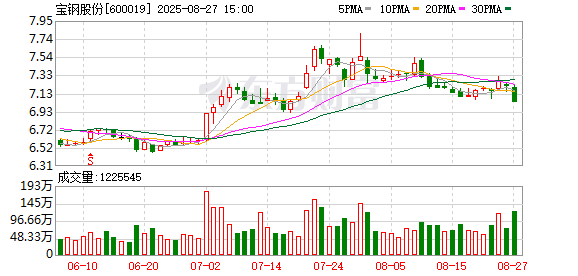
宝钢股份上半年净利增长超7% 现金流状况大幅改善
Zheng Quan Shi Bao· 2025-08-27 17:40
Core Insights - Baosteel Co., Ltd. reported a revenue of 151.37 billion yuan for the first half of the year, a year-on-year decrease of 7.28%, while net profit increased by 7.36% to 4.88 billion yuan, indicating strong profitability in the industry [2] - The increase in net profit is attributed to enhanced market coordination and cost control, leading to an expansion in the purchase-sale price difference [2] - The average price of iron ore and coking coal saw significant declines, with iron ore prices down 14.4% year-on-year and coking coal prices down 41.4% [2] Financial Performance - The company achieved an iron output of 23.71 million tons and a steel output of 25.73 million tons, with a sales volume of 25.31 million tons of finished products [3] - Cash flow from operating activities improved significantly, reaching 16.65 billion yuan, a 190.14% increase compared to the same period last year [3] - Sales expenses rose by 8.0% to 858 million yuan, while financial expenses decreased by 21.7% to 528 million yuan due to reduced interest expenses [3] Market Dynamics - The domestic market for the company's products spans various sectors including automotive, home appliances, energy, and marine equipment, contributing to the completion of the world's highest dam project [3] - The company faced trade protection challenges in overseas markets but managed to increase export orders by 9.4% to 3.32 million tons, exporting to over 70 countries and regions [3] Investment Activities - Baosteel completed equity investments totaling 5.59 billion yuan, acquiring a 49% stake in Maanshan Iron & Steel Co., Ltd. and establishing a joint venture with Saudi Aramco [4] - Fixed asset investments amounted to 9.27 billion yuan, focusing on projects such as a zero-carbon high-grade thin steel plate factory and optimizing product structures [4]