碳化硅

Search documents
士兰微(600460):全球份额稳步提升,碳化硅上车加速推进
Guoxin Securities· 2025-06-27 08:51
Investment Rating - The investment rating for the company is "Outperform the Market" [6] Core Views - The company is expected to maintain steady growth with a projected revenue of 11.22 billion yuan in 2024, representing a year-on-year increase of 20.14%. The net profit attributable to the parent company is forecasted to reach 2.52 billion yuan, a significant increase of 327.34% year-on-year [1] - The company is ranked sixth globally in power semiconductor market share, holding 3.3% of the market, and is the leading player in the domestic market [1] - The integrated circuit segment is anticipated to grow by 29% in 2024, with the IPM module revenue reaching 2.91 billion yuan, a year-on-year increase of 47% [2] - The discrete device segment is projected to generate revenue of 5.44 billion yuan in 2024, reflecting a year-on-year growth of 12.53%, with a focus on high-value products for automotive and photovoltaic applications [3] Summary by Sections Financial Performance - In 2024, the company achieved a revenue of 11.22 billion yuan, up 20.14% year-on-year, and a net profit of 2.52 billion yuan, up 327.34% year-on-year [1] - For Q1 2025, the company reported a revenue of 3 billion yuan, a year-on-year increase of 21.7%, with a net profit of 145 million yuan, reflecting a year-on-year growth of 8.96% [1] Segment Analysis - The integrated circuit segment's revenue in 2024 is expected to be 4.11 billion yuan, with a gross margin of 30.70%, up 1.23 percentage points year-on-year [2] - The discrete device segment's revenue is projected to be 5.44 billion yuan, with a gross margin of 13.53%, down 9.20 percentage points year-on-year [3] Profit Forecast - The net profit forecast for 2025 is 524 million yuan, with expected growth rates of 138.5% and 53.1% for 2026 and 2027, respectively [5] - The company’s gross margin is expected to improve, with projections of 23% for 2025, 2026, and 2027 [5]

高测股份20260626
2025-06-26 15:51
Summary of the Conference Call for Gaoce Co., Ltd. Company Overview - **Company**: Gaoce Co., Ltd. - **Date**: June 26, 2026 Key Points Industry Performance - The photovoltaic (PV) equipment industry is currently undergoing a capacity clearing phase, with low operating rates and irrational pricing, leading to significant pressure on the industry [4][33]. - Gaoce's financial data indicates an improvement in Q2 compared to Q1, with expectations for continued growth in Q3 and Q4 [4]. Financial Performance - Gaoce's Q1 performance showed improvement, with expectations for Q3 and Q4 to continue this trend [2]. - The PV equipment business is expected to incur losses this year due to a significant reduction in new orders, with projected revenues down from last year [4][17]. - The company anticipates a loss in the PV equipment sector for 2025, with current orders valued at approximately 200-300 million yuan [17]. Business Segments - **Diamond Wire Business**: After three consecutive quarters of decline, the diamond wire business achieved breakeven in Q1 and continued to improve in Q2, with expected annual shipment volume significantly higher than last year [2][4]. - **Wafer Slicing Business**: Currently in a loss position, but the loss has narrowed significantly in Q2, with hopes for breakeven in Q3 and Q4 [2][25]. - **Innovative Business**: The company is expanding into semiconductor, silicon carbide, and sapphire stone sectors, with expected revenue growth surpassing last year's 244 million yuan [2][5]. R&D and New Products - Gaoce is developing a screw grinding machine for humanoid robots, leveraging technology from the PV and semiconductor sectors. This project is in the early stages, with a prototype expected by the end of the year [5][9]. - The company has introduced new materials, including ultra-high molecular weight, tungsten wire, and carbon wire, with nearly 10 clients currently testing these products [12][13]. Market Trends and Pricing - The market price for carbon wire is approximately 11 yuan per kilometer, while tungsten wire is around 22 yuan per kilometer [20]. - The penetration rate of FOS materials in the PV industry has reached nearly 70% as of May [21]. Challenges and Opportunities - The main challenge in developing the screw grinding machine is the internal thread grinding technology, which requires high precision in narrow spaces [8]. - There is a significant opportunity for domestic substitution of imported humanoid robot screw grinding machines, as current market offerings are primarily from overseas [7]. Future Outlook - The company expects stable growth in innovative business segments, particularly in semiconductor and silicon carbide, with increasing market demand anticipated in the coming years [27]. - The overall performance of the PV industry is expected to remain under pressure, with no significant changes anticipated in 2025 [33]. Strategic Initiatives - Gaoce is actively promoting convertible bond conversions and considering various measures such as performance management, strategic objectives, and share buybacks to facilitate this process [32]. Conclusion - Gaoce Co., Ltd. is navigating a challenging environment in the PV industry while strategically expanding into innovative sectors. The company is focused on R&D and product development to capitalize on emerging market opportunities, despite facing significant industry pressures.

一个碳化硅巨人的非自然死亡
芯世相· 2025-06-26 03:54
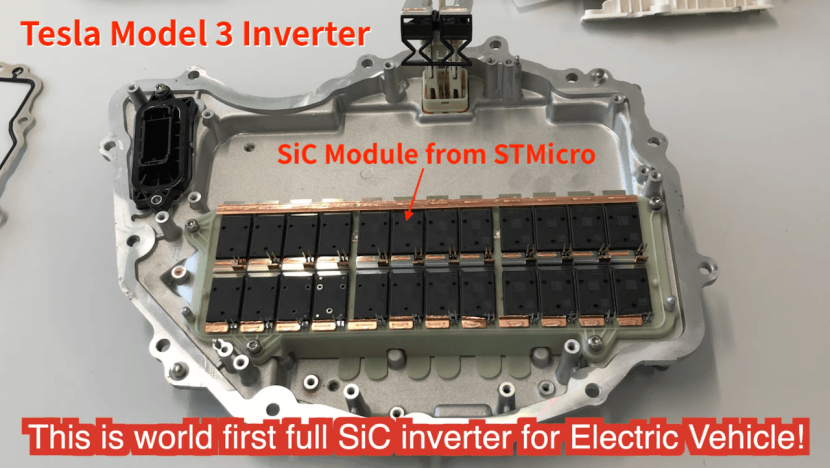
Core Viewpoint - The article discusses the evolution and challenges faced by Wolfspeed (formerly CREE) in the silicon carbide (SiC) semiconductor market, particularly in the context of the electric vehicle (EV) industry and the company's strategic decisions that led to its decline. Group 1: Company Background and Market Position - CREE, founded in 1987, initially struggled for recognition in the semiconductor industry until the rise of electric vehicles, particularly Tesla's Model 3, highlighted its dominance in SiC production, holding 60% of the global SiC wafer capacity [3][5]. - The transition from traditional silicon to SiC in Tesla's Model 3 inverter showcased the advantages of SiC, such as lower weight and higher efficiency, which positioned CREE as a key player in the EV supply chain [4][8]. Group 2: Strategic Decisions and Market Dynamics - In 2017, under new CEO Gregg Lowe, CREE shifted focus from LED to SiC semiconductors, leading to a significant increase in semiconductor revenue share from 10% to 53% by 2021 [20][19]. - The rebranding to Wolfspeed and the divestment of the LED business were bold moves aimed at solidifying its position in the SiC market, but the company faced challenges in scaling production and managing costs [21][20]. Group 3: Production Challenges and Competitive Landscape - The production of SiC wafers is complex and costly, with slower growth rates compared to silicon wafers, leading to high production costs and inefficiencies [13][9]. - As the EV market expanded, competition intensified, with other companies entering the SiC space, leading to a need for Wolfspeed to either expand its 6-inch wafer capacity or invest in 8-inch wafer production [24][26]. Group 4: Financial Performance and Future Outlook - Despite initial optimism, Wolfspeed's financial performance deteriorated, with a 12% revenue decline in 2024 and significant stock price drops, attributed to underutilization of its new 8-inch facility and rising competition from Chinese firms [34][37]. - The company's heavy investment in 8-inch production without immediate returns raised concerns among investors, leading to a significant drop in market value and ultimately resulting in bankruptcy proceedings [40][39]. Group 5: Industry Implications - The article highlights the broader implications for the semiconductor industry, emphasizing that cost control is critical in a highly competitive market where product standardization is prevalent [41][42]. - The challenges faced by Wolfspeed may signal a larger trend of consolidation and restructuring within the semiconductor supply chain, particularly in the context of the evolving EV market [45].


中国车规SiC功率模块市场现状研究分析与发展前景预测报告
QYResearch· 2025-06-25 07:51
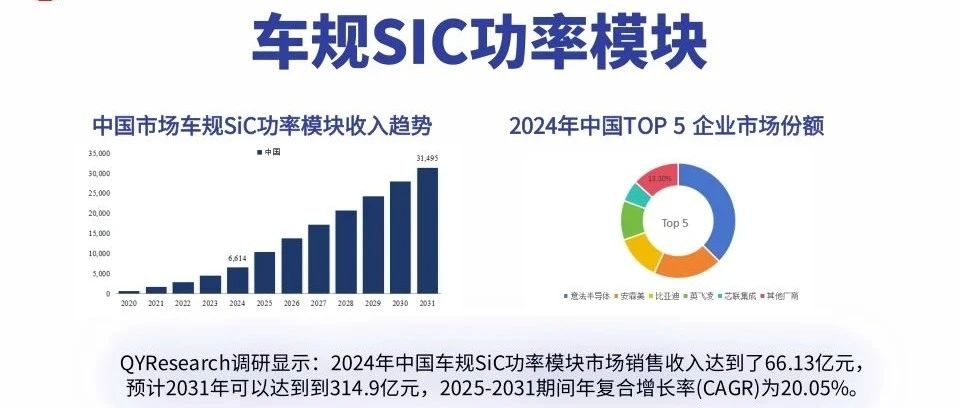
Core Viewpoint - The article emphasizes the significant advantages of Silicon Carbide (SiC) modules over traditional silicon-based devices, highlighting their high temperature tolerance, fast switching speeds, and high mobility, which are crucial for applications in electric vehicles and other emerging technologies [1][2]. Group 1: SiC Module Characteristics and Applications - SiC modules consist of multiple SiC chips packaged through specific circuits, achieving an output power of up to 200KW [1]. - In the electric vehicle sector, SiC is primarily used in main inverters, onboard charging systems, power conversion systems, and EV charging stations [1]. - The current market share of SiC power devices is approximately 6%, indicating that the industry is still in its early development stages, allowing room for new entrants [2]. Group 2: Market Size and Growth Forecast - According to QYResearch, the sales revenue of the Chinese automotive SiC power module market is projected to reach 6.613 billion yuan in 2024, with an expected growth to 31.49 billion yuan by 2031, reflecting a compound annual growth rate (CAGR) of 20.05% from 2025 to 2031 [5]. - The 1200V SiC module is currently the dominant product type, expected to capture 96% of the market share by 2031 [12]. Group 3: Competitive Landscape - The core manufacturers in the Chinese market include ON Semiconductor, BYD, Infineon, and Bosch, with the top seven companies accounting for approximately 94% of the market share in 2024 [10]. - The industry is witnessing a trend towards increased concentration, with leading companies gaining scale advantages through mergers and capacity expansion, while smaller firms may face challenges due to technological obsolescence [17]. Group 4: Industry Trends and Drivers - The industry is expected to experience three main trends: larger sizes and cost reduction through the adoption of 8-inch SiC substrate technology, diversification of application scenarios beyond electric vehicles, and a reshaping of the competitive landscape [17]. - The penetration of electric vehicles is rapidly increasing, with an expected production of 12.888 million units in China in 2024, leading to a significant rise in the adoption of SiC devices in high-voltage platforms [19]. - Government policies encouraging local chip procurement are providing a favorable environment for domestic SiC module manufacturers [20].

巨头破产,这个行业却迎来转机?
格隆汇APP· 2025-06-07 09:15
作者 | 弗雷迪 数据支持 | 勾股大数 据(www.gogudata.com) 上月末,由于难以解决巨额债务问题,全球 SiC (碳化硅)巨头 Wolfspeed 宣布准备在几周内申请破产。 先发优势并不代表企业护城河坚不可摧。在国产厂商的奋力追赶下,部分企业的市场份额已经能够望其项背。 最后一个靴子落地,随着供应链重新洗牌, SiC 衬底行业有望走出价格低迷的阴霾,竞争格局或将重塑。 对于技术工艺实力领先的国内企业如天岳先进、天科合达,随着产能供需逐渐走向平衡,争夺行业话语权的机会或在酝酿之中。 01 激进扩产埋下危机 Wolfspeed 的高光时刻发生在 2021 年,那年 10 月之前还叫做 Cree ,而 Wolfspeed 作为后者的三大部门之一,主要从事第三代半导体 业务。 成立于 1987 年的 Cree ,在上世纪 90 年代是全球最大的蓝光 LED 芯片制造商, 1991 年就已推出全球首片商业化碳化硅晶圆,一举奠定 行业鼻祖地位。 2011 年, Wolfspeed 率先推出全球第一款 SiC MOSFET ,在行业内树立起技术标杆。 但另外两个业务( LED 芯片和组件、照明系统及灯具 ...

17岁夺得广东高考物理头名,25岁拿下剑桥博士学位 如今他创立的基本半导体正闯关港交所
Mei Ri Jing Ji Xin Wen· 2025-06-06 14:29
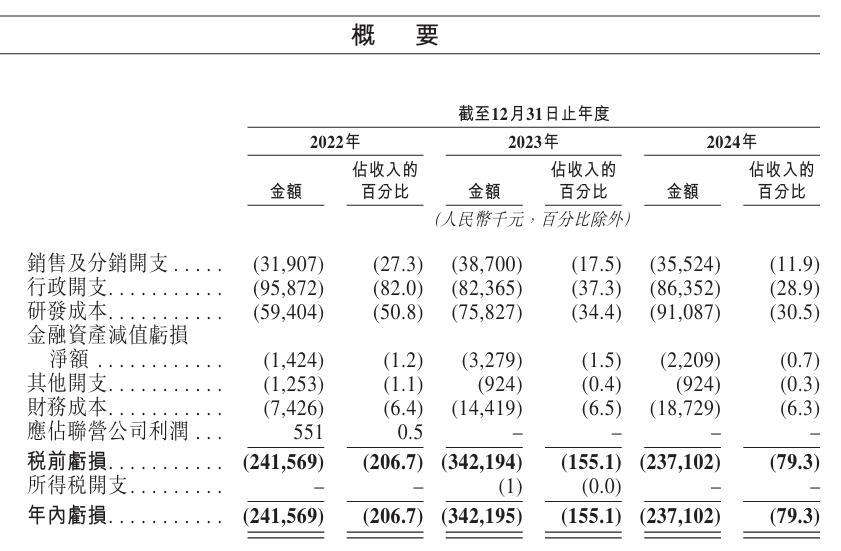
Core Viewpoint - Basic Semiconductor is the only company in China that integrates silicon carbide (SiC) chip design, wafer manufacturing, module packaging, and gate driver design and testing capabilities, and is preparing for an IPO in Hong Kong [1][12]. Company Overview - Basic Semiconductor was founded in 2016 and is led by a team of highly educated individuals, including founder Wang Zhihan, who achieved top scores in the physics section of the Guangdong provincial college entrance examination at age 17 and later earned a PhD from Cambridge University [1][5][4]. - The company's main products include SiC discrete devices, SiC power modules, and power semiconductor gate drivers [1]. Financial Performance - From 2022 to 2024, Basic Semiconductor reported total revenues of approximately 650 million RMB, but incurred total losses exceeding 800 million RMB [1]. - The revenue for the years 2022, 2023, and 2024 was 117 million RMB, 221 million RMB, and 299 million RMB, respectively, reflecting a compound annual growth rate (CAGR) of 59.9% [15]. - The revenue from SiC power modules specifically was 5.05 million RMB, 77.03 million RMB, and 146.57 million RMB for the same years, with a staggering CAGR of 434.3% [15]. Market Position and Product Development - Basic Semiconductor is recognized as a leading player in the SiC power device market, particularly in the electric vehicle sector, having secured design-in agreements with over 50 models from various automotive manufacturers [18]. - The company operates a wafer fab in Shenzhen and a packaging line in Wuxi, with plans to expand packaging capacity in Shenzhen and Zhongshan [14]. Investment and Valuation - Basic Semiconductor has undergone multiple rounds of financing, achieving a post-money valuation exceeding 5.1 billion RMB as of April 2023 [12]. - The latest round of financing included investments from state-owned enterprises in Zhongshan, indicating strong institutional support [12]. Challenges and Future Outlook - Despite significant revenue growth, Basic Semiconductor has not yet achieved profitability, with gross margins for SiC power modules reported at -75.5%, -66.0%, and -27.9% for the years 2022 to 2024 [18]. - The company anticipates continued net losses in the short term due to ongoing investments in research and development and business expansion [18].
电动车省电续航的隐藏王牌
2 1 Shi Ji Jing Ji Bao Dao· 2025-06-02 06:38
21世纪经济报道记者骆轶琪广州报道 让电动车充电更快、跑得更远的秘密,居然就藏在这个黄色的"圆盘"里? 前不久,小米创始人雷军发布了旗下首款SUV车型YU7,全系搭载800V碳化硅高压平台。上汽通用五 菱也展示了采用碳化硅功率模块的电控。 以及,同等性能下的碳化硅器件,尺寸大概只有硅器件的1/10,那么可以让电驱动系统的重量和体积进 一步被释放出来。 那么综合以上,让重量减轻、损耗减少,即便在恶劣环境中也能维持比较好的续航水平,这让碳化硅逐 渐成为新能源车的好伙伴。 从最开始只有特斯拉愿意用,到今天越来越多国产车型,甚至连造出多款"国民神车"的五菱都在采用碳 化硅制作出来的产品。为什么这几年碳化硅经历了这样的大起大落?碳化硅对新能源车来说到底意味着 什么? 碳化硅也被称为第三代半导体,这种材料有耐高温、耐高压的特性。在同样一种功率器件中,采用碳化 硅材料会比采用硅材料体积更小、实现更高的运行效率。 我们来举几个具体的例子。 目前碳化硅最多是被用在新能源车的主驱逆变器上,它怎么来发挥作用呢? 动力电池储存的是直流电,但电机需要的是交流电,所以在电池包和电机中间,需要一个把直流电变成 交流电的逆变器。这个转换过程 ...

影响市场重大事件:上海浦东发布具身智能产业支持16条政策,单个项目支持额度最高可达亿级
Mei Ri Jing Ji Xin Wen· 2025-05-29 23:24
Group 1: Embodied Intelligence Industry Support - Shanghai Pudong New Area has released a set of 16 support policies for the embodied intelligence industry, with funding support of up to 20 million yuan for key technology breakthroughs and innovation centers [1] - The policies aim to encourage the integration and application of embodied intelligence technology in various industries and markets, with individual project support potentially reaching up to 100 million yuan [1] Group 2: China-ASEAN Economic Cooperation - The Ministry of Commerce announced the completion of negotiations for the China-ASEAN Free Trade Area 3.0, which includes nine new chapters focusing on digital economy, green economy, and supply chain connectivity [2] - This agreement is expected to enhance cooperation in emerging fields and promote deep integration of production and supply chains between China and ASEAN [2] Group 3: Silicon Carbide Production - The largest silicon carbide wafer factory in Wuhan has commenced production, contributing 30% of the domestic silicon carbide wafer capacity, which is crucial for the new energy industry [5] - The factory, with an investment exceeding 20 billion yuan, aims to produce 360,000 six-inch silicon carbide wafers annually, meeting the manufacturing needs of 1.44 million electric vehicles [5] Group 4: Data Element Integration - The National Data Bureau is working on guidelines for the "data element x" initiative to enhance the integration of data into social production and unlock its value as a production factor [6] - The initiative aims to promote the construction of demonstration scenarios for public data and accelerate the establishment of comprehensive experimental zones for data elements [6] Group 5: Resource and Environmental Market Mechanisms - The Central Committee and the State Council have issued opinions to improve the market-based allocation system for resource and environmental elements by 2027, including the establishment of trading systems for carbon emissions and water rights [7] - The plan aims to enhance the efficiency of resource allocation and support environmental goals through active market mechanisms [7] Group 6: Bitcoin ETF Investment Trends - In the past five weeks, Bitcoin ETFs have attracted over $9 billion, while gold ETFs have seen outflows exceeding $2.8 billion, indicating a shift in investor preference towards digital assets [8] Group 7: Chery Automobile's Business Integration - Chery Automobile has integrated its subsidiaries into a new "Chery Intelligent Center," focusing on smart cockpit, assisted driving, and digital architecture, creating a comprehensive closed-loop system for innovation [9] Group 8: National Cultural Export Initiatives - The Ministry of Commerce and other departments have released lists of key enterprises and projects for national cultural exports for 2025-2026, recognizing 404 companies and 121 projects [10]
轻视中国市场,Wolfspeed“死不足惜”
Hu Xiu· 2025-05-29 05:42
Core Viewpoint - Wolfspeed, a leading player in the global silicon carbide industry, is seeking Chapter 11 bankruptcy protection due to insurmountable debt issues, with its stock price plummeting over 57% in after-hours trading [1] Group 1: Company Background and Market Position - Wolfspeed, formerly known as Cree, was a pioneer in silicon carbide (SiC) applications, launching the first SiC-based blue LED in 1989 and going public in 1993 [5][6] - The company transitioned from a strong LED business, which accounted for two-thirds of its revenue in 2017, to focus on compound semiconductors, particularly SiC substrates and devices, due to declining profitability in the LED market [7][8] - The saturation of the global LED market and the rise of Chinese competitors significantly impacted Wolfspeed's market position, leading to its eventual decline [9][10] Group 2: Strategic Missteps and Market Dynamics - A critical factor in Wolfspeed's downfall is its failure to establish a strong presence in the Chinese market, which is essential for growth in the semiconductor industry [3][4] - The company’s decision to focus on high-end 8-inch substrates, while neglecting the more mature 6-inch production lines, resulted in higher costs and lower competitiveness [20][21] - Despite initial success driven by Tesla's adoption of SiC technology, Wolfspeed faced challenges as Tesla announced plans to reduce its use of SiC transistors by 75% due to cost pressures, leading to a significant drop in Wolfspeed's stock price [24][25] Group 3: Financial Performance and Future Outlook - In 2023, Wolfspeed struggled with low capacity utilization, reporting only 20% utilization at its Mohawk Valley plant, and a 14.9% year-over-year revenue decline to $200 million in Q2 of fiscal 2024 [28] - The company’s gross margin fell to a historic low of 1.2%, with a net debt level 4.5 times its equity, indicating severe financial distress [28] - Wolfspeed's lack of a localized supply chain in China and slow response to market demands led to lost orders to competitors like Infineon and Sanan Optoelectronics, exacerbating its financial collapse [29][30]
长飞先进:武汉SiC基地已投产,年产能达36万片
行家说三代半· 2025-05-29 02:42
Core Viewpoint - The article highlights the successful launch of Changfei Advanced's silicon carbide (SiC) wafer production line in Wuhan, marking a significant milestone in the company's investment and production capabilities in the semiconductor industry [4][6]. Group 1: Company Overview - Changfei Advanced specializes in the research and manufacturing of silicon carbide (SiC) power semiconductor products, possessing a complete industrial chain capability from epitaxial growth to module packaging [7]. - The company has established a first-class 6-inch production line and advanced supporting systems, offering a full range of SiC SBD and MOSFET products for various applications including electric vehicles, photovoltaics, energy storage, and charging stations [7]. Group 2: Production Milestones - The Wuhan base, with a total investment exceeding 20 billion yuan, has officially commenced production, with an annual capacity of 360,000 silicon carbide wafers [4]. - The construction of the Wuhan facility was completed in under 10 months, showcasing a rapid development pace for large-scale investment projects [4]. Group 3: Technological Advancements - The Wuhan base is equipped with 6/8 inch compatible equipment, aligning with international standards for SiC device manufacturers, and features a fully automated crane system to enhance production efficiency [6]. - The facility has achieved a chip yield rate of 97%, which is considered internationally advanced, thanks to the deployment of an A3-level crane system that minimizes human interference [6]. Group 4: Market Impact - The production capacity of the Wuhan base is projected to supply the "heart" for 1.44 million electric vehicles annually, indicating a significant contribution to the electric vehicle market [6]. - The facility has already established collaborations with leading global automotive companies, with several SiC chip models undergoing testing and validation [6].