量化宽松

Search documents
【黄金收评】究竟怎么回事?金价暴涨51美元 美联储这则意外大消息引爆市场
Xin Lang Cai Jing· 2025-12-15 04:16
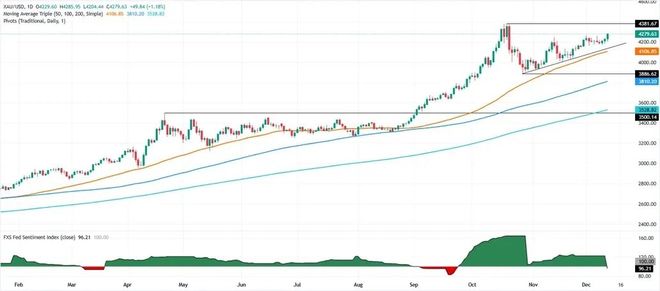
Core Viewpoint - The recent Federal Reserve decision to cut interest rates and initiate a "mini quantitative easing" has led to a significant surge in gold prices, reaching a one-month high, while silver has also hit a record high [1][2][3]. Federal Reserve Actions - The Federal Reserve announced a 25 basis point cut in the federal funds rate, bringing it to a target range of 3.50%-3.75% [7]. - A "mini QE" program will begin on December 12, involving the purchase of approximately $40 billion in short-term Treasury bills to manage market liquidity [2][10]. - Fed Chair Jerome Powell indicated that the labor market faces risks and downplayed inflation concerns, suggesting that further rate hikes are unlikely in the near future [7][9]. Market Reactions - Following the Fed's announcement, the dollar index fell to an eight-week low, making gold cheaper for overseas buyers, which contributed to the rise in gold prices [3][9]. - Gold prices closed up $51.17, or 1.21%, at $4,279.64 per ounce, with a notable increase in momentum due to the Fed's actions [2][12]. - Silver prices also surged, reaching a high of $64.31 per ounce, driven by strong market sentiment [6]. Economic Indicators - The U.S. initial jobless claims unexpectedly rose to 236,000, the largest increase since July 2021, indicating a cooling labor market [11]. - The 10-year Treasury yield dropped by 3 basis points to 4.122%, and the real yield fell nearly 2.5 basis points to 1.872%, supporting the rise in gold prices [3][9]. Technical Analysis - Analysts suggest that if gold closes above $4,300 per ounce, it could challenge $4,350 and potentially reach the historical high of $4,381 [12]. - Key support levels for gold are identified at $4,250 and $4,200 per ounce, with further support at the 20-day simple moving average at $4,158 per ounce [14].

陶冬:美联储正在变天,进入双主席模式
Di Yi Cai Jing· 2025-12-15 03:18
此时重开量化宽松在政治上不正确,美联储唯有暗渡陈仓,启动储备管理型买债。 美联储12月1日刚刚结束量化紧缩(QT),12月10日即开启了扩表,这种政策切换速度十分罕见,说明 货币当局意识到流动性短缺,更意识到了明年海外资金流入将下降。其他国家加息或停止降息,美国利 率却下行,日元套利交易可能全面拆仓,欧洲及离岸美元流入美元资产的数量可能萎缩,美债融资势必 面临更大的挑战。美联储必须尽快向体系内重新注入流动性。 然而此时此刻,重开量化宽松(QE)在政治上不正确,美联储唯有暗渡陈仓,启动储备管理型买债 (RMP)。这是投资组合层面的调整,属于技术性调整,不太招摇过市,对国会和选民较易交代,同 时也起到了对资金市场"补水"的作用。在笔者眼中,这仍是扩张资产负债表,就是QE,目前集中在短 债购买上,早晚会扩展到长年期债购买。 笔者预期,美联储明年会在资金成本和流动性两条战线同时着手,营造更宽松的货币环境,利好美股。 同时美元对其他货币贬值,直至其他国家央行也重启宽松政策。以欧央行为首的不少工业国央行曾经暗 示降息结束,不过本土经济增长乏力。要是美国率先QE,相信其他国家也会跟进,新一轮全球QE可能 就此展开,美元汇率 ...
美银:牛熊指标接近触发“卖出”信号 资金轮动预示2026年经济“火热运行”预期
智通财经网· 2025-12-15 01:46
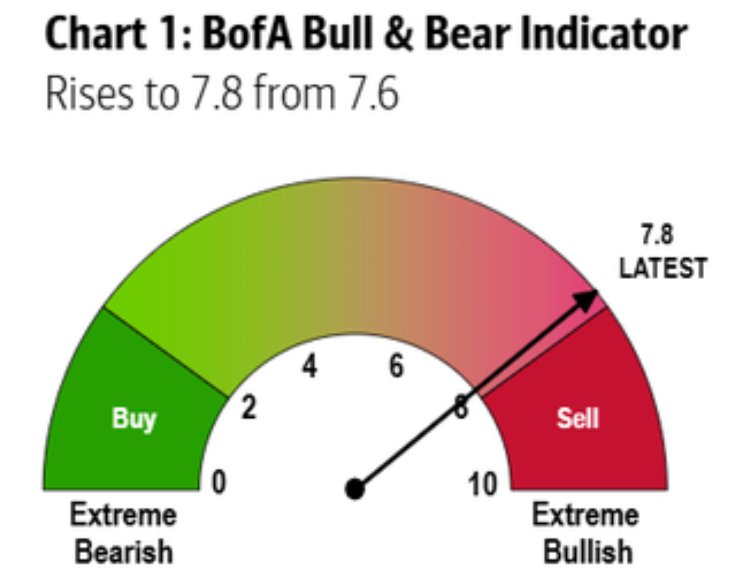
Group 1 - The core viewpoint of the report indicates a significant rotation of funds towards small-cap stocks, a resurgence of risk assets, and a rise in investor confidence, suggesting a "hot run" expectation for the economy in 2026 [1] - The revised Bank of America Bull & Bear Indicator has risen to 7.8, indicating that market positioning is approaching an "extremely bullish" zone, with historical correlations to tactical market tops [1][7] Group 2 - Investors are betting on a policy environment that supports growth without significantly increasing borrowing costs, which could be achieved through a surge in productivity or a substantial depreciation of the dollar [2] - The notable shift of funds from mega-cap stocks to small-cap stocks is linked to expectations of a hotter economy driven more by domestic factors in 2026 [3] - Consumer spending behavior continues to show a divide by income levels, with market expectations indicating that economic momentum will extend beyond 2025, moving towards a broader base [3] Group 3 - The ongoing asset purchases by the Federal Reserve, approximately $40 billion in short-term Treasury bonds monthly, alleviate concerns about global liquidity peaking [4] - The upcoming Bank of Japan meeting and anticipated U.S. Supreme Court ruling are highlighted as potential risks [4] Group 4 - Weekly fund flows indicate a complex risk appetite, with $8.8 billion flowing into bonds, $5.8 billion into stocks (the smallest inflow in three months), and $2.3 billion into gold [5] - The technology sector has seen significant outflows of $600 million, part of a larger $1.7 billion outflow over two weeks, marking the largest outflow since February [5] - Private client allocations remain predominantly in equities (64.9%), with bond exposure at 17.7% and cash at 10.3% [5]

美联储降息落地,金价震荡收涨
Dong Zheng Qi Huo· 2025-12-14 12:16
1. Report Industry Investment Rating - Gold: Oscillating [7] 2. Core Viewpoints of the Report - After the Fed cut interest rates by 25bp, market sentiment initially climbed, driving up precious metals, copper, and other non - ferrous metals. However, the stock, bond, and foreign exchange markets performed worse than commodities. After two hawkish voting members spoke, market risk appetite cooled, and stocks and commodities pulled back [3]. - The Fed's overall stance in this meeting was not more hawkish than expected, but it raised the economic growth forecast for next year. The dot - plot shows one interest rate cut in 2026 and 2027 respectively, indicating limited future interest rate cut space. The internal divergence within the Fed has increased unprecedentedly, and market games on the interest rate cut rhythm will intensify [3]. - The US employment market continues to weaken, with the initial jobless claims rising to 236,000 after the Thanksgiving holiday. With important economic data and central bank meetings coming up, market volatility is expected to increase [4]. - In the short term, the gold price is oscillating and has not broken through the previous high. Attention should be paid to the callback risk [5]. 3. Summary by Relevant Catalogs 3.1 Gold High - frequency Data Weekly Changes - The internal basis (spot - futures) decreased by 0.82 yuan/gram, a change rate of 16.3%. The internal - external futures price difference (internal - external) decreased by 11.47 yuan/gram, a change rate of 53426.7%. The Shanghai Futures Exchange gold inventory increased by 3 kilograms, a change rate of 0.0%. The COMEX gold inventory decreased by 342,923 ounces, a change rate of - 0.94% [11]. - The SPDR ETF holding volume increased by 2.86 tons, a change rate of 0.27%. The CFTC gold speculative net long position decreased by 7,145 lots, a change rate of - 6.9% [11]. - The US Treasury bond yield increased by 0.05 percentage points, a change rate of 1.2%. The US dollar index decreased by 0.58, a change rate of - 0.59%. The SOFR decreased by 0.26 percentage points, a change rate of - 6.6% [11]. - The US 10 - year break - even inflation rate increased by 0.0061 percentage points, a change rate of 0.27%. The S&P 500 index decreased by 43 points, a change rate of - 0.6%. The VIX volatility index increased by 0.3 percentage points, a change rate of 2.1% [11]. - The US 10 - year real interest rate increased by 0.04 percentage points, a change rate of 2.3%. The gold cross - market arbitrage trading decreased by 0.1, a change rate of - 1.4% [11]. 3.2 Financial Market - related Data Tracking 3.2.1 US Financial Market - The US overnight secured financing rate was 3.66%. Oil prices fell by 4.1%, and the US inflation expectation was 2.27% [18]. - The US dollar index fell by 0.6% to 98.4, and the US Treasury bond yield rose to 4.18%. The S&P 500 index fell by 0.63%, and the VIX index slightly rose to 15.7 [21]. - The real interest rate rebounded to 1.91%, and the gold price rose by 2.4%. The spot commodity index closed up, and the US dollar index fell by 0.6% [23]. 3.2.2 Global Financial Market - Stocks, Bonds, Foreign Exchange, and Commodities - Developed - country stock markets showed mixed performance, with the S&P 500 index falling by 0.63%. Most developing - country stock markets rose, while the Shanghai Composite Index fell by 0.34% [25]. - US and German bonds rose, with a US - German interest rate spread of 1.32%. The UK Treasury bond yield was 4.5%, and the Japanese bond yield was 1.95% [28]. - The euro appreciated by 0.83%, the British pound appreciated by 0.32%, the Japanese yen depreciated by 0.31%, and the Swiss franc appreciated by 1.12%. The US dollar index fell by 0.6% to 98.4, and most non - US currencies appreciated [31][34]. 3.3 Gold Trading - level Data Tracking - Gold speculative position data showed that the SPDR gold ETF holding volume slightly rose to 1053 tons [37]. - The RMB exchange rate oscillated, and the discount of Shanghai gold widened. Gold and silver prices rose, and the gold - silver ratio fell to 69.4 [39]. 3.4 Weekly Economic Calendar - Monday: China's November social retail and industrial growth data; US December NAHB housing market index and New York Fed manufacturing index [40]. - Tuesday: Eurozone, UK, and US December manufacturing PMI; US November non - farm payroll report [40]. - Wednesday: The Fed starts the reserve management plan [40]. - Thursday: Bank of England and ECB December interest rate meetings; US November CPI [40]. - Friday: Bank of Japan December interest rate meeting [40].
巨变酝酿中?美国财政部将“合并”美联储,贝森特才是真正的“影子联储主席”
美股IPO· 2025-12-14 11:57
Core Viewpoint - TS Lombard's Chief Economist Stephen Blitz argues that the Federal Reserve's resumption of balance sheet purchases is essentially a means to provide financing assurance for Treasury spending, leading to a "merger" of the two institutions' balance sheets [1][3]. Group 1: Federal Reserve and Treasury Relationship - The Federal Reserve is set to restart balance sheet purchases, planning to buy $40 billion in Treasury bills starting in January and increasing in February, which is framed as a response to the growth of the Treasury General Account (TGA) [3]. - This shift indicates that the Federal Reserve is committed to ensuring that Treasury spending is financed without causing interest rate fluctuations, effectively signaling a loss of market's ability to warn the government about excessive spending [5]. - The traditional separation between the Federal Reserve and the Treasury is becoming increasingly blurred, with the two entities' balance sheets effectively merging [5]. Group 2: Economic Implications - Blitz warns that the strategy aimed at providing cheap funding for the government will lead to higher inflation levels by 2026, despite the Federal Reserve's current economic projections showing a downward adjustment in core inflation expectations [4][8]. - The economic outlook suggests short-term weakness with long-term inflation risks, as recent employment data revisions indicate a downward trend rather than growth, which is a primary factor for potential interest rate cuts by the Federal Reserve [9]. - The anticipated inflationary pressures are expected to resurface in late 2026 or 2027, driven by fiscal policy stimulus, which may limit the impact of any economic downturns [9].

巨变酝酿中?美国财政部将“合并”美联储,贝森特才是真正的“影子联储主席”
华尔街见闻· 2025-12-14 10:31
Core Insights - The article discusses a significant shift in the relationship between the U.S. Treasury and the Federal Reserve, suggesting a de facto "merger" of their balance sheets, with Treasury Secretary Yellen playing a pivotal role as an "shadow Fed Chair" [1][4] - The Federal Reserve plans to restart asset purchases, beginning with $40 billion in Treasury bills in January, which is seen as a commitment to finance Treasury expenditures and stabilize market interest rates [1][3] - This new framework indicates that the market's ability to signal government spending limits through interest rates will be diminished, leading to a tighter coordination of policies between the Treasury and the Fed [4][5] Treasury and Federal Reserve Merger - The Federal Reserve's decision to resume bond purchases fundamentally alters traditional market dynamics, as it aims to set money market rates rather than manage them through open market operations [3] - The Fed's actions are intended to ensure that Treasury spending can be financed without causing interest rate "blockages," effectively merging the operational roles of the two institutions [4] New Power Structure - Should Kevin Hassett be confirmed as a potential Fed official, Secretary Yellen will effectively become his "boss," establishing a "single presidential authority" for daily communication and coordination [5] - The goal is to achieve low financing costs by injecting liquidity into the short end of the market, which is expected to contribute to rising inflation expectations by 2026 [5] Economic Outlook - The article highlights a concerning economic outlook, with recent labor data revisions indicating a downward trend in employment, suggesting a potential for further Fed rate cuts [7][8] - While short-term monetary easing is anticipated, long-term inflation risks remain, with fiscal policy expected to support economic activity and inflation potentially resurfacing in late 2026 or 2027 [8]
【广发宏观团队】从宏观视角看入境消费
郭磊宏观茶座· 2025-12-14 10:11
Group 1: Macroeconomic Perspective on Inbound Consumption - Inbound consumption has been growing rapidly, with inbound tourists reaching 131.9 million in 2024, a year-on-year increase of 60.8%, and total spending of $94.2 billion, up 77.8% [1] - The proportion of inbound consumption to GDP in China is approximately 0.5%, compared to 1% to 3% in major countries, indicating significant growth potential [2] - The Chinese government is focusing on enhancing the inbound consumption environment, as highlighted in the 14th Five-Year Plan, which aims to cultivate international consumption centers and improve the convenience of inbound tourism [2] Group 2: Advantages and Challenges of Inbound Consumption - China possesses rich natural and historical resources, with 60 UNESCO World Heritage sites, and a robust manufacturing sector that offers diverse products at competitive prices [2] - The supply capacity of tourism infrastructure is currently insufficient, which may constrain the overall experience for inbound tourists [3] - The government is working on optimizing tourism public service systems to match the high-quality development of the tourism industry [3] Group 3: Market Trends and Financial Environment - The U.S. Federal Reserve has lowered the federal funds rate, impacting global markets, with tech stocks experiencing volatility while cyclical and financial sectors show gains [4] - The A-share market is experiencing a mixed performance, with a notable increase in the computing power chain, while the overall trading volume has decreased [9] - The liquidity in the market remains loose, with overnight funding rates hitting new lows, indicating a supportive monetary policy stance [22][23] Group 4: Policy and Economic Outlook - The central economic work conference emphasized the need for a more proactive fiscal policy, aiming to stabilize investment growth and optimize the use of special bonds [25][26] - The government is focusing on enhancing financial support for the real economy, with an emphasis on maintaining low financing costs and improving the efficiency of monetary policy tools [22][23] - The upcoming policies are expected to address structural issues in the economy, including the optimization of consumption policies and the resolution of local government debt risks [28][36]

美联储降息扩表,美元继续走弱
Dong Zheng Qi Huo· 2025-12-14 08:42
[★Ta本bl周e_全Su球mm市a场ry]概述 市场风险偏好维持摇摆,股市涨跌互现,债券收益率多数上 行,美债收益率升至 4.18%。美元指数跌 0.6%至 98.4,非美货币 多 数 升 值 , 离 岸 人 民 币 涨 0.23% , 欧 元 涨 0.83% , 英 镑 涨 0.32%,日元跌 0.31%,瑞郎涨 1.12%,加元、新西兰元、澳元、 雷亚尔、比索等收涨,韩元收跌。金价涨 2.4%至 4299 美元/盎 司,VIX 指数微升至 15.7,现货商品指数收涨,布油跌 4.1%至 61.9 美元/桶。 外 ★市场交易逻辑 周度报告-外汇期货 d[Table_Title] 美联储降息扩表,美元继续走弱 汇 期 货 美联储 12 月利率会议如期降息 25bp 落地,并宣布在 12 月进行 400 亿美元的回购操作以维持准备金规模,会议整体基调没有超 预期的鹰派,两张降息反对票,一张支持降息 50bp 的反对票, 点阵图显示 2026 年和 2027 年各有一次降息,同时鹰派的鸽派对 降息路径的分歧空前加大,未来降息博弈增加,通胀的反弹压 力限制了降息空间,市场也在关注美联储下任主席人选。本次 会议美联 ...
巨变酝酿中?美国财政部将“合并”美联储,贝森特才是真正的“影子联储主席”
Hua Er Jie Jian Wen· 2025-12-14 03:58
周日,TS Lombard首席美国经济学家Stephen Blitz撰文指出,美联储即将迎来一场巨大的颠覆。随着财 政部与美联储的界限日益模糊,两大机构的资产负债表实际上正在走向"合并",而财政部长贝森特在这 一新架构中扮演关键角色,成为实质上的"影子联储主席"。 Blitz表示,美联储最新的政策信号表明,其正在重启资产负债表购买操作,计划于1月开始购买400亿美 元的国库券并在2月进一步增加。尽管官方说法是为应对总账户(TGA)在4月的膨胀及管理货币市场 利率,但这一举措的实质是美联储承诺为财政部支出提供融资保障,确保存款机构融资不会出现利率波 动。 这一转变不仅意味着美联储将平抑市场波动,更标志着市场向政府发出的"支出超载"信号将失效。在这 种架构下,未来的政策协调将更加紧密,贝森特将拥有巨大的话语权。随着Kevin Hassett 等潜在继任者 可能进入美联储,一条通往白宫、经由贝森特运作的"直接汇报线"正在形成,这将使得财政部能够主导 融资策略,即通过向短端注入流动性来压低融资成本。 贝森特和特朗普所期望的是廉价的融资成本——即通过淹没短端市场并限制长端发行来实现。美联储宣 布购买短端资产正是为了配合 ...
美股点金丨市场波动率再升温!年末美股上涨行情能否如约而至
Di Yi Cai Jing Zi Xun· 2025-12-14 03:17
上周美股三大指数走势分化,尾盘跳水将衡量市场波动性的恐慌指数推高近20%。 甲骨文与博通的季度业绩凸显出人工智能领域资本支出的庞大规模和业绩压力,这一因素抵消了美联储 货币政策释放的鸽派信号带来的利好。与此同时,美国国债收益率上扬也打压了市场情绪。 4.192%。 市场当前对美联储降息的预期略有降温。利率市场定价显示,市场预计美联储2026年首次降息最早发生 在4月(概率约为81%),到6月时降息概率理论上达到100%。届时新任美联储主席将正式上任,而特 朗普提名的人选预计会偏向鸽派。不过值得注意的是,与联邦公开市场委员会的谨慎不同,市场目前的 概率预期仍指向2026年将累计降息两次。 未来一周,投资者将继续权衡美联储降息前景,而对人工智能领域过度投资的担忧能否化解,也将成为 影响短期市场走向的关键因素。 美联储未来降息预期降温 上周市场需消化的经济数据相对有限。全美独立企业联盟(NFIB)小企业乐观指数11月上升0.8点至 99.0,略高于市场预期。分项指标中,计划上调平均售价的小企业主净占比上升13个百分点,达到 34%,创下2023年3月以来的最高水平。不过,预期企业经营状况将改善的小企业主净占比下降5 ...