
反内卷政策

Search documents
纯碱、玻璃日报-20260114
Jian Xin Qi Huo· 2026-01-14 01:37
Report Information - Report Name: Soda Ash and Glass Daily Report [1] - Date: January 14, 2026 [2] - Research Team: Energy and Chemical Research Team [4] Industry Investment Rating - Not mentioned in the provided content Core Viewpoints - For soda ash, the market supply has increased, and the supply pressure has not been fully digested. The demand side continues to decline, and the inventory is expected to face accumulation pressure. In the short - term, it may have a short - term rally as a low - valued commodity, but in the long - term, the industry's core contradictions remain unsolved, and the outlook is not optimistic if exports do not expand significantly or backward production capacity is not effectively cleared. It will operate weakly in the short - term [7]. - For glass, the market shipment is good, and prices have been raised due to market sentiment. However, the high - inventory problem restricts the market, and the cancellation of export tax rebates squeezes profit margins. Before substantial benefits such as production capacity clearance appear, the market is expected to rebound and then fall [8]. Summary by Directory 1. Soda Ash and Glass Market Review and Operation Suggestions - **Soda Ash Futures Data on January 13**: SA601 opened at 1155, closed at 1136, down 0.61%; SA605 opened at 1242, closed at 1212, down 1.30%. The overall supply increased, demand declined, and the downstream float glass market was weak. The long - term outlook depends on export expansion and production capacity clearance [7]. - **Glass Futures Data on January 13**: FG601 opened at 1082, closed at 978, down 1.41%; FG605 opened at 1143, closed at 1096, down 3.09%. The market shipment was good, and prices rose due to market sentiment. High inventory and the cancellation of export tax rebates are major constraints [7][8]. 2. Data Overview - **Price Trends**: There are figures showing the price trends of active contracts for soda ash and glass [10][12][14]. - **Soda Ash Production and Inventory**: Figures display the weekly soda ash production and enterprise inventory [17][19]. - **Market Price and Glass Production**: The figures show the central China heavy soda market price and flat glass production [20][21][23]
欣旺达:反内卷政策将引导行业从低价竞争转向高质量发展
Zheng Quan Ri Bao Wang· 2026-01-13 11:12
Group 1 - The core viewpoint of the article is that the anti-involution policy will guide the industry from low-price competition to high-quality development, which is beneficial for establishing a healthier and more sustainable profit ecosystem across the entire industry chain [1] - The company believes that this shift will have a positive impact on its business [1]

高盛瑞银看涨A股:盈利增长与政策红利双驱动
Xin Lang Cai Jing· 2026-01-13 10:11
Group 1 - The core viewpoint is that foreign institutions like Goldman Sachs and UBS are optimistic about the Chinese market, focusing on corporate profit growth as the main driver, replacing valuation recovery, with technology innovation and policy benefits seen as dual engines [1] Group 2 - Strong expectations for profit growth in 2026, with Goldman Sachs predicting a 20% increase in the MSCI China Index and a 12% increase in the CSI 300 Index, with a cumulative rise of 38% from 2026 to 2027, where corporate profits contribute 24% [2] - UBS forecasts a profit growth of over 14% for the MSCI China Index, with overall A-share profit growth rising from 6% in 2025 to 8%, driven by the technology sector, which accounts for 50% of the index [2] - Supporting factors include an increase in nominal GDP growth, a narrowing decline in PPI driving revenue growth, and policies optimizing supply-demand structures in industries like photovoltaics and chemicals [2] Group 3 - The MSCI China Index has a forward P/E ratio of only 12 times, significantly lower than the S&P 500 Index (22 times) and the Indian market (21 times), indicating a historical low [3] - Foreign ownership of A-shares is only 3.68%, much lower than the average of 40% in countries like Japan and South Korea, suggesting substantial room for increased allocation [3] - In the first ten months of 2025, foreign capital inflow into A-shares reached $50.6 billion, more than tripling year-on-year [3] Group 4 - Foreign investment is focusing on technology and structural opportunities, particularly in AI and its supply chain, with key areas including computing infrastructure and application scenarios in fintech and healthcare [4] Group 5 - Beneficiary sectors from policy dividends include new energy companies and high-end manufacturing leaders, with companies like CATL and Ganfeng Lithium receiving upgrades from Morgan Stanley [5] - Companies with high overseas revenue ratios in sectors like new energy vehicles and smart hardware are also targeted [5] - Structural opportunities in consumer services, particularly in dining and prepared foods, may see a rebound in the second half of the year due to PPI recovery [5] Group 6 - In the fourth quarter of 2025, northbound capital is expected to increase holdings in resource stocks while also adding to technology and financial sectors [6]


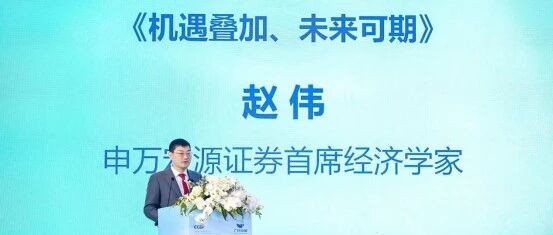
赵伟:机遇叠加、未来可期
申万宏源宏观· 2026-01-13 09:21
Economic Outlook - The core viewpoint emphasizes that 2026 marks the beginning of the "15th Five-Year Plan," which is crucial for understanding future policies and economic environments. The focus will be on "comprehensive efforts" and "strategic initiative" in various sectors [3][4] - "Comprehensive efforts" suggests an acceleration in policy implementation across development and reform areas, while "strategic initiative" indicates an increase in proactive policy measures, particularly in domestic economic management and international trade [3][4] Policy Framework - The central economic work conference has highlighted an increased frequency of terms like "reform" and "opening up," indicating a shift in focus for 2026. The concept of "cross-cycle" has returned, but this does not imply a reduction in growth stabilization efforts [5][6] - Fiscal policy will remain proactive, ensuring necessary spending and debt levels, while monetary policy will emphasize flexibility and efficiency in using tools like interest rate cuts [6][5] Market Dynamics - The analysis of 2025 reveals three significant shifts: the weakening of post-pandemic scars, reduced impact from tariff conflicts, and the establishment of a coherent new policy framework since late 2024 [7][8][9] - The economic recovery in 2026 is characterized as "atypical," with limited volume elasticity and a focus on price normalization, leading to a nominal GDP recovery from approximately 4% in 2025 to around 5% in 2026 [9] Capital Market Insights - The relationship between the ten-year government bond yield and A-share dividend yield illustrates the emotional cycles in the capital market, which have been disrupted since 2022 due to long-term concerns about the Chinese economy [10][11] - Key events influencing market behavior include a policy shift in late 2024 and the introduction of DeepSeek, which has redirected investment thinking from macro to micro perspectives [12][11] Investment Behavior - The new tariff war initiated by the Trump administration has led to a reevaluation of investment strategies, with non-U.S. funds increasingly seeking opportunities in China as the perception of risk shifts [13] - The "anti-involution" policy has gained attention, indicating a structural approach to restoring corporate profitability and nominal GDP growth, which has initiated a domestic "funds rebalancing" process [13] Future Projections - The nominal GDP recovery is expected to continue driving the "funds rebalancing" process into 2026, with a potential rise in bond market interest rates and support for traditional sectors' profitability and valuation [14] - The RMB is anticipated to enter a period of appreciation, with a projected annual increase of 2-3%, which could attract foreign investment and positively impact the stock market [15]

2025年期市成交规模创新高 2026年将更上一层楼
Xin Lang Cai Jing· 2026-01-13 01:26
Core Insights - The Chinese futures market experienced significant growth in 2025, with total trading volume reaching 90.74 billion contracts and total trading value at 766.25 trillion yuan, marking year-on-year increases of 17.4% and 23.74% respectively [1][2][11] Group 1: Market Performance - In December 2025, the national futures market recorded a trading volume of 9.51 billion contracts and a trading value of 90.81 trillion yuan, representing substantial year-on-year growth of 45.17% and 58.55% [1][11] - The trading volume in December 2025 increased by 23.55% compared to November, while the trading value surged by 36.32% [1][11] - The total open interest at the end of December 2025 was 45.24 million contracts, showing a month-on-month decline of 16.3% but a year-on-year increase of 13.7% [1][11] Group 2: Key Growth Drivers - The financial futures and options sector saw a remarkable year-on-year increase in trading volume and value of 94% and 33.66%, respectively, with volumes exceeding 300 million contracts and values surpassing 255 trillion yuan [2][11] - The non-ferrous metals and new energy metals sector experienced a trading volume increase of 64.11% and a value increase of 30.38%, with volumes exceeding 1 billion contracts and values surpassing 93 trillion yuan [4][12] - The precious metals sector, driven by new price highs for gold and silver futures, saw trading volume and value grow by 15.51% and 81.97%, respectively, with volumes exceeding 600 million contracts and values surpassing 146 trillion yuan [5][15] - The energy and chemical sectors exhibited strong trading activity, with energy trading volume increasing by 64.1% and value by 28.5%, while the chemical sector saw volume growth of 27.5% and value growth of 16.1% [9][16] - The black metals and building materials sector benefited from favorable policies, with overall trading volume increasing by nearly 11.2% [9][16] Group 3: Future Outlook - Projections for 2026 indicate that the national futures market is expected to continue its upward trend, with trading volume anticipated to reach between 95 billion and 100 billion contracts and trading value expected to exceed 800 trillion yuan [9][16]

化工2026年度策略:供需再平衡,化工新起点
Huafu Securities· 2026-01-12 11:03
Core Insights - The chemical industry is expected to experience a recovery in profitability in 2026, marking a new starting point for supply-demand rebalancing, driven by anti-involution policies and advancements in new productive forces such as AI and robotics [2][5]. Group 1: Industry Overview - The chemical industry faced a downturn in profitability and valuation in 2025, but signs of stabilization and recovery are anticipated in 2026 [2]. - The peak of capital expenditure in the chemical sector has passed, with fixed asset investment turning negative in the second half of 2025, indicating the end of the capacity expansion cycle [5][14]. - The Producer Price Index (PPI) for chemicals is expected to gradually turn positive in 2026 after a prolonged period of decline [14]. Group 2: Investment Themes - Capital expenditure is decreasing, and leading companies like Wanhua Chemical are expected to see a recovery in profitability as they reduce capital spending and increase their global market share in MDI [5]. - The anti-involution policy is reshaping supply dynamics, with a focus on quality development and the exit of outdated capacities, benefiting companies with innovative capabilities and export advantages [5]. - New materials are driving demand growth in traditional chemicals, with companies like Dinglong Technology and Anji Technology positioned to benefit from domestic substitution in high-end materials [5]. Group 3: Market Dynamics - Chemical prices have been under pressure, with the chemical product price index declining approximately 8.8% in 2025, but stock prices in the sector have rebounded by 33.3% [10][16]. - The operating rates of mainstream chemical products are showing signs of weakness, with inventory levels varying significantly across different products [17][18]. - The supply-demand balance for phosphate rock remains tight, with stable prices for high-grade phosphate rock, while the market for phosphate fertilizers is influenced by policy and demand fluctuations [46][43]. Group 4: Global Trends - The global chemical supply is shifting towards China, which has become the largest chemical producer, while European chemical production faces challenges due to high energy costs [31][33]. - The restructuring of supply chains due to tariff disturbances is prompting companies to adapt, with a focus on overseas expansion for leading chemical firms [26][22]. - The anti-involution policies are expected to enhance industry cash flow and promote sustainable development by curbing disorderly expansion and prioritizing profitability [40].






固收周观:股债跷跷板效应凸显,宽松基调下曲线陡峭(2026年第2期)
Soochow Securities· 2026-01-12 10:42
Report Industry Investment Rating - Not provided in the content Core Viewpoints of the Report - In the first week of 2026, the bond market experienced significant adjustments. The main reasons were that the central bank's open - market bond purchases in December 2025 were only 50 billion yuan, not increasing as expected, and the stock market had a strong start, causing funds to flow from the bond market to the stock market. The "stock - bond seesaw" effect was the more important factor suppressing the bond market. It is expected that the allocation funds in the bond market will be diverted by the stock market. In the next week, the release of December's financial data is expected to have limited impact on the bond market. Short - term interest rates will remain stable, while long - term interest rates are more affected by the stock market, and the yield curve is expected to steepen. When the 10 - year Treasury yield approaches the 1.9% stage high, investors can enter the market at an appropriate time [1][16][17] - Last week, gold in the cross - year market quickly rebounded to the previous high of $4,500 per ounce after a short - term plunge and is about to break through the previous high. The RMB exchange rate also had a short - term correction, but based on the expectation of loose fiscal and monetary policies in major global economies and their higher tendency of fiscal deficit monetization than China, the previous bullish view is continued. Crude oil is marginally bullish in terms of total demand and short - term bullish but long - term bearish in terms of total supply, and is expected to maintain a low - level volatile pattern [2] - In the medium - term thinking framework, the two - sector model of "an overheated technology sector + a cold traditional sector" should be continued. The growth engine shows structural characteristics, with monetary policy supporting the traditional sector and fiscal policy guiding the technology sector. The driving force of investment is greater than that of consumption, and domestic demand is more important than external demand, which is not limited to specific transitional economies [2][20] - The US unemployment rate in December 2026 slightly decreased, but new employment was lower than expected. The number of non - farm payrolls also decreased, and the labor market is gradually entering a low - speed equilibrium stage, which makes the Fed more inclined to maintain the current interest rate level. The probability of the Fed cutting interest rates in January is 24.4%, which is relatively low [4][21][26] Summary According to the Directory 1. One - Week Viewpoints - **Analysis of bond market adjustment in the first week of 2026**: From December 31, 2025, to January 9, 2026, the yield of the 10 - year Treasury active bond rose 1.8bp. Through daily analysis, factors such as the relaxation of bond fund redemption fee regulations, the "stock - bond seesaw" effect, the central bank's bond - buying volume, and market expectations all affected the bond market. The main reasons for the bond market adjustment were the central bank's bond - buying volume in December 2025 not meeting expectations and the strong start of the stock market [1][11][16] - **Analysis of future trends**: The release of December's financial data is expected to have limited impact on the bond market. Short - term interest rates will remain stable, long - term interest rates are more affected by the stock market, and the yield curve is expected to steepen. When the 10 - year Treasury yield approaches 1.9%, investors can enter the market [1][16][17] 2. Summary of Domestic and Foreign Data 2.1 Liquidity Tracking - **Open - market operations**: From January 5 to 9, 2026, the net investment in open - market operations showed a large - scale net withdrawal in the early stage and a net investment in the later stage. The total amount of net investment was - 122.14 billion yuan [36] - **Interest rate data**: The money market interest rate decreased last week compared with the previous week. The issuance volume of interest - rate bonds last week was 918.813 billion yuan, and the total repayment amount was 697.556 billion yuan, with a net financing amount of 221.257 billion yuan [37][38][41] 2.2 Domestic and Foreign Macroeconomic Data Tracking - **Commodity price data**: Steel prices generally rose, and the official prices of LME non - ferrous metal futures all increased. The price of rebar rose by 17 yuan/ton, and the price of hot - rolled coils rose by 20 yuan/ton. The prices of zinc, lead, copper, and aluminum futures all increased to varying degrees [55] 3. One - Week Review of Local Government Bonds 3.1 Primary Market Issuance Overview - **Issuance scale and type**: Last week, 26 local government bonds were issued in the primary market, with a total issuance amount of 117.664 billion yuan, including 29.23 billion yuan of refinancing bonds, 87.434 billion yuan of new special bonds, and 1 billion yuan of new general bonds. The net financing amount was 117.664 billion yuan, mainly invested in comprehensive projects [65] - **Issuing regions**: Three provinces and cities issued local government bonds, and two provinces and cities issued local special refinancing special bonds for replacing hidden debts, with a total issuance amount of 29.23 billion yuan. From January 1 to last week, the total amount of local special refinancing special bonds issued nationwide was 2,202.521 billion yuan [69] - **Early redemption of urban investment bonds**: The total early redemption scale of urban investment bonds last week was 1.33 billion yuan, from Zhejiang and Gansu provinces. From November 15, 2024, to last week, the total early redemption scale of urban investment bonds nationwide was 118.207 billion yuan, with Chongqing having the highest redemption scale [75][79] 3.2 Secondary Market Overview - **Transaction volume and turnover rate**: The stock of local government bonds last week was 54.73 trillion yuan, the trading volume was 310.211 billion yuan, and the turnover rate was 0.57%. The top three provinces in terms of trading activity were Shandong, Guangdong, and Jiangsu, and the top three trading - active maturities were 30Y, 10Y, and 7Y [82] - **Yield to maturity**: The yield to maturity of local government bonds decreased across the board last week [87] 3.3 Local Government Bond Issuance Plan for this Month - Not elaborated in detail, only a chart of the issuance plan is provided [88] 4. One - Week Review of the Credit Bond Market 4.1 Primary Market Issuance Overview - **Total issuance and net financing amount**: Last week, 336 credit bonds were issued in the primary market, with a total issuance amount of 269.892 billion yuan, a total repayment amount of 138.743 billion yuan, and a net financing amount of 131.149 billion yuan, an increase of 192.849 billion yuan compared with the previous week [88] - **Issuance by type**: The net financing amount of urban investment bonds was 28.226 billion yuan, and that of industrial bonds was 102.923 billion yuan. By bond type, the net financing amount of short - term financing bills was 38.817 billion yuan, that of medium - term notes was 47.129 billion yuan, that of enterprise bonds was - 2.881 billion yuan, that of corporate bonds was 45.019 billion yuan, and that of private placement notes was 3.065 billion yuan [90][93] 4.2 Issuance Interest Rates - The actual issuance interest rates of short - term financing bills decreased by 4.43bp, those of medium - term notes increased by 11.93bp, and those of corporate bonds decreased by 58.69bp [103] 4.3 Secondary Market Transaction Overview - The total trading volume of credit bonds last week was 558.53 billion yuan, with short - term financing bills having a trading volume of 159.816 billion yuan, medium - term notes having a trading volume of 294.315 billion yuan, enterprise bonds having a trading volume of 11.128 billion yuan, corporate bonds having a trading volume of 38.844 billion yuan, and private placement notes having a trading volume of 54.428 billion yuan [103] 4.4 Yield to Maturity - The yield to maturity of state - owned development bonds increased across the board. The yields of short - term financing bills and medium - term notes showed a differentiated trend, the yields of enterprise bonds generally increased, and the yields of urban investment bonds showed a differentiated trend [104][105][106] 4.5 Credit Spreads - The credit spreads of short - term financing bills and medium - term notes narrowed across the board, the credit spreads of enterprise bonds generally showed a differentiated trend, and the credit spreads of urban investment bonds narrowed across the board [108][109][113] 4.6 Grade Spreads - The grade spreads of short - term financing bills and medium - term notes showed a differentiated trend, the grade spreads of enterprise bonds showed a differentiated trend, and the grade spreads of urban investment bonds narrowed across the board [115][119][123] 4.7 Trading Activity - The most actively traded credit bonds last week were mainly from large - scale enterprises such as Yili and Huijin. The industrial sector had the largest weekly trading volume of bonds, followed by public utilities, finance, daily consumption, and materials [127] 4.8 Issuer's Rating Changes - Not elaborated in detail, only a table of issuer's rating or outlook improvement is provided [128]
热卷日报:震荡偏强-20260112
Guan Tong Qi Huo· 2026-01-12 09:43
1. Report Industry Investment Rating - The investment rating for the hot-rolled coil industry is cautiously bullish [5]. 2. Core View of the Report - The current production pressure of hot-rolled coils is not significant. Anti-involution policies still hold potential, offering strong support at the lower end. Although the weekly apparent consumption has slightly declined, the year-on-year figure remains strong. It's normal for demand to dip slightly in the off-season. The warming sentiment for winter storage may stimulate a wave of demand. In terms of cost, the strength of coking coal and coke, along with the sharp rise in iron ore prices, provide strong cost support. Despite the relatively high total inventory exerting some pressure, the hot-rolled coil market first saw a significant upward breakthrough, followed by two days of adjustment, then stabilized and strengthened near the 5-day and 10-day moving averages. It is recommended to adopt a cautiously bullish approach and consider buying on dips [5]. 3. Summary by Relevant Catalogs Market行情回顾 (Market Review) - **Futures Price**: On Monday, the main hot-rolled coil futures contract increased its open interest by 10,408 lots and had a trading volume of 408,729 lots, which was a decrease compared to the previous trading day. The intraday low was 3,289 yuan, and the high was 3,320 yuan. It showed a bullish trend with increased open interest during the day, standing above the 5-day, 10-day, and 20-day moving averages. It closed at 3,311 yuan/ton, up 18 yuan/ton or 0.55% [1]. - **Spot Price**: The price of hot-rolled coils in the mainstream Shanghai area was reported at 3,290 yuan/ton, up 10 yuan compared to the previous trading day [1]. - **Basis**: The basis between futures and spot was -21 yuan, indicating a slight premium of the futures over the spot [2]. 基本面数据 (Fundamental Data) - **Supply**: As of January 8, the weekly production of hot-rolled coils increased by 10,000 tons to 3.0551 million tons compared to the previous week. Year-on-year, it rose by 16,200 tons. Production has been rising for three consecutive weeks, mainly due to improved profitability of steel mills, increased production enthusiasm, the transfer of some steel mills' hot metal from building materials to plates, and the resumption of production after the end of annual maintenance. The subsequent upward momentum needs to be monitored [3]. - **Demand**: As of January 8, the weekly apparent consumption decreased by 24,300 tons to 3.0834 million tons compared to the previous week. The apparent demand declined slightly, but year-on-year, it rose by 72,500 tons, indicating that demand still has resilience [3]. - **Inventory**: As of January 8, the total inventory decreased by 28,300 tons to 3.6813 million tons on a weekly basis (social inventory increased by 21,700 tons, and steel mill inventory decreased by 50,000 tons). The total inventory continued to decline, but the decline rate narrowed. The total inventory is at a high level in the past five years, and the inventory still exerts pressure on prices [3]. - **Policy**: New regulations on the export license management of steel products have been introduced. In the short term, it will cause fluctuations in exports, increase supply, and put pressure on prices. In the long term, it will promote industrial upgrading, structural optimization, and competitiveness improvement. The Central Economic Work Conference held in December proposed a proactive fiscal policy and a moderately loose monetary policy. Addressing involution competition has been listed as a key task for 2026, which is beneficial to prices and industry profitability. Efforts will be made to stabilize the real estate market and expand domestic demand [3][4]. 市场驱动因素分析 (Market Driving Factor Analysis) - **Bullish Factors**: Decrease in supply-side production, expectation of winter storage demand start, export rush market, policy support ("14th Five-Year Plan", infrastructure investment), and strong iron ore prices [5]. - **Bearish Factors**: Unexpected resumption of production by steel mills in January, seasonal weakening of demand, insufficient manufacturing orders, and price suppression due to inventory accumulation [5].
刷新历史纪录!A股全市成交额3.64万亿元,后市怎么看?
Sou Hu Cai Jing· 2026-01-12 08:01
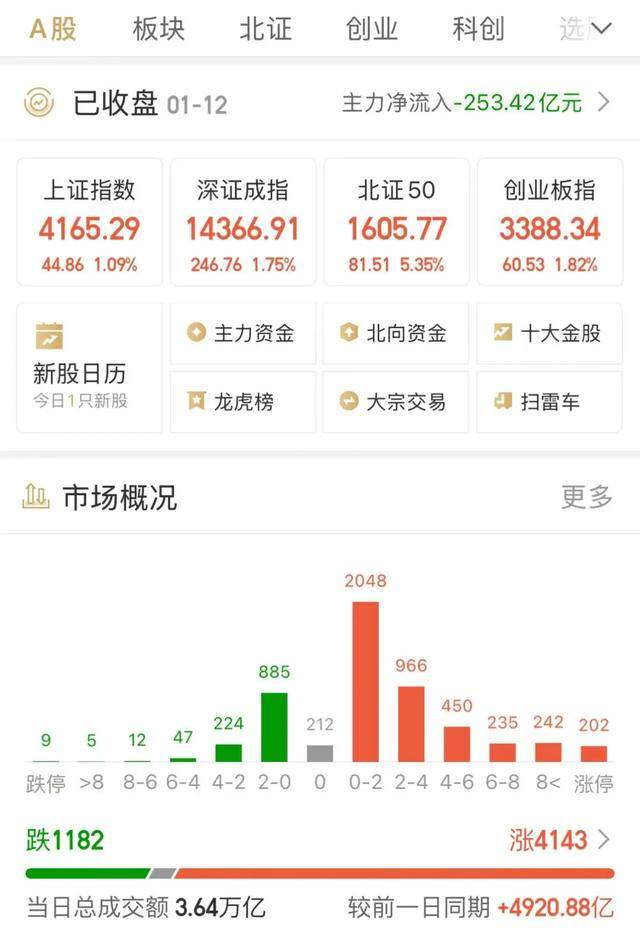
Market Performance - The Shanghai Composite Index rose over 1%, marking a "17 consecutive days of gains," while the Shenzhen Component Index increased by 1.75% and the ChiNext Index by 1.82% [1] - The total market turnover reached 3.64 trillion yuan, setting a new historical record, surpassing the previous high of 3.45 trillion yuan on October 8, 2024 [1][4] - More than 4,100 stocks experienced price increases during this trading session [1] Sector Performance - The commercial aerospace and AI application sectors led the market, with brain-computer interface concepts also seeing significant gains [1] - Sectors such as computing hardware, insurance, and oil and gas experienced the largest declines [1] Investor Sentiment - A veteran investor noted the unprecedented heat in the A-share market, highlighting that there has been no significant pullback [4] - In the first hour of trading on January 12, the total turnover approached 1.7 trillion yuan, with half-day turnover exceeding 2.31 trillion yuan, indicating strong capital inflow [4] Economic Outlook - The chief economist at AVIC Securities suggested that the spring market rally may have entered a major upward phase, supported by improvements in the fundamental and policy environment [7] - Recent domestic inflation data showed a year-on-year increase of 0.8% in CPI, the highest since March 2023, indicating a positive trend in economic conditions [7] - The "anti-involution" policy aligns with market concerns and is expected to have a more pronounced effect on industries under profit pressure [7] Investment Strategy - The economist recommended a balanced allocation in sectors with marginal catalysts and advised monitoring industries with improving fundamentals that have lagged in the current rally for potential investment opportunities [7]
中邮证券:1月电子纱价格提涨 AI产业链需求景气驱动下仍存涨价预期
智通财经网· 2026-01-12 06:40
Group 1: Electronic Yarn - The price of electronic yarn has increased, with G75 average price in China maintaining at 9377 yuan/ton, a nearly 1% increase month-on-month and an 11.31% increase year-on-year, driven by tight supply-demand dynamics in mid-to-high-end products [1] - The demand for high-end PCB is expected to support further price increases in the future [1] - Companies to watch include China Jushi (600176.SH) and China National Materials (002080.SZ) [1] Group 2: Cement Industry - The national cement market is entering a seasonal downturn, with overall demand showing a downward trend, particularly in the housing market, while infrastructure demand is regionally differentiated [2] - Mid-term capacity in the cement industry is expected to decline under production restriction policies, leading to increased capacity utilization and profit elasticity [2] - Companies to focus on include Conch Cement (600585.SH) and Huaxin Cement (600801.SH) [2] Group 3: Glass Industry - The glass industry is experiencing a continuous decline in demand due to the impact of real estate, with traditional peak season orders under pressure and high inventory levels among intermediaries [2] - Despite some production lines undergoing maintenance, the overall supply-demand pressure remains, and prices are expected to stay low in the short term [2] - Flagship companies to monitor include Qibin Group (601636.SH) [2] Group 4: Glass Fiber Industry - Demand in the glass fiber sector is stable in wind power and thermoplastic fields, while traditional demand is slowing down [2] - The electronic yarn segment is performing well, driven by demand from the AI industry, with expectations for significant growth in low-dielectric products [2] - Companies to watch include China Jushi and China National Materials [2] Group 5: Consumer Building Materials - The consumer building materials sector has reached a profitability bottom, with no further downward price space due to years of competition [3] - The industry is strongly advocating for price increases and profit improvements, with multiple categories like waterproofing, coatings, and gypsum boards expected to issue price increase notices [3] - Companies to focus on include Oriental Yuhong (002271.SZ), Sankeshu (603737.SH), Beixin Building Materials (000786.SZ), and Tubao (002043.SZ) [3]

