科技成长

Search documents
帮主郑重早间观察:5万存取款免登记+转融资破百亿!12月中长线布局抓准这两大主线
Sou Hu Cai Jing· 2025-12-01 00:59
Core Insights - The recent policy change allowing individuals to withdraw cash over 50,000 without registration is seen as a move to enhance liquidity in the financial market, boosting consumer and investment confidence [3] - The significant borrowing by brokerages, exceeding 100 billion from China Securities Finance, indicates their confidence in the market and willingness to leverage for business, which is a positive sign for market liquidity in the medium to long term [3] Group 1: Economic Indicators - The PMI for November rose to 49.2%, with all 11 sub-indices showing improvement, indicating a steady recovery in economic activity supported by both domestic policies and overseas demand [4] - The food and beverage, hotel, and tourism sectors are highlighted as key areas benefiting from the recovery in consumer spending, with companies like Shoulu Hotel and Jinjiang Hotel expected to see performance improvements [5] Group 2: Investment Opportunities - The technology growth sector is emphasized, with companies like Haiguang Information and Zhaoyi Innovation repeatedly mentioned as potential long-term investments, particularly in the fields of domestic computing power and commercial aerospace [4] - The lithium carbonate price has surged by 60% over six months, driven by increased demand for energy storage, presenting long-term investment opportunities in related industries [5] Group 3: Market Trends - The likelihood of a Federal Reserve interest rate cut in December has risen to 85.4%, which could lead to increased liquidity globally, benefiting both cyclical and growth sectors [5] - The focus for December's investment strategy should be on two main lines: technology growth in domestic computing power and commercial aerospace, and consumer recovery in hotel, tourism, and food and beverage sectors, along with demand-driven cyclical stocks like lithium resources [6]


【财经早报】一周大涨39%!商业航天热门股发声
Zhong Guo Zheng Quan Bao· 2025-11-30 23:45
Group 1: Economic Indicators - In November, the Manufacturing Purchasing Managers' Index (PMI) rose to 49.2%, an increase of 0.2 percentage points from the previous month [1] - The Non-Manufacturing Business Activity Index decreased to 49.5%, down by 0.6 percentage points from the previous month [1] - The Composite PMI Output Index fell to 49.7%, a decrease of 0.3 percentage points compared to the previous month, indicating overall economic stability [1] Group 2: Company News - Tongyu Communication announced that its stock price had abnormal fluctuations, with a cumulative increase of over 20% in two consecutive trading days, but confirmed that there were no undisclosed significant matters [7] - Xiaomi Auto reported the opening of 17 new stores in November, bringing the total to 441 stores across 131 cities, with plans for 36 more stores in December [8] - Aorede plans to sign a comprehensive technical service agreement worth approximately 635 million yuan, aimed at enhancing its capabilities in providing computing power services [8] - ST Tianrui announced that its controlling shareholder is planning a change in control, leading to a temporary suspension of its stock trading [8] - China Shenhua's subsidiary successfully completed a 168-hour trial run of its power generation unit, with further expansions planned to enhance regional power supply [9] - Daqian Ecology's chairman resigned for personal reasons, with no impact on the board's operation or company management [9] Group 3: Market Trends - According to a report by Galaxy Securities, funds are shifting from high-valuation growth stocks to undervalued cyclical stocks and dividend assets, indicating a rising appeal for defensive sectors [10] - CITIC Construction Investment anticipates an early spring market rally, recommending investments in technology growth and resource sectors, with a focus on non-ferrous metals, AI, new energy, and innovative pharmaceuticals [11]

陆家嘴财经早餐2025年12月1日星期一
Wind万得· 2025-11-30 22:34
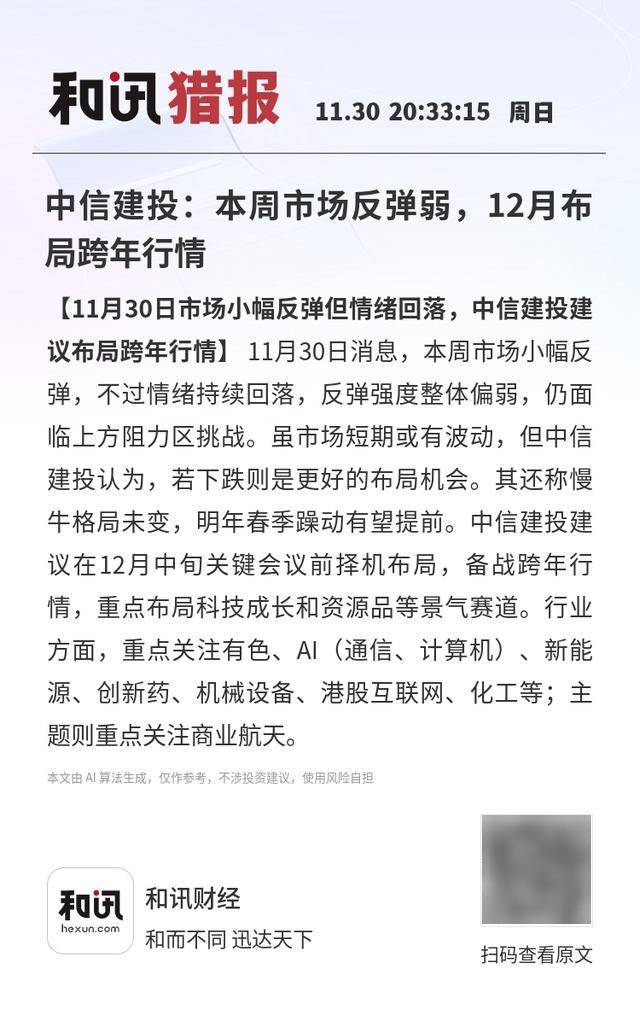
1、 12月一批新规将实施。资源税征管新规12月1日起施行,明确部分情形不缴纳资源税 ;《证券结算风险基金管理办法》12月8日起施行,调整计收范围 和交纳比例等;海南自贸港12月18日启动全岛封关运作;《市场监督管理信用修复管理办法》12月25日起施行,扩大信用修复范围等。 1、 国家统计局发布数据显示,11月份我国制造业PMI为49.2%,比上月上升0.2个百分点; 非制造业PMI为49.5%,比上月下降0.6个百分点;综合PMI产 出指数为49.7%,比上月下降0.3个百分点,我国经济景气水平总体平稳。 7、 中信建投发布研报表示,尽管市场短期可能仍有波动,但如有下跌则是更好的布局机会。 慢牛格局仍未改变,明年春季躁动在共识下有望提前。可在 12月中旬关键会议之前择机布局,备战跨年行情。重点布局科技成长和资源品等景气赛道。行业重点关注:有色(铜、银)、AI(通信、计算机)、新 能源、创新药、机械设备、港股互联网、化工等。主题重点关注:商业航天。 2、 国家发改委负责人表示,鼓励支持引导广大民营企业把握新一轮科技革命和产业变革、超大规模国内市场、城乡区域协调发展等民间投资发展机遇, 进一步拓宽市场准入空间、 ...

中信建投:本周市场反弹弱,12月布局跨年行情
Sou Hu Cai Jing· 2025-11-30 13:11
Group 1 - The market experienced a slight rebound this week, but overall sentiment continued to decline, indicating weak rebound strength and ongoing challenges from resistance levels above [1][2] - Despite potential short-term volatility, the company believes that any downturn could present better investment opportunities, maintaining a slow bull market outlook with expectations for an early spring rally next year [1][2] - The company recommends strategic positioning ahead of key meetings in mid-December to prepare for the year-end market trends, focusing on sectors such as technology growth and resource commodities [1][2] Group 2 - Key sectors to watch include non-ferrous metals, AI (communications, computing), new energy, innovative pharmaceuticals, machinery, Hong Kong internet stocks, and chemicals [1][2] - Thematic focus should be on commercial aerospace, indicating a specific area of interest for potential investment opportunities [1][2]

权益ETF系列:反抽还是反弹?多一点时间上的耐心
Soochow Securities· 2025-11-30 11:05
证券研究报告·宏观报告·宏观周报 金融产品周报 20251130 权益 ETF 系列: 反抽还是反弹?多一点时 间上的耐心 [Table_Tag] [Table_Summary] 事件 ◼ 基金配置建议: 2025 年 11 月 30 日 证券分析师 芦哲 执业证书:S0600524110003 luzhe@dwzq.com.cn 证券分析师 唐遥衎 执业证书:S0600524120016 tangyk@dwzq.com.cn 相关研究 《流动性与科技双驱动的资本市场— —2026 年度展望:大类资产》 2025-11-28 《俄乌"28 点"停火协议:和平之路 依旧漫长》 2025-11-27 东吴证券研究所 1 / 20 请务必阅读正文之后的免责声明部分 ◼ A 股市场行情概述:(2025.11.24-2025.11.28) ◼ 主要宽基指数涨跌幅:排名前三名的宽基指数分别为:科创 100 (4.48%),创业板指(4.22%),万得微盘股日频等权指数(3.77%); 排名后三名的宽基指数分别为:北证 50(0.12%),红利指数(0.16%), 中证红利(0.34%)。 ◼ 风格指数涨跌幅:排名前三名的 ...
A股下周怎么走?三大关键信号+投资策略全解析!
Sou Hu Cai Jing· 2025-11-30 04:14
Market Status - The market has experienced a rebound, with the ChiNext Index rising by 4.5%, indicating a marginal recovery in risk appetite, particularly towards growth-oriented sectors [2] - There is a significant shift in capital away from defensive sectors like banks and telecommunications towards high elasticity sectors such as information technology and communication equipment, driven by both overselling and optimism regarding future industrial policies [2] - The average daily trading volume of 1.73 trillion is insufficient to support a broad market rally, suggesting that the current market dynamics are more about reallocating existing capital rather than initiating a new trend [2] Upcoming Week Projections - The market is expected to experience a period of consolidation and fluctuation, with a focus on structural alpha for profitability [3] - Key observations will include the policy direction from upcoming meetings and whether trading volume can effectively increase, as both factors are critical for potential market breakthroughs [4] Strategy and Positioning - The recommended strategy involves a "core + satellite" approach, maintaining a neutral position while remaining flexible [3] - Core positions should focus on "technology growth" sectors, emphasizing companies with solid orders, performance, and reasonable valuations, while avoiding speculative plays [4] - Satellite positions may include investments in "policy play" sectors such as high-end manufacturing and new materials, along with some high-dividend assets to mitigate risks [4]
晚间重大,国常会出利好,4天缩量冲高回落,今天警惕一个关键信号
Sou Hu Cai Jing· 2025-11-29 06:01
Core Viewpoint - The A-share market experienced a "roller coaster" effect on November 27, 2025, with a slight increase in the Shanghai Composite Index but a decline in the Shenzhen Component and ChiNext indices, amidst decreasing trading volume over four consecutive days [1][3]. Market Trends - The market has shown a "shrinking rebound" trend for four days, with trading volume decreasing to 1.71 trillion yuan, raising concerns among investors about potential market stagnation or upcoming volatility [3][5]. - The market sentiment has cooled significantly, with the success rate of consecutive rising stocks dropping below 20%, indicating a cautious approach from active funds [3][5]. Technical Analysis - The shrinking trading volume reflects a decrease in capital participation and a strong sense of caution among investors, with the Shanghai Composite Index facing significant resistance at the 60-day moving average [5][7]. - Historical data suggests that the area above 3400 points on the Shanghai Composite Index has accumulated a considerable number of trapped positions, creating a strong resistance zone that requires substantial volume to break through [5][8]. Sector Performance - There is a noticeable shift in market focus from high-growth sectors to low-value stocks, with defensive sectors like banking, insurance, and liquor gaining traction as investors seek safety [8][10]. - The technology growth sectors, particularly semiconductors and AI, have faced significant pullbacks after substantial gains earlier in the year, leading to profit-taking behavior among investors [8][10]. Policy Impact - Recent government policies have positively influenced the pharmaceutical and medical device sectors, with expectations of continued active rebounds in certain stocks [10]. - Warnings from the Ministry of National Defense regarding Japan's stance on the Taiwan Strait have positively impacted the military industry and local stocks in Fujian [10]. Capital Flow - There is a noticeable slowdown in incremental capital, with northbound capital showing a cautious attitude and trading volumes declining [12]. - The overall market sentiment is cautious due to external uncertainties, with investors advised to maintain a 50% position and consider defensive sectors to hedge against risks [12].



公募规模36.96万亿创历史新高 机构展望A股12月慢牛可期
2 1 Shi Ji Jing Ji Bao Dao· 2025-11-28 23:34
Group 1 - The total scale of public funds in China has reached a record high of 36.96 trillion yuan, marking the seventh time this year it has set a new record [2][3] - As of November 23, 2025, a total of 1,340 new funds have been established this year, with a total issuance scale of 1,044.598 billion yuan, continuing a trend of over 1 trillion yuan in annual new fund issuance for the seventh consecutive year [2][3] - The stock fund sector has shown remarkable performance, with 750 new stock funds established this year, raising 382.015 billion yuan, accounting for 36.57% of the total new fund scale [3] Group 2 - In November, the A-share market experienced high-level fluctuations, with major indices like the ChiNext Index and the STAR Market Index showing signs of recovery after a dip [4][5] - The financing activities in the A-share market have been positive, with net purchases exceeding 9.8 billion yuan, particularly in the electronics and communications sectors [4][5] - The market is currently viewed as being in a "second phase of a bull market," with institutions suggesting a focus on technology growth sectors and advanced manufacturing as key investment areas [6][7]
2026年转债策略展望:因势而动,精耕个券
GUOTAI HAITONG SECURITIES· 2025-11-28 13:27
Group 1 - The report emphasizes the need to shift from a broad market beta approach to a more refined selection of convertible bonds, focusing on four main themes: technology growth, energy-driven investments, anti-involution, and low-volatility bottom positions [1] - In 2025, the convertible bond market showed a strong performance with the CSI Convertible Bond Index achieving a cumulative increase of 16.50%, while the high-price low-premium index surged by 21.48% [7][16] - The report identifies three significant trends in the convertible bond market for 2025: the scarcity of bottom-position convertible bonds, the indexation of allocation tools, and a valuation logic that is increasingly equity-oriented [16][17] Group 2 - The supply of convertible bonds is expected to remain under pressure, with a notable decline in the total outstanding amount, which decreased by 22.49% compared to the beginning of the year [17][24] - The report forecasts that the valuation of convertible bonds will maintain a high level in 2026, supported by optimistic expectations for the equity market, particularly due to policy incentives and ongoing industrial policies in technology and high-end manufacturing [17][36] - The report suggests that the convertible bond market will continue to face challenges due to ongoing contraction, with large, high-rated, and highly liquid convertible bonds enjoying liquidity premiums due to their scarcity [17][20] Group 3 - The report highlights the importance of convertible bond ETFs as a growing allocation tool for institutional investors, with the market size reaching 68.2 billion yuan, accounting for 12.5% of the total convertible bond market [12][31] - The investment logic in the convertible bond market has shifted from a focus on debt protection to an emphasis on equity upside, as indicated by the rising median prices and increased conversion premium rates [16][34] - The report outlines three strategic focuses for 2026: selecting convertible bonds that are not subject to early redemption, strategically participating in new bond issuance windows, and identifying bonds with strong conversion intentions [17][36]
国泰海通|固收:因势而动,精耕个券——2026年转债策略展望
国泰海通证券研究· 2025-11-28 08:56
Core Viewpoint - The convertible bond market in 2026 requires a shift from a broad reliance on overall market beta to a more refined selection of individual bond values, focusing on four main themes: technology growth, energy-driven investments, anti-involution, and low volatility bottom positions [1][3]. Group 1: Market Performance and Trends - In 2025, the convertible bond market strengthened due to a tight supply-demand balance and support from the equity market, with the China Convertible Bond Index showing a cumulative increase of 16.50% [1]. - High-priced, low-premium rate indices outperformed, with a cumulative increase of 21.48%, while low-priced convertible bonds achieved a steady return of 17.05% due to price recovery and valuation uplift [1]. - The convertible bond market exhibited three notable characteristics in 2025: scarcity of bottom-position bonds, index-based allocation tools, and a valuation logic leaning towards equity [1]. Group 2: Supply and Demand Dynamics - The convertible bond market experienced a significant contraction, with the total size down by 22.49% from the beginning of the year, primarily due to a reduction in issuance plans and an increase in forced redemptions as the equity market rose [1]. - The supply side is expected to remain under pressure, with a significant contradiction between the supply and maturity scale of convertible bonds, even without considering forced redemptions [1]. Group 3: Future Outlook and Strategy - The valuation of convertible bonds is expected to remain high in 2026, supported by optimistic expectations for the equity market, driven by policy incentives and strong demand for equity assets [2]. - The first half of 2026 is anticipated to be a peak period for allocation, with a tight supply-demand balance providing a resilient foundation for high valuations [2]. - A neutral to slightly aggressive position is recommended for 2026, with a focus on maintaining a certain level of bottom-position bonds for liquidity and stability [3]. - Strategic opportunities should include selecting non-redeemed equity-type convertible bonds, participating in new bond issuance windows, and identifying bonds with strong conversion intentions [3].