
反内卷政策

Search documents
2025年物价低位温和回升
Xin Lang Cai Jing· 2026-01-09 22:52
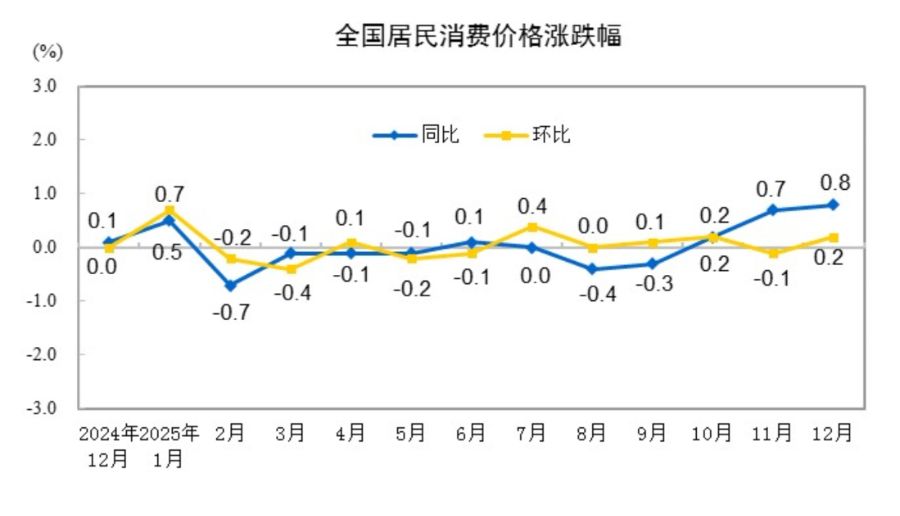
Group 1: CPI Analysis - In December 2025, the Consumer Price Index (CPI) increased by 0.2% month-on-month and 0.8% year-on-year, with the core CPI (excluding food and energy) rising by 1.2% year-on-year, marking a stable recovery in demand [1][2] - The year 2025 saw the CPI remain flat compared to the previous year, while the PPI decreased by 2.6% year-on-year, indicating a low and moderate recovery in price levels [1][4] - The increase in CPI was primarily driven by rising prices of industrial consumer goods, with a notable increase in prices for communication tools, baby products, and entertainment durable goods, which rose between 1.4% and 3.0% [1][2] Group 2: PPI Analysis - The Producer Price Index (PPI) rose by 0.2% month-on-month in December 2025, marking three consecutive months of increase, influenced by improved supply-demand dynamics and ongoing capacity governance in key industries [2][3] - Year-on-year, the PPI decreased by 1.9%, but the decline was less severe than in previous months, reflecting positive changes in certain industries due to macroeconomic policies [3][5] - The PPI's year-on-year decline was initially exacerbated by insufficient external demand and structural adjustments, but improved market competition and policy effects led to a narrowing of the decline in the latter half of the year [5] Group 3: Economic Outlook - The changes in CPI and PPI in December 2025 indicate a stable and improving economic environment, with demand gradually recovering and supply-side structural optimization continuing [3][5] - The implementation of consumption-boosting policies and the deepening of the unified national market are expected to support a moderate and stable price environment moving forward [3][5] - Looking ahead to 2026, a more proactive macroeconomic policy is anticipated to foster economic growth and reasonable price recovery, with the potential for PPI to enter a recovery phase, although it may take time to turn positive [5]
提振消费政策显效、企业竞争秩序优化、新动能快速成长——2025年物价低位温和回升
Jing Ji Ri Bao· 2026-01-09 22:02
Group 1: CPI Analysis - In December 2025, the Consumer Price Index (CPI) increased by 0.2% month-on-month and 0.8% year-on-year, with the core CPI (excluding food and energy) rising by 1.2% year-on-year [1][2] - The year 2025 saw the CPI remain flat compared to the previous year, while the PPI decreased by 2.6% year-on-year, indicating a generally low and mild recovery in price levels [1][4] - The increase in CPI is attributed to rising prices of industrial consumer goods, with a notable increase in prices for communication tools, baby products, and entertainment durable goods, which rose between 1.4% and 3.0% [1][2] Group 2: PPI Analysis - The Producer Price Index (PPI) rose by 0.2% month-on-month in December 2025, marking three consecutive months of increase, despite a year-on-year decline of 1.9% [2][3] - The PPI's year-on-year decline narrowed by 0.3 percentage points compared to the previous month, reflecting improvements in supply-demand structures and effective policies in key industries [3][5] - Prices in the coal mining and processing sectors, as well as lithium-ion battery manufacturing and cement production, have shown consistent increases, indicating a positive trend in certain industries [2][3] Group 3: Economic Outlook - Analysts suggest that the changes in CPI and PPI reflect a stable and improving economic environment in China, with demand gradually recovering and supply-side structural optimization continuing [3][5] - The implementation of consumption-boosting policies and the deepening of the national unified market construction are expected to support a stable and mild recovery in prices moving forward [3][5] - Looking ahead to 2026, a more proactive macroeconomic policy environment is anticipated to foster economic growth and reasonable price recovery, with CPI expected to rise steadily [5]
12月PPI环比连续上涨,CPI同比创2023年3月以来最高
2 1 Shi Ji Jing Ji Bao Dao· 2026-01-09 09:48
Group 1: Consumer Price Index (CPI) Insights - In December 2025, the Consumer Price Index (CPI) increased by 0.2% month-on-month and 0.8% year-on-year, with the year-on-year growth rate reaching its highest level since March 2023 [1][3] - The increase in CPI was primarily driven by a rise in food prices, which increased by 1.1%, contributing approximately 0.17 percentage points to the year-on-year CPI increase [4][6] - The overall CPI for 2025 remained flat compared to the previous year, indicating a relative lack of effective consumer demand and a mismatch between supply and demand [2][7] Group 2: Producer Price Index (PPI) Insights - The Producer Price Index (PPI) rose by 0.2% month-on-month in December 2025, marking the third consecutive month of increase, while the year-on-year decline narrowed to 1.9% [8][9] - Key industries such as coal mining and lithium-ion battery manufacturing saw price increases, reflecting improvements in supply-demand structures and ongoing capacity governance [9][10] - The overall PPI for 2025 decreased by 2.6%, indicating a historically low price level combination, which aligns with the current macroeconomic context of supply exceeding demand [11][12] Group 3: Economic Outlook and Policy Implications - The gradual release of "stabilizing growth and promoting consumption" policies is expected to lead to a moderate increase in CPI in 2026, surpassing the flat growth of 2025 [2][7] - The anticipated low base effect from the 2025 PPI decline may contribute to a rise in PPI in 2026, alongside increased demand for resources in a complex economic environment [12] - Continued efforts to address "involution" in competition and the establishment of a unified national market are expected to positively influence price dynamics in the coming year [11][12]

12月通胀点评:输入性因素的影响或加大
Bank of China Securities· 2026-01-09 09:21
Inflation Overview - December CPI increased by 0.2% month-on-month and 0.8% year-on-year, with core CPI rising by 1.2% year-on-year[2] - Food prices contributed approximately 0.05 percentage points to the month-on-month CPI increase, while industrial consumer goods prices (excluding energy) added about 0.16 percentage points[2] - Year-on-year, service prices contributed approximately 0.25 percentage points to CPI, and industrial consumer goods prices (excluding energy) contributed about 0.63 percentage points[2] PPI Analysis - December PPI increased by 0.2% month-on-month but decreased by 1.9% year-on-year, with PPIRM down by 2.1% year-on-year[2] - Key industries such as coal mining and lithium-ion battery manufacturing saw prices rise for three consecutive months, indicating improved supply-demand structures[19] - The year-on-year decline in PPI is narrowing, with notable increases in non-ferrous metals prices by 10.5%[19] Policy Impact - Consumer stimulus policies are showing continued effects, with a notable reduction in the drag from food prices on CPI[7] - The strategy to boost CPI growth in 2026 focuses on reducing food price impacts, improving industrial consumer goods prices, and enhancing service consumption[7] - Risks include potential global inflation resurgence and rapid economic downturns in Europe and the U.S.[22]
2025年12月物价数据点评:多重因素共振,年末物价数据全面回升
Dong Fang Jin Cheng· 2026-01-09 05:59
Group 1: CPI Analysis - In December 2025, the CPI increased by 0.8% year-on-year, up from 0.7% in the previous month, marking the highest increase since August 2023[2] - The cumulative CPI for January to December 2025 was 0.0%, indicating a stagnation in price growth over the year[1] - The main drivers for the December CPI increase included rising vegetable and fruit prices due to adverse weather, consumer promotion policies boosting appliance and vehicle prices, and an increase in international gold prices[3] Group 2: PPI Analysis - The PPI in December 2025 decreased by 1.9% year-on-year, a slight improvement from a 2.2% decline in November, with a cumulative decline of 2.6% for the year[1] - The December PPI saw a month-on-month increase of 0.2%, marking the third consecutive month of rising prices[6] - Key factors contributing to the PPI changes included improved supply-demand dynamics in certain industries and rising prices in the non-ferrous metals sector, with specific increases of 3.7% and 2.8% in mining and refining respectively[7][8] Group 3: Economic Outlook - The overall economic environment in 2025 was characterized by weak demand and a "strong supply, weak demand" scenario, leading to a continued decline in PPI[10] - Looking ahead to January 2026, the CPI is expected to drop to around 0.2% year-on-year due to a higher base effect from the previous year and seasonal price fluctuations[5] - The forecast for 2026 indicates a continued low inflation environment, with an expected annual CPI of approximately 0.4%[5]
纯碱、玻璃日报-20260109
Jian Xin Qi Huo· 2026-01-09 01:54
Report Information - Report Name: Soda Ash and Glass Daily Report [1] - Date: January 9, 2026 [2] Industry Investment Rating - Not provided. Core Views - Soda ash supply increased and inventory accumulated as of January 8, maintaining a weak pattern. The short - term is expected to be volatile and slightly stronger due to macro sentiment and other factors, but the long - term supply - demand contradiction remains unsolved [8][9]. - Glass futures' main contract FG2605 continued to rise on January 8, 2025. Short - term supply contraction may support prices, but high inventory restricts the market, and the upward trend is slow [10][11]. Summary by Directory 1. Soda Ash and Glass Market Review and Operation Suggestions Soda Ash - Supply: As of the week of January 8, the weekly output rose to 753,600 tons, a year - high, with a month - on - month increase of 8.11%. The equipment operation is stable with no maintenance plan [8]. - Demand: This week, the total shipment volume of Chinese soda ash enterprises decreased to 589,200 tons, a month - on - month decrease of 18.99%. The downstream float glass daily melting volume decreased by 300 tons to 151,500 tons, while the photovoltaic glass daily melting volume of 88,500 tons was relatively stable [8]. - Inventory: Affected by logistics during the festival, the factory inventory increased to 1.5727 million tons [8]. - Policy: The Shanxi differential electricity price policy strengthened the expectation of capacity clearance and "anti - involution" policies, accelerating the clearance of ammonia - alkali plants [8][9]. - Outlook: The short - term is expected to be volatile and slightly stronger, but the long - term supply - demand pattern remains unoptimistic without significant export expansion or backward capacity clearance [9]. Glass - Market: On January 8, 2025, the main contract FG2605 continued to rise. The market shipment was good, with obvious inventory reduction in some areas, and prices were boosted by market sentiment [10][11]. - Supply: There is an expectation of supply reduction. The overall inventory is high with obvious regional differentiation [11]. - Outlook: Short - term supply contraction may support the price, but high inventory restricts the market. The upward trend is slow, and there is an expectation of rebound and decline before substantial positive factors appear [11]. 2. Data Overview - The report provides multiple data charts, including the price trends of soda ash and glass active contracts, soda ash weekly production, soda ash enterprise inventory, central China heavy soda market price, and flat glass production, with data from Wind and iFind [13][18][20]
多家外资机构看好2026年中国市场表现
第一财经· 2026-01-08 15:36
Core Viewpoint - The article highlights a positive outlook for the Chinese market in 2026, driven by valuation recovery and structural changes in corporate fundamentals, with foreign investment showing increased interest and participation [3][5][8]. Market Performance in 2025 - In 2025, major A-share indices saw significant gains, with the Shanghai Composite Index rising by 18.41%, the Shenzhen Component Index by 29.87%, and the ChiNext Index by 49.57% [4]. - The overall performance of the Chinese capital market in 2025 was described as "comprehensive and exceeding expectations" [5]. Factors Supporting Market Growth - Valuation levels are currently reasonable, with the MSCI China Index trading at a price-to-earnings ratio of approximately 13, slightly above the past decade's average [5]. - Investor participation remains below historical highs, indicating potential for further growth [5]. - External factors, including global economic shifts and supportive domestic policies, are expected to benefit the Chinese market [5]. Structural Changes in Corporations - Chinese companies are shifting their operational focus from "scale first" to "internal improvement," emphasizing profitability quality, technological barriers, long-term value, and innovation [5]. - UBS forecasts a potential earnings growth of 14% or higher for the MSCI China Index in 2026, driven by sectors such as internet platforms, high-end manufacturing, and companies with global expansion capabilities [5][6]. Foreign Investment Trends - Foreign investors' attitudes towards Chinese assets have shifted from cautious observation to active participation, with a noticeable influx of capital [5][6]. - Despite a significant recovery in foreign investment in 2025, there remains considerable room for increased allocation compared to the averages from 2017 to 2021 [6]. Predictions for 2026 - Goldman Sachs maintains an overweight rating for A-shares and H-shares, predicting a 20% increase in the MSCI China Index and a 12% increase in the CSI 300 Index in 2026 [8]. - The market's growth momentum is expected to transition from valuation expansion to earnings-driven growth, particularly in the TMT sector, which is projected to see earnings growth of around 20% [8][9]. Investment Themes and Recommendations - Goldman Sachs suggests focusing on four key investment themes: companies benefiting from AI development, sectors supported by the "14th Five-Year Plan," leading export companies, and firms with substantial shareholder returns [9]. - The firm has assigned overweight ratings to sectors including technology hardware, insurance, materials, media/entertainment, and internet retail [9].



热卷日报:震荡整理-20260108
Guan Tong Qi Huo· 2026-01-08 12:05
1. Report Industry Investment Rating - Not mentioned in the provided content 2. Core View of the Report - The current production pressure of hot-rolled coils is not significant. The anti-involution policy still has expectations, providing strong support at the lower end. Although the weekly apparent consumption has slightly declined, it remains relatively strong year-on-year. A slight decline in off-season demand is normal. The warming of winter storage sentiment may drive a wave of demand. From the cost side, the strength of coking coal and coke and the sharp rise of iron ore provide strong cost support. The total inventory is relatively high, posing some pressure. On Wednesday, the entire black series rose sharply, with high enthusiasm. The hot-rolled coil futures broke through upwards with heavy volume. On Thursday, it tested the support level during intraday trading. It is recommended to adopt a bullish approach and it is relatively safe to buy on dips. It is expected to continue to rise strongly [5] 3. Summary by Relevant Catalogs Market行情回顾 - Futures price: On Wednesday, the open interest of the main hot-rolled coil futures contract increased by 63,008 lots, with a trading volume of 696,880 lots, showing a contraction compared to the previous trading day. The intraday low was 3,302 yuan, and the high was 3,348 yuan. It fluctuated within the day with intense washing. From the perspective of the daily moving average, it stood above the 5-day, 10-day, and 20-day moving averages, showing strength. It closed at 3,317 yuan/ton, up 16 yuan/ton, or 0.48% [1] - Spot price: The price of hot-rolled coils in the mainstream Shanghai area was reported at 3,320 yuan/ton, up 20 yuan from the previous trading day [1] - Basis: The basis between futures and spot was 3 yuan, close to flat water [2] Fundamental Data - Supply side: As of January 8, the weekly output of hot-rolled coils increased by 10,000 tons to 3.0551 million tons compared to the previous week. It was up 16,200 tons year-on-year. The output has rebounded for three consecutive weeks, mainly due to the improvement in steel mill profitability, increased production enthusiasm, the transfer of molten iron from building materials to plates by some steel mills, and the resumption of production after the end of the annual maintenance of steel mills. The supply has increased, and the subsequent increase needs to be observed [3] - Demand side: As of January 8, the weekly apparent consumption decreased by 24,300 tons to 3.0834 million tons compared to the previous week. The apparent consumption declined slightly, but it was up 72,500 tons year-on-year. The demand still showed resilience [3] - Inventory side: As of January 8, the total inventory decreased by 28,300 tons to 3.6813 million tons week-on-week (social inventory increased by 21,700 tons, and steel mill inventory decreased by 50,000 tons). The total inventory continued to decline, but the decline rate narrowed. The total inventory was at a five-year high. The inventory still exerted pressure on prices [3] - Policy side: The new regulations on the export license management of steel products have been introduced. In the short term, it will lead to fluctuations in exports, an increase in supply, and price pressure. In the long term, it will promote industrial upgrading, structural optimization, and competitiveness improvement. The Central Economic Work Conference held in December proposed an active fiscal policy and a moderately loose monetary policy. Deeply rectifying involutionary competition was listed as a key task for 2026, which is beneficial to prices and industry profitability. Efforts will be made to stabilize the real estate market and expand domestic demand [3][4] Market Driving Factor Analysis - Bullish factors: Decrease in supply-side output, expectation of the start of winter storage demand, export rush market, policy support ("14th Five-Year Plan", infrastructure investment), and the strength of iron ore as a furnace charge [5] - Bearish factors: The resumption of production of steel mills in January exceeded expectations, seasonal weakening of demand, insufficient manufacturing orders, and inventory accumulation suppressing prices [5]
煤炭ETF(515220)昨日净流入超3.2亿元,反内卷政策与需求预期支撑煤价中枢
Mei Ri Jing Ji Xin Wen· 2026-01-08 10:12
Group 1 - The coal ETF (515220) saw a net inflow of over 320 million yuan, supported by anti-involution policies and demand expectations stabilizing coal prices [1] - Shanxi Securities indicated that anti-involution policies have reversed market expectations for coal, with the "Document 108" in 2025 aiming to compress supply through measures like checking overproduction, leading to a stabilization and rebound in coal prices [1] - The short-term controlled supply combined with long-term demand recovery expectations is likely to improve industry profitability, with coal consumption expected to enter a peak plateau during the 14th Five-Year Plan [1] Group 2 - The demand for thermal coal is expected to remain stable as long as the incremental growth of renewable energy generation does not exceed the overall electricity consumption growth [1] - By 2026, thermal coal is projected to maintain a tight balance with a price center around 720 yuan/ton, while coking coal may show a weak balance with a price center estimated at 1440 to 1584 yuan/ton, calculated as 2.0 to 2.2 times that of thermal coal [1] - The coal ETF (515220) has a scale exceeding 9 billion yuan, tracking the CSI Coal Index (399998), with a high dividend yield in the coal sector, exceeding 6% over the past 12 months as of the end of 2025, highlighting its allocation value in a declining risk-free interest rate environment [1]
螺纹日报:震荡整理-20260108
Guan Tong Qi Huo· 2026-01-08 09:48
【冠通期货研究报告】 螺纹日报:震荡整理 发布日期:2026 年 1 月 8 日 需求端:淡季效应深化,冬储谨慎,截至 1 月 8 日当周,表观消费 量周环比下降 25.48 万吨至 174.96 万吨,年同比下降 15.09 万吨,北方地 方施工停滞,南方工期收尾,表需连续三周下降,后续关注冬储需求启动。 一、市场行情回顾 1,期货价格:螺纹钢主力合约周四持仓量增仓 40418 手,成交量相比上 一交易日缩量,成交量 1350602 手。全天震荡回落后尾盘企稳回升,均线来看站 上 5 日,20 日均线,最低 3156,最高 3198,收于 3168 元/吨,上涨 14 元/吨, 涨幅 0.44%。 2,现货价格:主流地区上螺纹钢现货 HRB400E 20mm 报价 3310 元/吨,相 比上一交易日维稳。 3,基差:期货贴水现货 142 元/吨。基差仍然较大,有一定支撑。盘面冬 储有一定性价比。 二、基本面数据 库存端:库存开始增库,截止 1 月 8 日当周,总库存周环比上升 16.08 万吨至 438.11 万吨,连续 9 周去化之后开始累库,其中社会库存 290.18 万 吨,周环比上升 7.52 万吨 ...