
新经济

Search documents
20cm速递|科创板100ETF(588120)、科创综指ETF国泰(589630)均涨超1%,改革举措与科技周期共振
Mei Ri Jing Ji Xin Wen· 2025-07-31 10:13
Group 1 - The core viewpoint of the articles indicates that the current market structure is transitioning from a "barbell strategy" to "mid-assets," with the technology and innovation sectors experiencing cyclical turning points [1] - In the industrial sector, new growth drivers such as AI (computing power), Hong Kong internet, innovative pharmaceuticals, new consumption, semiconductors, and new energy vehicles are entering their respective cyclical turning points, providing conditions for undervalued large-cap growth and the return of "mid-assets" to excess effectiveness [1] - The ChiNext Index's current price-to-earnings ratio is at 23.82%, significantly lower than other broad-based indices, with a first-quarter profit growth rate of 19%, outperforming other indices [1] Group 2 - The Science and Technology Innovation Board 100 ETF (588120) tracks the Science and Technology Innovation 100 Index (000698), which can have a daily fluctuation of up to 20% and selects 100 securities with moderate market capitalization and good liquidity from the Science and Technology Innovation Board [1] - The Science and Technology Innovation Comprehensive Index ETF (589630) aims to comprehensively reflect the overall performance of the Science and Technology Innovation Board market, covering nearly 97% of its market capitalization [2] - Investors without stock accounts can consider various linked funds related to the Science and Technology Innovation Board ETFs, which provide alternative investment options [2]
创业板ETF天弘(159977)跟踪指数近三月涨24%!估值洼地遇业绩拐点,后市可期
Sou Hu Cai Jing· 2025-07-30 02:54
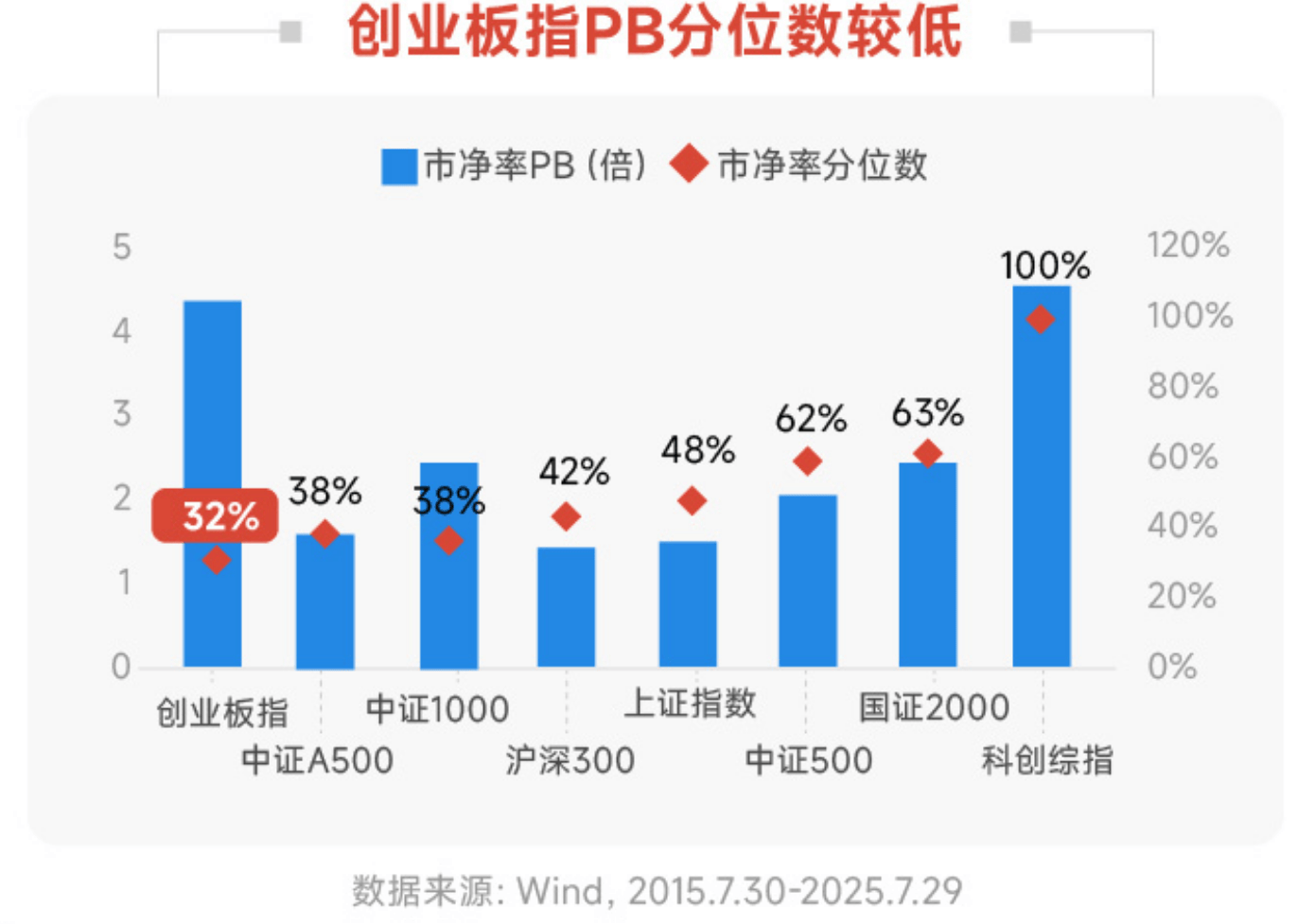
Core Viewpoint - The ChiNext board is experiencing structural opportunities amid increasing global tech competition, with the Tianhong ChiNext ETF showing significant price increases over various time frames, driven by valuation advantages and strong fundamentals [1][2]. Valuation Insights - The ChiNext index is currently at a significant valuation low, with a price-to-book ratio of approximately 4 times, marking a historical low of 32% since the index's inception. In contrast, the CSI 300 and CSI 500 indices have price-to-book ratios at 42% and 62%, respectively, highlighting the ChiNext's valuation advantage [2]. Performance and Growth - The ChiNext index has shown a strong performance, with an 18.74% increase since June 20, leading among major indices. Year-to-date, it remains in the top tier, demonstrating robust market resilience [4]. - The profitability turning point for the ChiNext is evident, with revenue and net profit both showing year-on-year growth, particularly a 20% increase in net profit for Q1 2025, providing solid support for the index's rise [8]. Historical Context - Historically, the ChiNext index has outperformed major indices during bull markets, with a cumulative increase of 141% since its base date, significantly surpassing the 50% increase of the CSI 300 index, validating its long-term growth potential [12]. Industry Strengths - The ChiNext's high elasticity is attributed to its deep coverage of new economy sectors, with over 65% of its constituents in key technology areas such as power equipment, electronics, pharmaceuticals, and communications. These sectors have recently shown marginal improvements in fundamentals, contributing to the index's momentum [14]. - The power equipment sector has risen by 29.4%, electronics by over 14%, pharmaceuticals by 11.6%, and communications by over 10%, indicating strong industry performance [14]. Research and Development - In 2024, the R&D expense ratio for ChiNext constituents is projected to reach 4.97%, significantly higher than that of the CSI 300 and Shenzhen Composite indices, reflecting a commitment to innovation [16]. - Continuous high-intensity R&D investments over three years are expected to yield a net asset return on equity (ROE) exceeding 12% by 2024, establishing a sustainable growth foundation through enhanced technological barriers [18]. Investment Strategy - The Tianhong ChiNext ETF, characterized by low valuation, high growth potential, and refined management, offers a clear investment strategy for investors looking to capitalize on the ChiNext's development opportunities [22].


七批110个新职业,折射经济发展新动能 “新饭碗”里有多少料?
He Nan Ri Bao· 2025-07-28 23:21
Core Viewpoint - The emergence of new professions driven by the new economy reflects the changing dynamics of economic development and offers new employment opportunities for the younger generation [11][16]. Group 1: New Professions and Economic Trends - The Ministry of Human Resources and Social Security, along with other departments, has released the seventh batch of new professions, including 17 new occupations and 42 new job types, highlighting the shift in economic development dynamics [11][16]. - The introduction of new professions such as coffee processing workers, elderly service workers, and drone flight planners indicates a response to the evolving job market and the increasing demand for diverse skills [16][17]. - The recognition of these new professions is expected to attract talent and support the development of emerging industries, creating a symbiotic relationship between employment and industrial growth [17][21]. Group 2: Individual Experiences in New Professions - Coffee processing worker Liu Shifei emphasizes the importance of mastering the entire coffee bean processing workflow to ensure quality and consistency in the final product [12][13]. - Elderly service worker Li Hankan focuses on providing personalized health management for seniors, reflecting the growing demand for specialized care in the aging population [14][16]. - Drone training instructor Xu Fusen highlights the increasing interest in drone operation and the need for skilled trainers in this rapidly expanding industry [15][18]. Group 3: Challenges and Opportunities - The coffee industry is projected to grow significantly, with the market size expected to reach 369.3 billion yuan by 2025, indicating a promising future for coffee processing workers [20]. - Despite the potential of new professions, challenges such as market competition and public perception remain, as seen in the experiences of individuals in the drone and two-dimensional culture sectors [19][20]. - The government is actively promoting vocational training programs to enhance the skills of young people, particularly in fields like big data, artificial intelligence, and smart manufacturing, to better align with industry needs [22].

明星基金,风格生变!刘格菘、焦巍、皮劲松……“口味”换了?
券商中国· 2025-07-28 10:36
Core Viewpoint - The article discusses the significant changes in investment strategies among fund managers in response to the evolving Chinese stock market dynamics and the contrasting performances between new and traditional sectors [2][7]. Group 1: Changes in Fund Managers' Strategies - Fund managers are increasingly abandoning their previous preferences and styles, adapting to the new market conditions [2][7]. - Notable fund managers, such as Liu Gesong and Jiao Wei, have shifted their investment focus towards Hong Kong stocks and new economy sectors, indicating a departure from their traditional investment styles [3][4]. - Liu Gesong's fund now heavily invests in Hong Kong companies like Xiaomi and Pop Mart, while Jiao Wei's fund has increased its Hong Kong stock allocation from 15% to 47% within a quarter [3][4]. Group 2: Impact of Market Dynamics - The rapid increase in the attractiveness of the Chinese stock market and the global popularity of new economic sectors have prompted fund managers to reassess their traditional investment beliefs [7][9]. - The innovation in the pharmaceutical sector, particularly in Chinese innovative drugs, has led to a significant shift in investment strategies, with many managers completely exiting U.S. stocks in favor of Hong Kong and A-share markets [7][9]. - The article highlights that the recognition of China's technological capabilities and the evolving narrative around Chinese consumption are creating new investment opportunities [9]. Group 3: Future Outlook - The changes in fund managers' investment preferences are expected to influence major stock market selections in 2025, reflecting a renewed confidence in Chinese assets [8]. - The article emphasizes that the ongoing transformation in the investment landscape is driven by a strong narrative of change, particularly in consumer behavior and technological advancements in China [9].

电商经营成本高企 多隐患易引发“骨牌效应”
Zheng Quan Ri Bao· 2025-07-28 03:02
Core Viewpoint - The e-commerce industry is facing significant challenges, with many companies experiencing high operational costs and ultimately failing, despite initial capital support [2][3][5]. Group 1: E-commerce Company Failures - At least 41 e-commerce companies collapsed in 2019, including well-known names like Le Feng and Tao Ji Ji, with at least 5 more failures reported in the first half of the current year [2]. - The majority of failed e-commerce companies were established around 2015 and primarily operated in sectors like fresh food and community e-commerce, with reasons for failure including funding shortages and poor business models [3][6]. - The average cost to acquire a customer in the e-commerce sector ranges from 200 to 400 yuan, which can exceed the price of many products, making customer retention critical for profitability [4]. Group 2: High Operational Costs - E-commerce operational costs include expenses for professional teams, system development, daily operations, and logistics, which can be substantial for small to medium-sized enterprises [3][4]. - Companies that expand into e-commerce often face increased costs related to system development and training, leading to financial strain before achieving stability [3]. - The high cost of customer acquisition and ongoing operational expenses can make e-commerce platforms more expensive to run than traditional brick-and-mortar stores [4]. Group 3: Market Dynamics and Competition - The e-commerce landscape is characterized by intense competition, with major players like Alibaba, JD.com, and Pinduoduo dominating the market, making it difficult for smaller companies to survive [5][6]. - The current environment requires e-commerce businesses to have strong cash flow and resources, which has led to many startups failing to sustain operations [3][6]. - The shift towards new business models, such as live-streaming e-commerce, is seen as essential for survival in the evolving market [6].
选股口味与时俱进 多只明星基金突破投研“舒适圈”
Zheng Quan Shi Bao· 2025-07-27 17:03
Group 1 - The core narrative of the article highlights a significant shift in investment strategies among fund managers in response to changing market dynamics in China, leading to a departure from traditional stock selection preferences [1][4][6] - Fund managers are increasingly embracing new consumption and new economy sectors, as evidenced by the portfolio adjustments of prominent fund managers like Liu Gesong and Jiao Wei, who have shifted their focus towards Hong Kong stocks and innovative industries [2][4][6] - The rise of the innovative pharmaceutical sector in China is noted as a key driver for changing investment preferences, with many fund managers reallocating their portfolios away from traditional sectors like white liquor to embrace new economy leaders [4][5] Group 2 - The article discusses the evolution of fund managers' investment styles, with a notable increase in allocations to Hong Kong stocks, reflecting a broader trend of adapting to the rapid development of the market [2][3][6] - The changing perception of the Chinese stock market's attractiveness is emphasized, with fund managers recognizing the potential of new technologies and consumer brands, which has led to a re-evaluation of investment strategies [5][6] - The article also mentions the unique value proposition of the Hong Kong market, driven by international capital's reassessment of Chinese innovation capabilities, which is expected to influence future investment flows [6]
解码二季报下半年投资机遇,新势力登台,国家队继续偏好ETF!
市值风云· 2025-07-25 10:03
Core Viewpoint - The public fund's second quarter report for 2025 reveals a significant recovery in profitability, with a total profit of 385.1 billion yuan, driven by the performance of equity and bond funds, indicating a strong "money-making effect" in the market [5][37]. Group 1: Market Overview - The global economy continues to face complexities, with geopolitical risks and trade protectionism affecting global trade and supply chains, while domestic economic recovery is supported by stable growth policies [2][3]. - The A-share market has shown structural opportunities, with the Shanghai Composite Index maintaining a range between 3300 and 3500 points, and daily trading volume averaging around 1.4 trillion yuan [3][4]. Group 2: ETF Performance - The ETF market has reached a record scale of 4.31 trillion yuan, with non-monetary ETFs at 4.14 trillion yuan, highlighting the growing importance of bond ETFs, which are nearing 400 billion yuan in scale [8][9]. - The top-performing funds in terms of profit are predominantly broad-based ETFs, providing investors with more options [10]. Group 3: National Team's Strategy - The "national team" has significantly increased its holdings in ETFs, with approximately 150 billion yuan added to four major ETFs, indicating a strong commitment to market stabilization and support for blue-chip stocks [20][24]. - The recent performance of the ETFs favored by the national team shows a one-year return of around 22.7%, outperforming the Shanghai Composite Index [25][26]. Group 4: Active Fund Preferences - Active equity funds have shown a preference for "new" stocks, with notable holdings in Tencent, Ningde Times, and others, while some traditional stocks have seen reductions in holdings [27][30]. - New entrants in the top ten holdings include Xiaomi and New Yi Sheng, reflecting a shift towards new economy and technology stocks [28][30]. Group 5: FOF Fund Holdings - FOF funds have shown a strong preference for low-cost, passive products, with three of the top five holdings being ETFs, indicating a trend towards efficient investment strategies [31][33]. - The top ETF held by FOFs is the Hai Fu Tong Short Bond ETF, with significant holdings across multiple funds [34]. Group 6: Conclusion - The second quarter report of public funds provides critical insights into market trends for the second half of 2025, emphasizing the record growth of ETFs and the national team's strategic support for market stability [37].

险资“换挡”!收缩债权投资,发力股权投资
券商中国· 2025-07-24 10:32
Core Viewpoint - The insurance asset management companies are shifting their focus towards equity investments and asset securitization, reflecting a change in how insurance funds serve the real economy [1][5]. Debt Investment Plans - In the first half of the year, insurance asset management institutions registered 137 debt investment plans with a total scale of 212.2 billion, marking a year-on-year decrease of 23% and 24.5% respectively [2]. - This decline in debt plans has been ongoing for four consecutive years, with the peak in 2021 seeing over 960 billion registered [2]. - The average yield of newly registered debt plans has dropped to just above 3%, with quality assets yielding less than 2% [3]. Shift to Asset Securitization - Insurance asset management companies are increasingly focusing on asset securitization to revitalize existing infrastructure projects [4]. - The asset-backed plans have seen significant growth, with the scale reaching nearly 460 billion in 2023, up from 300 billion in 2022 [5]. Growth in Equity Investment - In contrast to the decline in debt plans, equity investment business has experienced rapid growth, with 11 new equity investment plans registered, a 120% increase year-on-year [7]. - The total scale of equity investment plans reached approximately 26.8 billion, reflecting a 188% increase [7]. - The insurance private equity funds also saw substantial growth, with three new funds registered, totaling around 25 billion, marking increases of 50% and 524.9% respectively [8]. Investment Focus and Strategy - The new equity plans and private equity funds are increasingly directed towards projects in new economic sectors, such as green infrastructure and data centers [9]. - The insurance asset management sector is recognizing the need to adapt to the changing economic landscape, with a focus on equity investments becoming a core competitive advantage [9].

数据统计:2025上半年赴美IPO上市中概股统计分析
Sou Hu Cai Jing· 2025-07-21 02:18
Group 1 - In the first half of 2025, Chinese companies listed in the US demonstrated strong resilience amidst global market fluctuations, characterized by diverse industry development, balanced regional distribution, and a counter-trend increase in fundraising amounts [2][10] - A total of 45 Chinese companies successfully went public in the US, accounting for 22% of the US IPO market, significantly surpassing the 30 companies from the same period last year [3] Group 2 - The industry distribution of Chinese companies going public in the US shows that 37.21% are in the industrial and service sectors, followed by technology at 23% and consumer at 19%, indicating a shift towards a more diversified international presence [5] - The fundraising situation revealed that approximately $870 million was raised by Chinese companies in the US, with 71% of companies raising less than $10 million, while only 5% raised over $100 million, indicating a polarization in fundraising scales [7] Group 3 - The regional distribution indicates that 18 out of 40 Chinese companies are from Hong Kong, making up 45% of the total, followed by Zhejiang with 4 companies, and Guangdong and Fujian with 3 each, reflecting the influence of regulatory frameworks on listing locations [8] - Despite uncertainties in the global IPO market, the fundraising scale for Chinese companies increased by 22% year-on-year, representing 5.6% of the total IPO fundraising in the US during the same period, showcasing continued interest from the US market in Chinese enterprises [10] Group 4 - The characteristics of Chinese companies going public in the US in the first half of 2025 highlight the international hub role of Hong Kong and the rise of innovative companies from the mainland, driving market dynamics [11] - Looking ahead, the trend suggests that Chinese companies will continue to seek listing opportunities abroad, providing differentiated investment opportunities despite challenges such as rising regulatory costs and geopolitical risks [11]

《哪吒2》之后看什么
2025-07-16 06:13
Summary of the Conference Call Industry Overview - The focus of the conference call is on the media sector, particularly following the release of "Nezha 2" and its implications for the industry [1][2]. - The media sector is currently experiencing a good market performance, with growth observed in various segments such as movies, TV series, and food [2]. Key Points Discussed 1. Market Trends and Performance - The media platform market remains strong as of May, with overall growth expected to continue throughout the year [2]. - Specific examples include "Youxi 1000," which has seen over 10 years of growth, and the food sector showing more than five points of growth [2]. - The advertising sector, represented by companies like Longhe and Hengzhong, is also performing well, while some publishing companies are experiencing a downturn due to previous overperformance [2]. 2. Focus Areas for Investment - **Artificial Intelligence (AI)**: There is a significant interest in the development of AI technologies, particularly in their application within the media and entertainment sectors. However, a "killer application" has yet to emerge [3][4]. - **New Economic Tracks**: The changing demographics, especially with younger consumers entering the market, present new opportunities for investment. The cultural preferences of this demographic are crucial for future growth [4]. - **Cultural and Entertainment Industry's Role**: The industry is seen as a driver for consumerism, with government support for promoting domestic consumption [5]. 3. Impact of Tariffs and Geopolitical Factors - The impact of tariffs on the media sector is considered minimal, particularly for cultural products and digital goods. The gaming sector's overseas sales revenue was close to $50 billion in Q1, showing an 18-20% growth despite geopolitical tensions [6][7]. - The overall sentiment is that the cultural industry is resilient to tariff changes, and the market is expected to stabilize [8]. 4. Future of the Film Industry - The success of "Nezha 2" indicates a strong demand for quality films, suggesting that the market could return to pre-2019 levels if good content continues to be produced [9][10]. - The film industry is recovering from the pandemic, but the production cycle for high-quality films is lengthy, which may delay the release of new hits [13][14]. 5. Game Industry Insights - The penetration rate of domestic games remains low compared to Western markets, primarily due to historical differences in gaming culture and technology adoption [15][16]. - The emergence of high-quality games like "Black Myth" is expected to invigorate the market, but mobile gaming will likely remain dominant in China [16][17]. 6. AI Applications in Entertainment - AI is anticipated to play a significant role in enhancing user interaction in games and social media. The expectation is that AI-driven products will be launched soon, focusing on text-based interactions [19][20]. Additional Insights - The overall outlook for the first quarter of the year is positive, with many publishing companies reporting strong financial results. The gaming industry is also performing well, exceeding expectations [22][23]. - The upcoming financial season is expected to bring more clarity to market trends, with a focus on AI applications and new consumption patterns [24]. This summary encapsulates the key discussions and insights from the conference call, highlighting the current state and future outlook of the media and entertainment sectors.