
产能出清

Search documents
半年盘点| “反内卷”暂未将光伏企业拖出亏损泥潭,但部分企业二季度已减亏或盈利
Di Yi Cai Jing· 2025-07-15 14:39
Core Viewpoint - The photovoltaic industry is experiencing significant losses due to supply-demand imbalances and declining prices across the industry chain, although some companies have shown signs of reduced losses or profitability in the second quarter [1][2][3]. Industry Overview - The Ministry of Industry and Information Technology and industry associations have held multiple meetings to address overcapacity and chaotic competition in the photovoltaic sector, aiming to enhance product quality and facilitate the orderly exit of outdated capacity [2]. - Despite a temporary surge in demand in the distributed market, the overall industry continues to face substantial losses, with leading companies reporting increased losses compared to the previous year [2][3]. Company Performance - Major companies like Tongwei Co., Ltd. and TCL Zhonghuan are forecasting significant losses for the first half of the year, with Tongwei expecting a net loss of 4.9 billion to 5.2 billion yuan, and TCL Zhonghuan anticipating a loss of 4 billion to 4.5 billion yuan [2]. - JA Solar Technology is also projecting a net loss of 2.5 billion to 3 billion yuan, a substantial increase from the previous year's loss of 874 million yuan [2]. Second Quarter Performance - The second quarter has shown a divergence in performance among leading photovoltaic companies, reflecting differences in strategic execution and cost control measures [3][4]. - TCL Zhonghuan expects a second-quarter loss of 2.094 billion to 2.594 billion yuan, while Tongwei's loss is projected to be between 2.307 billion and 2.607 billion yuan, remaining stable compared to the first quarter [4]. Factors Influencing Performance - Longi Green Energy and JA Solar have reported reduced losses in the second quarter, with JA Solar's expected loss decreasing to between 862 million and 1.362 billion yuan from 1.638 billion yuan in the first quarter [4]. - Longi Green Energy attributes its performance improvement to enhanced internal management and a reduction in costs and expenses [5]. Market Dynamics - Aiko Solar's improved performance in the second quarter is primarily due to increased sales in overseas markets, with a focus on Europe, Australia, and Japan, leading to a better overall gross margin [6]. - The photovoltaic industry is anticipated to enter a recovery phase by the third or fourth quarter of the year, driven by measures from regulatory bodies and companies to achieve balance in the market [6].


中国圣牧20250611
2025-07-14 00:36
Summary of China Shengmu's Conference Call Company Overview - **Company**: China Shengmu - **Industry**: Organic Dairy Farming - **Market Position**: One of the largest suppliers of desert organic raw milk in China, holding approximately 35%-40% market share alongside Yili's YouRan Dairy [2][4]. Strategic Transformation - **Focus Shift**: Transitioned from a full-chain dairy product company to specializing in upstream cattle farming, selling downstream operations to Mengniu in 2019 [4]. - **Current Strategy**: Concentration on desert organic raw milk production, maintaining a stable customer base with 85% of raw milk sales to Mengniu [2][6]. Financial Performance - **Profitability Amid Price Decline**: Despite a downward trend in milk prices since 2021, China Shengmu has maintained a price premium of approximately 30% for organic raw milk compared to regular raw milk, helping sustain profit margins [5]. - **Cost Control**: Average selling price of raw milk in 2024 is projected at 4.4 RMB per kg, exceeding the industry average by about 1 RMB, with total costs controlled at around 3.31 RMB per kg [10]. - **Debt and Expense Ratios**: The company has a debt ratio of about 50% and a low expense ratio of less than 0.4 RMB per kg, indicating a solid financial position [8]. Cattle Management - **Herd Composition**: As of 2024, the company has approximately 157,000 cattle, with 147,000 being dairy cows. The proportion of breeding cows is about 42%, which is lower than the industry average, allowing for potential growth when milk prices recover [7]. - **Valuation of Cattle**: The average valuation per cow is less than 20,000 RMB, not fully reflecting the organic certification value, indicating significant asset appreciation potential in a market upturn [9]. Market Dynamics - **Beef Price Impact**: Rising beef prices positively affect profits through increased cash recovery from culling cows and direct profitability from beef operations. The price of culled cows has risen from under 500 RMB to approximately 1,000-1,200 RMB per head [14]. - **Culling Strategy**: The company plans to maintain a culling rate of about 70,000 dairy cows annually, with a focus on retaining more heifers to enhance future production capacity [41]. Industry Challenges - **Current Market Conditions**: The dairy industry is facing cash flow challenges due to low milk prices and high operational costs, leading to widespread losses among farms [12][13]. - **Future Price Outlook**: It is unlikely that milk prices will return to the highs of 2021 due to weaker demand and structural changes in the industry [32][33]. Future Prospects - **Production Growth**: The company anticipates a modest annual growth of 5%-7% in herd size under current market conditions, with no significant expansion plans due to market uncertainties [40]. - **Investment in Genetics**: Recent imports of high-quality dairy cattle are expected to improve herd quality and production efficiency in the long term [38]. Additional Insights - **Cash Flow Assessment**: The evaluation of cash flow is primarily based on free cash flow, which includes regular milk sales and capital expenditures related to raising calves [20][21]. - **Market Recovery Potential**: The company remains cautiously optimistic about future profitability, contingent on market recovery and improved demand dynamics [40]. This summary encapsulates the key points from the conference call, highlighting the strategic direction, financial health, market dynamics, and future outlook of China Shengmu in the organic dairy industry.
冠通每日交易策略-20250711
Guan Tong Qi Huo· 2025-07-11 10:42
Report Summary Overall Market Performance - As of July 11, 2025, domestic futures main contracts showed mixed performances. Coking coal rose over 3%, coke and glass rose over 2%, while aluminum oxide fell over 2%. Regarding stock index futures, CSI 1000 Index Futures (IM) rose 1.25%. In terms of capital flow, CSI 1000 2509 had an inflow of 4.43 billion, while Shanghai Gold 2510 had an outflow of 435 million [7]. Industry - Specific Analysis Coking Coal - The price of coking coal opened high and strengthened during the day. The mainstream price in the Shanxi market was 970 yuan/ton, up 10 yuan/ton from the previous trading day. Due to the closure of the Sino - Mongolian border during Mongolia's National Naadam Festival and the impact of supply - side reforms, the supply pressure eased. Coke enterprises proposed a price increase, and the short - term market remained strong [3]. Crude Oil - The easing of Middle East geopolitical risks reduced concerns about supply disruptions. OPEC + agreed to increase oil production by 548,000 barrels per day in August, exceeding market expectations. OPEC also lowered its global oil demand forecast for the next four years. The market was expected to be volatile, and attention should be paid to the development of the Middle East situation and the outcome of trade negotiations [4][5]. Copper - Copper opened high and weakened during the day. Trump announced a 50% tariff on copper starting from August 1. Supply was expected to improve, and demand was expected to enter the off - season. The market was bearish in the short term, and prices were expected to be volatile [9]. Carbonate Lithium - Carbonate lithium opened high and closed down after fluctuations. The spot price continued to rise, but the market deviated from the fundamental logic. Supply was abundant, and the market was mainly affected by news and macro - sentiment. The price was expected to be high and volatile, and there was a risk of a sharp decline [10][11]. Asphalt - The asphalt production rate increased, while the downstream construction rate mostly decreased. The inventory was at a low level. With the approaching peak season and the narrowing of the price range of crude oil, it was recommended to go long on the 09 - 12 spread at low prices [12]. PP (Polypropylene) - The downstream开工率 of PP decreased, and the production rate of enterprises increased. The market was affected by tariffs and the expected slowdown of global oil demand. Supply pressure was relieved to some extent, but demand recovery was slow. The price was expected to fluctuate at a low level [14]. Plastic - The production rate of plastic increased, while the downstream开工率 decreased. The market was affected by tariffs and the situation of global oil demand. Although the cost might decrease, demand recovery was slow, and the price was expected to fluctuate at a low level [15]. PVC - The PVC production rate decreased, and the downstream开工率 was low. Export was restricted, and inventory was high. The market was affected by the real - estate situation and new production capacity. The price was expected to fluctuate at a low level [18]. Soybean Oil - The price of soybean oil showed a high - opening and volatile trend, approaching the 8000 - yuan/ton pressure level. Supply was abundant, and demand increased recently. The price was expected to be volatile and strong, but the upside was limited [19]. Soybean Meal - The price of soybean meal rose. Supply was under pressure due to high domestic oil - mill operating rates, and demand improved slightly. The price was affected by factors such as US soybean production, trade policies, and livestock farming. It was necessary to pay attention to relevant factors [21]. Rebar - Rebar showed a strong - oscillating trend. Supply and demand were both weak, with production decreasing and demand in the seasonal off - season. Inventory was still high, but cost support was strong. The price was expected to remain strong in the short term [23]. Hot Rolled Coil - Hot rolled coil showed a strong - oscillating trend with "high - rising and falling back". Supply and demand both decreased, and inventory increased slightly. The market was affected by policies and raw - material prices. The price was expected to remain strong in the short term [24][25]. Urea - The urea price closed down after fluctuations. Production was stable, and demand was weak in the industrial sector but had local increases in the agricultural sector. Inventory decreased continuously. The price was expected to be volatile and strong in the short term, and attention should be paid to export policies [26].
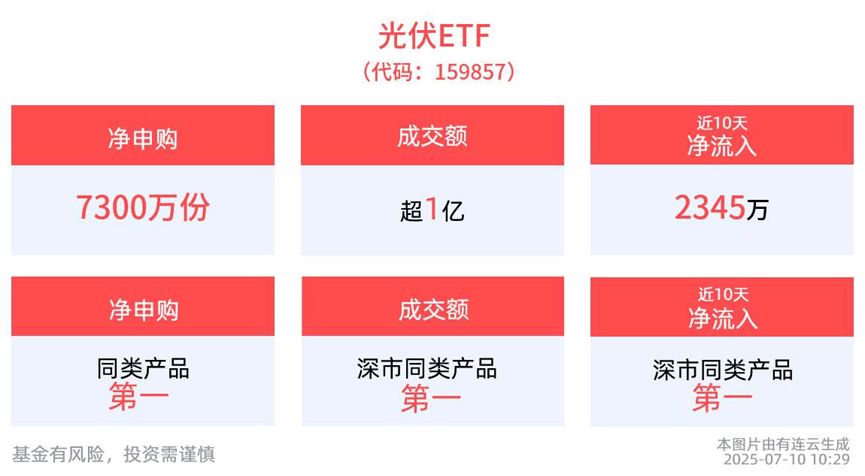
“反内卷”主题回调获加仓!深市最大的光伏ETF(159857)盘中净申购已达7300万份,高居同类第一!机构研判光伏行业出清与整合势在必行
Sou Hu Cai Jing· 2025-07-11 06:26
Group 1 - The core viewpoint of the news highlights the significant growth and investment interest in the photovoltaic ETF (159857), which has seen a net subscription of 73 million shares, leading the category in the Shenzhen market [3] - The photovoltaic ETF (159857) has reached a new high in scale at 2.324 billion yuan, with a notable increase of 79.7 million shares over the past six months [3] - In the last ten trading days, the photovoltaic ETF (159857) has attracted a total of 23.45 million yuan in inflows, indicating strong market interest [3] Group 2 - Guosen Securities predicts that the photovoltaic industry will undergo necessary consolidation and is expected to enter a stable development phase by 2027, with significant advantages in the silicon material segment [4] - The price of polysilicon has risen sharply to 45,000-50,000 yuan per ton, with some companies recovering profitability, suggesting a positive trend in the industry [4] - The photovoltaic industry is currently experiencing a cautious approach from power investment companies due to uncertainties in electricity prices and demand, raising questions about the sustainability of previous high growth rates [4] Group 3 - The overall trend in the photovoltaic industry post-June 1 indicates a market intervention to accelerate capacity clearance, despite weak demand [5] - Recent price increases in the capital and spot markets reflect a market response to policy interventions aimed at achieving profitability above costs [5] - The 136th document's impact on the market suggests a potential decrease in future electricity prices, indicating a need for companies to lower total investment costs [5] Group 4 - There are differing opinions on future trends, with one view suggesting that state intervention can quickly achieve supply-side reforms and capacity clearance, while another emphasizes the necessity of market-driven sales and profits [6] - The photovoltaic ETF closely tracks the CSI Photovoltaic Industry Index, which is currently at a historical low valuation with a price-to-book ratio of 1.9, presenting a compelling investment opportunity [6] - The CSI Photovoltaic Industry Index includes up to 50 representative listed companies from the photovoltaic industry chain, reflecting the overall performance of these securities [6]

工业硅&多晶硅日报(2025年7月11日)-20250711
Guang Da Qi Huo· 2025-07-11 05:04
工业硅日报 工业硅日报 工业硅&多晶硅日报(2025 年 7 月 11 日) 一、研究观点 点评 10 日多晶硅震荡偏强,主力 2508 收于 41345 元/吨,日内涨幅 5.5%,持仓增仓 1414 手至 98601 手;SMM 多晶硅 N 型硅料价格涨至 41500 元/吨,最低交割品 N 型硅料价格涨至 41500 元/吨,现货对主力升水收至 155 元/吨。工业硅震荡 偏弱,主力 2509 收于 8470 元/吨,日内涨幅 3.74%,持仓减仓 17792 手至 38.1 万手。百川工业硅现货参考价 8777 元/吨,较上一交易日持稳。最低交割品 #421 价格涨至 8250 元/吨,现货升水转至贴水 290 元/吨。市场消息多晶硅将 进行成本摸排定价,低于最低成本价或面临处罚;原定复产取消,行业或通过 收储、协会制定标杆成本价以及将光伏从制造品作为能源品定位等路径实现产 能逐步出清。目前多晶硅交易逻辑处于政策调控和多方消息的发酵期内,行业 反内卷减产预期加速。盘面波动率提升,整体存在较强支撑,不宜逆势沽空、 可选择观望或轻仓试多。工业硅仓单下降但社库积累压制反弹空间,仍以高抛 思路对待。重点关注双 ...
有机硅更新:陶氏将关闭英国工厂,有机硅产能有力出清
Tebon Securities· 2025-07-11 03:50
Investment Rating - The industry investment rating is "Outperform the Market" (maintained) [2] Core Viewpoints - The report highlights that the closure of Dow's UK plant, which has a capacity of 145,000 tons, is part of a strategy to optimize European assets and focus on high-value derivatives, signaling a potential marginal improvement in the organic silicon industry [6] - The report anticipates that the exit of overseas capacity will lead to an increase in the prices of organic silicon base materials, alleviating some of the downward price pressure caused by global overcapacity [6] - The report notes that the domestic manufacturers with better cost control are likely to benefit from the demand shift due to the closure of overseas plants [6] - The report emphasizes that the organic silicon industry is entering a phase of supply-side pressure relief, with a significant increase in production capacity expected in 2024, but the lack of large-scale new capacity following this period may lead to improved supply dynamics [6] - The report indicates that the domestic demand for organic silicon is expected to grow steadily, driven by increased penetration in emerging fields such as electronics, new energy vehicles, and photovoltaic cells [6] - The report also highlights that China's exports of polysiloxane are projected to reach approximately 80,000 tons in 2024, reflecting a significant growth opportunity as overseas demand remains strong [6] Summary by Sections Market Performance - The report provides a comparative performance analysis showing a range of market movements from -15% to +29% for the basic chemical sector against the CSI 300 index from July 2024 to July 2025 [3] Related Research - The report references several related studies that discuss trends in deep-sea technology, policy impacts on capacity overcapacity, and the recovery of demand for light initiators, indicating a broader context for the organic silicon market [4] Investment Recommendations - The report suggests focusing on companies such as Hoshine Silicon Industry, Xin'an Chemical, Xingfa Group, Dongyue Silicon Materials, and Sanyou Chemical as potential investment opportunities [5]
硅料产业专家交流
2025-07-11 01:05
光伏行业当前的供需情况呈现出明显的割裂状态。从需求端来看,电力投资企 业在电价和电量不确定的前提下趋于谨慎,导致下游装机增长存在疑问。虽然 难以得出明确结论,但市场需要时间来验证未来能否维持高增长。而从供给端 来看,产能过剩已成为共识。硅料作为光伏产业链中的关键环节,其产量决定 了下游产能的实际规模。如果硅料供应不足,下游产能将无法充分发挥。此外, 组件价格也受到政策干预,通过锁定成本价格来支撑上游环节。这种双重干预 使得市场表现出冰火两重天的状态。 政策对光伏行业有何影响? 政策对光伏行业产生了显著影响。首先,通过计划经济手段干预市场,以加速 产能出清并决定哪些主体能够留存。例如,136 号文具有划时代意义,它使得 未来电力投资企业的电价发生变化,并呈下降趋势。同时,通过政策干预,希 望以组件为代表的新规产业链环节能够实现盈利,从而快速完成供给侧改革。 然而,这种政策之间双手互搏的情况导致市场出现割裂,一方面要求度电成本 更低,另一方面要求系统成本更高。这种矛盾使得市场处于前所未有的不确定 状态。 硅料产业专家交流 20250710 摘要 光伏行业正经历政策与市场双重干预,一方面通过计划经济手段加速产 能出 ...
机构:光伏行业供给侧改革加速推进 三条主线或受益
Zheng Quan Shi Bao Wang· 2025-07-10 06:20
Group 1 - The photovoltaic industry chain is experiencing price increases, with polysilicon manufacturers raising prices to a range of 45,000 to 50,000 yuan per ton, although actual transactions at this level have not yet been observed [1] - There is a strong determination among polysilicon manufacturers to maintain prices, and some downstream companies may accept slight price increases to avoid future risks of further price hikes [1] - The macro-level supply-side clearing guidance is expected to provide a framework for the industry's "anti-involution," but actual implementation may take time [1] Group 2 - Zhongyuan Securities suggests focusing on "capacity clearing" and "new technology iteration" as two main lines for investment [2] - In terms of capacity clearing, attention should be paid to leading companies in the polysilicon and photovoltaic glass sectors, particularly those with significant losses and clear capacity clearing expectations [2] - New technology advancements, particularly in BC cells and perovskite cell commercial applications, are also highlighted as areas of interest [2]
工业硅&多晶硅日报-20250710
Guang Da Qi Huo· 2025-07-10 03:28
Group 1: Report Industry Investment Rating - Not provided in the content Group 2: Core Viewpoints of the Report - On July 9th, polysilicon showed a volatile and upward trend, with the main contract 2508 closing at 39,270 yuan/ton, an intraday increase of 5.03%, and the position increasing by 13,360 lots to 97,187 lots. The SMM polysilicon N-type silicon material price rose to 40,000 yuan/ton, and the price of the lowest deliverable N-type silicon material also rose to 40,000 yuan/ton. The spot premium over the main contract widened to 730 yuan/ton. Industrial silicon showed a volatile and downward trend, with the main contract 2509 closing at 8,140 yuan/ton, an intraday decrease of 0.67%, and the position increasing by 11,907 lots to 399,000 lots. The Baichuan industrial silicon spot reference price remained stable at 8,777 yuan/ton compared to the previous trading day. The price of the lowest deliverable 421 rose to 8,250 yuan/ton, and the spot premium narrowed to 90 yuan/ton [2]. - The polysilicon market is expected to gradually clear its production capacity through measures such as cost investigation and pricing, cancellation of planned restarts, state reserve purchases, the industry association setting a benchmark cost price, and re - positioning photovoltaics as an energy product rather than a manufacturing product. Currently, the trading logic of polysilicon is in a period of policy regulation and the fermentation of various news, and the expectation of anti - involution production cuts in the industry is accelerating. The market volatility has increased, and there is strong overall support. It is not advisable to short against the trend, and one can choose to wait and see or try to go long with a light position. For industrial silicon, although the warehouse receipts have decreased, the accumulation of social inventory suppresses the rebound space, so a high - selling strategy should be adopted. Attention should be paid to the implementation of production cuts for both types of silicon and the opportunity to go long on polysilicon and short on industrial silicon after the PS/SI price ratio rebounds [2]. Group 3: Summary by Relevant Catalogs 1. Research Viewpoints - Polysilicon and industrial silicon showed different trends on July 9th. Polysilicon was volatile and upward, while industrial silicon was volatile and downward. The polysilicon market is in a period of policy - driven production capacity adjustment, and the industrial silicon market is affected by inventory [2]. 2. Daily Data Monitoring - **Industrial Silicon**: The futures settlement price of the main contract decreased by 30 yuan/ton to 8,165 yuan/ton, and the near - month contract increased by 125 yuan/ton to 8,160 yuan/ton. Among the spot prices, the price of some grades such as the non - oxygenated 553 silicon in Sichuan and the oxygenated 553 silicon in Kunming increased by 50 yuan/ton, while the price of the 421 silicon for organic silicon use in Kunming decreased by 100 yuan/ton. The current lowest deliverable price remained unchanged at 8,250 yuan/ton, and the spot premium decreased by 125 yuan to 90 yuan/ton. The industrial silicon warehouse receipts decreased by 285, and the social inventory decreased by 400 tons [4]. - **Polysilicon**: The futures settlement price of the main contract increased by 885 yuan/ton to 39,270 yuan/ton, and the near - month contract decreased by 415 yuan/ton to 37,535 yuan/ton. The N - type polysilicon material price increased by 1,000 yuan/ton to 40,000 yuan/ton. The current lowest deliverable price increased by 1,000 yuan/ton to 40,000 yuan/ton, and the spot premium increased by 115 yuan to 730 yuan/ton. The polysilicon warehouse receipts remained unchanged at 2,780, and the Guangzhou Futures Exchange inventory increased by 0.5 million tons to 8.34 million tons [4]. - **Organic Silicon**: The price of DMC in the East China market remained stable at 10,800 yuan/ton, the prices of raw rubber and 107 glue remained unchanged, and the price of dimethyl silicone oil increased by 2,000 yuan/ton to 14,000 yuan/ton [4]. - **Downstream Products**: The prices of silicon wafers (single - crystal M10/G12) and battery cells (single - crystal M10/G12) remained unchanged [4]. 3. Chart Analysis 3.1 Industrial Silicon and Cost - side Prices - Charts show the prices of different grades of industrial silicon, grade price differences, regional price differences, electricity prices, silica prices, and refined coal prices [5][7][10] 3.2 Downstream Product Prices - Charts display the prices of DMC, organic silicon products, polysilicon, silicon wafers, battery cells, and components [13][17][19] 3.3 Inventory - Charts present the inventory of industrial silicon futures, industrial silicon factory warehouses, industrial silicon weekly industry inventory, DMC weekly inventory, and polysilicon weekly inventory [22][23][25] 3.4 Cost and Profit - Charts show the average cost and profit levels of main production areas, weekly cost and profit of industrial silicon, profit of the aluminum alloy processing industry, cost and profit of DMC, and cost and profit of polysilicon [28][30][32] 4. Non - Technical Content (Team Introduction) - The non - ferrous metals team of Everbright Futures Research Institute includes Zhan Dapeng, Wang Heng, and Zhu Xi, with their respective educational backgrounds, research directions, and professional qualifications introduced [34][35][36]
复盘供给侧改革:“反内卷”如何催生产能出清主升浪
Changjiang Securities· 2025-07-09 15:23
Group 1 - The report emphasizes the need to regulate low-price disorderly competition among enterprises and promote the orderly exit of backward production capacity, aiming to address the issue of "involution" in market competition [2][8] - Historical cases show that supply-side clearance driven by policy typically begins with market expectations, while the main upward trend requires improvements in industry structure to support cash flow and balance sheet recovery [8][10] - The current round of overcapacity is primarily concentrated in mid- and downstream industries, unlike the previous cycle which was focused on upstream resource sectors [9][10] Group 2 - The report suggests focusing on two main strategies: industries that have experienced prolonged supply-side clearance and are likely to see improvements in supply-demand dynamics, and industries that may benefit from policy-driven accelerated clearance [10][11] - For natural clearance, the report recommends monitoring demand-side indicators for upstream industries and supply-side indicators for mid- and downstream sectors, highlighting sectors such as agricultural chemicals, general machinery, pharmaceuticals, and components [10] - For policy-driven clearance, attention should be given to industries mentioned in recent policies aimed at addressing "involution," including photovoltaic, lithium batteries, automobiles, and cement [10][17]