去美元化

Search documents
2026年2月26日申万期货品种策略日报-黄金白银-20260226
Shen Yin Wan Guo Qi Huo· 2026-02-26 01:47
1. Report Industry Investment Rating - No relevant information provided 2. Core Viewpoints - The precious metals market showed a strong performance recently, with silver leading the gains. The core drivers are three - fold: the change in US tariff policy impacts the US dollar's credit; the tense situation in Iran boosts the safe - haven demand for gold; and the stagflation risk strengthens the anti - inflation property of gold. Short - term tariff rulings and geopolitical conflicts drive the precious metals market, and in the medium - to - long - term, factors like de - dollarization and geopolitical risks will support gold's upward trend. Silver is expected to continue its volatile and strong trend in the short term due to the resonance of its industrial and financial attributes [5] 3. Summary by Directory 3.1 Futures Market - **Prices**: The closing prices of Shanghai Gold 2606 and 2604 were 1154.34 and 1151.06 respectively, with increases of 0.52 and 0.56, and increases of 0.05%. The closing prices of Shanghai Silver 2606 and 2604 were 22786 and 23029 respectively, with increases of 756 and 702, and increases of 3.43% and 3.14% [2] - **Positions and Volumes**: The positions of Shanghai Gold 2606 and 2604 were 100812 and 155075 respectively, and the trading volumes were 51239 and 198537 respectively. The positions of Shanghai Silver 2606 and 2604 were 149845 and 182667 respectively, and the trading volumes were 272487 and 413159 respectively [2] - **Spot Premium**: The spot premiums of Shanghai Gold 2606 and 2604 were - 9.27 and - 5.99 respectively. The spot premiums of Shanghai Silver 2606 and 2604 were - 655 and - 898 respectively [2] 3.2 Spot Market - **Prices**: The closing price of Shanghai Gold T + D was 1145.07, with a decrease of 1.81 and a decrease of 0.16%. The closing price of London Gold was 5164.31, with an increase of 32.30 and an increase of 0.63%. The closing price of Shanghai Silver T + D was 22131, with an increase of 645 and an increase of 3.00%. The closing price of London Silver was 89.22, with an increase of 2.13 and an increase of 2.45% [2] - **Price Differences**: The difference between Shanghai Gold 2606 and 2604 was 3.28, and the difference between Shanghai Silver 2606 and 2604 was - 243.00. The gold - to - silver ratio (spot) was 51.74. The ratio of Shanghai Gold to London Gold was 1.00, and the ratio of Shanghai Silver to London Silver was 1.12 [2] 3.3 Inventory - **Domestic**: The inventory of Shanghai Futures Exchange gold was 105,072 kg (no change), and the inventory of Shanghai Futures Exchange silver was 355,830 kg, an increase of 5951 kg [2] - **Overseas**: The inventory of COMEX gold was 33,627,539 troy ounces, a decrease of 73624 troy ounces. The inventory of COMEX silver was 361,844,401 troy ounces, a decrease of 2155763 troy ounces [2] 3.4 Related Derivatives - **ETF Holdings**: The position of SPDR Gold ETF was 1,098 tons, an increase of 3 tons. The position of SLV Silver ETF was 16,080 tons, a decrease of 28 tons [2] - **CFTC Net Positions**: The net position of CFTC speculators in gold was 159,915, a decrease of 97. The net position of CFTC speculators in silver was 24,003, an increase of 1048 [2] 3.5 Macro News - **US - Iran Relations**: US Secretary of State Rubio said that Iran has long posed a serious threat to the US, and Iran is trying to reach a state where it can conduct uranium enrichment. On February 25, the US Treasury's Office of Foreign Assets Control (OFAC) imposed sanctions on multiple individuals, entities, and vessels related to Iran [3][4] - **Venezuela**: The Central Bank of Venezuela sold nearly 6 tons of gold in the second half of last year due to a severe shortage of US dollars caused by US restrictions on its oil exports. After the US Special Forces arrested Venezuelan President Maduro in January, the US allowed some of Venezuela's oil sales revenue to flow back to the country, which revitalized the official foreign exchange market [4] - **US Tariff Policy**: US Trade Representative Greer said that the tariffs of some countries will be raised to 15% [4]
上海市发布楼市“沪七条”:申万期货早间评论-20260226
申银万国期货研究· 2026-02-26 00:41
Group 1 - The core viewpoint of the article highlights the recent adjustments in Shanghai's real estate policies, which include easing restrictions for non-local residents to purchase homes, effective from February 26, 2026 [1] - The Ministry of Commerce responded to the U.S. Trade Representative's comments, emphasizing that China has fulfilled its commitments under the Phase One trade agreement, while the U.S. has tightened export controls and restricted bilateral investments, violating the spirit of the agreement [1] - The futures market saw a majority of domestic contracts decline, with synthetic rubber dropping over 2%, while LPG, fuel oil, and white sugar saw increases of over 1% [1] Group 2 - The shipping index for the European route (EC) fell by 4.76%, with expectations of increased export volumes from Asia to the U.S. due to a temporary tariff gap, alongside optimistic market sentiment regarding post-holiday exports of photovoltaic products [2] - Maersk's new shipping service to Rotterdam in the second week of March has a quoted price of $1,800 per container, a decrease of $100, marking the first price drop after four weeks of stability [2] - The overall shipping volume is expected to decline in March, traditionally a slow month, indicating a likely downward trend in freight rates [2] Group 3 - The sudden export ban on lithium ore from Zimbabwe is expected to drive lithium carbonate prices higher in the short term, as pre-holiday stocking by downstream companies has already initiated a price rally [3] - Despite a temporary price correction during the Spring Festival, the fundamental logic for a market reversal remains intact, with a long-term bullish outlook on lithium carbonate driven by increasing demand from the electric vehicle and energy storage sectors [3] - By 2026, a significant shift in the supply-demand dynamics for lithium carbonate is anticipated, with stable growth in lithium salt demand expected as the penetration rate of new energy vehicles continues to rise [3] Group 4 - The article discusses the cautious outlook on various commodities, including a cautious bearish stance on crude oil and a cautious bullish stance on methanol and rubber, indicating mixed market sentiments across different sectors [5] - The financial market is transitioning from a "broad rise" phase to a "selective alpha" phase, with a focus on industry leaders with strong earnings, as the market prepares for the upcoming disclosure of annual and quarterly reports [10] - The bond market is experiencing a general decline, with the yield on 10-year government bonds rising to 1.805%, reflecting ongoing adjustments in monetary policy and market expectations [11]


【广发宏观陈礼清】本轮人民币升值:驱动和后续趋势的再理解
郭磊宏观茶座· 2026-02-25 23:05
Group 1 - The core viewpoint of the article is that the Chinese Yuan (RMB) has maintained an appreciation trend for five consecutive months, with a rapid appreciation rate in the recent quarter, returning to the "6" era since the beginning of 2026. As of February 25, the offshore RMB exchange rate (USDCNH) reached 6.8588, showing strong performance compared to the US dollar, second only to the Australian dollar [1][7][35] - The RMB's appreciation can be divided into three phases: the "trend-following" phase (November 1 to December 14, 2025), the "self-driven" phase (December 15, 2025, to January 28, 2026), and the "multi-factor resonance" phase (from January 28, 2026, to present). The correlation coefficient between the offshore RMB exchange rate and the US dollar index has varied significantly across these phases [10][12][42] Group 2 - The driving factors behind the RMB's appreciation since 2026 include: (1) a renewed narrative of de-dollarization, leading to a collective rise of non-USD currencies; (2) a significant increase in the proportion of trade surplus converted into actual receipts, reaching approximately 77.6%, the highest in nearly a decade; (3) a rebound in domestic Producer Price Index (PPI) and a strong start in the stock market [2][12][55][61] - Seasonal factors are expected to stabilize the RMB post-Spring Festival, including a shift towards a weaker central parity since late January, a decline in seasonal settlement demand, and a potential return to mean volatility after a period of unilateral appreciation [3][18][67] Group 3 - The RMB's appreciation is supported by nominal growth improvements, with stable credit data and rising inflation indicators. The estimated remaining amount for settlement from 2022 to 2026 is between $725 billion and $1.14 trillion, with a significant portion of holdings in a "floating loss" state, indicating that the current settlement trend may not be short-term [4][24][26] - The RMB exchange rate is expected to maintain a slight appreciation trend throughout 2026, with a projected year-end range of 6.85 to 6.87. This is part of a new appreciation cycle driven by improvements in China's nominal growth and technological breakthroughs [5][28][32]

地缘局势与商品周期共振国际油价中期有望延续强势
Zhong Guo Zheng Quan Bao· 2026-02-25 20:22
Core Viewpoint - International crude oil prices have continued their strong performance since the Spring Festival, with Brent crude futures experiencing the highest increase in 13 years during this period, driven primarily by geopolitical tensions rather than supply-demand fundamentals [1][2]. Geopolitical Influence - The current rise in international oil prices has diverged from the oversupply fundamentals, with geopolitical factors, particularly the U.S.-Iran situation, becoming the main influence [2][3]. - Analysts suggest that the geopolitical risk premium in the oil market is currently around $1, which could rise to $4-$5 if tensions escalate, while a de-escalation could lead to a rapid price drop [2]. Historical Trends Post-Spring Festival - Historical data from 2013 to 2025 indicates that oil prices tend to have a higher potential for increase in the month following the Spring Festival, with an average increase of approximately 10.96% during the years when prices rose [2][3]. - Despite more years of price declines, the magnitude of increases in rising years significantly outweighs the declines, suggesting a favorable risk-reward ratio for price increases post-holiday [2]. Factors Affecting Oil Prices - Key supportive factors for oil prices include geopolitical uncertainties and U.S. sanctions on oil-producing countries, while global economic weakness and ongoing oversupply remain as negative factors [3]. - Historical events have shown that significant geopolitical events have a greater impact on oil prices than conventional supply-demand dynamics [3]. Commodity Cycle and Oil Price Outlook - The current global commodity cycle, characterized by rising prices in precious and industrial metals, is expected to provide upward momentum for oil prices [4][5]. - The analysis indicates that the transmission of price increases from precious metals to industrial metals and then to oil is effective, driven by liquidity improvements and economic recovery [4][5]. - Despite the unique characteristics of the current cycle, two main supportive factors for oil prices are identified: bullish market expectations and geopolitical risk premiums [5]. Short-term and Long-term Predictions - In the short term, geopolitical factors are expected to strongly influence oil prices, with potential fluctuations based on developments in U.S.-Iran relations [5]. - In the long term, historical trends suggest that oil prices may rise to the range of $75 to $80 per barrel by 2026, supported by bullish market sentiment and geopolitical risk premiums [5].
金价大跌真要拉开序幕!金价跌破1110,下周风险将加大
Sou Hu Cai Jing· 2026-02-25 18:10
今天早上,很多人的金价APP弹出了1109.8元/克的数字。 这个价格不仅跌破了关键的1110元心理关口,而且连续 两小时都在这个位置下方徘徊。 朋友圈里,卖金饰的商家截图说"今早加工费没降,但金料价少赚5块",定投黄 金的朋友也在问:"我定投的第9期,还扣不扣? "这不仅仅是数字的变化,背后是黄金ETF连续两周的资金净流 出、美联储官员不再提"3月大概率降息",以及美元指数涨到半年新高108.2。 当避险情绪退潮,美元强势归来, 黄金这场持续了数月的狂欢,似乎真的迎来了一个转折点。 国内基础金价在2月25日报1109.00元/克,较前一日下跌了1.20%。 而在国际市场上,现货黄金价格在2月24日一度 下跌近2.5%,最低触及5094美元/盎司,最终收在5141.43美元/盎司。 同一天,上海期货交易所的沪金主力合约价 格也跌至1080.05元/克。 与原料价格下跌形成鲜明对比的是,品牌金店的零售价依然高企。 周大福、老凤祥等品 牌的足金首饰报价普遍在1545元至1565元每克,深圳水贝批发市场的价格则在1314元至1336元每克。 这意味着消 费者购买一克品牌黄金,需要为品牌溢价和工艺费多支付超过400元 ...

贵金属“涨”声一片 机构建议这样布局
Guo Ji Jin Rong Bao· 2026-02-25 17:08
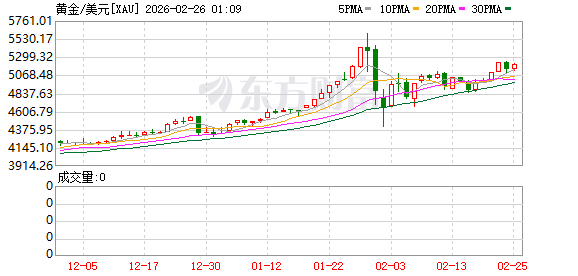
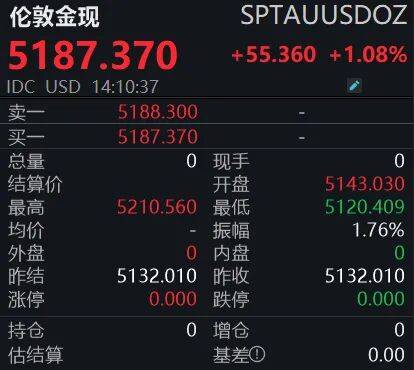
贵金属价格持续上涨。 2月25日,黄金、白银价格同步大幅拉升,其中白银涨势尤为突出,继续领跑贵金属板块。当日,现货 黄金盘中一度冲上5200美元/盎司,创下阶段性高位,市场避险情绪升温与资金推动作用凸显。 截至记者发稿,国际现货市场表现亮眼。伦敦金现日内上涨1.08%,报5187.37美元/盎司,盘中最高触 及5210.56美元/盎司;伦敦银现表现更为强劲,日内大涨4.24%,报90.777美元/盎司,最高触及91.236美 元/盎司,涨幅持续高于黄金,延续了近几个交易日的强势反弹态势。 期货市场同步拉升。截至发稿,COMEX黄金期货日内上涨0.47%,交投于5200美元/盎司附近,盘中最 高触及5230美元/盎司;COMEX白银期货大涨3.31%,报90.405美元/盎司,最高触及91.18美元/盎司。 对于本轮贵金属价格走强的原因,南华期货贵金属新能源研究组负责人夏莹莹向记者分析称,本质是春 节假期外盘大涨后的补涨行情,叠加白银低可交割库存带来的高弹性特征,使得白银涨幅更为突出。据 统计,马年春节假期期间,伦敦银现累计涨超13%,伦敦金现累计涨超3%,为节后国内市场补涨奠定 基础。 在夏莹莹看来,春节假期 ...
贵金属“涨”声一片,机构建议这样布局→
Sou Hu Cai Jing· 2026-02-25 13:20
贵金属价格持续上涨。 2月25日,黄金、白银价格同步大幅拉升,其中白银涨势尤为突出,继续领跑贵金属板块。当日,现货 黄金盘中一度冲上5200美元/盎司,创下阶段性高位,市场避险情绪升温与资金推动作用凸显。 | 伦敦金现 | | | SPTAUUSDOZ | | --- | --- | --- | --- | | 5187.370 | | | +55.360 +1.08% | | IDC USD 14:10:37 | | | 6 | | 实- | 5188.300 | | | | 买一 | 5187.370 | | | | 总量 | 0 | 现手 | 0 | | 结算价 | | 开盘 | 5143.030 | | 最高 | 5210.560 | 最低 | 5120.409 | | 均价 | | 振幅 | 1.76% | | 外盘 | 0 | 内盘 | 0 | | 昨年 | 5132.010 | 昨收 | 5132.010 | | 涨停 | 0.000 | 跌停 | 0.000 | | 持合 | 0 | 增仓 | 0 | | 估结算 | | 基差0 | 0.00 | | 伦敦银现 | | | SPTAGUSDOZ ...
海外札记20260224:K型经济走向再平衡
Orient Securities· 2026-02-25 11:17
Economic Overview - The Q4 2025 US GDP growth rate was +1.4%, significantly below the market expectation of 2.8% and the Q3 growth of 4.4%[4] - Government spending was a major drag, with Q4 government consumption and investment down by 5.1%, contributing a negative 0.9% to GDP growth[4] - Personal consumption expenditure growth was recorded at 2.4%, with service consumption at +3.4% and goods consumption at -0.1%[4] Inflation Insights - The January CPI year-on-year growth rate was 2.4%, lower than expected, while core CPI was at 2.5%[4] - Energy prices were the largest drag on inflation, decreasing by 1.5% month-on-month[4] - Core goods inflation dropped to 1.1% from 1.4% in December, with used car prices falling by 1.8%[4] Policy Implications - The US Supreme Court's rejection of Trump's tariff-related measures could lead to a potential refund of tariffs, estimated at up to $175 billion, which may increase the US deficit rate by 0.5-0.6 percentage points[6] - The average effective tariff rate in the US was 9.8% as of December 2025, with China facing the highest rate at 33.4%[6] Market Trends - Since the beginning of 2026, asset prices have shown a trend of old economy sectors catching up with new economy sectors, with energy up by approximately 22.7% and technology down by 4.6%[8] - Non-US markets have also been catching up, with Japan up by 12%, Korea by 38%, and emerging markets by 12%[8] Risk Factors - There is uncertainty regarding the economic fundamentals, particularly if employment and consumption deteriorate, which could lead to a hard landing for the US economy[9] - The risk of worsening US fiscal deficits could pressure bond supply and interest rates, negatively impacting global risk assets[9]
杨德龙:马年春季攻势行情悄然启动
Xin Lang Cai Jing· 2026-02-25 10:39
Group 1 - The A-share market has started the year positively, with expectations for a spring rally following the Spring Festival [1][8] - The technology sector, particularly the humanoid robot segment, remains a key focus, with significant improvements noted compared to previous years [1][9] - The AI robot industry is transitioning from the initial development phase to a more advanced stage, indicating strong investment potential [1][9] Group 2 - The robot and AI robot sectors have experienced different phases, with 2025 characterized by speculative investments and 2026 expected to focus on order acquisition [2][9] - The upcoming year will see a performance verification phase, where only companies that can deliver results will continue to thrive [2][9] - Short-term market fluctuations should not deter long-term investment perspectives, as the market can behave unexpectedly [2][9] Group 3 - Approximately 50 trillion yuan in fixed deposits are maturing this year, leading to a potential shift of funds into capital markets as deposit rates decline [3][10] - The real estate market is currently in a correction phase, which may further encourage savings to flow into equity markets [3][10] - The trend of household savings moving towards capital markets is gradually strengthening, contributing to a sustained bullish market [3][10] Group 4 - In 2025, technology stocks are expected to outperform, with other sectors like non-ferrous metals and military industries also showing promise [4][11] - Traditional blue-chip stocks may see recovery opportunities in 2026, as market dynamics evolve [4][11] - The recent bullish market signals a positive outlook, but investors should remain cautious of potential short-term adjustments [4][11] Group 5 - The gold market has surged past $5,000 per ounce, reflecting a trend of de-dollarization and a reassessment of the dollar's credibility [5][12] - The expected interest rate cuts by the Federal Reserve may support the performance of non-ferrous metals, although demand remains a concern [5][12] - The actual demand for non-ferrous metals has not significantly increased despite price surges, indicating a need for careful monitoring [5][12] Group 6 - The current capital market in China is in a mid-stage of a slow bull market, with opportunities for value investing in undervalued companies [6][13] - Companies with declining profit growth due to macroeconomic factors may rebound as the economy recovers, while those facing industry decline should be approached with caution [6][13] - The technology sector is expected to experience differentiation, with leading companies likely to perform well while speculative stocks may face declines [6][13]
硬抗3天后,特朗普接受现实:全球关税大战结束,中国预测太准了
Sou Hu Cai Jing· 2026-02-25 10:11
Core Viewpoint - The U.S. Supreme Court's ruling against Trump's tariff policy marks a significant shift in the global trade landscape, emphasizing the importance of constitutional checks and balances in trade decisions [1][5][7]. Group 1: Legal and Political Implications - The Supreme Court ruled that the President cannot impose tariffs under a national emergency without Congressional approval, reinforcing the principle of separation of powers [5][7]. - Trump's initial response to the ruling included public denouncement, but ultimately he had to comply, halting tariffs that amounted to over a hundred billion dollars [5][7]. - The ruling serves as a reminder that even a powerful presidency is subject to legal constraints, highlighting the role of the judiciary in trade policy [7][17]. Group 2: Global Trade Dynamics - The tariff battle initially aimed at competitors inadvertently affected U.S. allies, leading to increased tariffs on European and British goods, which caused significant economic concerns [9][11]. - The changes in U.S. tariff policy resulted in a decrease in exports to the U.S. from Europe by an estimated 8%, while some countries like Brazil benefited from reduced tariffs [11][12]. - The overall global average tariff levels have decreased, positioning Asian economies as new winners in the shifting trade landscape [11][12]. Group 3: U.S.-China Trade Relations - The trade conflict between the U.S. and China has been characterized by retaliatory measures, with China responding to U.S. tariffs with its own restrictions on imports [12][14]. - The eventual "ceasefire" in trade discussions in October 2025 led to a temporary suspension of tariffs, indicating a recognition that unilateral trade policies are unsustainable [15][19]. - The trade war has resulted in a significant drop in U.S. agricultural imports from China, while China's trade surplus with the U.S. remained stable [15][19]. Group 4: Future Trade Order - The evolving trade dynamics suggest a move towards a more diversified global trade system, with countries seeking alternatives to reliance on the U.S. dollar [19][22]. - The emphasis on rules-based trade agreements is becoming increasingly important, as nations navigate the complexities of international trade relationships [21][22]. - The recent tariff disputes illustrate that power dynamics in global trade are shifting away from unilateral actions towards collaborative negotiations and established rules [22].