新兴产业

Search documents
股指进入修复阶段
Hua Tai Qi Huo· 2025-11-25 05:45
1. Report Industry Investment Rating - No relevant content provided 2. Core Viewpoints - Due to the weak employment market, Fed officials' remarks were dovish, and the market's expectation of a December rate cut has increased. The Sino-US presidential dialogue boosted market sentiment, leading to gains in the three major US stock indexes. The domestic market showed a trend of bottoming out and rebounding. As the accumulated market sentiment is gradually released, it is expected to start a volatile upward trend. The specific pace still needs to focus on policy dynamics [3] 3. Summary by Relevant Catalogs Market Analysis - **Macro and Overseas**: The Sino-US presidents had a dialogue, and Fed officials believed the labor market was weak and advocated a December rate cut [1] - **Spot Market**: A-share and US stock indexes closed higher. The defense and military, media, computer, and social service sectors led the gains, while the petroleum and petrochemical, coal, banking, and food and beverage sectors led the losses. The trading volume of the Shanghai and Shenzhen stock markets was 1.7 trillion yuan. The Ministry of Industry and Information Technology launched the creation of national emerging industry development demonstration bases [2] - **Futures Market**: The degree of futures index discount narrowed, and the trading volume and open interest of stock index futures decreased simultaneously [2] Strategy - Overseas, due to the weak employment market, Fed officials' remarks were dovish, increasing the market's expectation of a December rate cut. The Sino-US presidential dialogue boosted market sentiment, and the three major US stock indexes closed higher. The domestic market showed a trend of bottoming out and rebounding, and is expected to start a volatile upward trend. The specific pace still needs to focus on policy dynamics [3] Macro Economic Charts - The charts include the relationship between the US dollar index and A-share trends, the US Treasury yield and A-share trends, the RMB exchange rate and A-share trends, and the US Treasury yield and A-share style trends [7][8] Spot Market Tracking Charts - **Domestic Main Stock Index Daily Performance**: On November 24, 2025, the Shanghai Composite Index rose 0.05%, the Shenzhen Component Index rose 0.37%, the ChiNext Index rose 0.31%, the CSI 300 Index fell 0.12%, the SSE 50 Index fell 0.18%, the CSI 500 Index rose 0.76%, and the CSI 1000 Index rose 1.26% [13] - **Other Charts**: Include the trading volume of the Shanghai and Shenzhen stock markets and the margin balance [14] Futures Market Tracking Charts - **Futures Index Position and Volume**: The trading volume and open interest of stock index futures decreased simultaneously. For example, the trading volume of the IF contract decreased by 52,863, and the open interest decreased by 7,338 [16] - **Futures Index Basis**: The basis of stock index futures showed certain changes. For example, the basis of the IF contract's current-month contract was -12.85, with a change of -40.44 [41] - **Futures Index Inter - Period Spread**: The inter - period spread of stock index futures also changed. For example, the spread between the next - month and current - month contracts of the IF contract was -15.80, with a change of +37.00 [48]
央行持续呵护流动性利好成长!创业板ETF天弘(159977)“量价齐升”!连续5日“吸金”1.21亿元
Sou Hu Cai Jing· 2025-11-25 03:33
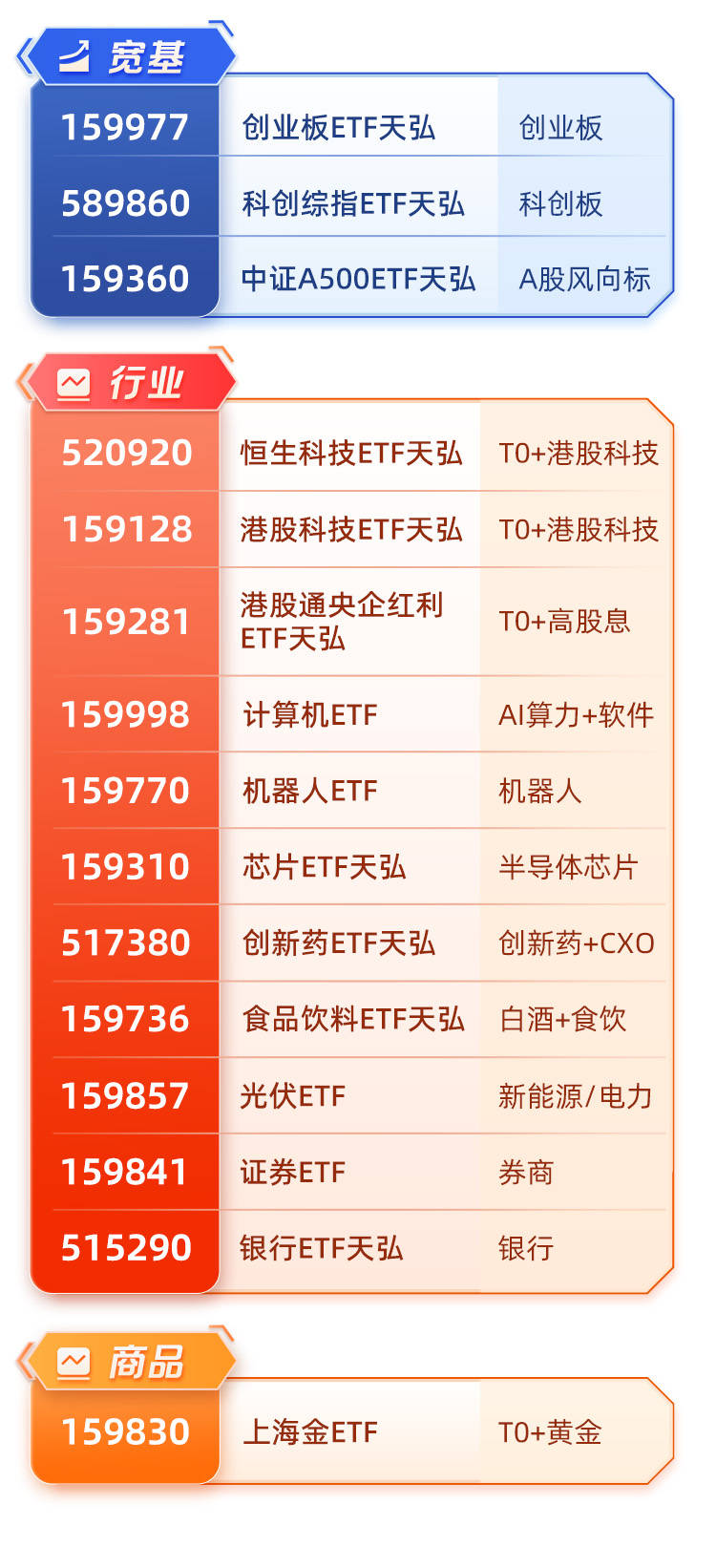
Group 1 - The core viewpoint highlights a significant recovery in the Tianhong ChiNext ETF (159977), with a trading volume of 1.24 billion yuan and a strong increase of 3.06% in the ChiNext Index (399006) as of November 25, 2025 [1] - The Tianhong ChiNext ETF has seen a substantial increase in shares, growing by 66 million shares over the past week, indicating strong investor interest [1] - The ETF has experienced continuous net inflows over the past five days, totaling 121 million yuan, reflecting a positive sentiment towards the ChiNext market [1] Group 2 - The People's Bank of China (PBOC) has conducted a 1 trillion yuan MLF operation to maintain ample market liquidity, marking the ninth consecutive month of increased medium-term lending facility (MLF) operations [2] - The MLF net injection for November is projected to reach 100 billion yuan, with a total of 600 billion yuan in medium-term liquidity released over the past four months, indicating a continued accommodative monetary policy stance [2] - Analysts suggest that the PBOC's actions are aimed at supporting credit growth and stabilizing economic expectations during a critical period for economic development [2] Group 3 - Galaxy Securities notes that the A-share market is currently characterized by a "high-cut low" feature, with cautious market sentiment and rapid sector rotation [3] - The upcoming Central Economic Work Conference is expected to provide important policy guidance, which could influence market trends [3] - Despite recent market concerns, the upward trend in corporate profits and industry development remains intact, supported by structural highlights in emerging industries and narrowing PPI declines [3]


百亿私募狂冲87%仓位,创185周新高
Guo Ji Jin Rong Bao· 2025-11-25 03:25
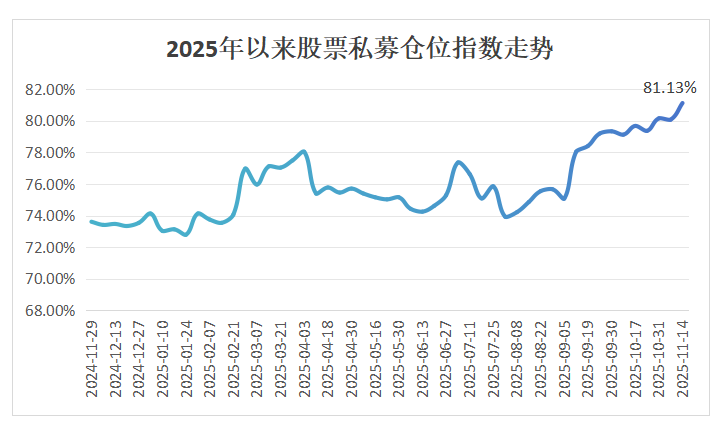
Core Insights - The stock private equity position index has reached a new high of 81.13% as of November 14, 2025, marking a significant increase of 1.05% from the previous week and achieving a peak not seen in 112 weeks [1] - The surge in the index is primarily driven by a concentration of medium-position private equity funds increasing their holdings, with full-position private equity now accounting for 65.9% [1] Group 1: Private Equity Position Statistics - As of November 14, 2025, the position index for different scales of stock private equity shows significant variation, with the following percentages: over 100 billion at 87.07%, 50-100 billion at 83.56%, 20-50 billion at 78.67%, 10-20 billion at 80.48%, 5-10 billion at 80.86%, and 0-5 billion at 80.09% [2][3] - The proportion of full-position private equity funds over 100 billion has increased to 73.41%, while the medium-position funds have decreased to 18.47% [2] Group 2: Market Dynamics and Trends - The continuous rise in private equity positions is attributed to the sustained upward trend in the A-share market since August, which has improved performance and provided confidence for institutional investors to increase their holdings [6] - Policy support for the long-term healthy development of the capital market and the ongoing trend of asset allocation towards equity markets have reinforced the consensus on the long-term value of A-shares [6] - Large private equity firms are leveraging their research capabilities in emerging industries like technology and innovative pharmaceuticals to capture structural opportunities, which has led to an overall increase in industry positions [6]
【11月25日 财经信息差 】行业机会与风险预警全解析
Sou Hu Cai Jing· 2025-11-25 02:19
Group 1 - The Ministry of Industry and Information Technology of China has initiated the creation of national emerging industry development demonstration bases, covering nine major fields including new generation information technology and new energy, with a target of establishing 100 park-type and 1,000 enterprise-type bases by 2035, which will receive policy and resource support [2] - The Federal Reserve officials have signaled a potential interest rate cut in December, with an 82.9% probability of a 25 basis point cut according to CME FedWatch, leading to a 2.69% increase in the Nasdaq and a broad rise in technology stocks [2] - Former President Trump signed an executive order for the AI "Genesis Plan," opening federal scientific data sets, while Amazon plans to invest $50 billion to expand AI and supercomputing infrastructure for the U.S. government, benefiting AI-related companies [2] Group 2 - The European Union has approved a budget of €192.8 billion for 2026, focusing on defense and high-end manufacturing, with €716 million reserved for emergency funds, which will create procurement opportunities for related industries [3] - The Bank of Israel has lowered the benchmark interest rate from 4.5% to 4.25%, allowing businesses in the Middle East to optimize their capital allocation [3] Group 3 - The Nasdaq Golden Dragon China Index rose by 2.82%, with Hesai Technology increasing by over 12%, indicating strong capital interest in Chinese tech companies like Baidu and Alibaba, which will benefit their supply chain partners [4] - Spot gold has surpassed $4,140 per ounce, and WTI crude oil has risen above $59 per barrel, providing profit opportunities for energy and precious metals companies [4] Group 4 - The European Central Bank has warned about the risks of stablecoins diverting retail deposits in the Eurozone, urging companies involved in crypto assets to manage compliance costs [5] - The U.S. pressured the EU to amend digital regulations in exchange for lowering steel and aluminum tariffs, which was rejected, creating tariff volatility risks for related import-export businesses [6] - Bitcoin has surpassed $89,000, and Thailand's Bitkub plans to raise $200 million through a Hong Kong IPO in 2026, highlighting opportunities in the Hong Kong digital asset hub [6]

黑龙江“十五五”规划建议发布:做强星网产业链 发展卫星制造、测控和数据地面应用
Zheng Quan Shi Bao Wang· 2025-11-25 02:15
Core Insights - The proposal from the Heilongjiang Provincial Committee emphasizes the cultivation and expansion of emerging and future industries [1] Industry Development - Implementation of industrial innovation projects to promote the construction of innovation facilities, technology research and development, and product iteration [1] - Establishment of a national heavy equipment manufacturing base, focusing on high-end equipment, aerospace, and new materials to develop trillion-level industrial clusters [1] - Development of a northern manufacturing base for the electronic information industry and a pilot zone for large high-power intelligent agricultural machinery [1] Economic Expansion - Acceleration of the low-altitude economy, enhancing the manufacturing industry of low-altitude aircraft and expanding applications in agricultural protection, emergency rescue, and logistics [1] - Strengthening the satellite industry chain, including satellite manufacturing, control, and data ground applications [1] - Promotion of deep processing of graphite and innovation in the supply of development policies for strategic emerging industries [1] - Encouragement of large-scale application demonstrations for new technologies, products, and scenarios to accelerate the development of emerging industries [1]
汽车早餐 | 深蓝汽车称有计划接手北京现代重庆工厂;我国牵头制定的联合国全球技术法规《电动重型车辆车载电池耐久性》获表决通过
Zhong Guo Qi Che Bao Wang· 2025-11-25 01:24
Domestic News - The Ministry of Industry and Information Technology announced the creation of national emerging industry development demonstration bases, focusing on key areas such as intelligent connected new energy vehicles, new materials, and high-end equipment, aiming to establish around 100 park-type and 1,000 enterprise-type bases by 2035 [2] - Hebei Province plans to implement an industrial innovation project to accelerate the cultivation of industries like intelligent connected vehicles, biomedicine, and new energy, aiming for integrated cluster development and boosting consumption [4] International News - The UK government announced an additional £1.3 billion (approximately 121.09 billion RMB) in electric vehicle subsidies and £200 million (approximately 18.62 billion RMB) for charging infrastructure, further promoting the transition to zero-emission vehicles [5] Company News - VinFast reported a significant increase in Q3 electric vehicle deliveries, but its net loss expanded to approximately 240 trillion VND (about 68.4 billion RMB), a year-on-year increase of 81%, despite a 47% rise in total revenue [6] - Tesla launched its Full Self-Driving (FSD) software in South Korea, marking the software's availability in seven countries/regions [7] - BYD and Midea reached a strategic cooperation agreement to create a "people-vehicle-home" smart living paradigm, allowing users to control home appliances from their vehicles [9] - Deep Blue Automotive plans to take over Beijing Hyundai's Chongqing factory, although specific production timelines and models remain undisclosed [10] - Xiaomi Group's founder Lei Jun invested over HK$100 million to increase his stake in the company, raising his ownership to 23.26% [11] - The Ministry of Industry and Information Technology announced the establishment of a standardization technical committee for humanoid robots, with members including executives from Chery and XPeng [12] - IM Intelligent Vehicle launched its IM6 model in New Zealand, with a starting price of NZ$66,900 (approximately 267,000 RMB) [13] - Pony.ai and Sunshine Mobility announced a strategic partnership to develop a large-scale autonomous driving fleet, enhancing the quality of autonomous mobility services in major cities [14] - JD Group commenced construction of a new R&D center in Nanjing, with an investment of 3.5 billion RMB, focusing on AI, robotics, and autonomous driving technologies [15]

国家新兴产业发展示范基地创建工作启动
Zhong Guo Xin Wen Wang· 2025-11-24 13:30
Core Points - The creation of the National Emerging Industry Development Demonstration Base has officially started, focusing on key emerging industries and aiming to enhance their development and influence [1][2] - The initiative targets the forefront of the new round of technological revolution and industrial transformation, concentrating on sectors such as new generation information technology, new energy, new materials, biotechnology, high-end equipment, intelligent connected new energy vehicles, green environmental protection, low-altitude equipment, and aerospace [1][2] Summary by Categories Demonstration Bases - The plan aims to establish around 100 demonstration bases for industrial parks and approximately 1,000 for enterprises by 2035, creating a backbone force and important engines for emerging industry development [2] - Demonstration parks are defined as legally established industrial parks in China that lead in areas such as industrial cluster development, collaborative innovation, ecological optimization, and governance enhancement [1] Enterprises - Demonstration enterprises are registered entities in China with independent legal status, focusing on emerging industry sectors and excelling in product development, technological innovation, business model innovation, and management efficiency [1] Implementation and Support - The creation period for the demonstration bases is set for two years, followed by an evaluation and acceptance process [2] - Support measures include establishing a dedicated section for demonstration bases on the national industrial-financial cooperation platform and encouraging financial institutions to enhance and develop specialized financial products to support the construction of these bases [2]
安永与浙江大学联合发布《专精特新上市公司创新与发展报告(2025年)》
Sou Hu Cai Jing· 2025-11-24 03:59
Core Insights - The report titled "Innovation and Development Report of Specialized, Refined, Characteristic, and New Listed Companies (2025)" was jointly released by Ernst & Young Research Institute and Zhejiang University School of Management, continuing the methodology and metrics from previous years [2] - As of June 30, 2025, the Ministry of Industry and Information Technology has announced six batches of "specialized, refined, characteristic, and new" small giant enterprises, with the report analyzing 2,328 listed companies that published annual reports in 2024 [2] Financial Performance - Specialized and new listed companies showed an increase in revenue growth rate in 2024 compared to 2023, but profitability remains under pressure [4] - The market capitalization of specialized and new listed companies continued to rise significantly, driven by external macroeconomic changes, policy guidance, liquidity easing, and positive expectations for a new round of technological revolution [4][10] - As of August 31, 2025, the average market capitalization of specialized and new companies increased by 88.02%, while non-specialized companies saw a 46.53% increase, reflecting a recovery in market confidence [5][6] Industry Focus - Specialized and new listed companies are actively investing in strategic emerging industries such as intelligent manufacturing equipment, energy-efficient industries, and next-generation information networks [4] - The industries with high strategic focus on the four dimensions of "specialized, refined, characteristic, and new" include general equipment manufacturing, computer, communication and other electronic equipment manufacturing, specialized equipment manufacturing, and chemical raw materials and products manufacturing [4][25] Internationalization and Digitalization - The proportion of specialized and new companies going overseas has increased, with the top five regions for overseas company distribution being Hong Kong, the United States, Singapore, Germany, and Japan [8] - Specialized and new listed companies are focusing on digital transformation through technologies such as artificial intelligence, the Internet of Things, and big data, with a significant number of patents in industrial internet and high-end chip technology [8][42] Regional and Sectoral Distribution - The provinces with the highest number of specialized and new listed companies are Jiangsu, Zhejiang, and Guangdong, with Beijing and Shanghai showing strong competitiveness across all four dimensions [35][38] - The report indicates that specialized and new companies are increasingly focusing on domestic substitution strategies, with a clear correlation between attention to domestic substitution and the focus on industrial fundamentals [39][41] ESG and Sustainability - The number of specialized and new listed companies achieving higher ESG ratings has significantly increased, indicating improvements in ESG management capabilities [51] - As of September 19, 2025, 303 companies published their 2024 ESG reports, reflecting a growth of 53.81% in disclosure rates [54]

中国银河证券:预计A股短期行情仍以震荡结构为主
Xin Lang Cai Jing· 2025-11-24 00:32
中国银河证券表示,在市场情绪较为谨慎、板块轮动速度加快、热点行情持续性不足的环境下,A股市 场呈现出明显的"高切低"特征。预计短期行情仍以震荡结构为主。同时,近期行情主要受到前期涨幅较 大和市场担忧情绪加重的拖累,企业盈利和产业发展向上趋势并未出现根本性逆转。周五欧美股市多数 收涨也释放边际回暖信号。建议关注近期调整后的布局机会。随着经济转型背景下新兴产业结构性亮点 更加突出,PPI降幅收窄带动企业利润率水平进一步回升,同时市场流动性向上逻辑有望持续演绎,A 股向好趋势不改。 ...

公募基金投资逻辑深度重构:“主题投资”风行一时 “全市场选股”暂避锋芒
Zheng Quan Shi Bao Wang· 2025-11-23 23:42
Core Viewpoint - The investment style of public funds has shifted from core assets to high-growth stocks amid economic transformation, moving from "full market stock selection" to "thematic investment" strategies [1][3]. Group 1: Shift in Investment Strategies - Public funds previously favored large-cap stocks like Sany Heavy Industry and Kweichow Moutai, achieving significant returns through a diversified stock selection approach [2]. - The "full market stock selection" strategy has become less prominent, with thematic products dominating annual performance rankings [2][3]. - Changes in the investment environment, including economic deceleration and shifts in consumer behavior, have led to decreased profitability and valuation of traditional core assets [3]. Group 2: Rise of Thematic Investment - Thematic funds have gained popularity due to structural opportunities concentrated in high-growth sectors, outperforming traditional industries [5]. - The volatility of thematic products can lead to substantial excess returns, encouraging funds to increase style purity and concentration [5]. - Thematic investments help investors engage with long-term trends and direct capital towards government-supported sectors, fostering a positive cycle of capital market support for national strategies [6]. Group 3: Challenges of Thematic Investment - Thematic investment requires deeper industry understanding and foresight, raising the bar for fund managers [7]. - The need for rigorous valuation and risk management frameworks is heightened, as concentrated portfolios are more susceptible to individual stock performance and policy changes [8]. - The complexity of managing risks in concentrated portfolios necessitates meticulous control over concentration, liquidity, and stress testing [8]. Group 4: Future of Full Market Stock Selection - The "full market stock selection" strategy is unlikely to disappear, as it offers unique advantages in capturing structural opportunities across various sectors [10]. - Market aesthetics will continue to evolve with macroeconomic and structural changes, but the fundamental capabilities of full market stock selection will remain relevant [10]. - Thematic investments, while potentially lucrative, carry risks of significant losses if market trends shift unfavorably [11].