
碳市场

Search documents
力鸿检验(01586)获北京绿色交易所2024年度最佳交易奖
智通财经网· 2025-07-08 10:05
Core Viewpoint - China Lihong Inspection Holdings Limited has been awarded the Best Trading Award for 2024 by the Beijing Green Exchange, highlighting its significant role in the carbon market and commitment to sustainable development [1][2] Group 1: Company Achievements - Lihong Inspection is recognized for its contributions to the national voluntary emission reduction (CCER) trading market and the Beijing local carbon market [1] - The company has expanded its carbon asset trading scale with leading clients, assisting them in achieving annual compliance at lower costs [1] Group 2: Industry Context - The carbon market is an essential policy tool for addressing climate change and promoting a comprehensive green and low-carbon transformation of the economy and society [1] - The Beijing Green Exchange has become one of the most influential environmental rights trading platforms in China, authorized by the Ministry of Ecology and Environment [1] - The Chinese government aims to upgrade the Beijing Green Exchange into a national-level green trading platform, enhancing its role in global green finance and sustainable finance [1]
专访马骏:银行要把握好NDC对转型金融的催化机遇丨首席气候官
2 1 Shi Ji Jing Ji Bao Dao· 2025-07-08 02:59
Core Insights - The article discusses the growing trend of green investment and the challenges faced by traditional high-carbon industries in securing financing for low-carbon transition projects. It highlights the emergence of transition finance as a focal point in global green finance efforts [2][3]. Group 1: Transition Finance - Transition finance is expected to experience explosive growth once policies, standards, and capabilities are in place, as the share of transition industries in the economy is significantly larger than that of pure green industries [3]. - The People's Bank of China has developed transition finance directories for four industries, and various local governments have begun to implement regional transition finance standards [3]. - Financial institutions must enhance their internal capabilities and processes to identify eligible clients and projects for transition finance, as many banks currently lack systematic processes for this [5][6]. Group 2: NDC and Market Opportunities - The upcoming announcement of China's Nationally Determined Contributions (NDC) targets is expected to create urgency for companies to establish short- and medium-term carbon reduction goals, making transition finance a necessity rather than an option [7]. - If financial institutions are unprepared to offer transition finance services when the NDC is announced, they risk missing valuable market opportunities [7]. Group 3: ESG Disclosure Gaps - Many entities, including banks, have not fully met the International Sustainability Standards Board (ISSB) requirements for ESG reporting, particularly in carbon-related disclosures [9][10]. - There is a notable lack of comprehensive transition plans among domestic enterprises and financial institutions, which should include specific short-, medium-, and long-term carbon reduction targets [10]. Group 4: Global Cooperation and Standards - The article emphasizes the need for global cooperation to establish unified ESG disclosure standards to reduce market fragmentation and transaction costs [12][16]. - The joint classification directory developed by China and Europe is highlighted as a significant step towards improving the compatibility of green finance standards and facilitating cross-border financing [15]. Group 5: Carbon Market Internationalization - The article discusses the complexities of internationalizing China's carbon markets, distinguishing between mandatory and voluntary carbon markets, with the latter being more feasible for international connectivity [19][20]. - The potential for cross-border carbon credit trading under the Paris Agreement's Article 6 is noted, with suggestions for pilot programs involving regions like Hong Kong and Macao [21].


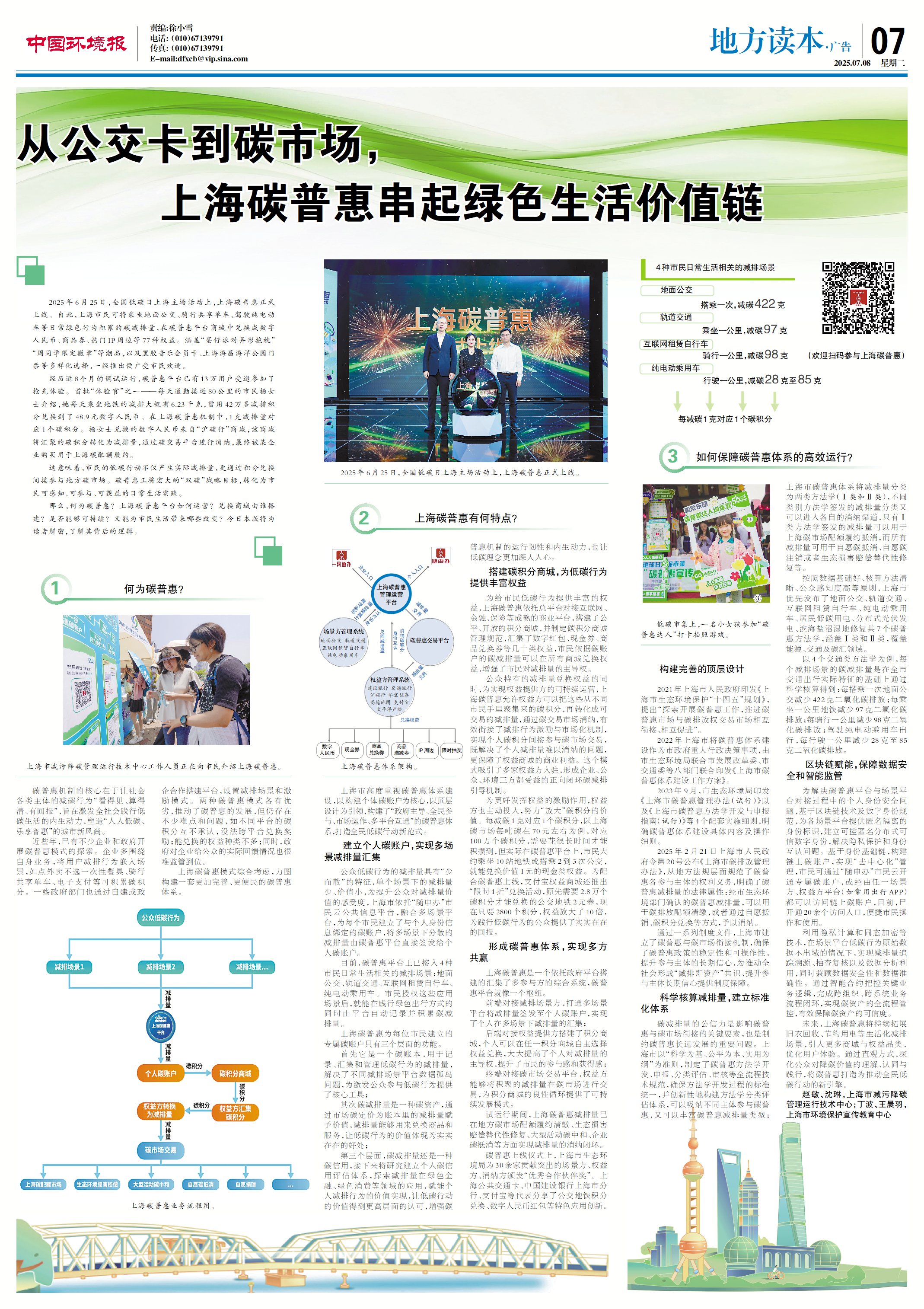
从公交卡到碳市场,上海碳普惠串起绿色生活价值链
Zhong Guo Huan Jing Bao· 2025-07-08 02:01
Core Points - The Shanghai Carbon Benefit platform officially launched on June 25, 2025, allowing citizens to convert carbon reduction from daily green behaviors into digital currency and various rewards [1][14][16] - The platform has gained popularity, with 130,000 users participating in the initial experience phase, demonstrating the public's engagement with low-carbon actions [16][18] - The carbon reduction mechanism aims to make carbon reduction actions visible, measurable, and rewarding, fostering a culture of low-carbon living among citizens [18][23] Group 1: Carbon Benefit Mechanism - The core of the carbon benefit mechanism is to enable various societal entities to see, quantify, and receive rewards for their carbon reduction efforts, thus motivating low-carbon lifestyles [18][19] - The platform integrates multiple daily life scenarios for carbon reduction, including public transport, shared bicycles, and electric vehicles, allowing users to accumulate carbon credits [24][37] - Each gram of carbon reduction corresponds to one carbon credit, which can be exchanged for rewards, enhancing the perceived value of low-carbon actions [16][27] Group 2: Platform Features and Structure - The Shanghai Carbon Benefit system is designed with a focus on individual carbon accounts, supported by a top-down approach that encourages government leadership, public participation, and market operations [23][24] - The platform has established a comprehensive and user-friendly carbon benefit system, addressing challenges such as data silos and limited reward options [19][25] - The carbon credit marketplace allows users to exchange their accumulated credits for a variety of rewards, thus linking individual actions to broader carbon market transactions [26][30] Group 3: Regulatory and Technical Framework - The Shanghai government has implemented a series of regulations and guidelines to ensure the effective operation of the carbon benefit system, including the establishment of legal attributes for carbon credits [32][33] - A standardized methodology for calculating carbon reduction has been developed, ensuring the credibility of carbon credits and facilitating their integration into the carbon market [33][34] - Blockchain technology is utilized to secure data and manage identities, enhancing the reliability and transparency of the carbon benefit platform [35]
中国宏桥(01378):动态跟踪报告:高分红一体化龙头业绩同比高增,西芒杜铁矿项目有望提供利润新增点
EBSCN· 2025-07-07 15:30
Investment Rating - The report maintains a "Buy" rating for the company, indicating a projected investment return exceeding the market benchmark by more than 15% over the next 6-12 months [5]. Core Insights - The company is expected to report a net profit increase of approximately 35% year-on-year for the first half of 2025, reaching around 12.36 billion yuan [1]. - The growth in performance is attributed to rising prices of aluminum alloy and alumina products, alongside an increase in sales volume [1]. - The average price of aluminum (A00) for H1 2025 is projected at 20,317 yuan/ton, a 2.6% increase year-on-year, while the average price of domestic alumina is expected to decline by 3.4% to 3,389.9 yuan/ton [1]. - The company has established a stable supply of bauxite resources through joint ventures in Guinea, with the West Mangu iron ore project expected to provide new profit growth starting in 2026 [2]. - The company has a comprehensive integrated layout in the aluminum industry, with a total alumina production capacity of 19.5 million tons and an electrolytic aluminum capacity of approximately 6.46 million tons [2]. - The company has announced a dividend of 1.02 HKD per share for 2025, with a cumulative dividend of 1.61 HKD per share for 2024, resulting in a dividend yield of 11% based on the stock price as of May 21, 2025 [2]. Financial Projections - The projected net profits for 2025-2027 are 23.37 billion yuan, 25.20 billion yuan, and 27.77 billion yuan respectively, with corresponding P/E ratios of 6.7, 6.2, and 5.6 [3][4]. - Revenue is expected to grow from 133.62 billion yuan in 2023 to 165.06 billion yuan in 2025, with a revenue growth rate of 5.69% in 2025 [4]. - The company's return on equity (ROE) is projected to be 18.9% in 2025, slightly decreasing in subsequent years [4].
全国碳市场7月碳价预计全面上涨 启用单向竞价交易
Zheng Quan Shi Bao· 2025-07-01 11:48
Group 1 - The carbon price index released by Fudan University indicates a comprehensive increase in national carbon market prices in July, with expected buying price for carbon emission allowances at 70.67 yuan/ton and selling price at 76.67 yuan/ton, resulting in a midpoint price of 73.67 yuan/ton [1] - The buying price index increased by 3.37% to 176.66, while the selling price index rose by 2.52% to 172.98, and the midpoint price index saw a 2.93% increase to 174.73 [1] - The average closing price for carbon allowances in June was 71.04 yuan/ton, up approximately 1.6% from May's average of 69.90 yuan/ton, with a significant increase of over 12% from the beginning to the end of June [1] Group 2 - The Shanghai Environment and Energy Exchange announced the implementation of a one-way bidding trading method for the national carbon emission trading system, which can adopt either uniform price or bid price transaction models [2] - The minimum bid quantity for sellers in the one-way bidding process is set at no less than 100,000 tons of carbon dioxide equivalent, with sellers allowed to set a base price based on the previous trading day's closing price or a 10% discount [2] - Buyers are restricted to a maximum bid price that does not exceed 10% above the previous trading day's closing price for the designated annual carbon emission allowances [2]
张希良:中国碳市场成效显著,有望引领国际自愿碳市场建设
Nan Fang Du Shi Bao· 2025-07-01 05:06
正值全国碳市场运行四周年之际,6月25日,2025全国低碳日"国际自愿碳市场对话"在杭州召开,主题 为"巴黎协定背景下我国参与国际自愿碳市场的机遇与挑战"。 随着《巴黎协定》第六条实施细则的出台,国际碳市场合作框架逐步明晰。该条款首次明确允许国家间 通过碳信用交易机制(ITMOs)合作实现减排目标,为全球自愿碳市场注入新规则。 中国环境科学学会碳排放交易专业委员会主任、清华大学能源环境经济研究所所长张希良会后接受记者 采访时表示,四年以来,我国的碳市场建设取得了显著的成就,且中国在落实《巴黎协定》第六条中可 发挥重要作用,具备多方面优势。"我深刻感受到中国在国际碳市场上应更具自信,未来有望在全球自 愿碳市场中发挥引领作用。" 全国碳市场运行四年显成效 控排占比超60%,成本低促双碳落地 南都:正值全国碳市场运行四周年之际,如何评价我国碳排放权交易市场及温室气体自愿减排交易市场 的建设情况? 张希良:我国的强制性碳市场取得了显著的成就,其关键作用在于切实推动"双碳"目标的落地实施。目 前,该市场所管控的碳排放量占全国排放总量的60%以上,且作为一种低成本减排机制,实现了以较低 成本达成减排目标,这是极具建设性的 ...
圆桌|新碳信用标准通过后,全球碳市场的“梦想”会实现吗?
Sou Hu Cai Jing· 2025-06-29 23:51
Group 1 - The introduction of international emissions trading at COP3 in 1997 aimed to help countries meet their emission reduction commitments through the purchase of carbon credits [1] - The carbon market is divided into mandatory and voluntary types, with Europe leading the establishment of emissions trading systems, followed by countries like China, South Korea, Japan, and Australia [1][3] - The lack of a unified international standard has hindered the establishment of a robust market, with the Paris Agreement's Article 6 still facing challenges in implementation due to verification method issues [1][8] Group 2 - The UN approved the "Paris Agreement Carbon Credit Mechanism" (PACM) in May 2025, providing guidance for evaluating the effectiveness of emission reduction projects [1] - The new standards include a baseline standard to estimate potential emissions without the mechanism and a leakage standard to account for unintended emissions increases [1][15] - The establishment of the "Development Carbon Market Alliance" by Singapore, Kenya, and the UK signifies a government-led initiative to advance carbon markets [2] Group 3 - Carbon markets help achieve emission reduction goals at lower costs, enhancing economic efficiency and promoting energy conservation awareness [3] - Major carbon markets include the EU carbon market and China's national carbon market, with the EU market being a mature example using an absolute cap-and-trade model [3][4] - China's carbon market, launched in July 2021, covers approximately 5.1 billion tons of CO2 emissions and includes 2,257 key emitting units [4] Group 4 - The Kyoto Protocol established the Clean Development Mechanism (CDM) in 2005, allowing developed countries to obtain certified emission reductions (CERs) through projects in developing countries [5] - The carbon market's core function is to create a carbon price signal that guides emission reduction actions, with the expectation that carbon prices will rise as emission caps tighten [5][6] Group 5 - The EU carbon market has seen a significant price increase, with expectations that prices will exceed €120 per ton by 2030 and €400 by 2040, reflecting the costs of advanced reduction measures [6] - The demand for carbon markets from countries is driven by the need to achieve climate goals cost-effectively, with different mechanisms in place across regions [6][7] Group 6 - The establishment of national carbon markets is crucial for countries to meet their Nationally Determined Contributions (NDCs) under the Paris Agreement [7][9] - The EU's carbon market has undergone structural reforms to recover carbon prices after a prolonged period of low prices due to oversupply [7][9] Group 7 - The challenges in creating a global carbon market include historical issues with previous mechanisms and differing national interests between developed and developing countries [9][11] - The complexity of mechanism design and the need for clarity in methodologies and standards are significant barriers to establishing a unified global carbon market [9][10] Group 8 - The implementation of new standards aims to enhance the quality of carbon credits and ensure the authenticity of emission reductions, promoting high-quality development in global carbon markets [15][16] - Future directions include improving verification processes, enhancing international cooperation, and integrating carbon markets with global climate actions [15][17] Group 9 - China's transition from a seller to a buyer in the international carbon market poses challenges in aligning domestic mechanisms with international standards [19][20] - The national carbon market's tightening control over emissions will support China's dual carbon goals while balancing domestic and international climate trade requirements [20][21]
会议纪要 | 不确定性中的确定性机会—CFC年中策略会新能源&金属篇
对冲研投· 2025-06-27 12:46
Group 1 - The carbon market is experiencing a short-term price decline due to macroeconomic factors, but market activity and transaction volume are increasing, indicating robust development. Long-term expectations suggest tightening carbon emission quotas from 2026, pushing companies towards green energy and energy-saving technologies [2] - The electricity market reform is driven by the surge in renewable energy installations, leading to increased pressure on grid peak regulation. The reform aims for full market-based pricing for renewable energy, which may create revenue uncertainties and has led to a drop in demand since June [3] - Domestic polysilicon production remains stable at 90,000 to 100,000 tons per month, with annual capacity exceeding 3 million tons. However, high inventory levels and unstable profit expectations from photovoltaic power generation have resulted in weakened demand [4] Group 2 - Industrial silicon prices have unexpectedly dropped below 7,000 yuan per ton, below the optimal cost line for leading companies. Despite losses, production remains stable due to employment and loan pressures, with monthly production at 300,000 tons [5] - The lithium carbonate market is facing increasing oversupply, with projected supply of 1.6 million tons and demand of 1.3 million tons by 2025, leading to a surplus of 200,000 tons. Prices may continue to be under pressure in the short term [6] - The aluminum alloy futures market has low participation and limited delivery sources, with a focus on cost factors such as scrap aluminum prices and industrial silicon [10][12]

北京碳市场联动绿电交易,重点碳排放单位成为绿电消纳主力
Xin Jing Bao· 2025-06-25 03:09
Group 1 - The core event of the "National Low Carbon Day" was held in Beijing, focusing on the linkage between the carbon market and green electricity trading, with key carbon emission units becoming the main consumers of green electricity [1] - Beijing's carbon market has been operational for 11 compliance cycles, with the average online transaction price of carbon emission allowances rising from approximately 50 yuan per ton at the start to 111 yuan per ton by 2024 [1] - Approximately 900 key carbon emission units are managed under Beijing's carbon market, covering industries such as electricity, cement manufacturing, petrochemicals, thermal supply, public transportation, and other industrial and service sectors, with a total carbon emission volume of about 45 million tons [1] Group 2 - Companies consuming green electricity can receive around 0.06 yuan compensation per kilowatt-hour, resulting in a net benefit of approximately 0.04 yuan after offsetting about 0.02 yuan of the incremental cost of green electricity [2] - The local carbon market primarily distributes carbon emission allowances for free, supplemented by paid allocations to promote healthy market operation and signal the cost of carbon emissions [2] - Since 2022, the introduction of paid competitive bidding for carbon emission allowances has increased market liquidity and activity, contributing to the healthy functioning of the carbon market [2]
新型电力系统系列报告之一:绿电绿证碳市场政策体系全景梳理:绿电底层需求持续扩容,看好下游运营和监测设备-20250622
Hua Yuan Zheng Quan· 2025-06-22 05:43
Investment Rating - Investment Rating: Positive (Maintained) [4] Core Viewpoints - The report emphasizes the continuous expansion of underlying demand for green electricity, highlighting the positive outlook for downstream operation and monitoring equipment [3][5] - The construction of a systematic green electricity trading market in China, centered around carbon markets, green electricity trading markets, and green certificate trading markets, is crucial for addressing the pricing of environmental value in electricity [5][10] - The decoupling of carbon markets from green electricity and green certificates indicates that the expansion of carbon markets will not impact the demand for green electricity [24][38] Summary by Sections Section 1: Carbon Market and Green Electricity Market - The national carbon market, initiated in 2021, currently includes only four industries, with a slow expansion rate [22] - The report outlines the relationship between carbon markets, green electricity trading markets, and green certificate trading markets, emphasizing the need for a comprehensive approach to promote green electricity consumption [13][18] Section 2: Demand Side Analysis - Domestic policies and international recognition are driving the gradual expansion of demand for green electricity and green certificates [5][6] - Key domestic policies include mandatory renewable energy consumption assessments for local governments and encouragement for high-energy-consuming enterprises to consume green electricity [38][45] Section 3: Supply Side Analysis - The introduction of Document No. 136 is expected to reduce the supply of green certificates, improving the current oversupply situation [5][6] - The report suggests that the price of green certificates is likely to rise as supply decreases, moving away from the current low price levels [5][6] Section 4: Investment Recommendations - The report recommends focusing on carbon detection companies and green electricity operation companies, particularly biomass power generation enterprises, as they are expected to benefit from rising green certificate prices [6][5] - The report highlights the potential for offshore wind power projects to generate additional revenue through CCER trading, especially with the recognition of CCER by the EU's CBAM [6][37] Section 5: Policy Implications - The introduction of long-term power purchase agreements for renewable energy projects is expected to stabilize demand and profitability for new energy enterprises [6][5] - The report discusses the implications of various policies on the renewable energy market, including the impact of the CBAM and other international policies on domestic green electricity consumption [6][38]