
金融强国

Search documents
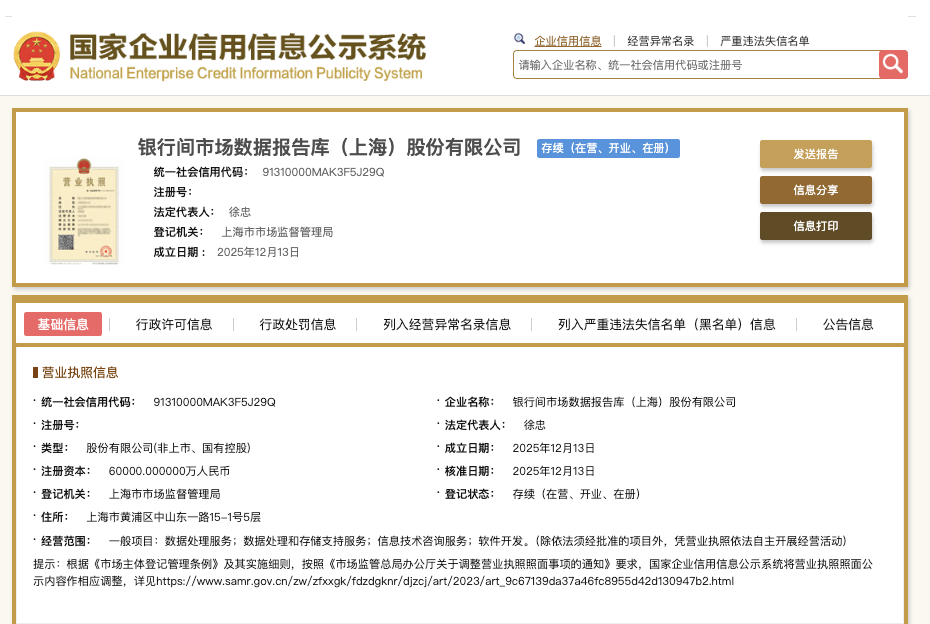
银行间市场数据报告库公司在沪成立 交易商协会徐忠担任董事长
2 1 Shi Ji Jing Ji Bao Dao· 2025-12-16 06:18
Core Insights - The establishment of the Interbank Market Transaction Reporting Database in Shanghai is a significant development aimed at enhancing financial market transparency and risk management [1][2][4] - The database will aggregate and analyze high-frequency trading data across various financial sub-markets, including bonds, currencies, derivatives, gold, and bills, serving financial institutions and regulatory bodies [1][2] Group 1: Company Formation and Structure - The Interbank Market Data Reporting Database (Shanghai) Co., Ltd. was officially established on December 13, with a registered capital of 600 million RMB [1] - The company is jointly funded by seven entities, including the Shanghai Gold Exchange and the China Interbank Market Dealers Association, with contributions varying from 15 million to 100 million RMB [1][2] Group 2: Leadership and Expertise - Xu Zhong, an economist with extensive experience in financial research and market infrastructure, is appointed as the chairman of the company [2] - The financial officer, Tang Yingwei, has a strong background in the bill market and has been involved in the transition from paper-based to electronic systems [2] Group 3: Importance and Challenges - The database is viewed as a crucial infrastructure for building a strong financial system and promoting high-quality financial development, with its core value being the enhancement of transparency and systemic risk prevention [2][3] - Challenges such as data quality issues and the lack of standardized reporting mechanisms need to be addressed to maximize the database's effectiveness in risk monitoring and market services [3]

工行、农行、中行、建行、交行、邮储银行齐表态!
Jin Rong Shi Bao· 2025-12-16 03:09
Group 1 - The Central Economic Work Conference was held in Beijing on December 10-11, summarizing the economic work for 2025 and analyzing the current economic situation while deploying tasks for 2026 [1] - Major state-owned banks, including Industrial and Commercial Bank of China, Agricultural Bank of China, Bank of China, China Construction Bank, Bank of Communications, and Postal Savings Bank, held expanded party meetings to convey the spirit of the Central Economic Work Conference and discuss implementation measures [1] Group 2 - Industrial and Commercial Bank of China emphasized the importance of adhering to the centralized leadership of the Party on financial work and supporting high-quality development while focusing on risk prevention and compliance [2] - Agricultural Bank of China highlighted the need to align its work with the eight key tasks outlined in the conference, focusing on rural financing and supporting domestic demand and consumption [3] - Bank of China stressed the importance of supporting consumption and income growth initiatives, enhancing financial services for various sectors, and promoting green and low-carbon transitions [4] - China Construction Bank focused on improving financial services for the real economy, enhancing support for key areas such as domestic demand and technological innovation [5][6] - Bank of Communications aimed to serve the real economy and maintain financial stability by supporting domestic market development and addressing risks in key areas [7] - Postal Savings Bank committed to maintaining its retail business advantages while supporting consumption and enhancing financial services for new industries and projects [8]





江海证券党委书记、董事长赵洪波:以文铸魂 履责于行 赋能黑龙江发展新质生产力
Zhong Guo Zheng Quan Bao· 2025-12-16 00:57
"金融是国民经济的血脉,是新质生产力的重要组成部分,也是培育和发展新质生产力的重要引擎。"江 海证券有限公司党委书记、董事长赵洪波日前在接受中国证券报记者专访时如是表示。 "十五五"规划建议提出,要加快建设金融强国。赵洪波表示,作为地方券商,江海证券深入贯彻落实党 中央决策部署,立足黑龙江本土券商责任担当,以夯实文化软实力为根基,以做好金融"五篇大文章"为 着力点,全链条服务发展新质生产力,将自身改革发展融入国家战略、服务地方经济,坚定不移走中国 特色金融发展之路,为建设金融强国、推进中国式现代化贡献力量。 发展新质生产力,科技创新是核心驱动力。在此背景下,江海证券积极响应时代号召,紧跟科技变革的 步伐。赵洪波表示:"江海证券认真落实哈投集团的数字转型战略,依托集团在资源整合与科技赋能方 面的有力支持,筑牢数字化转型的坚实底座。" 在对外服务层面,江海证券聚焦科技创新创业的金融服务体系与金融生态环境,提升服务质效。在对内 管理方面,江海证券着力强化数字赋能,创新数字化管理新范式,推动管理效能显著跃升。 在科技金融领域,赵洪波介绍,江海证券积极发挥资本市场在资源配置中的枢纽作用,聚焦于"专精特 新"企业等科技创 ...

江海证券党委书记、董事长赵洪波: 以文铸魂 履责于行 赋能黑龙江发展新质生产力
Zhong Guo Zheng Quan Bao· 2025-12-15 22:19
Core Viewpoint - The company emphasizes the importance of finance as a vital component of the national economy and a key driver for developing new productive forces, committing to contribute to building a strong financial nation and advancing modernization in China [1][8]. Group 1: Financial Services and Cultural Branding - The company aims to create a warm financial brand by integrating financial services with community welfare, focusing on a culture of "benefit and righteousness" [1][2]. - It has launched the "Accompany You - Shining 50 Plan" to enhance inclusive financial services and promote a positive ecosystem [2]. Group 2: Elderly Financial Services - The company has developed a comprehensive financial service system for the elderly, including retirement financial products and services, to enhance the quality of life for senior citizens [2]. - It is actively working to eliminate the "digital divide" for older clients by improving digital interfaces and offline service points [2]. Group 3: Compliance and Risk Management - The company is committed to a proactive compliance culture, transitioning from passive compliance to active governance, ensuring a robust internal control system [3]. Group 4: Financial Innovation and Technology - The company is focusing on technological innovation as a core driver for new productive forces, implementing a digital transformation strategy to enhance service quality and management efficiency [4][5]. - It has introduced an AI-driven investment trading app to improve investor engagement and service diversity [5]. Group 5: Commitment to Local Economic Development - The company is dedicated to supporting the local economy by integrating financial services with the development of green finance and low-carbon initiatives [6][7]. - It is actively involved in rural revitalization efforts, enhancing local industries and public welfare projects [7]. Group 6: Strategic Goals and Future Plans - The company plans to optimize its financial service supply structure and leverage financial innovation to support the development of new productive forces in alignment with national strategies [8].

刘世锦:实现强大的货币,需大幅增加离岸人民币数量
Sou Hu Cai Jing· 2025-12-15 09:30
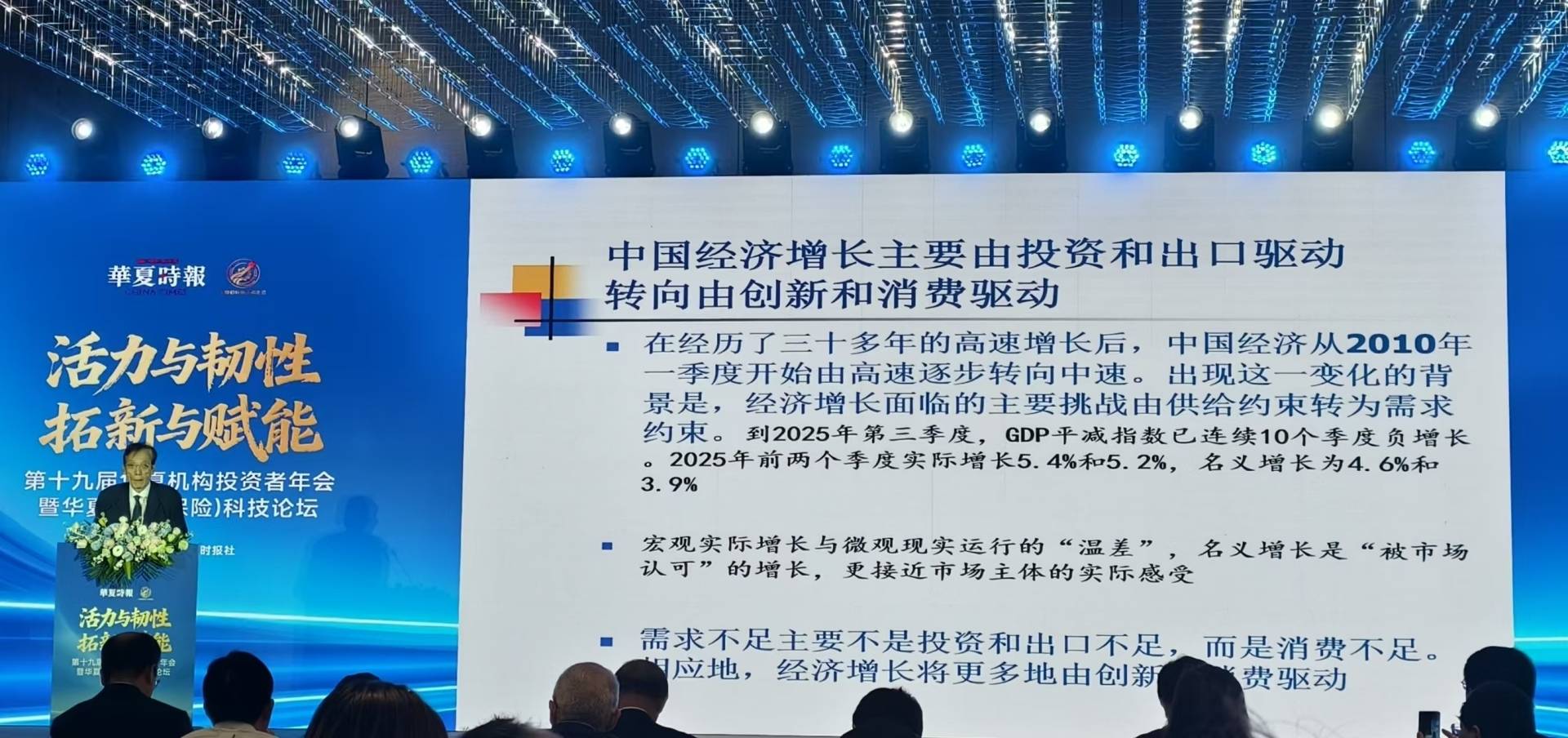
Group 1 - The core viewpoint is that China's economic growth is transitioning from high-speed to medium-speed, driven by a shift from supply-side constraints to demand-side issues, with a focus on innovation and consumption rather than investment and exports [1] - The next steps involve promoting the construction of a manufacturing powerhouse, a consumption powerhouse, and a financial powerhouse [3] - For the manufacturing powerhouse, the emphasis is on the transformation and upgrading of the manufacturing sector, particularly towards productive service industries [4] Group 2 - In terms of becoming a consumption powerhouse, there is a need to address the structural deviation of China's consumption as a percentage of GDP compared to the international average, aiming to become the largest consumer market globally [6] - The financial sector is seen as a bridge, requiring a modern financial system to support the manufacturing and consumption powerhouses, with a focus on selecting projects that have market potential and manageable risks [7] - During the 14th Five-Year Plan period, if China's GDP maintains a growth rate of 4% to 5%, it is expected to generate a net asset increase of no less than 30 trillion yuan annually, with new funds likely flowing into capital markets due to declining risk-free rates [7] Group 3 - A strong currency is essential for a financial powerhouse, with historical evidence suggesting that as a country's real economy grows in global share, its currency's global usage also increases [7] - To enhance the international use of the renminbi, increasing the offshore renminbi supply is crucial, which can be achieved by boosting imports and settling payments in renminbi [8] - Developing offshore renminbi financial products and improving liquidity and convenience will significantly accelerate the internationalization of the renminbi [8]
吴晓求:消费扩张需要深度重构三个核心函数
Xin Jing Bao· 2025-12-15 08:26
Core Insights - The "15th Five-Year Plan" aims for China's per capita GDP to reach the level of moderately developed countries by 2035, emphasizing the need for new economic growth drivers and ongoing financial reforms [1][14] - The transition from a "shortage economy" to a "surplus economy" necessitates a fundamental shift in governance logic, focusing on structural upgrades and technological advancements rather than mere scale expansion [4][18] Economic Characteristics - The "15th Five-Year" period will be characterized by significant historical changes, including a global technological revolution and a historic leap in China's economic structure [3][17] - The manufacturing sector's contribution to global value added is nearing 30%, maintaining the world's largest scale for 15 consecutive years, indicating strong supply-side capabilities [4][18] Consumption Dynamics - In a "surplus economy," consumption is viewed as a key force for maintaining economic balance, influenced by income, wealth, and social security [4][16] - Approximately 60% to 70% of household wealth is concentrated in real estate, leading to potential consumption contraction if property prices decline [5][19] Financial System Reform - The core task of financial reform during the "15th Five-Year" period is to adapt to the transition from a shortage to a surplus economy through innovation and openness [7][22] - There is a need for a robust, liquid, and high-credit-rated government bond market, which is essential for the internationalization of the RMB and the establishment of an international financial center [9][24] Capital Market Evolution - The capital market is expected to play a pivotal role in the economic ecosystem, transitioning from a financing market to an investment market that provides wealth management functions [10][25] - Enhancing the quality of listed companies is crucial, as they are the foundation of the capital market, and a strict delisting system is necessary to ensure market health [11][26] Regulatory Environment - A transparent regulatory framework is vital for rebuilding the capital market ecosystem, with a focus on increasing penalties for fraudulent activities to restore investor confidence [12][27] - The government should prioritize social security and public services over industrial investment funds to effectively release consumer purchasing power [6][21]

上银基金:坚守金融为民初心 践行高质量发展使命 为服务中国式现代化大局贡献行业力量
Zheng Quan Shi Bao Wang· 2025-12-15 04:16
Core Viewpoint - The 20th Central Committee's Fourth Plenary Session outlines a high-quality development path for the capital market during the "14th Five-Year Plan" period, emphasizing the role of public funds in supporting the real economy and enhancing residents' wealth [1] Group 1: Long-term Investment and Technological Innovation - The session highlights that technological innovation is a key battleground in international strategic competition, necessitating long-term, stable financial support for the development of new productive forces [2] - Public funds are positioned as a crucial channel for residents' investment, tasked with facilitating the flow of social capital into the real economy during the development of new productive forces [2] Group 2: Professional Capital and Common Prosperity - The session emphasizes the importance of advancing common prosperity, assigning a deeper mission to financial work that transcends mere profit-seeking [4] - The public fund industry, managing over 30 trillion yuan in resident assets, is evolving into a trusted "professional capital" under the guidance of the "Action Plan for Promoting the High-Quality Development of Public Funds" [4] - The company aims to achieve nearly 9.5 billion yuan in profits for investors in 2024, a 113% year-on-year increase, while enhancing the assessment system to align the interests of fund managers and investors [4] Group 3: Product Development and Financial Education - The company is expanding its product offerings to meet diverse resident needs, including short-term bond funds and retirement target funds, to cater to low-risk investors [5] - A comprehensive financial education system is being developed to guide investors throughout the investment process, enhancing their financial knowledge and investment experience [5] Group 4: Cross-Border Capital and Global Integration - The public fund industry plays a vital role in interpreting the value of Chinese assets to international markets and guiding global capital towards key sectors of the Chinese economy [6][7] - The company is enhancing its international research capabilities and expanding its QDII product offerings to provide investors with a broader range of overseas investment options [7]
明年经济工作怎么干?——中央经济工作会议学习体会
Hua Xia Shi Bao· 2025-12-14 10:40
Core Viewpoint - The Central Economic Work Conference emphasizes a pragmatic and positive approach to economic work for 2026, focusing on stabilizing growth, optimizing structure, and prioritizing people's livelihoods while addressing existing challenges and risks in the economy [2][3][4]. Economic Situation Assessment - The conference acknowledges both achievements and ongoing challenges in the economy, recognizing that many issues are solvable through effort [3][4]. - China's economy demonstrated resilience in 2025, with exports exceeding expectations and capital markets performing well, contributing to a projected GDP growth of around 5% for the year [4][5]. Policy Orientation - The conference continues the previous macroeconomic policy direction of being "more proactive and effective," with an emphasis on fiscal policy being more active and monetary policy remaining moderately loose [3][7]. - There is a shift in focus from external shocks to strengthening domestic economic coordination and managing expectations [8][9]. Structural and Institutional Arrangements - The conference highlights the importance of structural and institutional arrangements, including the establishment of a unified national market and improvements in the local tax system [9][10]. - Emphasis is placed on creating a fair competitive environment and reducing local government interference in market operations [10][11]. Fiscal Policy - The fiscal policy remains proactive, with a focus on increasing spending intensity and optimizing the structure of fiscal expenditures to address local government debt risks [14][15]. - The conference suggests maintaining a fiscal deficit rate of no less than 4% and increasing the scale of new debt to support economic stability [16][17]. Monetary Policy - The monetary policy is expected to remain moderately loose, with potential for interest rate cuts and reserve requirement ratio reductions to support economic growth [21][22]. - Structural tools will be enhanced to support key sectors such as consumption, technology, and elderly care [21][22]. Domestic Demand and Investment - The conference emphasizes the importance of domestic demand, with plans to implement a "rural residents' income increase plan" to boost consumption [23][24]. - Investment policies will shift from merely improving efficiency to stabilizing investment levels, with a focus on increasing central budget investments and optimizing local government bond usage [26][27]. Capital Market Reforms - The conference calls for deepening capital market reforms to enhance its functions and support national strategies, including improving inclusivity for innovative enterprises [28][29]. - There is a focus on increasing the quality of listed companies and promoting long-term investment to stabilize the market [31][32]. Real Estate Market Stability - The conference aims to stabilize the real estate market through targeted measures, including controlling new land supply and promoting the conversion of unsold properties into affordable housing [33][34]. - Emphasis is placed on high-quality housing construction and the establishment of a new development model for the real estate sector [35][36]. Innovation and Industry Development - The conference stresses the importance of innovation, with a focus on strengthening the role of enterprises in driving technological advancements and fostering new growth drivers [37][38]. - Specific industries will be targeted for high-quality development, including traditional sectors transitioning to higher standards and emerging industries expanding their scale [38]. Public Services and Livelihood - The conference reiterates the principle of prioritizing people's livelihoods, with specific measures to enhance employment, education, healthcare, and social security systems [39][40]. - Policies will be introduced to support flexible employment and improve social insurance coverage for new employment forms [39].

易方达基金:深入贯彻中央经济工作会议精神 助力金融强国和中国式现代化建设
Zhong Zheng Wang· 2025-12-14 09:10
Core Viewpoint - The central economic work conference highlighted the importance of the public fund industry in supporting high-quality development and enhancing wealth management services for residents, emphasizing the need for a more adaptive and competitive capital market [1] Group 1: Development of New Productive Forces - The public fund industry should deepen its understanding of new productive forces and enhance its research capabilities on new technologies and industries, guiding funds towards innovation sectors [2] - E Fund has established a comprehensive research system focused on technology industries, investing in sectors such as information technology, artificial intelligence, and renewable energy [2] Group 2: Strengthening Domestic Circulation - The public fund industry must prioritize investor interests, helping residents achieve property income through capital markets to boost consumption and domestic demand [3] - E Fund has been optimizing its product and service systems to cater to long-term capital, promoting long-term investment and value investment strategies [3] Group 3: Enhancing High-Quality Development - The public fund industry should integrate ESG principles into investment decisions and promote corporate governance improvements through shareholder rights [4] - E Fund has been actively expanding its international business and enhancing its global asset allocation capabilities, aiming to attract long-term foreign investment into China [4] Group 4: Future Outlook - Looking ahead to the 15th Five-Year Plan, E Fund aims to optimize its integrated research system and support technological innovation while meeting diverse wealth management needs [5]
中国工商银行党委传达学习中央经济工作会议精神
Xin Lang Cai Jing· 2025-12-12 13:56
Core Viewpoint - The meeting of the Industrial and Commercial Bank of China (ICBC) emphasized the importance of aligning with the spirit of the Central Economic Work Conference, which provides guidance for economic and financial work in the upcoming year and beyond [1][7]. Group 1: Key Themes from the Meeting - The meeting highlighted the significance of the achievements during the 14th Five-Year Plan and the need to understand the decisive meaning of the "two establishments" [2][8]. - It stressed the importance of confidence, leveraging advantages, and addressing challenges to maintain economic stability and growth [2][8]. - The meeting called for a comprehensive understanding of the overall requirements and policy directions for economic work in the coming year, focusing on the "eight persistences" [2][8]. Group 2: Implementation Strategies - The meeting outlined five key strategies for financial work: 1. Upholding the centralized and unified leadership of the Party over financial work, enhancing political capabilities, and promoting strict governance [3][9]. 2. Acting as a main force to promote high-quality development by providing comprehensive financial solutions and supporting key sectors such as domestic demand and technology innovation [3][9]. 3. Serving as a stabilizing force by managing risks and ensuring asset quality remains stable [3][9]. 4. Leading efforts in high-level openness and supporting initiatives like the Belt and Road [3][9]. 5. Acting as a benchmark bank to enhance reform effectiveness and align with the financial power construction goals [4][10]. Group 3: Future Work Focus - The meeting emphasized the need to complete annual goals with high quality and to plan for the key tasks of the 15th Five-Year Plan to ensure a strong start [4][10].