
人工智能(AI)

Search documents
麦肯锡:香港近九成用户认可AI增效 高管使用率仅14%
2 1 Shi Ji Jing Ji Bao Dao· 2026-02-11 10:01
在具体应用场景中,AI工具的各项功能的使用评价存在差距。调查显示,文本撰写或编辑功能被最多 受访者(24%)评为最有效,而数据分析或编程功能紧随其后,获得21%的认可。 麦肯锡针对这一现状提出四点关键建议:第一,将AI置于整体战略框架下推行;第二,将AI视为端到 端的业务转型过程,而不只是IT项目;第三,在推动能够提升公司长期发展轨迹的重大举措的同时,积 极开发能快速见效的应用场景;第四,持续投资于AI技能提升与变革管理,以切实驱动转型。 此外,网络安全与数据隐私是当前阻碍AI广泛应用的首要障碍。调查显示,数据隐私及保安问题是各 行业最普遍的担忧,而应用场景不明确、应用渠道有限及培训资源不足也是重要制约因素。 对此,麦肯锡公司全球合伙人及香港分公司总经理石烽麟对21世纪经济报道记者表示,管理层使用率较 低与其工作性质相关。目前AI工具多应用于数据分析、资料整理或媒体创作等实务性工作,基层和中 层员工使用较多。但高层管理者本身不需要亲自处理这些具体事务,而是通过团队成员完成。 石烽麟表示,尽管AI在速度上具有明显优势,但在工作质量方面,优秀的员工仍比AI表现更佳,尤其 在任务与具体需求的"贴合度"上。因此,高层 ...
远程等离子体源行业报告 | 全球与中国市场现状及未来发展趋势
QYResearch· 2026-02-11 09:22
Core Viewpoint - The Remote Plasma Source (RPS) technology is increasingly vital in various industries, particularly in semiconductor manufacturing, due to its ability to produce high-density, uniform plasma without direct contact with the substrate, thus minimizing contamination and damage risks [2][4]. Industry Current Status - **Widespread Application in Semiconductor Manufacturing**: RPS is crucial in microelectronics, especially in Chemical Vapor Deposition (CVD), Atomic Layer Deposition (ALD), and Plasma Etching processes, as the demand for precision and uniformity increases with smaller process nodes like 5nm and 3nm [4]. - **Material Surface Treatment and Functionalization**: RPS is effectively used to enhance surface properties such as adhesion, wettability, and corrosion resistance across various sectors including aerospace, automotive, electronics, optics, and medical [4]. - **Expansion in Environmental Protection**: RPS technology is being applied in waste gas and wastewater treatment, effectively decomposing harmful gases and organic pollutants, thus aligning with stricter environmental regulations [4]. - **Innovative Applications in Medical and Biotechnology**: RPS is rapidly developing in biomedical fields, demonstrating strong antibacterial properties and potential cancer cell inhibition, with advantages in processing biocompatible materials and ensuring sterility [4]. Development Trends - **Higher Efficiency and Low Power Design**: Future RPS designs will focus on enhancing plasma generation efficiency while reducing energy consumption, addressing rising energy costs and environmental concerns [5]. - **Miniaturization and Integration**: The trend towards compact and multifunctional RPS systems will reduce space requirements and maintenance costs by integrating key components [5]. - **Intelligent and Automated Control**: The incorporation of AI and IoT technologies will enable real-time monitoring and automatic adjustments to optimize performance, enhancing reliability and efficiency [5]. - **Multifunctionality and Cross-Field Applications**: RPS will evolve to support multiple functions, such as surface cleaning, etching, and film deposition, broadening its application across various industries [5]. Global Market Analysis - **Market Size and Growth**: The global RPS market is projected to reach $514.86 million in 2024 and $5,216.96 million by 2031, with a CAGR of 36.89% [9]. - **Regional Insights**: The Chinese market is expected to grow from $166.67 million in 2024, accounting for approximately 32.37% of the global market, to $1,486.36 million by 2031 [9]. - **Product Type and Application**: RPS cleaning is the highest revenue-generating segment, expected to reach $332.14 million in 2024, while CVD applications will generate $242.04 million, indicating strong demand in semiconductor processes [9]. Competitive Landscape - **Key Players**: Major companies in the RPS market include Advanced Energy, New Power Plasma, Samco-ucp, MKS Instruments, and Muegge GmbH, collectively holding over 81.03% market share in 2024 [10]. - **Domestic Market Dynamics**: The domestic RPS industry in China is still in its early stages, with a localization rate of approximately 6.76%, indicating significant potential for growth and development [10][11]. Industry Opportunities and Drivers - **Technological Advancements**: Continuous improvements in RPS technology enhance performance and efficiency, meeting evolving customer needs [12]. - **Environmental Awareness**: Growing environmental concerns drive demand for RPS solutions in waste treatment and pollution control [12]. - **Policy Support**: Government initiatives promoting environmental protection and energy efficiency create a favorable environment for RPS development [12]. - **Application Demand**: The broad applicability of RPS in sectors like pollution control, renewable energy, and semiconductor manufacturing supports market expansion [12].


“AI颠覆”忧虑再蔓延!华尔街年初热门交易全军覆没,市场怎么了?
Di Yi Cai Jing Zi Xun· 2026-02-11 07:41
Core Viewpoint - The recent concerns regarding AI's potential to disrupt various industries have led to significant sell-offs in the stock market, particularly affecting software and wealth management stocks, as investors reassess the implications of AI advancements on traditional business models [1][3][6]. Group 1: Market Reactions - The sell-off was triggered by the launch of Altruist's new tool, Hazel, which aims to automate financial advisory services, raising fears about the efficiency of wealth management firms [3][4]. - Major wealth management firms experienced substantial declines, with Raymond James Financial down 8.8%, Charles Schwab down 7.4%, and LPL Financial down 8.3%, marking their largest single-day drops since April [3][4]. - The S&P 500 insurance index fell 3.9% on September 9, the largest single-day drop since October of the previous year, due to similar concerns in the insurance sector [3]. Group 2: AI Investment Trends - Analysts suggest a shift in AI investment focus from "AI enablers," which build the necessary infrastructure, to "AI beneficiaries," which are companies that will benefit from increased productivity and efficiency through AI [5]. - There is a belief that while AI may not completely disrupt certain industries, it will significantly enhance productivity and profitability in sectors that seem unrelated to AI [5]. Group 3: Broader Market Context - The overall market has seen a significant downturn, with the Nasdaq index down 1.8% for the week and the S&P 500 software and services index down nearly 8%, marking its worst weekly performance since March 2020 [6][7]. - The market's volatility is attributed to a combination of factors, including concerns over AI's impact, potential changes in Federal Reserve leadership, and high valuations in various asset classes [7][8]. - Despite the recent sell-off, some analysts view the market's reaction as an overreaction, suggesting that the fundamentals remain strong and that the current adjustments may set the stage for future growth [7][8].

美股科技巨头利润“霸权”告终?盈利增长正向全行业扩散
Hua Er Jie Jian Wen· 2026-02-11 06:49
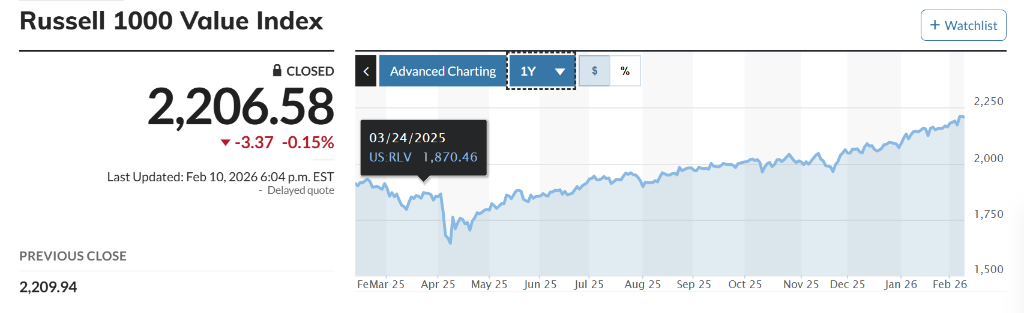
Core Insights - The dominance of a few tech giants in profits is fundamentally changing as the earnings season progresses, with the Russell 1000 Value Index outperforming growth indices since mid-December 2022 [1] - The number of sectors in the S&P 500 showing positive growth has increased from 6 to 8, with nearly half of the companies reporting double-digit growth rates, and a median growth rate close to 10%, marking a four-year high [1] Group 1: Earnings Growth and Market Dynamics - The overall earnings growth rate for the S&P 500 has risen to 14.5%, a four-year high, indicating a broadening of growth beyond just large tech stocks [3] - Market analysts suggest a style rotation is occurring, driven by cyclical factors rather than a decline in tech giants, signaling an end to the previously rare concentration of profits [3] - The current economic phase is characterized as a "robust broad expansion," which typically benefits widespread corporate profits, as confirmed by the earnings reports of S&P 500 constituents [4] Group 2: Sector Rotation and Valuation Shifts - There has been a significant rotation towards "AI-immune" sectors such as utilities, food, mining, construction, and telecommunications, reflecting a reevaluation of capital-intensive and traditional industry valuations [4] - The weakening dollar has notably impacted corporate earnings, with export-oriented S&P 500 companies experiencing higher earnings and revenue growth compared to those focused on domestic business [5] - Nvidia Corp. plays a crucial role in the earnings growth of S&P 500 companies with significant international exposure; excluding Nvidia, the blended earnings growth rate would drop from 17.7% to 12.0% [5]

xAI爆离职潮 48小时内两创始成员离任
Xin Lang Cai Jing· 2026-02-11 06:25
全球首富马斯克(Elon Musk)旗下人工智能(AI)初创xAI再有核心创始成员离职。联合创办人吴宇怀(Tony Wu)周一在社交平台宣布辞职后,不到48小时,另一名联合创始人Jimmy Ba亦宣布离任。 吴宇怀周二(2月10日)下午在社交平台贴文写:"I resigned from xAI today"。并说,"是时候开启新篇章 了,这是一个充满无限可能性的时代:一个配备AI的小团队可以移山填海,重新定义一切皆有可能。" 马斯克于2023年与另外11人共同成立xAI,冀挑战OpenAI和谷歌(Google)等竞争对手。 然而,xAI已有多名联合创办人包括巴布舒金(Igor Babuschkin)、Kyle Kosic、Christian Szegedy及杨格 (Greg Yang)先后宣布离任,其中杨格上月指因患上莱姆病而呈辞。 计及吴宇怀及Jimmy Ba,意味已有一半联合创办人已离任。95后的吴宇怀是xAI在数学推理和符号AI领 域的核心人物。Jimmy Ba则负责大部分业务运营,不过去年底,其多项核心职责已被拆分予吴宇怀及 另一联合创办人张国栋(Guodong Zhang)。 Jimmy Ba则在今 ...
年度策略-AI重构电力和汽车产业生态
2026-02-11 05:58
Summary of Key Points from Conference Call Industry Overview - The conference call discusses the global electricity supply and demand challenges, particularly focusing on the impact of AI on the electricity and automotive industries. The increasing share of renewable energy has raised total installed capacity but has not sufficiently addressed peak demand, leading to a heightened risk of power shortages [1][5]. Core Insights and Arguments 1. **Structural Challenges in Electricity Supply**: Despite an overall surplus in electricity supply, certain regions, such as Texas and California, face imbalances due to independent grid systems and infrastructure damage from events like wildfires [3][5]. 2. **Increased Share of Renewable Energy**: Over the past decade, the proportion of renewable energy sources, such as solar and wind, in new electricity installations has risen significantly. For instance, solar energy became the largest source of new electricity supply in the U.S. around 2015, while traditional fossil fuels have seen stagnant growth [3][4]. 3. **AI Data Centers' Impact**: The rapid growth of AI Data Centers (AIDC) has significantly increased electricity demand, particularly in regions like Virginia, Texas, and California. By 2030, AIDC is expected to account for over half of the new electricity demand in the U.S. [6]. 4. **Investment in Grid Infrastructure**: To address the challenges posed by renewable energy integration, countries like China, Europe, and the U.S. are increasing investments in grid infrastructure. For example, China's "14th Five-Year Plan" emphasizes high-voltage construction to mitigate power shortages in major consumption provinces [8][9]. 5. **Storage Market Outlook**: The energy storage market is expected to have a long-term and stable outlook, driven by government subsidies and policy support. The standardization of storage products will be a key competitive factor [10][11]. 6. **Natural Gas Generation Dynamics**: AIDC is changing the competitive landscape of natural gas generation, with some data centers opting for self-built natural gas power generation to detach from public grids. The U.S. is experiencing a significant demand increase for natural gas power generation due to the replacement of aging gas units [12][14]. 7. **Emerging Market Trends**: Emerging markets are increasingly reliant on renewable energy due to limited options for traditional power generation. This trend has been evident since 2014, leading to tighter electricity supply globally [6][13]. Additional Important Insights - **Technological Developments**: The shift in power technology from internal server components to external solid-state transformers (SST) is anticipated to transform supply chain structures by 2029, with companies like Delta and Lite-On actively developing new products [2][19]. - **Investment Opportunities**: Future investment opportunities are expected to arise in areas closely tied to AI, particularly in large-scale energy structure changes and gas generation, which present long-term certainty [27][28]. - **Challenges in Autonomous Driving**: The autonomous driving industry faces significant challenges, particularly in user experience and operational efficiency. Despite technological advancements, issues such as vehicle positioning and user convenience remain critical [21][23][24]. This summary encapsulates the key points discussed in the conference call, highlighting the challenges and opportunities within the electricity and automotive sectors influenced by AI and renewable energy trends.
宏观-经济-近期外资机构观点荟
2026-02-11 05:58
Summary of Key Points from Conference Call Records Industry Overview - Recent adjustments in the US stock market were primarily driven by a sell-off in AI software stocks, with Goldman Sachs predicting that the downward trend may continue, although the peak volatility has passed [4][1] - Foreign institutions are optimistic about gold, with Deutsche Bank and JPMorgan raising their 2026 target prices to $6,000-$6,300 per ounce, while maintaining a cautious stance on silver and copper [5][1] - UBS has revised its GDP growth forecast for the Eurozone in 2026 from 1.1% to 1.3%, mainly due to expansive fiscal policies, particularly defense spending [6][1] Core Insights and Arguments - The stability of the US stock market requires an improvement in earnings prospects, and the recovery of investor sentiment may need several quarters of solid fundamentals to support it [4][1] - AI technology stocks face risks of valuation corrections and exit difficulties, with some listed companies experiencing significant declines. However, Deutsche Bank believes that AI-driven private credit transactions will promote the development of the real economy and reduce risks in the long term [7][1] - Foreign institutions are focusing on major asset classes, including US stocks, commodities, and foreign exchange, with a bullish outlook on precious metals (gold and silver) and copper, while being cautious about silver [8][1] Additional Important Insights - The trend of the Chinese yuan strengthening in the medium term is expected to remain unchanged, driven by improved growth prospects and increased policy tolerance in China. The appreciation of the yuan is characterized by a slow and steady pace, with increased stability in the central parity and a decoupling from the US dollar [9][1] - Foreign institutions view the recent pullback in the A-share market at the end of January as a healthy technical adjustment, optimistic about the transition to a stable liquidity environment in the Chinese stock market, supported by the strengthening yuan and positive regulatory signals [10][1][11]


狂砸6500亿美元押注AI,科技巨头们的“烧钱叙事”能走多远?
Guo Ji Jin Rong Bao· 2026-02-11 04:13
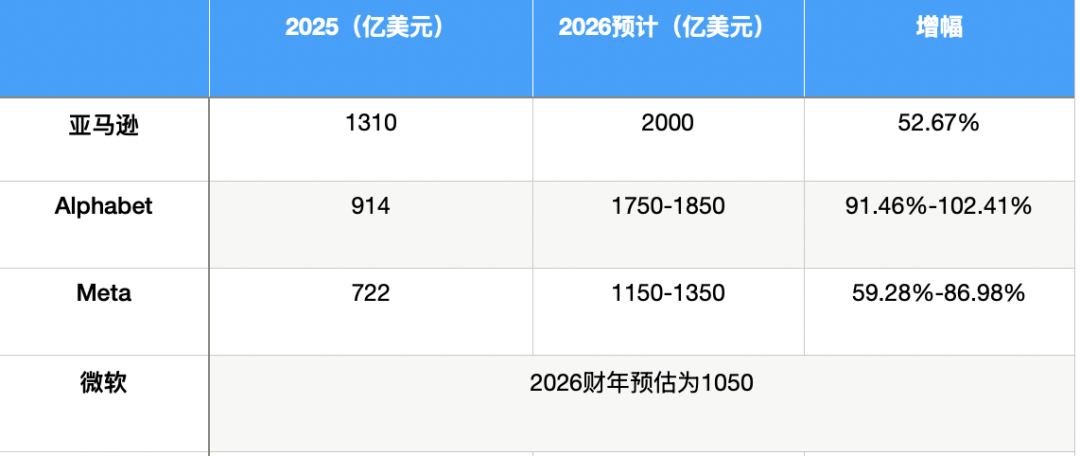
Core Viewpoint - The focus of the market has shifted towards the substantial capital expenditure budgets set by major tech companies for 2026, which are significantly higher than expected, totaling approximately $650 billion, indicating a strong commitment to AI development despite concerns from investors about the aggressive spending plans [1][4]. Group 1: Capital Expenditure Plans - Amazon is projected to have a capital expenditure of $200 billion in 2026, exceeding analyst expectations of $144.7 billion, representing a year-over-year increase of over 50% from $131 billion in 2025 [2][3]. - Alphabet (Google) anticipates capital expenditures between $175 billion and $185 billion for 2026, a significant increase from $91.4 billion in 2025, reflecting a growth rate of approximately 91.5% to 102.4% [3]. - Meta plans to double its capital expenditure to between $115 billion and $135 billion in 2026, compared to $72.2 billion in 2025, indicating a growth rate of 59.3% to 87% [3]. - Microsoft is expected to reach a capital expenditure of $105 billion for its fiscal year ending in June 2026, with a reported $37.5 billion in capital expenditures for the second fiscal quarter, marking a 66% year-over-year increase [2][3]. Group 2: Investment Focus and Strategy - The investment strategies of these companies are aligned, focusing on the strong demand for AI while addressing capacity constraints that require increased investment [4]. - Meta is prioritizing investments in computational infrastructure, with plans to build large-scale data centers to support AI models and ensure stable power supply [4]. - Alphabet aims to enhance its computational and cloud services capabilities, with approximately 60% of its 2026 capital expenditures allocated to servers and 40% to data centers and network equipment [5]. - Amazon's capital expenditures will primarily support its cloud business (AWS) to meet strong customer demand, emphasizing the ability to quickly deploy computing resources [6]. Group 3: Market Performance and Concerns - The cloud business is becoming a high-return investment area in the AI sector, with notable performances from major cloud service providers during the earnings season [7]. - Amazon's AWS sales reached $35.6 billion in Q4 2025, a 24% year-over-year increase, while Microsoft's cloud revenue grew 26% to $51.5 billion, and Alphabet's cloud revenue increased 48% to $17.7 billion [8]. - Despite the strong order backlog, which includes $240 billion for Google Cloud and $244 billion for AWS, there are concerns about the pressure on profitability and cash flow due to the need for continued capital investment [8][9]. Group 4: Financial Health and Investor Sentiment - Amazon's free cash flow has dropped significantly from $38.2 billion to $11.2 billion over the past year, with predictions of a negative free cash flow of $17 billion in 2026 [9]. - Alphabet is also facing challenges, with projections indicating a 58% and 80% drop in free cash flow per share for the fiscal years 2026 and 2027, respectively [9]. - Microsoft's aggressive capital expenditure plans have raised concerns among investors, leading to a 10% drop in its stock price following its earnings report, the largest single-day decline since March 2020 [9][10].




周一保险经纪崩了、周二财富管理崩了,美股遍寻“下一个AI受害者”
华尔街见闻· 2026-02-11 03:38
Core Viewpoint - The launch of Altruist Corp.'s AI tool for tax strategy planning has raised concerns about the future of traditional wealth management firms, indicating a potential disruption in their core business model [1][2][4]. Group 1: Market Reaction - Following the announcement of Altruist's AI tool, shares of major wealth management firms experienced significant declines, with Charles Schwab (SCHW) dropping 9.5% intraday and closing down 7.4%, while Raymond James Financial Inc. (RJF) and LPL Financial Holdings Inc. (LPLA) saw declines of over 9% and 11% respectively [2]. - The sell-off in wealth management stocks reflects broader market anxieties regarding AI's potential to disrupt financial advisory and wealth management services, leading to fears of efficiency gains being eroded by competition and long-term fee compression [4][6]. Group 2: Broader Industry Impact - The threat posed by AI to traditional business models is spreading across various sectors, with wealth management stocks being the latest to feel the impact [5]. - Prior to the wealth management stock declines, insurance brokerage stocks had already faced significant losses, with the S&P 500 Insurance Index dropping 3.9%, marking its largest single-day decline since October 2025 [7]. - The introduction of new AI tools by companies like Insurify has raised concerns about the potential threat to the consulting business of insurance brokers, although some analysts view these tools as efficiency enhancers rather than existential threats [9]. Group 3: Market Trends and Analyst Insights - The recent sell-off in stocks across software, financial services, and asset management sectors resulted in a combined market value loss of $611 billion [10]. - Since the launch of OpenAI's ChatGPT, the potential for AI disruption has been a hot topic, with investors previously focusing on beneficiaries of AI advancements, such as semiconductor and network equipment companies [12]. - Despite the current market turmoil, analysts project a 19% growth in earnings for S&P 500 software and services constituents by 2026, indicating a potential recovery in the sector [14].




光大证券晨会速递-20260211
EBSCN· 2026-02-11 02:50
2026 年 2 月 11 日 晨会速递 分析师点评 市场数据 总量研究 【宏观】"安全"的溢价:地缘政治如何重塑全球利率曲线?——《光大投资时钟》 系列第二十九篇 地缘政治正通过"安全"溢价深刻重塑全球利率曲线,超长端利率的上行本质是财政 扩张服务于国家安全的结构性变化,而非简单的周期性波动。高通胀下推行的财政扩 张,大幅削弱了传统意义上债券的避险属性。在美国中期选举之前,特朗普带来的宏 观叙事仍将主导资产价格波动,人民币计价资产已经显现出"避风港"属性。风险提 示:地缘危机升级超预期;美国经济超预期走弱并引发风险偏好下行;美国对关键矿 产加征关税政策调整;海外巨头 AI 资本开支低于预期。 【海外策略】恒生科技:战略配置区间已至,逆势布局正当时——港股策略观点更新 当前恒生科技指数已形成"超卖估值洼地 + 资金逆势抢筹 + AI 基本面向上 + 回购 加码在即"的四重底部特征,短期情绪扰动充分释放,风险收益比显著优化,是中长 期战略配置的黄金窗口。优先配置恒生科技 ETF,兼具互联网龙头、AI 应用、算力等 全板块标的,个股配置方向:优先配置"AI+平台"双主线龙头标的,聚焦商业化落 地快、现金流稳健、估 ...