
人民币升值

Search documents
洪灝最新判断:白银可以见好就收,人民币升值目标位6.8,这几类公司都会受益
Xin Lang Cai Jing· 2025-12-30 11:42
炒股就看金麒麟分析师研报,权威,专业,及时,全面,助您挖掘潜力主题机会! 来源:六里投资报 12月29日,著名分析师、莲华资管首席投资官洪灝,在一场对话中对当下热议的白银走势,人民币汇 率,以及市场走向等做出了观点鲜明的判断,并展望了2026年的政策大方向。 洪灝指出,贵金属方面,因为最近两个星期涨得太疯狂,比如现在白银的盘面情况; 让人想到1980年历史性的逼空行情,当时白银涨到了50美元一盎司。 但即便在那次逼空行情中,白银也没有出现连续8个月上涨的情况, 而且,这个月白银的大阳线,远远超过了80年代顶部的那根大阳线。 因此,洪灝建议应该见好就收,等待明年再布局。 洪灝早在半年前,就已明确提示白银的投资机会--银价绝对会创历史新高,投资报也最早予以跟踪分 析,并给出了具体的投资标的,点此查看。 当时国内唯一的这只白银基金其净值尚在1元附近,如今净值早已翻倍,其二级市场价格更是大涨200% 多。 但是, 洪灝同时指出,贵金属基于美元信用走弱的长线逻辑依然成立, 无论是黄金还是其他贵金属,涨势还没有结束。 财政政策上,他认为当前广义财政赤字率偏低, 面对经济数据走软,应大幅提升至20%左右以提振经济,并预计2 ...


岳阳林纸:公司的自产浆供给能力超过70%
Mei Ri Jing Ji Xin Wen· 2025-12-30 10:00
Group 1 - The company has a self-produced pulp supply capacity exceeding 70%, ensuring a stable supply of raw materials [1] - The company engages in import and export business, and the appreciation of the RMB is beneficial for its import operations [1] - Current exchange rate fluctuations have a minimal impact on the company's performance [1]

造纸轻工周报:关注底部高股息资产、轻工企业积极外延布局;造纸板块受益人民币升值、反内卷-20251230
Shenwan Hongyuan Securities· 2025-12-30 08:29
Investment Rating - The report maintains a positive outlook on the paper and light industry sectors, highlighting high dividend safety margin assets and companies with strong growth potential [1][2]. Core Insights - The report emphasizes the importance of focusing on high dividend safety margin assets in the packaging and home furnishing sectors, benefiting from the appreciation of the RMB and the expected decrease in paper procurement costs [2][4]. - It identifies key companies in the packaging sector such as Yongxin Co., Yutong Technology, Huawang Technology, and Meiyingsen, as well as home furnishing leaders like Kuka Home, Mousse, Oppein, and Sophia [2][4]. - The paper industry is expected to benefit from rising wood pulp prices and seasonal demand, with companies like Sun Paper, Nine Dragons Paper, and Bohui Paper being highlighted for their potential [2][4]. - The report also discusses the export sector, noting the impact of RMB appreciation and the importance of supply chain and brand expansion for companies like Jiangxin Home, Yongyi Co., Jiayi Co., and Zhongxin Co. [2][4]. Summary by Sections Packaging Sector - The packaging industry is characterized by a mature competitive landscape, with leading companies reducing capital expenditures and demonstrating advantages in overseas markets [5][6]. - Yongxin Co. is noted for its stable high dividend policy and strong performance in soft packaging and film business, with a dividend rate of 84% to 81% from 2020 to 2024 [5]. - Yutong Technology has expanded its global supply chain, enhancing its operational efficiency and increasing its dividend rate to 70% by 2025 [6]. - Huawang Technology is positioned well in the decorative paper market, with expectations of improved profitability due to limited new supply and rising demand [7]. - Meiyingsen is recognized for its strategic overseas expansion and high dividend yield, with a focus on emerging markets [8]. Home Furnishing Sector - The home furnishing industry is experiencing accelerated consolidation, with a positive outlook driven by supportive real estate policies and improving consumer confidence [9][10]. - Companies like Kuka Home and Sophia are expected to benefit from the increasing demand for home renovation and the implementation of "old-for-new" policies [10][23]. - The report highlights the importance of retail capabilities and supply chain improvements for companies to enhance their market share and profitability [23][24]. Paper Industry - The paper industry is anticipated to see a recovery in demand and pricing, supported by strong control over production by overseas pulp mills [11][13]. - Companies such as Sun Paper and Nine Dragons Paper are expected to benefit from the stabilization of pulp prices and improved supply-demand dynamics [11][13]. - The report notes that the industry has been at a low point for several years, but a mid-term recovery is expected as demand gradually increases [11][13]. Export Sector - The export sector is influenced by the global economic environment, with a focus on companies that are expanding their international presence and brand recognition [14][15]. - Jiangxin Home is noted for its innovative product offerings and strong growth in customer numbers, while Yongyi Co. is positioned to capitalize on the growing demand for ergonomic chairs [15][16]. - Jiayi Co. is recognized for its strategic expansion in the insulated cup market, while Zhongxin Co. is highlighted for its growth potential in the pulp molding sector [16][17]. Pet Products Sector - The pet products sector is experiencing robust growth, with companies like Yiyi Co. and Yuanfei Pet benefiting from strong export performance and brand development [18]. - Yiyi Co. is expected to see significant revenue growth due to its acquisition strategy and strong sales performance [18]. - Yuanfei Pet is noted for its rapid growth in the domestic market and expansion of its product offerings [18]. Light Industry Sector - The report emphasizes the importance of monitoring changes in the light industry, with companies like Anfu Technology and Jianlin Home focusing on strategic acquisitions and technological advancements [19][20]. - Anfu Technology is expected to enhance its profitability through increased ownership in Nanfeng Battery and expansion into new business areas [19]. - Jianlin Home is transitioning towards smart robotics, leveraging its existing technology and market position [20].


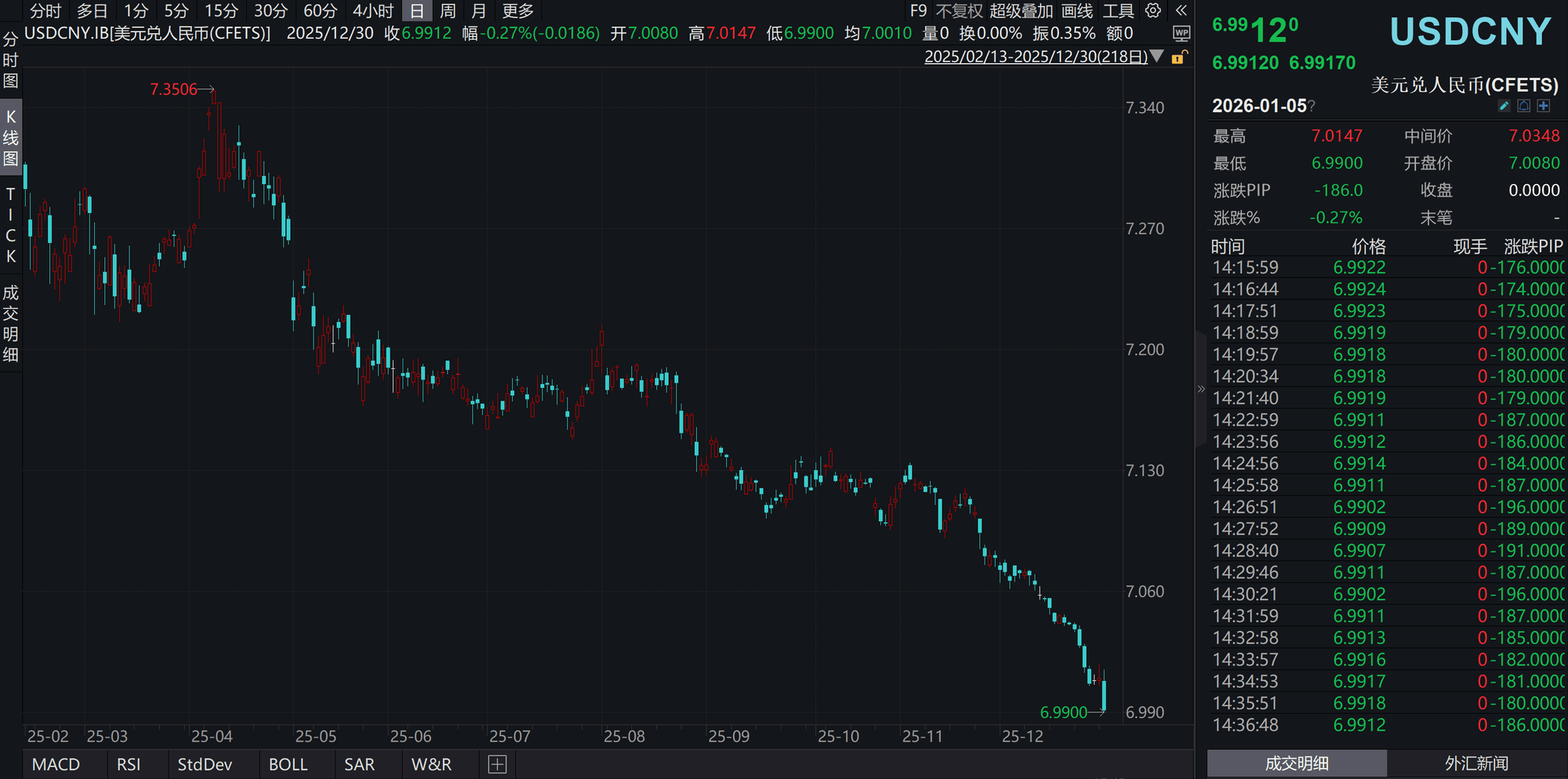
在岸人民币对美元“破7” 创2023年5月以来新高
Sou Hu Cai Jing· 2025-12-30 07:21
Group 1 - The core viewpoint of the articles is that the onshore RMB has recently appreciated against the USD, breaking the important 7.0 threshold, with the highest exchange rate reaching 6.9900, the highest since May 18, 2023 [1][3] - The appreciation of the RMB is attributed to two main factors: the weakening of the USD and increased foreign exchange settlement due to easing tariff issues and capital inflows [3] - The RMB appreciation is expected to positively impact the A-share market by attracting foreign investment and providing room for monetary policy easing, particularly benefiting growth stocks [3] Group 2 - The recent monthly appreciation of the RMB reached approximately 1%, with an annualized rate exceeding 10%, which may not be sustainable in the long term [4] - Historical patterns indicate that after periods of rapid appreciation, the RMB typically experiences a phase of consolidation influenced by changes in internal and external environments [4] - The central bank's monetary policy committee emphasizes the need to enhance the resilience of the foreign exchange market and maintain stability in the RMB exchange rate at a reasonable and balanced level [4]
百洋股份(002696.SZ):人民币升值未对公司饲料业务的经营业绩产生直接影响
Ge Long Hui· 2025-12-30 07:11
Group 1 - The core viewpoint of the article is that Baiyang Co., Ltd. (002696.SZ) has confirmed that all of its feed products are currently sold in the domestic market, with no involvement in export business [1] - The company's feed products are popular in regions such as South China, Southwest, Central China, and East China [1] - The appreciation of the Renminbi has not had a direct impact on the company's feed business performance due to the lack of export activities [1]

造纸轻工周报:关注底部高股息资产、轻工企业积极外延布局,造纸板块受益人民币升值、反内卷-20251230
Shenwan Hongyuan Securities· 2025-12-30 07:03
Investment Rating - The report maintains a positive outlook on the paper and light industry sectors, highlighting high dividend yield assets and companies with strong growth potential [1][2]. Core Insights - The report emphasizes the importance of focusing on high dividend yield assets in stable industry segments, particularly in packaging and home furnishing sectors [5][10]. - The appreciation of the RMB is expected to lower procurement costs in the paper industry, with price increases in wood pulp and seasonal demand supporting paper prices [2][12]. - The report identifies key companies for investment, including packaging leaders like Yongxin Co., Yutong Technology, and home furnishing brands such as Kuka Home and Mousse [2][10]. Summary by Sections 1. Weekly Insights - Short-term focus on high dividend yield assets in stable packaging companies and leading home furnishing brands [5][6]. - Anticipated benefits from RMB appreciation leading to lower procurement costs in the paper industry [5][12]. - Recommendations for companies with strong export capabilities and potential for brand development [5][15]. 2. Industry Perspectives Packaging - The packaging industry is stabilizing, with leading companies reducing capital expenditures and maintaining high dividend payouts [6][7]. - Yongxin Co. is noted for its strong position in soft packaging and high dividend rates [6]. - Yutong Technology benefits from global supply chain advantages and is expected to increase its dividend payout [7]. Home Furnishing - The home furnishing sector is expected to see valuation recovery driven by supportive real estate policies and improving consumer confidence [10][11]. - Companies like Kuka Home and Mousse are highlighted for their strong market positions and potential for growth [10][11]. Paper Industry - The paper industry is entering a recovery phase with stabilizing prices and improved demand dynamics [12][14]. - Companies such as Sun Paper and Nine Dragons Paper are positioned to benefit from these trends [12][14]. Export Sector - The report highlights the importance of global supply chain strategies and brand development for companies in the export sector [15][16]. - Companies like Jiangxin Home and Yongyi Co. are noted for their strong export capabilities and market positioning [15][16]. Pet Products - The pet products sector is experiencing growth with strong domestic brands and international expansion [19]. - Companies like Yiyi Co. and Yuanfei Pet are recommended for their robust growth potential [19]. Light Industry - The report discusses the strategic changes in light industry companies, focusing on mergers and acquisitions to enhance growth [20]. - Companies like Anfu Technology and Jianlin Home are noted for their innovative approaches and market positioning [20][21].
人民币,破7!创两年半来新高
Sou Hu Cai Jing· 2025-12-30 06:22
Core Viewpoint - The recent appreciation of the Renminbi (RMB) against the US dollar is primarily attributed to a weaker US dollar and strong domestic equity market performance attracting foreign capital inflows, rather than indicating the start of a new appreciation cycle [1] Group 1: Currency Performance - On December 30, 2025, the onshore RMB reached a high of 6.9960 against the US dollar, breaking the 7.0 mark for the first time since May 17, 2023 [1] - The offshore RMB also surpassed the 7.0 threshold on December 25, marking the first occurrence in 15 months [1] Group 2: Economic Analysis - Market analysts, including the chief economist at China Merchants Bank, suggest that the recent RMB appreciation is driven by short-term favorable factors and does not signify the beginning of a new appreciation cycle [1] - The future trajectory of the RMB exchange rate is expected to be influenced by three main factors: the relative strength of economic recovery in China and the US, trends in US dollar interest rates and exchange rates, and the evolution of China's foreign trade relationships alongside domestic economic recovery [1] Group 3: Market Expectations - The market is advised not to overly focus on specific exchange rate levels or develop linear expectations of unilateral appreciation or depreciation, as a two-way fluctuation in the exchange rate is likely to become the norm [1]
在岸人民币兑美元升破7,为2023年5月来最高
Hua Er Jie Jian Wen· 2025-12-30 05:56
在岸人民币兑美元汇率突破关键心理关口,创下近两年半新高。 12月30日,在岸人民币兑美元升破7.0关口,最高触及6.9960,涨幅达0.1%,创2023年5月17日以来最高水平。此前离岸人 民币已在12月25日突破这一市场密切关注的心理关口。 值得注意的是,12月期间,央行在在岸市场频繁出手。26日,人民币兑美元中间价虽上调34点并创逾一年新高,但较市场 预期弱301点,创2018年来最大偏离。近日,央行强调,需稳定市场预期,防范汇率超调风险。 外资流入与经济复苏预期提供支撑 此次突破正值中国人民银行设定较弱的每日中间价之际。26日,人民币兑美元中间价报7.0358,上调34点,创2024年9月30 日以来新高。这一水平比彭博调查中交易员和分析师的平均预期弱了301个点。该偏离幅度不仅反映了监管层的引导意图, 更是自2018年该项调查启动以来,中间价与市场预测之间出现的最大差距。 据央视新闻,近日中国人民银行货币政策委员会召开2025年第四季度例会。会议强调,增强外汇市场韧性,稳定市场预 期,防范汇率超调风险,保持人民币汇率在合理均衡水平上的基本稳定。 华泰研究表示,关注2026年"开门红"和中美经贸关系进一 ...
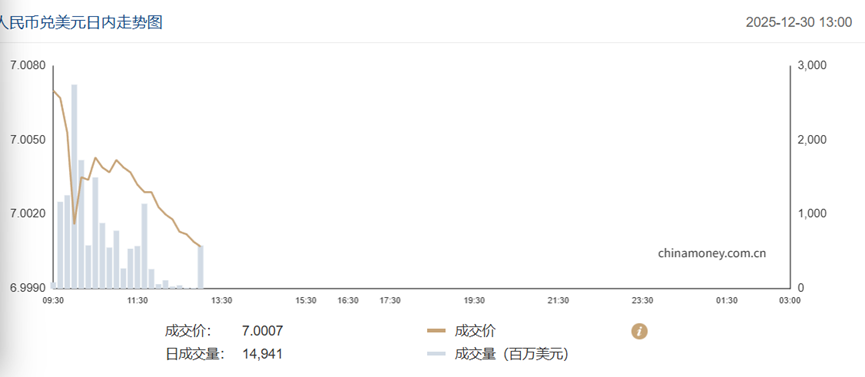
人民币对美元即期汇率升破“7”,今年已累计升值4%
Sou Hu Cai Jing· 2025-12-30 05:07
Group 1 - The core viewpoint is that the Chinese yuan has recently appreciated against the US dollar, breaking the "7" threshold in both offshore and onshore markets for the first time since October 2024 [1][2] - As of December 30, the onshore yuan's exchange rate against the US dollar has strengthened, marking a cumulative appreciation of 4% for the year, with a notable acceleration in appreciation since late November [1] - The offshore yuan also broke the "7" mark on December 25, indicating a recovery of this key level for the first time since October of the previous year [1] Group 2 - According to Wenkang Securities, the trend of yuan appreciation is expected to continue, but it will be gradual rather than rapid [2] - The narrowing of the interest rate differential between China and the US is anticipated to support the yuan's appreciation, driven by ongoing loose monetary policy in China and the potential for further rate cuts by the Federal Reserve [2] - China's trade surplus is also expected to contribute to the appreciation of the yuan in the external environment [2]
申万期货品种策略日报:股指-20251230
Shen Yin Wan Guo Qi Huo· 2025-12-30 03:27
| 五、宏观信息 | | --- | | 贵金属市场遭遇"黑色星期一"。周一现货白银亚市早盘历史首次突破80美元/盎司关口,并迅速冲高逼近84美元关口,涨幅接近6%。但随后行情急转直下, | | 纽约市场盘中一度大跌超11%。白银跳水带动其他贵金属同步下挫,现货钯金一度暴跌17%,现货铂金跌15%,现货黄金跌超5%。国内铂金、钯金双双封跌停; | | 沪银尾盘跳水,回吐全部日内10%涨幅,夜盘进一步下跌8.74%;沪金收盘跌近1%,夜盘进一步下跌4%。COMEX黄金期货收跌4.45%报4350.2美元/盎司,COMEX | | 白银期货收跌7.2%报71.64美元/盎司。 | | 中国将成为首个为央行数字货币计息的经济体。中国人民银行出台数字人民币行动方案,新一代数字人民币计量框架、管理体系、运行机制和生态体系将于 | | 2026年1月1日正式启动实施。届时,数字人民币钱包余额将按照活期存款计付利息,数字人民币将从"数字现金时代"迈入"数字存款货币"时代。 | | 12月29日开始,中国人民解放军东部战区组织陆军、海军、空军、火箭军等兵力,位台湾海峡、台岛北部、台岛西南、台岛东南、台岛以东等区域,组织"正 ...