
流动性宽松

Search documents
帮主郑重聊逆回购:央行7000亿操作,散户该关心啥?
Sou Hu Cai Jing· 2025-08-08 04:04
Group 1 - The central bank's reverse repurchase operation of 700 billion yuan is expected to enhance liquidity in the market, benefiting financial and consumer sectors sensitive to funding [2] - This operation signals the central bank's commitment to stabilizing the economy, which may boost market confidence, particularly in the volatile A-share market [2] - Historical data indicates that while short-term stock market gains are likely after reverse repurchase operations, long-term trends depend on corporate earnings and economic fundamentals [2] Group 2 - Investors are advised to focus on opportunities aligned with policy directions, such as valuation recovery in financial stocks and stable-performing leading companies in the consumer sector [3] - The core of long-term investment remains the company's profitability and industry outlook, cautioning against being swayed by short-term policy stimuli [3]

连续5日“吸金”,券商ETF(159842)盘中溢价,机构:板块有望迎来增量资金配置
2 1 Shi Ji Jing Ji Bao Dao· 2025-08-08 02:16
Group 1 - The three major indices opened lower and declined, with the brokerage ETF (159842) dropping by 0.96% and a trading volume exceeding 33 million yuan, indicating active trading despite the decline [1] - As of August 7, the brokerage ETF (159842) has seen a net inflow of nearly 190 million yuan over five consecutive trading days, reflecting strong investor interest [1] - The brokerage ETF tracks the CSI All Share Securities Companies Index, which consists of up to 50 stocks from the securities industry to represent the overall performance of the sector [1] Group 2 - In the first half of the year, the securities industry showed strong performance, with 24 out of 27 listed brokerages reporting profits, and 23 of them expecting profit growth [2] - Brokerage and margin financing businesses benefited from favorable policies, leading to significant increases in market transactions and maintaining high margin financing balances [2] - The regulatory body is promoting industry mergers and enhancing self-regulation, shifting the industry focus from "license-driven" to "capability-driven," which is expected to sustain market activity and liquidity [2]
商品,要抄底吗?
雪球· 2025-08-07 08:02
Core Viewpoint - The article discusses the recent volatility in the commodity market, highlighting the impact of market sentiment and policy changes on investment strategies, particularly in the context of CTA (Commodity Trading Advisor) strategies [5][23]. Market Environment - The commodity market experienced a reversal due to various factors, including liquidity conditions and economic recovery expectations, leading to a significant price drop in some commodities, with weekly declines reaching up to 20% [5][6]. - The market's recent downturn is seen as a correction of expectations returning to reality, despite underlying support from liquidity and economic factors [5][6]. Investment Strategies - Several CTA strategies are analyzed, showcasing their diverse approaches to capturing market opportunities while managing risks [8][20]. - Strategy A employs a multi-strategy approach with a focus on traditional trend-following and fundamental analysis, maintaining a diversified portfolio across approximately 40 commodities, stock indices, and treasury futures [8][10]. - Strategy B utilizes high-frequency trading with a focus on short-term opportunities, achieving an annualized return of 14.68% since its inception, although it faced challenges in the current low-volatility environment [14][15][17]. - Strategy C, a well-established player, has shown resilience with a 10.2% annualized return since 2017, maintaining a diversified portfolio across over 60 trading instruments [20][21]. Performance Metrics - Strategy A reported an annualized return of 15.73% since March 2023, with a maximum drawdown of 11.52% [12]. - Strategy B's performance was impacted by market conditions, resulting in a return of less than 1% year-to-date, with a recent drawdown of 3.62% due to market reversals [17][18]. - Strategy C achieved an 8.06% return in the current year, demonstrating strong performance amidst market fluctuations [21]. Conclusion - The article concludes that the recent commodity market reversal was primarily driven by emotional trading rather than policy changes, emphasizing the importance of market sentiment in shaping investment outcomes [23].

流动性宽松逻辑不改,关注恒生国企ETF(159850)、恒生ETF(159920)布局窗口
Sou Hu Cai Jing· 2025-08-06 06:35
Core Viewpoint - The recent pullback in Hong Kong stocks is primarily due to adjustments in both domestic and external expectations, but the medium-term liquidity easing logic remains unchanged [1] Group 1: Market Performance - As of the midday close on August 6, the Hang Seng Index rose by 0.18%, the Hang Seng China Enterprises Index fell by 0.03%, and the Hang Seng Tech Index increased by 0.03% [1] - Popular ETFs such as the Hang Seng China Enterprises ETF (159850) and the Hang Seng ETF (159920) experienced slight gains [1] Group 2: Investment Strategy - Huatai Securities recommends focusing on sectors with improving sentiment and low valuations, particularly emphasizing the technology sector [1] - Short-term trading should revolve around mid-year performance reports, with a focus on: 1. Game and internet e-commerce leaders that have attractive valuations and improving sentiment 2. Innovative pharmaceuticals and non-bank financials that have slightly higher forward 12-month valuation percentiles but strong earnings realization [1]
标的指数大涨,香港证券ETF(513090)近一月日均成交额超170亿元,居全市场股票型ETF第一
Mei Ri Jing Ji Xin Wen· 2025-08-05 17:39
Group 1 - The Hong Kong Securities Index rose by 2.1%, the China Securities Bank Index increased by 1.6%, the CSI 300 Non-Bank Financial Index went up by 1.3%, and the CSI All Share Securities Company Index climbed by 1.1% [1] - The Hong Kong Securities ETF (513090) had an average daily trading volume exceeding 17 billion yuan over the past month, making it the top-performing stock ETF in the market [1] - CITIC Securities believes that several brokerage firms are expected to report increased semi-annual earnings, driven by favorable conditions in brokerage, margin financing, and investment banking businesses, alongside deepening capital market reforms and liquidity easing [1] Group 2 - The CSI 300 Non-Bank Financial Index consists of 27 stocks from the CSI 300 Index that belong to the capital market, other financial sectors, and the insurance industry, with the insurance sector accounting for over 35%, making it one of the indices with the highest insurance sector representation in the market [3] - The Hong Kong Securities ETF tracks the CSI Hong Kong Securities Investment Theme Index [4] - The index includes stocks from asset management, custodial banks, investment banking, and brokerage industries within the Hong Kong Stock Connect range, as well as the Hong Kong Stock Exchange [5]
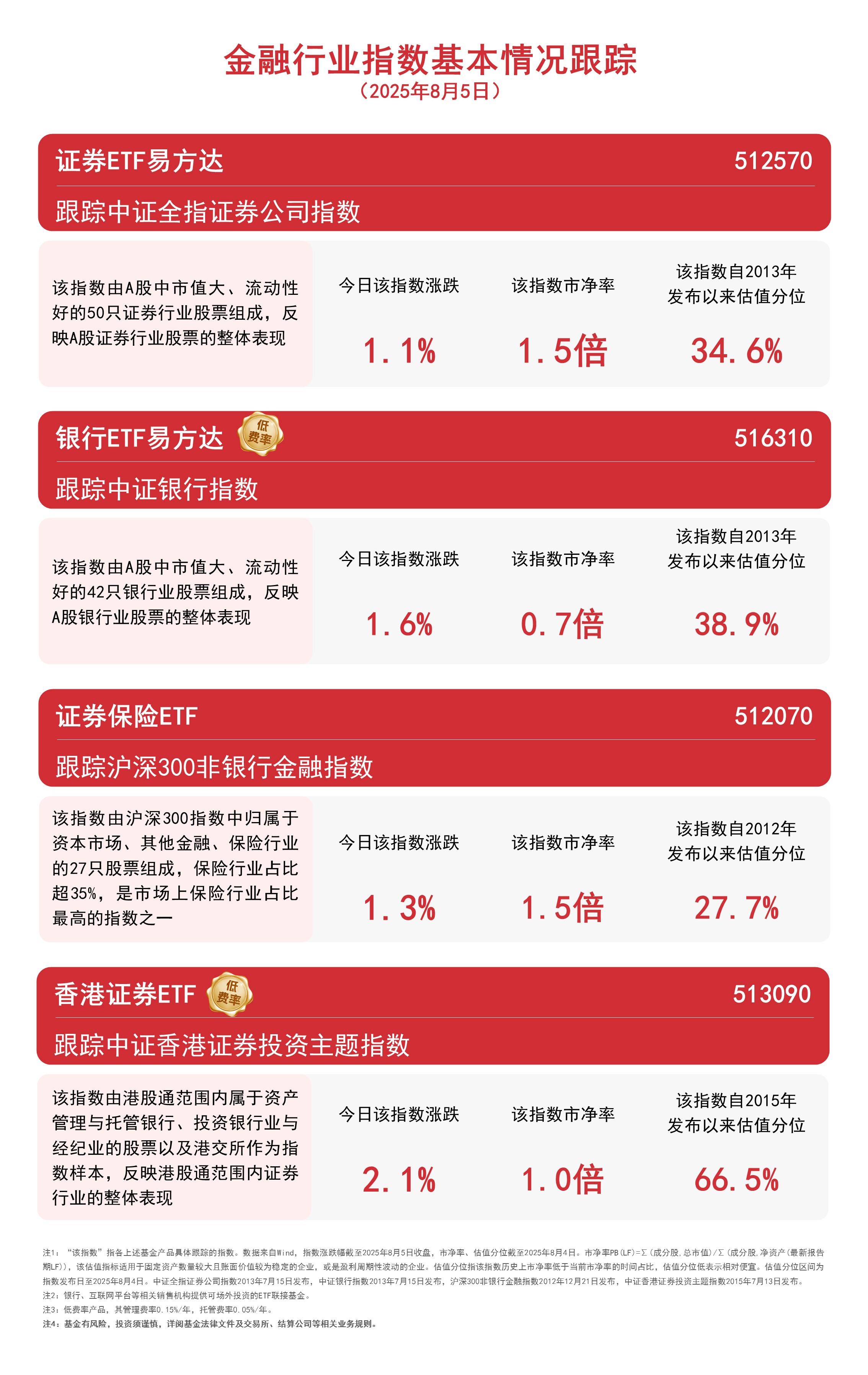
中资券商股普涨 权益市场收益率明显改善 机构料上半年券商业绩或好于预期
Zhi Tong Cai Jing· 2025-08-05 03:57
Group 1 - Chinese brokerage stocks experienced a general rise, with notable increases in shares such as GF Securities (up 2.46% to HKD 17.93), Dongfang Securities (up 2.42% to HKD 17.28), and CITIC Securities (up 1.52% to HKD 12.7) [1] - As of August 1, 27 listed brokerages have released their semi-annual performance forecasts, with 24 reporting profits, 23 showing profit increases, and 1 turning from loss to profit [1] - The brokerage sector is expected to see significant investment opportunities in the second half of the year, driven by strong semi-annual performance forecasts, deepening capital market reforms, and expectations of increased market liquidity [1] Group 2 - Guotai Junan predicts that the performance of listed brokerages in the first half of 2025 will exceed expectations, with a projected year-on-year increase in net profit attributable to shareholders of 61.23% [2] - Investment business is expected to contribute the most to revenue growth, accounting for 60.51% of the adjusted operating income increase, primarily due to improved returns in the equity market compared to the first half of 2024 [2] - The brokerage business is anticipated to contribute 32.40% to the adjusted revenue increase, driven by a significant year-on-year rise in market trading volume in the first half of 2025 [2]



“真金白银”积极入市 资金共振趋势或延续
Shang Hai Zheng Quan Bao· 2025-08-03 19:14
Group 1 - The core viewpoint is that with the gradual increase in market risk appetite, various funds are actively entering the market, with bank wealth management and public funds expected to become significant marginal forces in the second half of the year [1][2] - As of August 1, the weekly net subscription of stock ETFs in the Shanghai and Shenzhen markets exceeded 60 billion and 50 billion units respectively in the past two weeks, indicating strong inflow of incremental funds [1] - In July, the new issuance scale of equity funds reached 34.7 billion, an 18.8% increase from June's 29.2 billion, with the number of new funds increasing by 26 [1] Group 2 - The average position of public actively managed mixed equity funds was approximately 85.99% as of July 25, up 2.05 percentage points from July 18, indicating a significant increase in equity exposure [2] - It is estimated that about 3 trillion yuan of incremental funds will enter the market from various institutions, including insurance, wealth management, public funds, and trusts in 2025 [2] - The current market environment is characterized by a historical extreme in the stock-bond price ratio, driving a shift in asset allocation towards equity assets due to expected return requirements [2] Group 3 - The liquidity easing is expected to provide valuation support for A-shares, with both domestic and international factors contributing to a favorable environment for risk assets [3] - The recent continuous rise in A-shares has led to some profit-taking, but the overall liquidity environment is anticipated to support valuations in the long term [3] - Structural opportunities in A-shares are expected to continue emerging due to the active participation of funds and the market's recovery in profitability [3]
策略周报:市场回调带来结构性机会-20250803
HTSC· 2025-08-03 14:25
Group 1: Market Overview - Recent market pullback primarily due to internal and external expectation adjustments, with the Hang Seng Index down 4.5% from its recent peak, compared to a 2.3% decline in the CSI 300[3] - External factors, such as rising US Treasury yields (up to 4.4%) and a strengthening US dollar (breaking the 100 mark), have exerted greater pressure on Hong Kong stocks compared to A-shares[5] - Southbound capital inflow surged to a net inflow of HKD 59 billion, marking the highest weekly inflow since April 11, 2025[6] Group 2: Investment Strategy - Emphasis on sectors with improving sentiment and low valuations, particularly in technology, gaming, and e-commerce leaders[2] - Recommended to focus on stocks with reasonable valuations and improving fundamentals, especially in the innovative pharmaceutical and non-bank financial sectors[7] - The report suggests a tactical approach centered around upcoming mid-year earnings reports, with a focus on companies expected to deliver strong earnings[7]
中信建投:流动性相对宽松 行业配置方面战略看多成长
Zheng Quan Shi Bao Wang· 2025-08-01 00:25
Core Viewpoint - The economic data for the second quarter exceeded expectations, and the Central Political Bureau meeting at the end of July set a positive tone, indicating that the overall economy will still have support in the third quarter [1] Group 1: Economic Environment - The domestic liquidity environment is currently relatively loose, showing a "see-saw" effect between stocks and bonds [1] - Global risk appetite has significantly rebounded, suggesting a more favorable outlook for growth sectors [1] Group 2: Trade Relations - Recent tariff negotiations between the US and several countries have concluded, with actual additional tariff rates around 15% [1] - There is still considerable room for negotiation in future talks between the US and China, indicating manageable risks [1]

股指:上周中枢上行,本周有望延续结构性行情
Sou Hu Cai Jing· 2025-07-30 09:16
【股指周度观点更新:结构性行情有望延续但需警惕风险】上周主要观点指出,流动性宽松与反内卷政 策预期支撑指数震荡中枢上移,结构性行情延续,不过国内供需矛盾与全球贸易政策不确定性或压制上 行空间。 上周走势显示,在政策利好、产业复苏与流动性宽松共振下,三大指数震荡中枢继续上行。 上半年GDP增速5.3%,基本面韧性复苏。7月LPR维持不变,央行MLF净投放1000亿,货币政策延续支 持。 此外,工信部将出台重点行业稳增长方案,推动落后产能退出,钢铁、煤炭等传统行业盈利改善 预期增强。雅江下游水电工程、海南自贸区全岛"封关"带动相关板块上涨。 本周主要观点认为,当前 国内流动性宽松与政策预期共振,海外制造业需求回升,指数有望延续结构性行情震荡上涨。但要关 注"反内卷"政策与需求端配合,以及关税和美联储降息节奏扰动。短线需警惕情绪过热回调风险。 风 险提示包括反内卷政策不及预期、关税摩擦升级、美联储降息推迟。 本文由 AI 算法生成,仅作参考,不涉投资建议,使用风险自担 ...