
美元贬值

Search documents
人民币破7在望,在岸价升至7.0908创一年来新高
21世纪经济报道· 2025-11-14 09:16
Core Viewpoint - The article discusses the recent performance of the RMB against the USD, highlighting a stable and slightly appreciating trend due to a weaker USD environment and strong domestic equity market attracting foreign investment [2][4]. Exchange Rate Performance - On November 14, the RMB/USD central parity rate was adjusted up by 40 basis points to 7.0825, with a year-to-date increase of approximately 1000 basis points [4]. - The onshore and offshore RMB also showed slight increases, with onshore RMB at 7.0937 and offshore RMB at 7.0935 as of noon on November 14 [4]. - The overall trend for the USD against the RMB has been a one-sided decline throughout the year, with the USD starting at 7.27 RMB and reaching a low of 7.08532 RMB on September 17 [5]. Future Outlook - Analysts predict that the RMB will continue to operate in a strong state in the short term, with potential for moderate appreciation by 2026 [2][7]. - Factors influencing this outlook include the anticipated acceleration of Fed rate cuts and the limited upward space for the USD index due to the impact of US tariff policies [7][9]. - The central bank's policies are expected to provide substantial support for the RMB, ensuring stability in the exchange rate [9]. Market Sentiment - There is a potential for the RMB central parity to test the "7" level, supported by a weak USD and seasonal demand for currency settlement [8]. - Optimistic scenarios suggest that the USD/RMB exchange rate could approach 7.0 by year-end, with a new equilibrium potentially around 6.7 [8][10]. - The RMB is expected to maintain a dual-directional fluctuation pattern, with limited risks of rapid appreciation or depreciation [8].


算力争霸:比特币挖矿背后,中美正在争夺全球经济的新权力钥匙
Sou Hu Cai Jing· 2025-11-12 12:30
Core Insights - China was once the global center for cryptocurrency, controlling 80% of Bitcoin production and 85% of trading volume, but has now been overtaken by the U.S. following the "9.24 ban" which classified cryptocurrency mining as an "eliminated industry" [1][35][36] - The U.S. is promoting "green mining" by utilizing wasted energy as a strategic asset, positioning itself as the new leader in the cryptocurrency space [1][10] Group 1: Bitcoin as an Energy Resource - Bitcoin mining is often criticized for wasting energy, with the energy required to mine one Bitcoin equivalent to the annual electricity consumption of about 80 American households [4][5] - Both the U.S. and China experience significant amounts of wasted electricity annually, with China alone discarding 5.59 billion kilowatt-hours of wind and solar energy in 2024 [8] - In the U.S., 19% of wasted electricity is projected to be consumed by mining operations by 2025, resulting in a reduction of 1.3 million tons of CO₂ emissions [11] Group 2: U.S. Strategic Initiatives - The U.S. has introduced the "FLARE Act" to utilize associated gas from oil extraction for powering mining operations, effectively reducing pollution while mining [16][17] - The merger of Hut8 and the Trump family's "American Data Center Company" to form "American Bitcoin Company" highlights the political and financial interests in the mining sector [21][22] - The Trump administration has positioned Bitcoin alongside gold and oil, promoting it as a tool for economic stability and risk hedging [27][28] Group 3: China's Potential Strategies - Experts suggest that China could convert its wasted electricity into Bitcoin as a form of energy reserve, adopting a model similar to Texas's "solar + storage + mining" approach [40] - Establishing a digital RMB stablecoin and enhancing cross-border settlements could help China regain its footing in the cryptocurrency market [41][42] - Accelerating the production of advanced chips domestically to reduce reliance on foreign suppliers like TSMC is crucial for China's competitiveness in the mining hardware sector [45][46] Group 4: The Broader Implications - The CEO of Core Scientific emphasizes that the U.S. aims to "weaponize" Bitcoin by controlling energy through mining operations [48] - China's ability to convert wasted electricity into computational power, combined with a stablecoin strategy, could reshape the balance of power in the global economy [49][51] - The next decade will see Bitcoin mining evolve beyond a technical competition to a significant shift in civilizational dynamics [52]
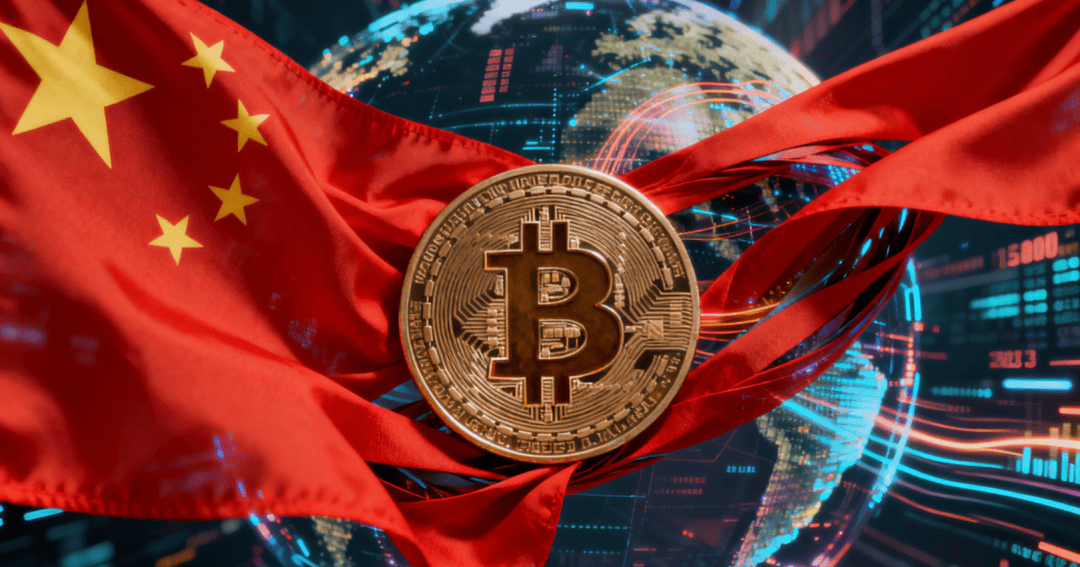
dbg markets盾博:分析师预测美元将在特朗普任期内继续下跌13.5%
Sou Hu Cai Jing· 2025-11-12 01:40
Core Viewpoint - Renowned analyst Stephen Jen maintains a bearish outlook on the US dollar, believing that its recent rebound is unlikely to last and that the dollar will continue to decline [1][3]. Group 1: Dollar Outlook - According to Jen's estimates, the dollar index may decline by an additional 13.5% during Trump's remaining presidential term [3]. - As of 2025, the dollar index is projected to have fallen approximately 7% from the beginning of the year, potentially making 2025 the worst year for the dollar in nearly eight years [3]. - The dollar's weakness this year is primarily attributed to the erratic trade policies of the Trump administration and strong market expectations for a Federal Reserve rate cut [3]. Group 2: Economic Indicators - A report from ADP indicates a noticeable slowdown in the US labor market, with job growth falling short of expectations, which contributed to a slight decline in the Bloomberg dollar spot index [3]. - The International Monetary Fund forecasts that US GDP growth will slow from 2.8% last year to 2% by 2025, while the Eurozone's economic growth is expected to rise from 0.9% in 2024 to 1.2% [3]. Group 3: Policy Implications - Jen emphasizes that the Trump administration's efforts to revitalize US manufacturing align with a weaker dollar, as it would lower export costs and enhance competitiveness in global markets [3]. Group 4: Alternative Assets - The market's aversion to the dollar and other major reserve currencies is increasing, driving prices of alternative assets like gold to historical highs [4]. - Jen believes that as the dollar continues its downward trend, the preference for safe-haven assets and non-sovereign currency assets will strengthen, sustaining the upward trend in gold prices [4].
金价创新高,专家说美元会大幅贬值,滑向上世纪大萧条时代
Sou Hu Cai Jing· 2025-11-07 06:42
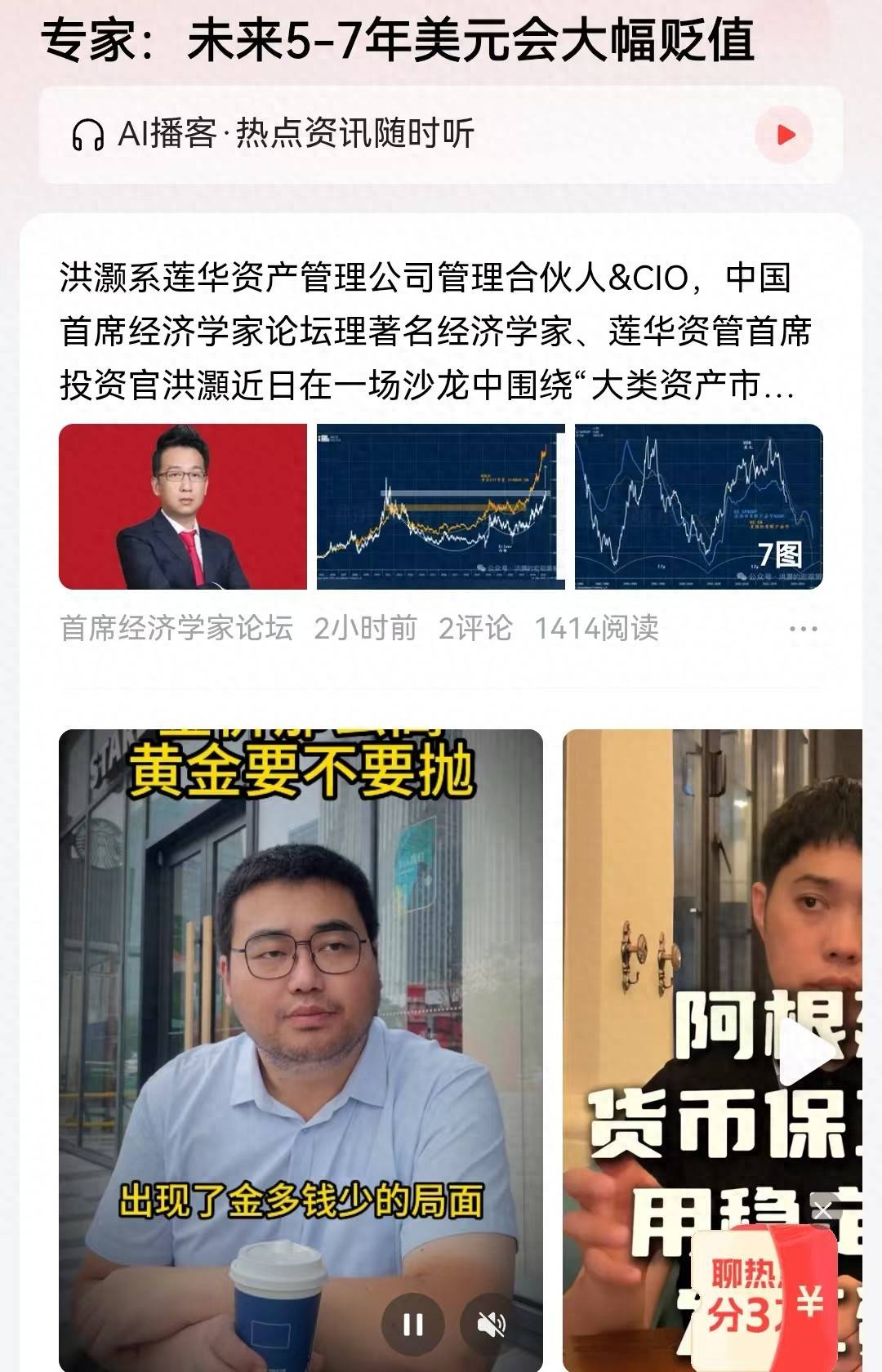
Core Viewpoint - The Federal Reserve's interest rate cuts have not led to a decrease in gold prices, which have reached new highs, indicating that monetary policy alone cannot resolve the underlying issues in the U.S. economy [1][3]. Gold Market Analysis - Goldman Sachs has reported that international gold prices have entered a bull market, projecting prices to reach $6,000 per ounce, with current prices exceeding $3,770 per ounce, reflecting a nearly 2% increase [3][4]. - The domestic price of gold jewelry has surpassed 1,100 yuan per gram, while the spot trading price has exceeded 865 yuan per gram, marking unprecedented high prices [3][4]. - Gold prices have been adjusted for inflation, surpassing historical peaks from 45 years ago, with 31 new price highs recorded in 2025 alone [3][4]. Economic Implications - The continuous rise in gold prices suggests a depreciation of the U.S. dollar against gold, with predictions of significant dollar devaluation in the next 5 to 7 years [4][5]. - The U.S. is facing increasing fiscal and trade deficits, with the potential for a fiscal crisis, which could lead to a loss of confidence in the dollar and a shift towards gold as a safe-haven asset [8][10]. - Global experts, including Ray Dalio from Bridgewater Associates, have expressed concerns about the U.S. economic policies, warning of a possible debt crisis reminiscent of the Great Depression [8][10]. Market Sentiment - The ongoing concerns regarding the U.S. economic outlook have contributed to the sustained bull market in gold, even after inflation adjustments [10]. - The political interference in the Federal Reserve's operations has raised doubts about its independence and credibility, further driving investors towards gold [12].
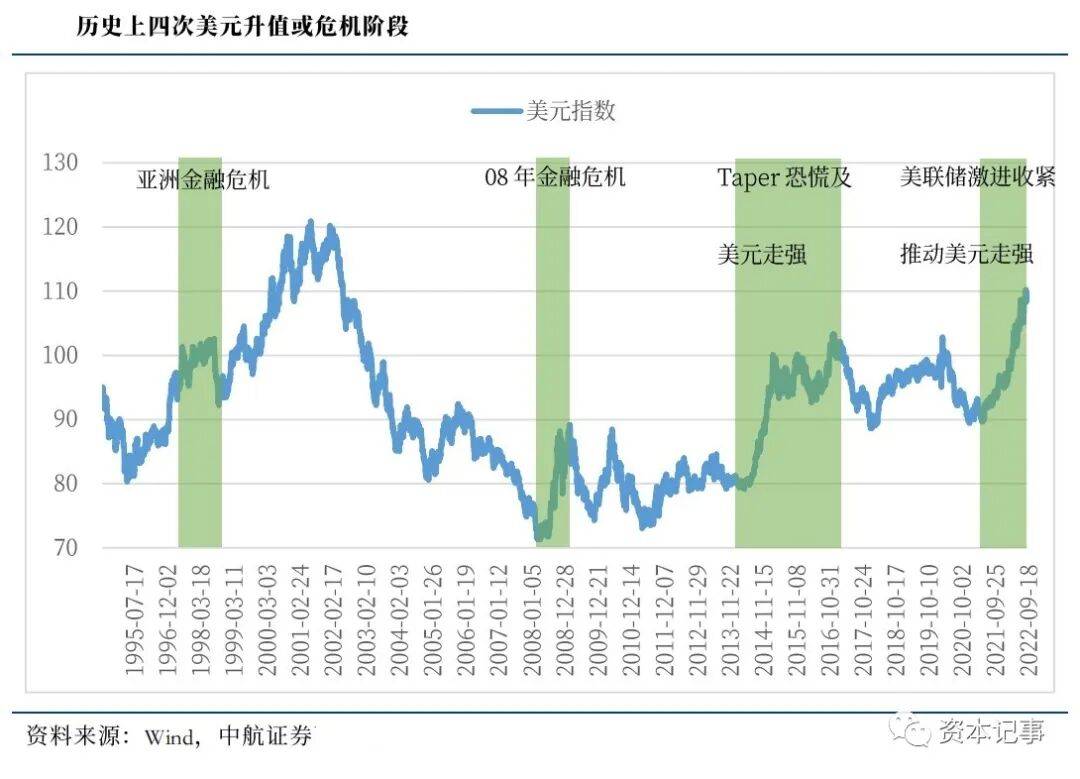
时钟已进入弱美元周期
Sou Hu Cai Jing· 2025-11-06 14:12
Core Viewpoint - The article discusses the transition from a strong dollar cycle to a weak dollar cycle, highlighting the expected decline of the US dollar and its implications for global assets and currencies [1][2][3]. Summary by Sections Dollar Cycle Phases - The dollar has experienced various cycles since 1971, with the current phase being a weak dollar cycle that has lasted over a year [1]. - Morgan Stanley predicts a significant decline in the DXY dollar index to 89 by the end of 2026, approximately 10% lower than the current level of 99.7 [2]. Currency Predictions - By the end of 2026, the euro is expected to rise from 1.1533 to 1.27 against the dollar, and the British pound from 1.3111 to 1.47 [2]. - The dollar is projected to fall against the Japanese yen from 154 to 124 [2]. - Deutsche Bank forecasts the dollar to yuan exchange rate to drop to 6.7 by the end of 2026 [2]. Monetary Policy and Interest Rates - The Federal Reserve recently lowered the federal funds rate by 25 basis points to a target range of 3.75%–4.00%, signaling a gradual easing approach [2]. - Market expectations for further rate cuts in 2026 have decreased, with a potential terminal rate approaching 3% [2]. Factors Influencing Dollar Weakness - Interest rate differentials are narrowing, with the Fed's rate cuts and the European Central Bank's slower rate cuts expected to reduce the dollar's carry trade advantage [3]. - Fiscal policies, including the anticipated tax cuts under Trump, are projected to increase federal deficits significantly, contributing to a weaker dollar [3]. - Global trust in the dollar as a safe asset is diminishing due to geopolitical tensions and economic policies, with the IMF reporting the lowest global dollar reserve share since 1995 [3]. Asset Rotation and Market Sentiment - A clear rotation in global assets is anticipated, with risk assets rebounding and commodity prices rising as the dollar weakens [7]. - Institutions like Allianz, UBS, and Bank of America recognize the consensus on a weaker dollar, shifting market logic towards buying non-dollar assets [7]. - UBS has upgraded emerging market stocks to overweight, particularly favoring Chinese stocks due to their relative valuation and low foreign investor holdings [7].


美元空头公然对抗美联储 看跌预期根深蒂固
Sou Hu Cai Jing· 2025-11-06 07:45
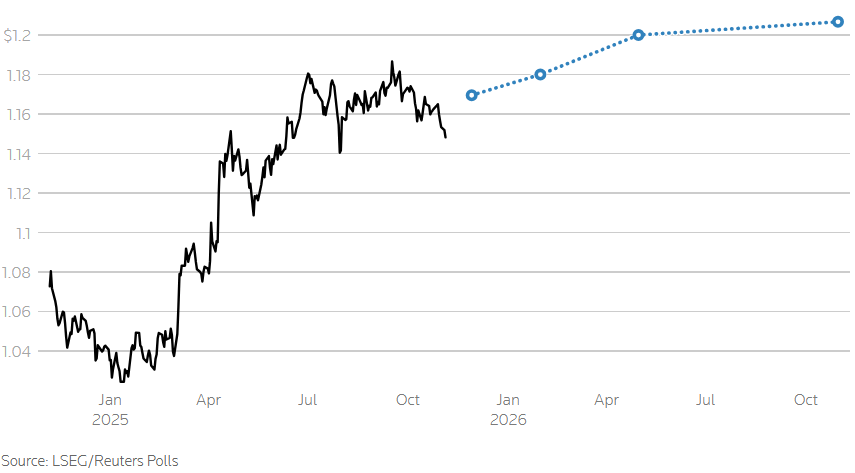
Core Viewpoint - The market is betting on multiple interest rate cuts by the Federal Reserve, leading to a weaker dollar in the coming months, with traders expected to maintain net short positions on the dollar throughout November [1]. Group 1: Market Sentiment and Predictions - A recent Reuters survey indicated that 30 out of 45 strategists (two-thirds) expect traders to maintain net short positions on the dollar by the end of November, although the degree of short positioning is anticipated to be less extreme than in previous observations [1]. - According to Jayati Bharadwaj from TD Securities, the current dollar positioning is only moderately bearish and is gradually approaching neutral levels, contrasting with previous extremes [2]. - The probability of a December rate cut by the Federal Reserve is currently estimated at around 70%, down from nearly 90% prior to the last policy meeting, which has cooled the enthusiasm for "selling the dollar" but has not changed overall market expectations [2]. Group 2: Currency Forecasts - Strategists predict that the euro will appreciate against the dollar, with expectations of a slight increase to 1.18 in three months and reaching 1.20 in six months, while the one-year forecast remains stable at 1.21 [2]. - Approximately 53% of respondents in a recent survey believe that the dollar's year-end closing price is more likely to be below their predicted value, indicating a cautious outlook [3]. Group 3: Political Influence on Monetary Policy - Vincent Reinhart, a former Fed official, noted that political influence on the Federal Reserve is expected to increase, particularly as the current administration gains more voting power on the Fed's board over time [3]. - The current administration's strong approach in exercising this control is a core reason for the prediction of lower policy rates and a depreciating dollar [4].
美联储12月降息或仍是大概率事件!机构:美元贬值或成港股科技破局关键
Sou Hu Cai Jing· 2025-11-05 03:32
Group 1 - The Hang Seng Technology Index experienced a decline of over 2%, influenced by a sell-off in U.S. tech stocks, with major AI concept stocks mostly falling [1] - Key stocks such as Bilibili, Tencent Music, Kingsoft, Huahong Semiconductor, SenseTime, and XPeng Motors led the decline, while Alibaba saw a drop of over 2% with a trading volume exceeding 7.5 billion [1] - Chief Investment Officer of Lianhua Asset Management, Hong Hao, indicated that a 25 basis point rate cut by the Federal Reserve in December is a high probability event due to current liquidity tightness and inflation pressures [1] Group 2 - Zheshang Securities highlighted that the depreciation of the U.S. dollar is crucial for the next market breakthrough, with expectations for this trend to solidify by the end of November [2] - The Hang Seng Technology Index ETF (513180) is currently valued at a price-to-earnings ratio of 22.59, which is 26.83% lower than its historical average, indicating it is cheaper than over 73% of its historical time [2] - The combination of potential Fed rate cuts and a weakening dollar is expected to attract foreign capital back into the market, with the AI industry trend remaining strong, suggesting a possible turnaround for the Hang Seng Technology Index in the fourth quarter [2]
11月底若美元确立贬值趋势,最受益品种或为恒生科技
Mei Ri Jing Ji Xin Wen· 2025-11-03 02:57
Group 1 - The Hong Kong stock market showed mixed performance on November 3, with the Hang Seng Technology Index experiencing slight fluctuations after a small opening [1] - The energy and coal sectors remained active, while the semiconductor and non-ferrous metals sectors led the declines [1] - The Hang Seng Technology Index ETF (513180) followed the index's downward trend, with leading stocks including Xiaomi, Xpeng Motors, and NIO, while SMIC and Huahong Semiconductor lagged [1] Group 2 - According to Zheshang Securities, the current market's capital activity is weakening, and the depreciation of the US dollar is seen as a key factor for the next market breakthrough [1] - The firm anticipates that the depreciation of the US dollar will remain a mid-term trend, with a potential starting point around the end of November [1] - Recent data indicates a shift towards marginal tightening in US fiscal policy, which may weaken the overall US job market [1] Group 3 - As of October 31, the latest valuation (PETTM) of the Hang Seng Technology Index ETF (513180) is 22.85 times, placing it in the historical low valuation range, below 71% of the time since the index was launched [2] - The technology sector in Hong Kong is expected to benefit from the current trends in AI, with potential foreign capital inflows exceeding expectations due to the backdrop of Federal Reserve interest rate cuts [2] - Investors without a Hong Kong Stock Connect account may consider using the Hang Seng Technology Index ETF (513180) to gain exposure to core Chinese AI assets [2]
A Different Way Of Looking At The Rally In The Price Of Gold
Forbes· 2025-11-02 15:35
Core Insights - The price of gold has increased by nearly 30% over the past year as investors seek stability amid geopolitical tensions, particularly regarding the likelihood of war with Iraq [2] - Ken Fisher argues that gold is often misinterpreted as a reliable indicator of market performance, suggesting that equities have historically outperformed gold [3][4] - The historical performance of gold and equities shows that while gold has periods of significant gains, equities tend to provide higher long-term returns [7][8] Gold as an Inflation Hedge - Fisher claims that gold is not a great hedge against inflation, citing 2022 when inflation reached 40-year highs while gold experienced declines [5] - The article posits that the inflation seen in 2022 was not true inflation but rather a result of disruptions in global production, leading to higher prices without the underlying economic conditions typically associated with inflation [5] - Historical data indicates that gold's price surged during the 1970s, suggesting it can be a reliable measure of inflation during certain periods [6][9] Market Dynamics - The 2000s saw a significant increase in gold prices, closing the decade at $1,226 per ounce, representing a 360% return, while the S&P 500 declined [8] - The article suggests that gold's current price levels, while high, are relatively modest compared to previous decades, indicating a potential for stronger equity returns if the dollar were not weak [10] - The distinction between inflation measured by the Consumer Price Index (CPI) and inflation as indicated by gold prices raises concerns for investors, as gold may signal deeper economic issues [11]

主动量化周报:11月:资金动能减弱,月底再启动-20251102
ZHESHANG SECURITIES· 2025-11-02 10:26
- The report discusses the construction and evaluation of a market timing model based on micro-market structure indicators. The model tracks the activity level of informed traders to predict market movements. The specific process involves monitoring the marginal changes in the activity level of informed traders, which is then used to gauge their sentiment towards future market trends[17][20] - The report also includes a price segmentation system for the Shanghai Composite Index. This system analyzes the index's daily and weekly price movements to identify marginal upward trends. The construction process involves segmenting the price data into different intervals and analyzing the trends within these segments[16][19] - The evaluation of the market timing model indicates that the activity level of informed traders has shown a slight increase, suggesting a cautiously optimistic outlook for the market. The price segmentation system shows that the Shanghai Composite Index has maintained a marginal upward trend on both daily and weekly scales[17][19][20] Model Backtesting Results - Market Timing Model: The activity level of informed traders has shown a slight increase, indicating a cautiously optimistic outlook for the market[17][20] - Price Segmentation System: The Shanghai Composite Index has maintained a marginal upward trend on both daily and weekly scales[16][19] Quantitative Factors and Construction - The report discusses various BARRA style factors and their performance. These factors include turnover, financial leverage, earnings volatility, earnings quality, profitability, investment quality, long-term reversal, EP value, BP value, growth, momentum, non-linear size, size, and volatility. The construction process involves calculating these factors based on financial and market data, and then analyzing their performance over the week[24][25][26] - The evaluation of these factors shows that momentum and investment quality factors have performed well, while high volatility and high turnover stocks have faced pullbacks. The BP value factor has also shown positive performance, indicating a preference for value stocks over growth stocks[24][25][26] Factor Backtesting Results - Turnover: -0.5%[25] - Financial Leverage: 0.1%[25] - Earnings Volatility: 0.0%[25] - Earnings Quality: 0.3%[25] - Profitability: 0.3%[25] - Investment Quality: 0.4%[25] - Long-term Reversal: -0.5%[25] - EP Value: -0.3%[25] - BP Value: 0.2%[25] - Growth: 0.1%[25] - Momentum: 1.2%[25] - Non-linear Size: 0.0%[25] - Size: -0.3%[25] - Volatility: -0.5%[25]
