关税

Search documents
TJX(TJX) - 2026 Q3 - Earnings Call Transcript
2025-11-19 17:02
Financial Data and Key Metrics Changes - The company reported a consolidated comp sales growth of 5%, exceeding expectations, driven by strong performance across all divisions [5][8] - Pre-tax profit margin for the third quarter was 12.7%, up 40 basis points year-over-year, while gross margin increased by 100 basis points due to lower freight costs and expense efficiencies [8][9] - Diluted earnings per share for the third quarter were $1.28, a 12% increase compared to the previous year, and above expectations [9][24] Business Line Data and Key Metrics Changes - At Marmaxx, comp sales grew by 6%, with strong increases in both apparel and home categories, and segment profit margin improved to 14.9%, up 60 basis points year-over-year [10] - HomeGoods experienced a 5% increase in comp sales, with segment profit margin rising to 13.5%, up 120 basis points compared to last year [11] - TJX Canada's comp sales increased by 8%, while segment profit margin on a constant currency basis was 14.9%, down 20 basis points due to unfavorable foreign exchange [12] Market Data and Key Metrics Changes - TJX International saw a 3% increase in comp sales, with segment profit margin on a constant currency basis rising to 9.2%, up 190 basis points year-over-year [12] - The company reported a 12% increase in overall inventory, with inventory per store up 8% compared to last year, indicating strong buying into quality branded merchandise [13] Company Strategy and Development Direction - The company is focused on maintaining its value proposition and expanding its store footprint, with a long-term target of 7,000 stores in current countries and Spain [18] - The strategy includes enhancing customer experience through fresh assortments and marketing campaigns aimed at value-conscious shoppers [15][17] - The company plans to leverage its strong inventory position to attract customers during the holiday season and beyond [16][19] Management's Comments on Operating Environment and Future Outlook - Management expressed confidence in the company's ability to navigate the current retail environment, citing strong consumer demand for value and a positive shopping experience [5][18] - The company anticipates continued growth opportunities, particularly in the U.S. and international markets, despite potential challenges from tariffs [24][90] - Management highlighted the importance of maintaining a balanced approach to pricing and inventory management to sustain momentum [41][115] Other Important Information - The company returned $1.1 billion to shareholders through buybacks and dividends in the third quarter [13] - The 2025 Global Corporate Responsibility Report was published, covering key areas such as workplace, communities, environmental sustainability, and responsible sourcing [21] Q&A Session Summary Question: What gives confidence in continuing comp momentum during the holiday season? - Management noted consistent comp momentum driven by a strong shopping experience and branded merchandise at competitive prices [28][29] Question: Was the increase in basket size due to higher AUR or true price increases? - The increase in basket size was attributed more to selective price increases rather than a change in merchandise mix [40][41] Question: Are there categories where raising prices has been less successful? - Management indicated that they had one category where price increases were not successful, but overall, they were 95% successful in their pricing strategy [80][81] Question: How does the company view the impact of tariffs on inventory availability? - Management expressed surprise at the high availability of inventory despite tariffs, suggesting that other retailers may be struggling [122]

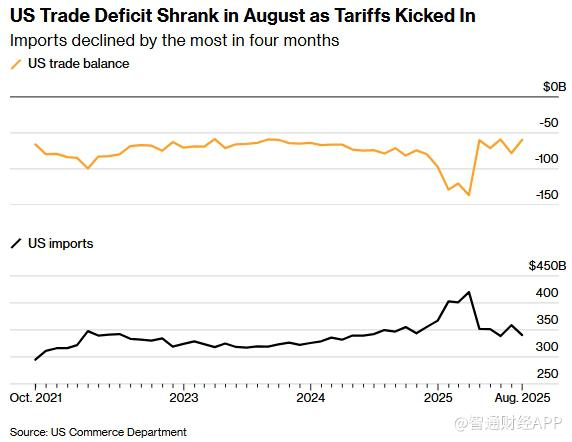
美国补发8月贸易数据 逆差大幅收窄至596亿美元 黄金进口暴跌
智通财经网· 2025-11-19 14:28
Core Insights - The latest data from the U.S. Department of Commerce indicates a significant narrowing of the trade deficit in August, attributed to a sharp decline in imports following the implementation of global tariffs announced by President Trump [1][3] - The trade deficit for goods and services decreased by nearly 24% from July, reaching $59.6 billion, which was better than the market expectation of $60.4 billion [1][3] Trade Data Summary - Total imports in August fell by 5.1%, marking the largest decline in four months, while exports saw a slight increase [3] - The previous month, July, experienced an expansion of the trade deficit due to businesses accelerating inventory purchases ahead of the implementation of tariffs [3] - The volatility in trade data is expected to impact economic indicators such as GDP, with the Atlanta Fed's GDPNow model indicating a 0.57 percentage point contribution from net exports to Q3 GDP [3] Import Dynamics - The primary reason for the decline in imports was a significant reduction in non-monetary gold imports, directly linked to increased tariffs on Swiss gold products [3] - The U.S. trade deficit with Switzerland has notably narrowed due to these tariff adjustments, and an agreement has been reached to lower gold import taxes [3] - Additionally, there was a decrease in imports of capital goods, including computer parts and communication equipment [3] Adjusted Trade Deficit - After inflation adjustment, the trade deficit for goods in August narrowed to $83.7 billion, the smallest since the end of 2023 [3] - The trade deficit with China expanded to its highest level since April, while the deficit with Mexico slightly decreased and the deficit with Canada significantly narrowed [3]

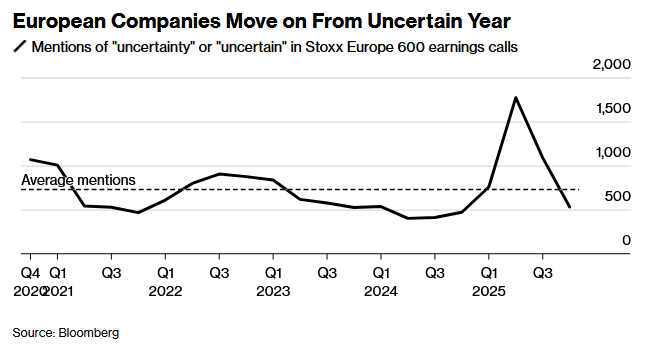
欧洲企业摆脱不确定性困扰 着眼2026年乐观增长前景
Zhi Tong Cai Jing· 2025-11-19 06:51
Group 1 - European companies largely withstood pessimistic profit expectations in Q3, with more upward guidance revisions than downward ones, achieving better-than-expected profit margins despite tariff and exchange rate pressures [3] - The overall tone of discussions regarding supply chains, inflation, and economic recovery has become more optimistic, as indicated by a decrease in mentions of tariffs compared to Q1 and Q2 [3] - The trade agreement between the US and EU, which established a 15% tariff rate, has contributed to increased confidence among companies regarding future cost and profit trajectories [3] Group 2 - Hexpol AB, a company providing rubber and plastic components for the automotive and construction industries, frequently mentioned uncertainty due to ongoing trade tensions, indicating that US tariffs have negatively impacted North American clients and suppressed demand [3] - Volvo Group expressed concerns over uncertainty in the North American market, attributing reduced orders to decreased freight activity and a 25% tariff on medium and heavy trucks, expecting this weakness to persist into next year [4] Group 3 - The current weak market conditions have shifted from being widespread to more localized, enhancing confidence in a recovery next year, which has led to upward revisions in expectations for 2026 [7] - Despite challenges in the automotive and chemical sectors, the resilience shown by both cyclical and defensive industries is laying a stronger foundation for profit growth in 2026 [7]
瑞银:房价企稳时间再度推迟
Sou Hu Cai Jing· 2025-11-19 04:08
Group 1: Currency and Investment Trends - Offshore RMB (CNH) has the lowest adjusted 3-month carry yield among major Asian currencies at approximately -0.20, making it less attractive for capital inflows aimed at arbitrage compared to higher-yield currencies [6] - Morgan Stanley indicates that this low yield supports the view that the offshore RMB to USD exchange rate will continue to fluctuate within a range [6] Group 2: Real Estate Market Insights - UBS forecasts that the national residential inventory digestion cycle will extend from approximately 30 months to 25 months, with stabilization of housing prices expected by mid-2027, delayed from early 2026 [8] - The forecast faces multiple downside risks, including weaker-than-expected sales recovery and rising mortgage default rates, which could exert new downward pressure on housing prices [8] Group 3: International Travel and Economic Impact - Japan is projected to be the largest international air travel destination for Chinese tourists by 2025, with an estimated 66,150 flights planned, significantly higher than South Korea and Thailand [11] - Nomura estimates that restrictions on Chinese tourists traveling to Japan could result in a GDP loss of up to 0.36 percentage points for Japan [11] Group 4: Manufacturing and Investment Shifts - Chinese companies are accelerating the relocation of manufacturing facilities to Southeast Asia, with the region's share of China's total outbound direct investment rising from nearly 9% in 2017 to close to 18% by 2024 [13] - China's reliance on high-end capital goods from Germany is decreasing, particularly in automotive parts and machinery, as domestic manufacturing capabilities improve [16] Group 5: Automotive Market Developments - The UAE has overtaken Russia to become China's second-largest export market for passenger vehicles, with exports reaching 367,800 units in the first nine months of 2025, surpassing 357,700 units to Russia [18] - Chinese automotive brands are rapidly increasing their market share in the UAE, rising from 10%-14% last year to 15%-20% in the first nine months of this year [20] Group 6: Economic Sentiment and Consumer Behavior - In the U.S., the disparity in economic confidence between high-income and low-income groups is widening, with high-income households maintaining a growth expectation of 3.0%-3.5%, while low-income households' expectations have dropped to around 2.0% [31] - Food price inflation disproportionately affects low-income families, with the lowest income decile spending 45% of their after-tax income on food, compared to about 15% for the second-lowest income group [28] Group 7: Corporate Financing and AI Investments - Amazon plans to issue approximately $12 billion in bonds to finance its AI infrastructure, marking its first dollar bond issuance in three years, as part of a broader capital race in the tech sector [37] - OpenAI and Anthropic exhibit contrasting strategies in capital utilization and profitability paths, with OpenAI expected to incur significantly higher cash consumption before achieving profitability by 2030 [42] Group 8: European Economic Outlook - The European Commission has raised its GDP growth forecast for the Eurozone in 2025 to 1.3%, up from 0.9%, due to stronger-than-expected economic performance in the first nine months of the year [47] - European companies are generally lowering their earnings expectations for the 2025 fiscal year, with 19 out of 22 sectors experiencing downward revisions, particularly in cyclical industries like paper and packaging, and automotive [50] Group 9: Commodity and Energy Market Dynamics - Russian Urals crude oil prices have sharply declined as sanctions against major Russian energy companies come into effect, with the price gap between Urals and Brent crude widening to $23.52 per barrel [65]

Fed BOMBSHELL: 150 years of data shatters Dems tariff talking points
Youtube· 2025-11-19 01:15
Core Viewpoint - A new Federal Reserve study suggests that tariffs may actually lower inflation by reducing demand, causing unemployment, and slowing economic activity, contradicting the establishment's narrative that tariffs are inflationary [1][4][9]. Economic Impact of Tariffs - The study indicates that tariffs lead to a one-time price adjustment rather than an ongoing inflationary spiral, as inflation is defined by continuous price increases rather than singular adjustments [4][5]. - Tariffs can raise prices, leading to decreased consumption and slower economic activity, which may not necessarily result in inflation [8][9]. - The political narrative surrounding tariffs has shifted, with some parties attributing inflationary pressures to tariffs as a means to project blame onto previous administrations [6][14]. Consumption Trends - Current data does not show evidence of reduced consumer spending, with consumers remaining active despite tariff impacts [12][15]. - The perception of a tariff-induced recession is argued to be a political strategy rather than a reflection of economic reality, as GDP growth has been relatively strong [14][15]. Strategic Considerations - While tariffs may have negative economic effects, they could serve strategic purposes in trade relationships, particularly with countries like China [8]. - The discussion around tariffs and their economic implications has been influenced by political agendas, affecting how economic data is interpreted and communicated [14][15].

富格林:可信探测斟酌细节保障安全
Sou Hu Cai Jing· 2025-11-18 03:31
Group 1: Gold and Oil Markets - Spot gold prices fell for the third consecutive trading day, dropping nearly $100 from the daily high, closing down 0.83% at $4045.67 per ounce [1] - International crude oil opened lower as Russian oil exports from Novorossiysk port resumed after a two-day halt; WTI crude failed to break the $60 mark, closing down 0.13% at $59.74 per barrel, while Brent crude fell 0.38% to $63.71 per barrel [1] Group 2: Federal Reserve Insights - Federal Reserve Vice Chair Jefferson noted an increase in downside risks to employment but emphasized the need for cautious policy adjustments [1] - Fed Governor Cook denied fraud allegations, labeling them as "political persecution" [1] - Fed Chair candidate Hassett mentioned mixed signals in the job market, suggesting that AI may suppress hiring demand [1] - Fed Governor Waller supports a 25 basis point rate cut in December, which would provide additional support to the labor market, with upcoming employment data unlikely to alter this view [1] Group 3: Trade and Tariffs - The EU plans to warn the U.S. against expanding the scope of steel tariffs [1] - The UK is reportedly drafting countermeasures against EU steel tariffs [1] - India and the U.S. may soon reach an agreement on reciprocal tariffs, as India's trade deficit hit a record in October due to soaring gold imports and declining exports to the U.S. [1] Group 4: Economic Forecasts - The EU has raised its GDP growth forecast for this year from 0.9% to 1.3%, with inflation nearing the European Central Bank's target [2] Group 5: Export Tax Plans - Indonesia plans to impose an export tax of 7.5% to 15% on gold products starting in 2026 [3]
India's goods trade deficit in October shatters records, beating estimates, as gold imports surge 200%
CNBC· 2025-11-18 02:04
Core Insights - India's goods trade deficit reached a record high of $41.7 billion in October, driven by a surge in gold imports and the impact of U.S. tariffs on exports [1][2] Trade Deficit and Imports - The trade deficit significantly exceeded Reuters poll estimates of $28.8 billion and surpassed the previous record of $37.8 billion set in November 2024 [2] - Gold imports in October amounted to $14.7 billion, marking an increase of nearly 200% compared to the same month last year, with consumers estimated to have spent $11 billion during the five-day festival period [2] Exports and Tariff Impact - Exports to the U.S. declined for the second consecutive month, falling 8.5% year-on-year in October to $6.3 billion due to the 50% tariffs implemented at the end of August [3] - Despite the decline, the U.S. remained the largest export destination for India, with shipments worth $52 billion in the first seven months of the fiscal year [3] - Key exports such as gems and jewelry fell by 29.5% to $2.3 billion, while engineering goods decreased by 16.7% to $9.4 billion [4] Future Outlook - Merchandise imports are expected to decrease in November and December 2025 as gold imports decline post-festival season, alongside a potential increase in exports [5] - India's current account deficit is projected to widen to 2.4-2.5% of GDP in the third quarter of the fiscal year ending March 2026, with a CAD to GDP ratio of around 1.2% for fiscal year 2026 if U.S. tariffs remain in place [6] Trade Negotiations - Ongoing trade negotiations between the U.S. and India have yet to yield a deal, although both sides are softening their positions, with hints from U.S. President Trump about potential tariff reductions [7] - India has increased oil and gas purchases from the U.S. to address the trade surplus and is expected to buy agricultural products as well [7]

关税压力大,利润缩水,中国企业暂停美豆采购,巴西豆成新宠?
Sou Hu Cai Jing· 2025-11-18 00:48
Core Viewpoint - The 13% import tariff on U.S. soybeans has significantly increased the landed price, making Brazilian soybeans a more attractive option for Chinese crushing companies, leading to a halt in purchases of U.S. soybeans [1][3]. Group 1: Tariff Impact - The 13% tariff has raised the price of U.S. soybeans by nearly $50 per ton, severely impacting the already thin margins of crushing plants [3][5]. - Chinese crushing companies are unwilling to purchase U.S. soybeans unless they are priced at least $45 to $50 per ton cheaper than Brazilian soybeans [5][10]. Group 2: Market Dynamics - Brazilian soybean exports to China have surged, with port inventories reaching a three-year high, while domestic soybean prices in China have increased due to reduced local production [5][10]. - The current market conditions, including high U.S. soybean futures prices, have discouraged purchases, as the cost of imports continues to rise [5][11]. Group 3: Political and Economic Considerations - The Chinese government has only "paused" additional tariffs, leaving room for future policy changes, which creates uncertainty for businesses considering long-term orders [8][10]. - Potential political changes in the U.S. add to the uncertainty, as companies are wary of committing to large orders without a stable trade environment [10][11]. Group 4: Seasonal Factors - The period from November to February is typically a supply lull for South American soybeans, presenting a potential short-term opportunity for U.S. soybeans, but actual orders depend on market demand rather than policy-driven purchases [7][11].

Trump Reverses Tariffs On Coffee, Bananas And Other Foods In Response As Prices Soar
Forbes· 2025-11-17 21:40
Core Points - President Trump initially imposed tariffs on food imports to enhance U.S. self-sufficiency but has now reversed some of these tariffs on agricultural products that cannot be produced domestically at scale, such as coffee, bananas, and orange juice [1][4] - The new tariff exemptions took effect retroactively on November 13, 2025, with Trump indicating that he does not foresee further policy rollbacks in the future [1][8] Tariffs and Economic Impact - Tariffs are taxes on imports aimed at protecting domestic industries and generating revenue, theoretically leading to reduced imports and increased domestic consumption [2] - Despite the intention behind tariffs, they cannot effectively stimulate production of items like coffee and bananas that are not feasible to grow in the U.S. [4][6] - Coffee prices surged over 40% year-over-year due to the tariffs, while banana prices increased nearly 9% [7] Legal Challenges - The tariffs have faced legal challenges, with a federal appeals court ruling that Trump overstepped his authority by imposing tariffs under the International Emergency Economic Powers Act (IEEPA) [9][11] - The Supreme Court is currently reviewing the case, with indications that justices may be skeptical of Trump's authority to impose such tariffs [12] Tariff Rebate Checks - Trump proposed a $2,000 per person tariff "dividend" to alleviate cost of living concerns, although this would require Congressional approval [13][14] - Despite claims of reduced prices, average grocery prices in the U.S. were reported to be 2.7% higher in September compared to the previous year [14]