
利率政策

Search documents
欧元区物价走势现分化!德国通胀意外加速 突破央行2%目标上限
Zhi Tong Cai Jing· 2025-08-29 13:10
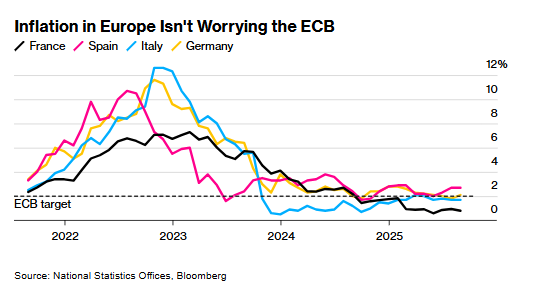
Group 1 - Germany's inflation rate rose to 2.1% in August, exceeding economists' expectations of 2%, driven by rising food costs and a slowdown in energy price declines [1][3] - Other major Eurozone countries reported lower-than-expected inflation rates, with France at 0.8%, Italy at 1.7%, and Spain at 2.7% [1] - The European Central Bank (ECB) is expected to maintain its interest rates at 2% in the upcoming meeting, as officials believe inflation risks are "generally balanced" [3] Group 2 - The ECB's survey indicated that consumer inflation expectations remained stable for the next 12 months, with only a slight increase for the next three years [3] - Germany's central bank anticipates inflation rates to exceed 2% in the coming months, primarily due to base effects, but considers this increase to be "temporary" [3] - Despite the rise in inflation, Germany's economy is still recovering slowly after two years of contraction, putting pressure on Chancellor Merz [3] Group 3 - Germany's unemployment rate remains stable at 6.3%, with a slight decrease of 9,000 in seasonally adjusted unemployment figures, despite the number of unemployed surpassing 3 million [4]

欧央行7月会议纪要:通胀风险大致平衡,按兵不动是稳健之举
Hua Er Jie Jian Wen· 2025-08-28 17:00
Core Viewpoint - The European Central Bank (ECB) decided to maintain interest rates unchanged during the July monetary policy meeting, citing balanced inflation risks and resilience in the Eurozone economy despite external challenges [1][2]. Group 1: Interest Rate Decisions - The ECB officials believe that the current interest rate level is appropriate as inflation is close to the 2% target, and the decision to keep rates steady is seen as a "prudent move" [1][2]. - The current deposit rate stands at 2%, which is considered to be in the "neutral range" following eight consecutive rate cuts since the end of last year [2]. Group 2: Inflation Outlook - The ECB expects overall inflation to remain around current levels for the remainder of 2025, with a projected decline to approximately 1.5% by the first quarter of 2026 [3]. - Core inflation is currently at 2.3%, the lowest in three years, with expectations of a further drop to 2% by early next year [3]. Group 3: Communication Strategy - The ECB emphasizes the need for cautious and neutral communication regarding future rate decisions, avoiding overly explicit signals [2]. - The committee maintains a flexible approach to respond swiftly to necessary changes based on evolving data and uncertainties [3].
欧股期货上涨,印度市场承压,美元维持跌势,亚洲芯片股受关注
Hua Er Jie Jian Wen· 2025-08-28 06:57
Group 1 - The Asia-Pacific stock markets showed mixed results, with Japanese and South Korean markets rising, supported by the Bank of Korea's decision to maintain interest rates [1][2] - The Bank of Korea kept the policy rate at 2.5%, aligning with market expectations, which positively impacted the Kospi index, rising by 0.28% [2] - The Indian Nifty 50 index opened down by 0.59% due to the announcement of a 50% tariff on Indian goods by the U.S. Department of Homeland Security [2] Group 2 - Nvidia reported better-than-expected earnings and revenue, with sales growth projected to remain above 50%, although its data center business revenue fell short for the second consecutive quarter [4] - The sentiment among tech investors remains focused on "buying the dip," despite Nvidia's stock experiencing a decline in after-hours trading [4] - Asian chip stocks are under scrutiny following Nvidia's mixed performance, indicating potential volatility in the sector [4] Group 3 - The Nikkei 225 index closed up 0.7% at 42828.79 points, while the Korean Seoul index rose 0.3% to 3196.32 points [6] - U.S. stock indices closed higher, with the Dow Jones Industrial Average, S&P 500, and Nasdaq Composite rising by 0.32%, 0.24%, and 0.21% respectively [7]

7月通胀率超预期上升 支持澳洲联储9月按兵不动
Zhi Tong Cai Jing· 2025-08-27 07:03
Core Viewpoint - Australia's inflation rate in July exceeded expectations, rising to 2.8%, which is the highest annual increase since July 2024, prompting the Reserve Bank of Australia (RBA) to maintain its current interest rate policy in September [1]. Group 1: Inflation Data - The Consumer Price Index (CPI) in Australia increased by 2.8% year-on-year in July, significantly higher than June's 1.9% and above economists' expectations of 2.3% [1]. - The trimmed mean inflation measure favored by the RBA rose to 2.7%, up from 2.1% in the previous month [1]. - Housing prices surged by 3.6%, driven by soaring electricity prices, making it one of the largest contributors to annual price changes [2]. Group 2: Monetary Policy Implications - The RBA recently lowered the cash rate by 25 basis points to 3.6%, marking the third rate cut this year, with expectations for further cuts in the future [2]. - Market expectations indicate that the RBA will likely keep rates unchanged in September, with the next anticipated rate cut in November [1]. - The RBA's chair, Michele Bullock, emphasized the need for cautious policy adjustments, suggesting that monthly CPI data may not fully reflect the actual inflation situation [2]. Group 3: Economic Outlook - Moody's Australia economic head, Sunny Kim Nguyen, expressed a dovish stance, predicting that government energy subsidies starting this month may alleviate some price pressures [2]. - Nguyen noted that seasonal price increases related to travel typically diminish after the July school holidays [2][3].
硬刚特朗普!库克胜算如何
Di Yi Cai Jing Zi Xun· 2025-08-26 13:37
Core Viewpoint - The article discusses the recent announcement by former President Trump to dismiss Federal Reserve Board member Lisa Cook, citing alleged mortgage fraud as the reason for the dismissal [2][3][8]. Group 1: Dismissal Announcement - Trump announced the dismissal of Lisa Cook via social media, claiming authority under the U.S. Constitution and the Federal Reserve Act [3]. - Cook, appointed by President Biden in 2022, stated she would not resign and intends to continue her duties [2][3]. Group 2: Allegations and Legal Context - Trump accused Cook of making false statements in mortgage documents, suggesting potential criminal behavior that undermines her credibility as a regulator [8][9]. - The Federal Reserve Act allows the President to dismiss board members for "cause," but the definition of "cause" is not clearly defined in legal terms [9]. Group 3: Legal Actions and Implications - Cook's legal team plans to take necessary actions to challenge Trump's dismissal, asserting that he lacks the legal grounds to do so [11]. - The outcome of any legal challenge could be uncertain, depending on how the courts interpret the concept of "cause" [11][12]. Group 4: Broader Implications - The situation may reflect Trump's broader strategy to influence Federal Reserve policies, especially given recent tensions between his administration and the Fed [12][13]. - The involvement of the FHFA director, appointed by Trump, in providing evidence against Cook raises questions about potential political motivations behind the allegations [12][13].

新世纪期货交易提示(2025-8-25)-20250825
Xin Shi Ji Qi Huo· 2025-08-25 04:47
Report Industry Investment Ratings - Iron Ore: Volatile [2] - Coking Coal and Coke: Bullish with Volatility [2] - Rebar and Coiled Steel: Volatile [2] - Glass: Bullish with Volatility [2] - CSI 300 Index: Volatile [2] - SSE 50 Index: Bullish [2] - CSI 500 Index: Upward [3] - CSI 1000 Index: Upward [3] - 2 - Year Treasury Bond: Volatile [3] - 5 - Year Treasury Bond: Volatile [3] - 10 - Year Treasury Bond: Downward [3] - Gold: Bullish with Volatility [3] - Silver: Bullish with Volatility [3] - Pulp: Consolidating [4] - Logs: Range - bound Volatility [4] - Soybean Oil: Bullish with Volatility [4] - Palm Oil: Bullish with Volatility [4] - Rapeseed Oil: Bullish with Volatility [4] - Soybean Meal: Volatile [4] - Rapeseed Meal: Volatile [4] - No. 2 Soybeans: Volatile [4] - No. 1 Soybeans: Bearish with Volatility [4] - Live Pigs: Bearish with Volatility [6] - Rubber: Volatile [8] - PX: Hold for Observation [8] - PTA: Volatile [8] - MEG: Hold for Observation [8] - PR: Hold for Observation [8] - PF: Bullish with Volatility [8] Core Views - The short - term manufacturing recovery has been interrupted, and the Politburo meeting fell short of expectations. However, Powell signaled a potential interest rate cut, providing support for commodities [2] - The expected blast furnace production restrictions in China have been temporarily disproven, so the impact on iron ore demand is minimal. The iron ore market is expected to move in a volatile manner [2] - Affected by a coal mine accident in Fujian and the initial success of anti - cut - throat competition, coking coal and coke prices rose sharply overnight. The overall recovery of coal mines in the production areas is still slow, and coal prices are supported in the short term [2] - The steel market's supply - demand contradiction has intensified. With the approaching traditional peak season, the spot demand for rebar remains weak, and the futures price is looking for support after a significant adjustment [2] - The glass market's supply - demand pattern has not improved significantly in the short term. The market is subject to many sentiment disturbances, and the real demand needs to be further observed [2] - The stock index market has seen capital inflows into semiconductor, computer hardware, and financial sectors, while capital has flowed out of aviation and gas sectors. The market's bullish sentiment is rising, and it is recommended to hold long positions in stock indices [2][3] - The bond market has shown weak trends due to market interest rate fluctuations. It is recommended to hold long positions in bonds with a light position [3] - The pricing mechanism of gold is shifting from being centered on real interest rates to central bank gold purchases. The current logic driving the gold price increase remains valid, and gold is expected to be bullish with volatility [3] - The pulp market shows a pattern of weak supply and demand, and the price is expected to consolidate [4] - The log market has relatively small supply pressure and increasing demand for stocking up by processing plants. The price is expected to move within a range [4] - The oil market has positive demand prospects. The demand for biofuels is increasing, and the inventory of palm oil is lower than expected. The oil market is expected to be bullish with volatility [4] - The meal market is affected by factors such as the adjustment of soybean planting area, weather conditions, and import policies. The market is expected to be volatile [4] - The live pig market has an increasing supply and weak consumption demand due to high - temperature weather. The price is expected to be bearish with volatility [6] - The natural rubber market has a pattern of supply exceeding demand, but the gap is narrowing. The price is expected to be strong in the short term [8] - The PX market is affected by the uncertainty of ending the Russia - Ukraine conflict and the reduction of old production capacity in South Korea. The price is relatively strong [8] - The PTA market's supply - demand situation has improved, and the price mainly follows cost fluctuations [8] - The MEG market has increasing supply pressure, but low inventory supports the price [8] - The PR and PF markets have relatively stable short - term supply - demand structures, but the market's expectations for future demand are cautious [8] Summaries by Categories Metals - **Iron Ore**: Global iron ore shipments have increased significantly on a环比 basis, and the arrival volume has also rebounded. There is no obvious inventory accumulation pressure under high port clearance. The terminal demand is weak, but steel mills have little motivation to cut production actively. The price is expected to be volatile [2] - **Coking Coal and Coke**: Affected by a coal mine accident and anti - cut - throat competition, the prices rose sharply overnight. The recovery of coal mines in production areas is slow, and downstream enterprises'开工 rates remain high. The price is expected to be bullish with volatility [2] - **Rebar and Coiled Steel**: The steel mill's production restrictions in Tangshan are less than expected. The overall demand is weak, and the supply - demand contradiction has intensified. The price is expected to be volatile [2] - **Gold and Silver**: The pricing mechanism of gold is changing, and its de - fiat currency attribute is becoming more prominent. The market's risk - aversion demand still exists, and the price is expected to be bullish with volatility [3] Financial Futures - **Stock Indices**: The market's bullish sentiment is rising due to policies such as large - scale equipment updates and promoting sports consumption. It is recommended to hold long positions in stock indices [2][3] - **Bonds**: The bond market trends are weak due to market interest rate fluctuations. It is recommended to hold long positions in bonds with a light position [3] Industrial Products - **Pulp**: The cost support for pulp prices has weakened, and the demand is in the off - season. The market shows a pattern of weak supply and demand, and the price is expected to consolidate [4] - **Logs**: The supply pressure is relatively small, and the demand for stocking up by processing plants is increasing. The price is expected to move within a range [4] - **Rubber**: The supply - demand gap in the natural rubber market is narrowing. With the expected improvement in supply and relatively stable demand, the price is expected to be strong in the short term [8] - **PX, PTA, MEG, PR, PF**: The PX price is relatively strong due to supply - demand and production capacity factors. The PTA price follows cost fluctuations, the MEG price is supported by low inventory, and the PR and PF markets have stable short - term supply - demand but cautious demand expectations [8] Agricultural Products - **Oils and Meals**: The demand for oils is positive due to biofuel demand and lower - than - expected palm oil inventory. The meal market is affected by planting area, weather, and import policies, and is expected to be volatile [4] - **Live Pigs**: The supply of live pigs is increasing, and the consumption demand is weak due to high - temperature weather. The price is expected to be bearish with volatility [6]
鲍威尔错了吗?
Sou Hu Cai Jing· 2025-08-23 17:32
Core Viewpoint - The independence of the Federal Reserve is facing unprecedented challenges due to public pressure and threats from Trump, raising questions about Jerome Powell's actions and decisions during his tenure [1][3]. Group 1: Economic Context - Since taking over the Federal Reserve in 2018, Jerome Powell has navigated significant economic turmoil, including the prosperity from Trump's tax cuts, the financial crisis triggered by the COVID-19 pandemic, and a rare inflation surge not seen in 40 years [3]. - By 2025, the inflation rate is projected to decrease to 2.3%, yet the Federal Reserve is expected to maintain interest rates at a high level of 4.25% to 4.5%, refusing to lower rates despite the economic conditions [3]. Group 2: Powell's Leadership - Powell's leadership has been marked by both decisive actions and criticisms; he successfully pulled the market back from the brink of collapse during the pandemic but has also faced backlash for misjudging situations [3]. - During the COVID-19 crisis in March 2020, Powell took bold actions, reducing interest rates from 1.5% to near zero within two weeks as the stock market experienced multiple circuit breakers and unemployment surged to 14.7% [3].

What to Expect from Fed Chair Powell's Jackson Hole Speech
ZACKS· 2025-08-22 15:20
Group 1 - The Federal Reserve has maintained interest rates at 4.25-4.50% year-to-date, with a focus on achieving full employment and controlling inflation, targeting a 2% inflation rate [2][3] - Recent economic trends show a cooling labor market alongside rising inflation due to tariff initiatives, raising questions about a potential 25-basis-point rate cut at the upcoming September meeting [3][8] - The Fed's decision-making process is heavily reliant on economic data, with the next Personal Consumption Expenditures (PCE) report due shortly after Powell's speech, which is expected to be data-dependent [6][8] Group 2 - The June PCE report indicated a headline inflation rate of +2.6%, which is moving away from the Fed's +2% target, while core PCE remained at +2.8% for two consecutive months [7][8] - The market showed positive movement in pre-market futures, with the S&P 500 attempting to break a five-session losing streak, reflecting adjustments in tech stock valuations and retail earnings amid tariff considerations [9]

鲍威尔讲话将上演哪种剧本?一文读懂三大情景下的市场风暴
对冲研投· 2025-08-22 12:33
Core Viewpoint - The market is highly focused on the upcoming speech by Federal Reserve Chairman Jerome Powell, which is expected to provide insights into the latest interest rate policy, particularly regarding the anticipated rate cuts in September and potential further cuts by the end of the year [2][4]. Group 1: Market Reactions to Powell's Speech - Investors are almost certain about a rate cut in September and are closely monitoring Powell's indications regarding the policy path for the remainder of the year [2]. - The market is sensitive to any deviations from the expected dovish stance, with a 47% probability of two rate cuts by the end of the year, which could lead to significant market volatility [2][4]. Group 2: Scenarios Based on Powell's Indications - **Scenario 1: Hawkish Indications** If Powell suggests a more conservative rate cut path than expected, U.S. equities may face downward pressure due to high valuations reflecting an overly optimistic outlook [4]. - **Scenario 2: Dovish Indications** A more accommodative stance from Powell could boost future earnings growth for major companies, positively impacting U.S. equities, although this scenario is considered the least likely [6]. - **Scenario 3: Meeting Market Expectations** If Powell's speech aligns with market expectations, confirming a September rate cut and another by year-end, market reactions could range from neutral to negative, as investors might engage in "sell the news" behavior [8].

鲍威尔或采取折中方案,特朗普和市场都不会满意?
Jin Shi Shu Ju· 2025-08-22 12:28
Core Viewpoint - The Federal Reserve, under Chairman Powell, is facing unprecedented political pressure from former President Trump, which complicates its monetary policy decisions amid mixed economic data [1][2]. Group 1: Federal Reserve's Monetary Policy - Powell's upcoming speech at the Jackson Hole Economic Symposium may reveal a new monetary policy framework, simplifying the complex principles introduced five years ago [1]. - Some analysts predict a compromise in interest rate policy, with Powell potentially opening the door for a rate cut in September due to weak job growth, but without making further commitments until inflation concerns are addressed [2]. - Kansas City Fed President George suggests that a rate cut could send a dangerous signal to consumers regarding inflation control, emphasizing the importance of maintaining credibility in anchoring inflation expectations [1][2]. Group 2: Political Pressure and Independence - Trump's increasing political pressure on the Fed is seen as a threat to its independence, with any decision interpreted as either a concession to Trump or an unreasonable defiance [2][3]. - Trump has launched personal attacks on Powell and has called for the resignation of Fed Governor Lisa Cook, alleging conflicts of interest, although Cook has stated she will not resign due to "bullying" [3]. - The potential resignation or forced departure of Fed governors could give the White House greater influence over monetary policy and the appointment of regional Fed presidents, raising concerns about the erosion of the Fed's independence [4].