估值

Search documents
中金 | 美国四大行:降息中的经营韧性
中金点睛· 2026-01-14 00:08
Core Viewpoint - The current interest rate cut cycle highlights the operational resilience of the four major U.S. banks, which are expected to maintain stable performance despite the ongoing economic adjustments [1]. Group 1: Net Interest Income - There is no need for excessive concern regarding the pressure from interest rate cuts, as the market anticipates the pace of cuts, allowing for adjustments on the liability side that help mitigate downward pressure on net interest margins. As of Q3 2025, the average net interest margin for the four major banks is 2.37%, having only decreased by 6 basis points from the peak of the current cycle [3][24]. - The average credit growth for the four major banks has rebounded from 0.8% in Q2 2024 to 6.4% in Q3 2025, indicating a recovery in credit growth rates [3][30]. Group 2: Non-Interest Income - Non-interest income is expected to remain at a high level, with the four major banks averaging over 40% of total revenue from non-interest sources, benefiting from diversified business operations. Positive investment sentiment in the U.S. capital markets is likely to support continued high revenue from investment banking, global markets, and asset management [3][32]. Group 3: Asset Quality - The asset quality of the four major banks is relatively stable, although marginal changes should be closely monitored. The overall non-performing loan rate and net charge-off rate in the U.S. banking sector have slightly increased since 2024, but the four major banks maintain better asset quality than the overall industry [3][35]. Group 4: Capital Regulation - Regulatory easing is expected to further release excess capital. The latest capital requirements from the Federal Reserve, effective from October 2025, will lower the capital buffer requirements for many banks, allowing for the release of more excess capital in the coming year, which could enhance returns for bank investors [3][39]. Group 5: Valuation - The average price-to-book (P/B) ratio for the four major U.S. banks has reached a historical high since 2008, reflecting stable macroeconomic expectations, a shift towards a more accommodative regulatory environment, and continuous improvement in bank profitability. The current average P/B is 1.6, above the historical mean of 1.1 [3][42].


PriceSmart, Inc. (NASDAQ: PSMT) Showcases Strong Financial Performance in Fiscal Q1 2026
Financial Modeling Prep· 2026-01-08 23:00
Core Insights - PriceSmart, Inc. reported strong financial performance in its fiscal first quarter of 2026, with earnings per share (EPS) of $1.29, slightly above estimates of $1.28, and revenue of approximately $1.38 billion, exceeding forecasts of $1.36 billion [2][6] Financial Performance - The company's revenue increased by 9.9% from the previous year's $1.26 billion, demonstrating consistent growth [2] - Net merchandise sales grew by 10.6%, reaching $1.35 billion, up from $1.22 billion in the first quarter of fiscal year 2025, with comparable net merchandise sales rising by 8.0% [3][6] - Foreign currency exchange rate fluctuations contributed an additional $13.8 million, or 1.1%, to net merchandise sales [3] Valuation Metrics - PriceSmart's shares have risen by nearly 40% over the past year, trading at 23 times forward earnings, which is considered a discount compared to Costco [4][6] - The company's price-to-earnings (P/E) ratio is approximately 25.92, with a price-to-sales ratio and enterprise value to sales ratio both at about 0.74, indicating favorable valuation relative to its sales and earnings [4] Financial Health - PriceSmart maintains a low debt-to-equity ratio of approximately 0.14 and a current ratio of around 1.33, indicating strong liquidity [5] - The enterprise value to operating cash flow ratio is approximately 13.51, reflecting the company's ability to cover its enterprise value with operating cash flow [5] Growth Potential - The company has plans to expand in Costa Rica, demonstrating growth potential in underpenetrated markets [5]


大类资产早报-20260107
Yong An Qi Huo· 2026-01-07 01:21
1. Report's Industry Investment Rating - No information provided in the content 2. Report's Core View - No clear core view presented in the content 3. Summary According to Relevant Catalogs Global Asset Market Performance - **10 - Year Treasury Bonds**: Yields of 10 - year Treasury bonds in major economies are as follows: US 4.174, UK 4.480, France 3.553, Germany 2.841, Italy 3.533, Spain 3.270, Switzerland 0.246, Greece 3.413, Brazil 6.190, China 1.876, Australia 4.793, New Zealand 4.509 [3] - **2 - Year Treasury Bonds**: Yields of 2 - year Treasury bonds in major economies are: US 3.464, UK 3.693, Germany 2.098, Japan 1.179, Italy 2.204, China (1Y yield) 1.341, Australia 4.084 [3] - **Exchange Rates**: The latest exchange rates of the US dollar against major emerging - economy currencies are: Brazil 5.376, South Africa zar 16.356, South Korean won 1447.500, Thai baht 31.245, Malaysian ringgit 4.047. The latest onshore RMB is 6.984, offshore RMB is 6.981, RMB central parity is 7.017, and RMB 12 - month NDF is 6.864 [3] - **Stock Indices**: The latest values of major economy stock indices are: S&P 500 6944.820, Dow Jones Industrial Average 49462.080, Nasdaq 23547.170, Mexican index 65022.240, UK index 10122.730, France CAC 8237.430, Germany DAX 24892.200, Spanish index 17647.100, Japanese Nikkei 52518.080, Hong Kong Hang Seng Index 26710.450, Shanghai Composite Index 4083.667, Taiwan index 30576.300, South Korean index 4525.480, Indian index 8933.609, Thai index 1274.750, Malaysian index 1672.350, Australian index 8996.918, emerging - economy index 1467.160 [3] - **Credit Bond Indices**: The latest values of credit bond indices are: US investment - grade credit bond index 3545.480, euro - zone investment - grade credit bond index 266.170, emerging - economy investment - grade credit bond index 290.480, US high - yield credit bond index 2921.870, euro - zone high - yield credit bond index 411.440, emerging - economy high - yield credit bond index 1827.901 [3] Stock Index Futures Trading Data - **Index Performance**: The closing prices of A - shares, CSI 300, SSE 50, ChiNext, and CSI 500 are 4083.67, 4790.69, 3158.76, 3319.29, and 7814.14 respectively, with daily percentage changes of 1.50%, 1.55%, 1.90%, 0.75%, and 2.13% [4] - **Valuation**: The PE (TTM) of CSI 300, SSE 50, CSI 500, S&P 500, and Germany DAX are 14.52, 12.13, 35.38, 27.74, and 19.26 respectively, with环比 changes of 0.19, 0.15, 0.71, 0.17, and 0.01 [4] - **Risk Premium**: The risk premium for S&P 500 (1/PE - 10 - year rate) is - 0.57 with a环比 change of - 0.04, and for Germany DAX is 2.35 with a环比 change of 0.02 [4] - **Fund Flows**: The latest fund flow values for A - shares, main board, ChiNext, and CSI 300 are 631.23, 552.00, 78.91, and 396.75 respectively. The 5 - day average values are - 65.98, - 129.00, 41.00, and 104.37 respectively [4] Other Trading Data - **Transaction Amount**: The latest transaction amounts of Shanghai and Shenzhen stock exchanges, CSI 300, SSE 50, small - and medium - sized board, and ChiNext are 28065.07, 7254.15, 1800.48, 5735.57, and 7565.29 respectively, with环比 changes of 2602.36, 948.38, 104.86, 498.64, and 603.11 [5] - **Main Contract Basis and Spread**: The basis of IF, IH, and IC are - 12.69, 3.04, and - 27.74 respectively, with spreads of - 0.26%, 0.10%, and - 0.35% [5] - **Treasury Bond Futures**: The closing prices of T2303, TF2303, T2306, and TF2306 are 107.70, 105.57, 107.66, and 105.57 respectively, with daily percentage changes of - 0.14%, - 0.13%, - 0.18%, and - 0.14% [5] - **Funding Rates**: The funding rates of R001, R007, and SHIBOR - 3M are 1.3302%, 1.4930%, and 1.5960% respectively, with daily changes of - 16.00 BP, 0.00 BP, and 0.00 BP [5]
A股市场将延续“慢牛”格局
Zheng Quan Shi Bao· 2026-01-04 17:30
Core Viewpoint - In 2026, the global debt issue will present three main solutions: real growth exceeding real interest rates (growth-based debt reduction), inflation exceeding expectations (inflation-based debt reduction), and fiscal tightening (fiscal-based debt reduction). Both AI and gold are expected to benefit from these paths, forming a dual mainline logic for asset performance [1] Group 1: A-Share Market Outlook - The A-share market is expected to maintain a "slow bull" pattern in 2026, driven by a profound change in corporate profit structures despite ongoing weakness in real estate, infrastructure, consumption, social financing, and PPI [1] - The net asset return on equity (ROE) for non-financial enterprises in the A-share market has stabilized over several quarters, with profits from eight advanced manufacturing industries now accounting for 38% of total profits [1] - Companies with overseas operations have seen their overseas revenue share increase to 20%, with overseas market gross margins exceeding domestic margins by 5 percentage points, which may drive a rebound in overall A-share ROE after stabilization [1] Group 2: Investment Directions - Investment focus should be on industries with constrained supply and clear prosperity trends, such as the AI industry chain, which has strong capital expenditure demand and limited short-term supply release [1] - Other sectors to consider include energy storage and metals, which have undergone capacity clearing [1] - Tactically, it is recommended to utilize market adjustments to position for the spring rally, prioritizing the aforementioned high-prosperity sectors [1]

转债市场日度跟踪20251231:债券日报-20260104
Huachuang Securities· 2026-01-04 14:45
Report Industry Investment Rating No relevant content provided. Core Viewpoints On December 31, more than half of the convertible bond industries rose, and the valuation increased month - on - month. The convertible bond market trading sentiment weakened, and the median price of convertible bonds increased. Different industries in the A - share and convertible bond markets showed different trends in terms of rise and fall [1]. Summary by Related Catalogs Market Overview - **Index Performance**: The CSI Convertible Bond Index rose 0.02% month - on - month, the Shanghai Composite Index rose 0.09%, the Shenzhen Component Index fell 0.58%, the ChiNext Index fell 1.23%, the SSE 50 Index fell 0.18%, and the CSI 1000 Index fell 0.03% [1]. - **Market Style**: Mid - cap value was relatively dominant. Large - cap growth fell 0.82%, large - cap value fell 0.13%, mid - cap growth fell 0.42%, mid - cap value rose 0.45%, small - cap growth rose 0.14%, and small - cap value fell 0.17% [1]. - **Fund Performance**: The trading sentiment in the convertible bond market weakened. The trading volume of the convertible bond market was 74.68 billion yuan, a 0.50% month - on - month decrease; the total trading volume of the Wind All - A was 2.065788 trillion yuan, a 4.43% month - on - month decrease; the net outflow of the main funds in the Shanghai and Shenzhen stock markets was 23.828 billion yuan, and the yield of the 10 - year treasury bond decreased 1.09bp to 1.85% [1]. Convertible Bond Price - The weighted average closing price of convertible bonds was 134.60 yuan, a 0.07% month - on - month increase. Among them, the closing price of equity - biased convertible bonds was 196.81 yuan, a 2.93% month - on - month decrease; the closing price of bond - biased convertible bonds was 119.10 yuan, a 0.21% month - on - month increase; the closing price of balanced convertible bonds was 130.12 yuan, a 0.32% month - on - month increase [2]. - The proportion of high - price bonds above 130 yuan was 60.57%, a 0.63pct month - on - month increase. The interval with the largest change in proportion was 110 - 120 (including 120), with a proportion of 8.36%, a 1.07pct month - on - month decrease. There were 0 bonds with a closing price below 100 yuan. The median price was 133.05 yuan, a 0.34% month - on - month increase [2]. Convertible Bond Valuation - The fitted conversion premium rate of 100 - yuan parity was 34.04%, a 0.50pct month - on - month increase; the overall weighted parity was 101.47 yuan, a 0.36% month - on - month decrease [2]. - The premium rate of equity - biased convertible bonds was 16.20%, a 2.18pct month - on - month decrease; the premium rate of bond - biased convertible bonds was 86.36%, a 0.42pct month - on - month decrease; the premium rate of balanced convertible bonds was 26.25%, a 1.08pct month - on - month increase [2]. Industry Performance - **A - share Market**: Among the 31 sectors, 15 industries rose. The top three industries in terms of increase were national defense and military industry (+2.13%), media (+1.54%), and real estate (+1.13%); the top three industries in terms of decline were communication (-1.35%), agriculture, forestry, animal husbandry and fishery (-1.10%), and electronics (-1.02%) [3]. - **Convertible Bond Market**: A total of 17 industries rose. The top three industries in terms of increase were beauty care (+2.81%), national defense and military industry (+2.50%), and building materials (+1.45%); the top three industries in terms of decline were non - bank finance (-1.43%), light industry manufacturing (-1.32%), and steel (-0.69%) [3]. - **Comprehensive Indicators**: - Closing price: Large - cycle increased 0.18%, manufacturing decreased 0.02%, technology increased 0.86%, large - consumption increased 0.49%, and large - finance decreased 0.76% [3]. - Conversion premium rate: Large - cycle increased 0.45pct, manufacturing increased 0.9pct, technology decreased 0.7pct, large - consumption increased 0.15pct, and large - finance increased 0.22pct [3]. - Conversion value: Large - cycle decreased 0.20%, manufacturing decreased 0.16%, technology increased 1.36%, large - consumption increased 0.55%, and large - finance decreased 1.23% [3]. - Pure bond premium rate: Large - cycle increased 0.27pct, manufacturing increased 0.041pct, technology increased 1.5pct, large - consumption increased 0.59pct, and large - finance decreased 0.94pct [4]. Industry Rotation The national defense and military industry, media, and real estate led the rise. The national defense and military industry had a daily increase of 2.13% in the A - share market and 2.50% in the convertible bond market; the media had a daily increase of 1.54% in the A - share market and 0.75% in the convertible bond market; the real estate had a daily increase of 1.13% in the A - share market [57].
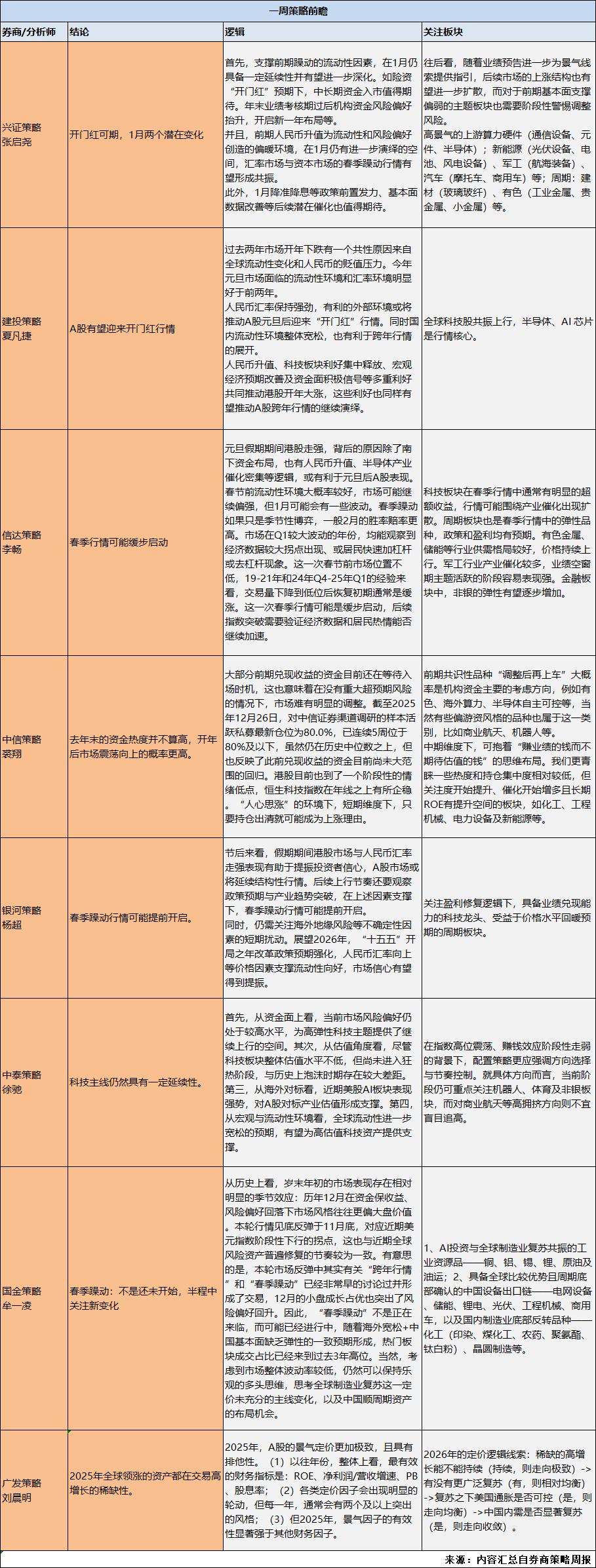
A股分析师前瞻:开门红可期,主题与业绩双线作战
Xuan Gu Bao· 2026-01-04 12:08
Group 1 - The core viewpoint of multiple brokerage strategies is the expectation of a strong market opening in January, supported by liquidity factors and potential policy changes such as interest rate cuts [1][3] - The market environment in January is expected to be better than the previous two years, with a favorable liquidity and exchange rate situation, which may drive the continuation of the cross-year market trend [1][3] - Analysts suggest that the upcoming earnings forecasts will provide further guidance for market trends, indicating a potential expansion of the market's upward structure [1][3] Group 2 - The focus for institutional funds post-holiday is likely to be on consensus stocks that have adjusted, such as sectors like non-ferrous metals, overseas computing power, and semiconductors [2][4] - There is a preference for sectors with lower heat and concentrated holdings that are beginning to gain attention, such as chemicals, engineering machinery, power equipment, and new energy [2][4] - The spring market rally is anticipated to start gradually, with the potential for structural market trends to continue, although some volatility may occur in January [4][5] Group 3 - The strategies from various brokerages highlight the importance of monitoring policy expectations and industry trends, which could support the spring market rally [3][4] - The current market risk appetite remains high, providing room for high-elasticity technology themes to continue their upward trajectory [4][5] - Analysts emphasize the need for a cautious approach towards sectors that have previously shown weak fundamental support, as they may face adjustment risks [1][3]
Waymo千亿估值背后的长期布局
Xin Lang Cai Jing· 2025-12-30 09:15
Core Viewpoint - Waymo is negotiating a new round of financing with a proposed valuation of $100 billion, which corresponds to 280 times its latest annual revenue, significantly higher than other ride-hailing platforms [3][12] Group 1: Financial Performance and Projections - Waymo has completed over 14 million paid autonomous rides, doubling its volume compared to 2024, and has achieved an annual revenue exceeding $350 million from services in five cities [4][13] - Analysts predict that Waymo's annual revenue could reach at least $2.5 billion by 2030 if growth rates meet expectations [4][14] - If annual revenue reaches $2.5 billion, Waymo's expected valuation multiple would drop to 40 times revenue, contrasting sharply with Uber and Lyft, which have valuation multiples below 3 times [5][14] Group 2: Market Expansion and Diversification - Waymo plans to expand beyond ride-hailing services into local delivery and long-haul freight, and eventually license its autonomous driving technology to car manufacturers [7][16] - A partnership with DoorDash to launch autonomous delivery services in Phoenix is seen as a potential stepping stone for further business expansion [7][16] Group 3: Competitive Landscape - Waymo's operational costs per mile are currently around $1.43, compared to Tesla's $0.81, although Waymo aims to reduce its costs to between $0.99 and $1.08 by 2026 [9][19] - Waymo has a regulatory advantage over competitors like Tesla and Zoox, which have not yet received approval for paid ride services in operational cities [10][20] - The company’s early market entry and aggressive expansion strategy could create a deeper competitive moat compared to Uber, which currently has a market value significantly higher than its competitors [10][20]

大类资产早报-20251230
Yong An Qi Huo· 2025-12-30 00:52
Group 1: Global Asset Market Performance - The latest yields of 10 - year government bonds in major economies: US 4.111, UK 4.486, France 3.524, Germany 2.828, Italy 3.503, Spain 3.249, Switzerland 0.263, Greece 3.393, Japan 2.045, Brazil 6.156, China 1.854, Australia 4.755, New Zealand 4.439 [3] - The latest yields of 2 - year government bonds in major economies: US 3.456, UK 3.715, Germany 2.114, Japan 1.151, Italy 2.205, China (1Y yield) 1.324, Australia 4.049 [3] - The latest exchange rates of the US dollar against major emerging - economy currencies: Brazil 5.573, South Africa zar 16.678, Korean won 1434.000, Thai baht 31.448, Malaysian ringgit 4.060 [3] - The latest exchange rates of the RMB: on - shore RMB 7.006, off - shore RMB 6.997, RMB central parity rate 7.033, RMB 12 - month NDF 6.871 [3] - The latest values of major economies' stock indices: S&P 500 6905.740, Dow Jones Industrial Average 48461.930, Nasdaq 23474.350, Mexican stock index 65347.080, UK stock index 9866.530, France CAC 8112.020, Germany DAX 24351.120, Spanish stock index 17195.800, Japanese Nikkei 50526.920, Hong Kong Hang Seng Index 25635.230, Shanghai Composite Index 3965.280, Taiwan stock index 28810.890, South Korean stock index 4220.560, Indian stock index 8644.256, Thai stock index 1254.030, Malaysian stock index 1680.990, Australian stock index 9032.046, emerging - economy stock index 1401.660 [3] - The latest values of credit - bond indices: Eurozone investment - grade credit - bond index 265.878, Eurozone high - yield credit - bond index 410.230 [3] Group 2: Stock Index Futures Trading Data - Index performance: A - share closing price 3965.28, up 0.04%; CSI 300 closing price 4639.37, down 0.38%; SSE 50 closing price 3034.63, down 0.35%; ChiNext closing price 3222.61, down 0.66%; CSI 500 closing price 7430.61, down 0.38% [4] - Valuation: PE (TTM) of CSI 300 is 14.16 (up 0.01), SSE 50 is 11.81 (up 0.03), CSI 500 is 33.70 (down 0.13), S&P 500 is 27.59 (down 0.09), Germany DAX is 18.85 (up 0.01) [4] - Risk premium: 1/PE - 10 - year interest rate of S&P 500 is - 0.49 (up 0.03), Germany DAX is 2.48 [4] - Fund flow: A - shares' latest value is - 858.51, 5 - day average is - 242.00; Main - board's latest value is - 675.82, 5 - day average is - 229.00; ChiNext's latest value is - 163.63, 5 - day average is - 17.01; CSI 300's latest value is - 150.77, 5 - day average is 25.26 [4] Group 3: Other Trading Data - Transaction amount: The latest value of Shanghai and Shenzhen stock markets is 21393.38 (down 208.53), CSI 300 is 4826.14 (up 221.87), SSE 50 is 1171.20 (up 162.03), small and medium - sized board is 4629.60 (down 42.78), ChiNext is 5379.66 (down 333.48) [5] - Main contract basis and spread: IF basis is - 29.17 (- 0.63%), IH basis is 3.37 (0.11%), IC basis is - 94.01 (- 1.27%) [5] - Treasury - bond futures: T2303 closing price is 107.98 (down 0.30%), TF2303 closing price is 105.84 (down 0.20%), T2306 closing price is 107.99 (down 0.30%), TF2306 closing price is 105.85 (down 0.17%) [5] - Fund interest rates: R001 is 1.3376% (down 19.00 BP), R007 is 1.9360% (up 41.00 BP), SHIBOR - 3M is 1.6000% (no change) [5]
Why This Bull Market Isn't All About Tech
Youtube· 2025-12-22 15:38
Market Overview - The market is perceived as healthy, with a belief that the tech pullback is not indicative of a broader market decline, as many stocks are still performing well [1][2] - Predictions for 2026 suggest a total return of 12% to 15% for the market, indicating continued optimism [3][4] - Historical patterns show that after significant market volatility, such as a 15% decline, the following year typically sees an average increase of 20% [5] Stock Performance - Recent data indicates an increase in the number of stocks reaching 52-week highs on the NYSE, suggesting broad market strength beyond just technology [2] - Micron's recent strong performance is highlighted, with its stock price showing significant gains, although it has not yet surpassed its yearly highs [6][7] - Concerns remain about the concentration of the S&P 500, where 40% of the index is made up of a few large stocks, which could pose risks if any of these stocks falter [7][8] Sector Analysis - There is a cautious sentiment among investors regarding certain sectors, with some stocks like Oracle and Costco being viewed as overvalued [11][12] - Defensive stocks and biotechs are currently performing well, while oil stocks are underperforming [11] - Developed international markets are gaining attention, with countries like Japan and Germany reaching all-time highs, suggesting potential investment opportunities outside the U.S. [15][16] Economic Indicators - The Federal Reserve is expected to maintain a dovish stance, with potential interest rate cuts anticipated, which could influence market dynamics [19][20] - Retail sales data and earnings reports have been solid, indicating a resilient economy despite concerns about the labor market [21]

为啥中国的世界级企业估值都那么低?
集思录· 2025-12-22 13:44
Core Viewpoint - The article discusses the valuation challenges faced by various industries in the A-share market, highlighting that despite global competitiveness, many sectors are undervalued due to market dynamics and investor behavior [1][10]. Group 1: Industry Valuations - Home Appliances: Midea (13x), Haier (12.3x), Hisense (12.73x) [1] - Engineering Machinery: Sany (23.6x), XCMG (20x), Zoomlion (17x) [2] - Forklifts: Hangcha (16x), Heli (14x) [2] - Tires: Zhongce (12x), Sailun (16x), Senqilin (14x) [2] - Heavy Trucks: China National Heavy Duty Truck (12x) [2] Group 2: Market Dynamics - The industries mentioned are characterized by low-frequency consumption and strong cyclicality, leading to fluctuating performance and valuations based on government subsidies and market conditions [1][2]. - The article suggests that a P/E ratio around 15x is reasonable for stable growth industries, providing a risk premium over ten-year government bonds [1][2]. Group 3: Investment Behavior - Institutional investors hold significant pricing power in these markets, making it challenging for individual investors to influence valuations [1][2]. - The article emphasizes that high expectations can lead to investment disasters, and that long-term returns may be better for established companies despite their low valuations [3][10]. Group 4: Valuation as an Incentive Mechanism - Valuation is described as an incentive mechanism that reflects market competition and societal evolution, where higher valuations encourage innovation and investment in growth sectors like technology [4][5][6]. - Conversely, traditional industries with stable earnings often receive lower valuations due to a lack of societal encouragement for new investments [7][10]. Group 5: Global Comparisons - The article notes that mature manufacturing companies globally, such as Toyota and Caterpillar, also exhibit low valuation multiples, indicating a broader trend beyond the A-share market [14][15][16].