恒生科技

Search documents
——策略周聚焦:布局良机,结构胜仓位
Huachuang Securities· 2026-03-23 00:55
Market Trends - Recent increase in U.S. Treasury yields due to rising oil prices has pressured liquidity-sensitive assets like gold and the tech sector[1] - The current market adjustment reflects a contraction in risk appetite rather than a deterioration in fundamentals[10] PPI and Earnings Outlook - PPI turning positive is expected to boost A-share earnings, with a projected increase in non-financial net profit growth from 11% under neutral assumptions to 17% under optimistic scenarios for 2026[2] - The contribution of cyclical resources and manufacturing to overall A-share profits is significant, accounting for 45% of non-financial profits over the past five years[2] Index and Valuation - The Shanghai Composite Index has retraced approximately 64% from its peak, nearing historical pullback levels seen in previous bull markets[3] - Current valuations remain high, with the Shanghai Composite PE-TTM at 16.6x and the overall A-share market at 22.6x, both around the 75th percentile of the last 20 years[3] Key Influencing Factors - Geopolitical risks and oil price trends are critical, with three scenarios outlined: easing, maintaining, and escalating tensions in the Middle East affecting market liquidity and asset prices[4] - Changes in domestic and external demand are crucial, with recent data indicating a shift towards stronger domestic demand, particularly in real estate[4] Investment Strategy - Short-term focus on low-volatility assets, while maintaining a strategic emphasis on cyclical resources throughout the year[9] - Structural opportunities in inflation-benefiting sectors, particularly upstream industries, are highlighted as key areas for investment[4]
康波的齿轮-农产品-箭在弦上
2026-03-17 02:07
Summary of Key Points from the Conference Call Industry Overview - The focus is on the agricultural sector and its potential as a "bullish option" for investment in 2026, alongside oil and petrochemical industries [2][3][6] Core Insights and Arguments - **Investment Strategy for 2026**: The core strategy is to "eliminate undervaluation," with a focus on four key sectors: petrochemicals, agriculture, Hang Seng technology, and liquor [2][7] - **Oil Price Projections**: Oil prices are expected to rise by 20%, targeting $120 per barrel, with a theoretical ceiling of $200 per barrel due to geopolitical tensions and supply constraints [2][3] - **Coal Chemical Sector**: The profitability of the coal chemical sector is expected to increase significantly as oil prices rise above $75 per barrel, with current prices exceeding $100 per barrel [5] - **Agricultural Sector Timing**: The agricultural sector is anticipated to start its upward trend in Q2-Q3 of 2026, as it is currently undervalued and has limited downside risk [2][6] Additional Important Insights - **Historical Context**: The agricultural sector is viewed as the final phase of the commodity supercycle, which began in July 2020 with gold prices. This cycle typically lasts 3-5 years, suggesting a peak around mid-2026 to mid-2027 [5][6] - **Market Dynamics**: The agricultural index has been in a downward trend since 2021 and is currently at historical lows, indicating potential for recovery as oil prices stabilize [5][6] - **Sector Rotation**: The agricultural sector is considered a "bullish option" due to its current stagnation compared to other sectors that have already seen significant gains [6][7] Investment Recommendations - **2026 Investment Strategy**: The recommendation is to increase allocations in petrochemicals, large refining, and agriculture in the first half of 2026, followed by a shift to Hang Seng technology and liquor in the second half as liquidity conditions improve [2][7]

大股东疯狂抛售,临近年底注意风险
Xin Lang Cai Jing· 2025-12-09 12:54
Group 1 - The Hong Kong stock market is currently experiencing a downward trend, raising concerns about a potential bear market similar to 2023 [1][2] - The Hang Seng Tech Index has a current price-to-earnings ratio of 23.29, which is considered relatively low historically [4][5] - The recent bull market saw adjustments in the Hang Seng Tech Index lasting no more than five months, indicating that current market corrections may present investment opportunities, especially with the ongoing development of artificial intelligence [5] Group 2 - The A-share market has seen a significant reduction in holdings, with a total amount exceeding 400 billion yuan by the end of November 2025, which is much higher than in previous years [8][9] - The recent sell-off has been concentrated in high-growth and high-valuation sectors, particularly in telecommunications and semiconductor industries [10][11] - The market's final rally often leads investors to believe that prices will not fall, which can result in unexpected downturns, especially given the current economic conditions and consumer confidence being lower than in 2021 [12] Group 3 - Dividend stocks with yields above 4% are considered good investment opportunities, while those with yields above 6% provide a higher safety margin [14] - The current bank loan interest rate is 3%, and lower rates for provident funds further enhance the attractiveness of high-dividend stocks [14] - A balanced investment strategy involving both growth and value stocks is recommended, as extreme market conditions rarely lead to simultaneous crashes in both equities and bonds [23]

四季度ETF资金流向大揭秘
Guo Ji Jin Rong Bao· 2025-11-28 11:55
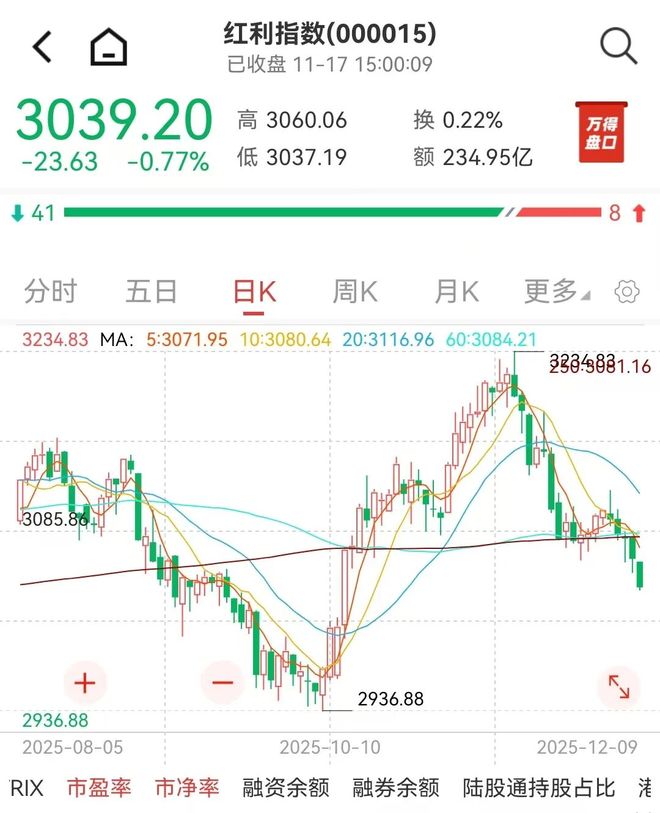
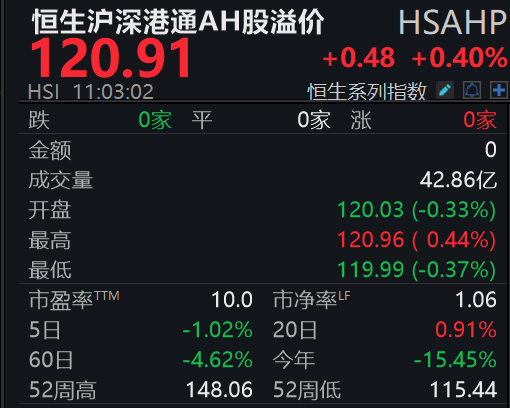
Core Viewpoint - Despite recent fluctuations in the Hong Kong stock market, it continues to attract southbound capital inflows, with A-shares also maintaining strong appeal [1] Group 1: Market Performance - Since the beginning of the fourth quarter, both A-shares and Hong Kong stocks have experienced a decline, with major indices showing significant drops. As of November 27, the Shanghai Composite Index fell by 0.19%, the STAR 50 Index dropped by 12.34%, and the ChiNext Index decreased by 3.29%. In the Hong Kong market, the Hang Seng Tech Index plummeted by 14.06%, while the Hang Seng Index fell by 3.29% [6] - Despite the fourth-quarter pullback, both A-shares and Hong Kong stocks have recorded substantial gains for the year. As of November 27, the Hang Seng Index and Hang Seng Tech Index rose by 29.34% and 25.29% respectively, while the Shanghai Composite Index increased by 15.62% and the STAR 50 Index by 32.54%. The Hong Kong innovative drug sector performed exceptionally well, with related indices showing over 90% growth [6] Group 2: Capital Inflows - There has been a notable trend of capital flowing into ETFs as investors seek opportunities. As of November 27, the top two stock ETFs by net inflow in the fourth quarter were from Guotai Junan Securities and Huabao Securities, with net inflows of 89.51 billion and 59.55 billion respectively. The Huaxia STAR 50 ETF also saw a net inflow of 51.65 billion, ranking third [6][7] - In terms of year-to-date net inflows, various themes such as securities, chemicals, robotics, and banking have been popular, with eight stock ETFs exceeding 10 billion in net inflows. Additionally, 11 cross-border ETFs related to the Hang Seng Tech or Hong Kong Stock Connect have also attracted significant capital, each exceeding 10 billion in net inflows [7] Group 3: AH Share Premium - The AH share premium index has been declining, currently around 120. Historically, A-shares of "A+H" companies have traded at a premium, but now some Hong Kong stocks are outperforming their A-share counterparts. For instance, as of November 28, the Hong Kong-listed NIO's stock price was 472 HKD per share, compared to 373.2 CNY for its A-share [9] - The continuous inflow of southbound capital is influencing the pricing power of Hong Kong stocks, with expectations that the AH premium will return to a more reasonable range as the interconnectivity mechanism improves [10] Group 4: Long-term Outlook - The long-term return outlook for A-shares is positive, with an expected annualized return of 7.7% over the next 10 to 15 years, based on three main drivers: economic resilience, ongoing shareholder return policies, and improved corporate governance [12]
化工涨的比创新药还多?
Xin Lang Cai Jing· 2025-11-13 07:52
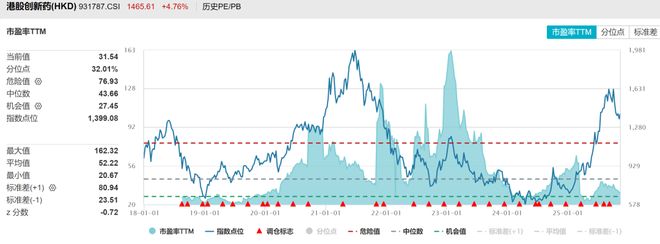
Core Insights - The chemical sector has outperformed the innovative pharmaceutical sector recently, with a notable increase of 3.7% in chemical stocks, leading to a total profit of over 20% from a rotation strategy between chemicals and green energy [3][20]. - The innovative pharmaceutical sector has also seen significant gains, with a current increase of 4.76% and a price-to-earnings (P/E) ratio of 31.83, which is relatively low compared to its historical average [5][6]. - The innovative pharmaceutical sector's growth this year has been driven by earnings rather than mere price increases, indicating a strong underlying performance [8]. Chemical Sector - The chemical sector has shown a profit of 15% after a recent bottom-fishing strategy, with the price now exceeding the previous selling price by 7% [2][3]. - The rotation strategy between chemicals and green energy has yielded a combined profit of over 20% [3][20]. Innovative Pharmaceutical Sector - The innovative pharmaceutical sector has experienced a significant rise, with a reported profit of 93.73% on a specific ETF holding, which is expected to exceed 100% with recent gains included [9]. - Despite the substantial price increase this year, the P/E ratio remains at a reasonable level, suggesting potential for further growth [6][8]. Market Trends - The market is witnessing a shift towards more stable investments, with investors inquiring about the potential for further investments in dividend and fixed-income funds [16][19]. - The overall sentiment indicates that while the market has recovered significantly, future profits will increasingly depend on identifying sectors with potential for substantial earnings growth [18].
六大机构,研判A股后市!
Zhong Guo Zheng Quan Bao· 2025-11-09 15:42
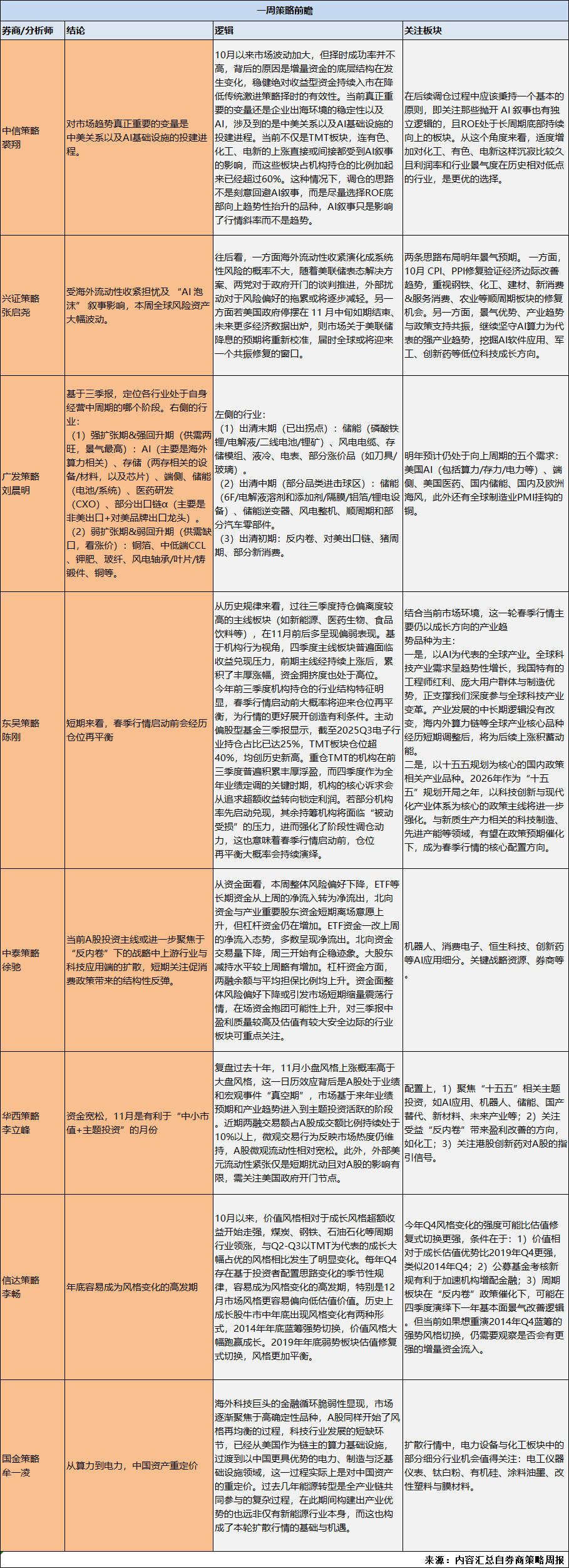
Core Viewpoint - A-shares are experiencing weak fluctuations, with the Shanghai Composite Index hovering around 4000 points, but still showing resilience supported by stable economic and policy expectations, indicating potential for further growth in the Chinese stock market from foreign investors [1] Economic Indicators - In October, the Consumer Price Index (CPI) rose by 0.2% month-on-month and year-on-year, while the core CPI (excluding food and energy) increased by 1.2%, marking the sixth consecutive month of growth [2] - The Producer Price Index (PPI) saw a month-on-month increase of 0.1%, the first rise this year, while the year-on-year decline narrowed to 2.1%, a reduction of 0.2 percentage points from the previous month [2] - The People's Bank of China reported a continuous increase in gold reserves for the 12th consecutive month, reaching 74.09 million ounces by the end of October [2] Market Adjustments - MSCI announced the inclusion of 26 new Chinese stocks in its China Index, while removing 20, with new additions including several resource stocks and technology companies in semiconductors and high-end manufacturing [3] Investment Recommendations - CITIC Securities suggests increasing allocations in sectors like chemicals, non-ferrous metals, and renewable energy, which are at historical low profitability and industry prosperity levels [4] - Zhongtai Securities highlights opportunities in robotics, brokerage firms, and other sectors benefiting from consumption policies and market recovery, focusing on strategic upstream industries and technology applications [5] - Industrial Securities emphasizes the resilience of A-shares, recommending investments in cyclical sectors such as steel, chemicals, and new consumption, while also maintaining focus on AI-related technology growth [6] Market Valuation - In terms of valuation, the MSCI China Index has a forward P/E ratio of 13.9, significantly lower than the S&P 500's 22.9, indicating that the Chinese stock market remains attractive despite recent increases [7] - The Chinese market is seen as appealing due to diversified economic growth, improving liquidity, and upward revisions in corporate earnings forecasts, supported by ongoing fiscal policies [7] - The demand for energy storage is driving lithium prices up, with expectations of continued high growth in the storage market, potentially leading to a significant increase in lithium prices by 2026 [7]
A股分析师前瞻:年末为什么会出现仓位与风格的再平衡?
Xuan Gu Bao· 2025-11-09 13:15
Group 1 - The focus of brokerage strategy analysts this week is on year-end style rebalancing, with historical patterns indicating that sectors with high deviation in holdings during the third quarter, such as new energy, pharmaceuticals, and food and beverage, tend to show weaker performance around November [1][3] - The fourth quarter is expected to face profit-taking pressure in main sectors, as previous main lines have accumulated significant gains, leading to high levels of capital crowding [1][3] - The structure of institutional holdings in the first three quarters of this year is evident, suggesting a high probability of position rebalancing before the spring market rally, which will create favorable conditions for better market performance [1][3] Group 2 - The strategy team from Guojin highlights the fragility of financial cycles among overseas tech giants, leading to a focus on high-certainty varieties, with A-shares also beginning a process of style rebalancing [2][4] - The transition of the tech industry's development from U.S.-led computing infrastructure to China's advantages in electricity, manufacturing, and general infrastructure represents a repricing of Chinese assets [2][4] - In the diffusion market, opportunities in specific sub-sectors within the electric equipment and chemical sectors are worth attention, including electrical instruments, titanium dioxide, organic silicon, and specialty plastics [2][4] Group 3 - The strategy team from Dongwu notes that the spring market rally is likely to experience a position rebalancing before its initiation, with a focus on sectors that have independent logic beyond AI narratives and are experiencing upward trends in ROE from long-term lows [1][3] - The analysis indicates that the small-cap style has a higher probability of rising compared to large-cap style in November, attributed to A-shares being in a performance and macro event "vacuum period," leading to active theme investments based on next year's performance expectations [1][3] Group 4 - The strategy team from Huaxi reviews the past decade, noting that November is favorable for "small-cap value + theme investment," with the market entering an active phase based on performance expectations and industry trends [1][3] - The current investment focus in A-shares may further concentrate on upstream industries and technology applications under the "anti-involution" strategy, with short-term attention on policies promoting consumption [1][3]
科技跌幅居前,互联网、医疗等紧随其后,银行股逆势反攻
Ge Long Hui· 2025-10-29 04:11
Group 1 - The Hang Seng Index closed down 0.33% after a weak performance throughout the day, with the Hang Seng Tech Index experiencing the largest decline [1] - The Hang Seng Tech Index fell by 1.44%, with notable declines in stocks such as SMIC down 3.26%, while NetEase rose by 2.35% [3] - Healthcare stocks continued to weaken, closing down 1.37%, with WuXi AppTec dropping 2% and other companies like Innovent Biologics and 3SBio also experiencing declines [3] Group 2 - Bank stocks rebounded after hitting a low, closing up 1.2%, with HSBC rising by 4.41% and Standard Chartered increasing by 3.73% [3] - Other banks such as Bank of China Hong Kong, Agricultural Bank of China, and Postal Savings Bank also saw gains of over 1% [3]

8大行业年内涨超50%,机构看好三个方向
21世纪经济报道· 2025-10-28 13:26
Core Viewpoint - The Shanghai Composite Index has surpassed the 4000-point mark for the first time since August 2015, closing at 3988.22 points, with a year-to-date increase of 18.99% [1] Industry Performance - The electronics sector has shown remarkable performance with a year-to-date increase of 98.01%, nearly doubling in value [1] - Other sectors such as non-ferrous metals, communications, machinery, comprehensive, power equipment, basic chemicals, and building materials have also performed well, each with over 50% year-to-date growth [1] - The food and beverage sector is the only one with negative returns this year, down by 1.09% [1] Momentum Effect - The phenomenon of sustained excess returns in certain sectors or stocks is referred to as the "momentum effect," raising questions about whether previously high-performing sectors can maintain their strong performance [4] Future Investment Opportunities - Huatai Securities suggests that the A-share market is currently in a phase of low trading volume and consolidation, presenting adjustment opportunities for investment. They recommend focusing on three areas: 1. Technology sectors that may remain the short-term market focus due to policy and trading factors, including low-position targets in Hang Seng Technology, A-share computing power, and robotics [6] 2. Defensive dividend sectors that may still have configuration opportunities [6] 3. Consumer sectors where risk has been sufficiently digested, allowing for potential left-side positioning [6] - Datong Securities emphasizes three focus areas: 1. The impact of reforms in the Sci-Tech Innovation Board and the startup of reforms in the Growth Enterprise Market, particularly in chips, artificial intelligence, and communications [6] 2. Opportunities for mergers and acquisitions amid the backdrop of high-quality development of listed companies [6] 3. The continuous inflow of medium to long-term funds into high-dividend stocks such as banks, coal, and public utilities [6]

投资别折腾!我们可能没那么聪明
雪球· 2025-10-09 08:05
Group 1 - The core viewpoint emphasizes the importance of not overtrading in the investment strategy for the fourth quarter, suggesting that maintaining a steady approach is crucial for enhancing investment experience [7][10]. - The article highlights the current market trends, noting that sectors such as artificial intelligence, Hong Kong innovative pharmaceuticals, and new energy batteries are performing well, while consumer sectors are lagging [8][10]. - It discusses the upcoming "15th Five-Year Plan" as a significant document for long-term investors, indicating that understanding this plan is essential for identifying investment opportunities and risks in the context of China's economic transformation [11][12]. Group 2 - The article raises the question of whether the market's main focus will shift from technology growth to resource cycles, suggesting that sectors like rare earths, non-ferrous metals, and new energy batteries may become the next focal points [13][14]. - It expresses concerns about the rapid rise in resource cycles, particularly in non-ferrous metals, which may face resistance at historical high levels [16]. - The article argues against the need for a defensive strategy in the fourth quarter, asserting that the dual themes of "valuation reassessment of Chinese assets" and "improvement in company quality" will likely continue to develop [18][19].