
外资流入

Search documents
投资者微观行为洞察手册·12 月第 2 期:融资资金流入加速,外资重回流入
GUOTAI HAITONG SECURITIES· 2025-12-15 14:59
Market Pricing Status - The market transaction activity has increased, but the profit-making effect has marginally decreased. The average daily trading volume for the entire A-share market rose to 2 trillion yuan, while the proportion of stocks that increased in value dropped to 31.8% [6][12][9] - The trading concentration has improved, with five industries showing turnover rates above the 90th percentile historically, including defense and military, commercial retail, and light industry manufacturing [6][12] A-Share Liquidity Tracking - The issuance of new equity funds has decreased to 9.11 billion yuan, while financing capital inflow has accelerated, with net buying amounting to 26.04 billion yuan [6][23][16] - The confidence index for private equity funds remained stable compared to November, with positions nearing the highest level of the year as of December 5 [6][34] - Foreign capital inflow into the A-share market was 0.1 million USD as of December 10, with the proportion of northbound capital transactions dropping to 30.0% historically [6][35][39] - The net amount raised from IPOs was 1.27 billion yuan, and the scale of private placements was 1.34 billion yuan, with a total of 13.03 billion yuan in restricted shares set to be unlocked in the coming week [6][16] A-Share Industry Allocation - Foreign and financing capital have both flowed into the electronics sector, with net inflows of 13.8 million USD and 70.6 billion yuan respectively [6][3.1] - In the ETF market, net inflows were concentrated in non-ferrous metals (2.2 billion yuan) and transportation (860 million yuan), while outflows were seen in non-bank financials (2.9 billion yuan) and defense and military (2.6 billion yuan) [6][3.2] - The top three industries in the龙虎榜 (top trading list) were electronics, light industry manufacturing, and environmental protection [6][3.4] Hong Kong and Global Fund Flow - Southbound capital has turned to outflows, while foreign capital has marginally flowed into the US and emerging markets. The Hang Seng Index decreased by 0.4% during this period [6][4.1] - The net outflow of southbound capital was 3.44 billion yuan, placing it in the 6% percentile since 2022 [6][4.2] - In the global context, foreign capital has marginally flowed into the US and South Korea, with inflows of 2.03 billion USD and 610 million USD respectively [6][4.3]
外资加速流入中国
2 1 Shi Ji Jing Ji Bao Dao· 2025-12-14 23:31
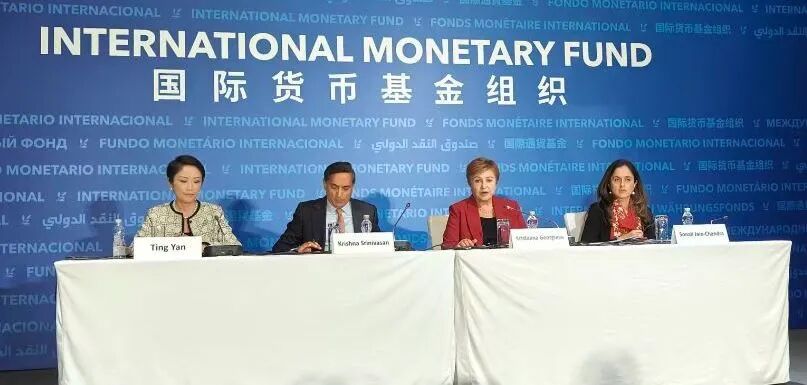
Economic Growth Forecasts - The International Monetary Fund (IMF) raised China's GDP growth forecast for 2025 by 0.2 percentage points to 5%, attributing this adjustment to macroeconomic policy measures [2] - The World Bank increased its 2025 growth prediction for China by 0.4 percentage points to 4.9%, citing supportive fiscal and monetary policies as well as diversified export markets [2] - Goldman Sachs revised its GDP growth forecast for China in 2025 from 4.9% to 5.0% and also raised projections for 2026 and 2027 [3] - Deutsche Bank adjusted its 2025 economic growth forecast for China to 5.0% [4] - Standard Chartered Bank increased its 2026 GDP growth forecast for China from 4.3% to 4.6% [5] Resilience and Structural Changes - China's economic resilience is recognized, with significant contributions from technology innovation and integration of tech policies with industrial development [5] - The Chinese economy is expected to rely more on domestic demand in the coming years, supported by structural reforms in the social security system [2][6] - There is a notable increase in overseas investment interest in Chinese assets, with institutional investors and retail investors showing signs of increased market participation [7] Investment Opportunities - The Asian markets, including China, are expected to provide attractive diversification and rebalancing investment opportunities in 2026, supported by policy benefits and improving fundamentals [8] - The upcoming "15th Five-Year Plan" is anticipated to focus on high-quality growth and a shift towards a consumption-driven economic model [9] - The financial system in China, particularly non-bank financial institutions, is expected to play a larger role in promoting consumer spending [9] Future Economic Outlook - The Chinese economy is projected to maintain steady growth, with internal demand expected to increase further and external demand remaining robust due to a stable US economy and AI investments [10] - Key areas for infrastructure investment are expected to include underground utilities, green transition projects, and AI computing centers [10]

外资加速流入中国
21世纪经济报道· 2025-12-14 23:29
Core Viewpoint - Recent reports from the IMF, World Bank, and various global financial institutions have raised their growth forecasts for the Chinese economy, highlighting its resilience and effective policy measures despite complex internal and external environments [2][3]. Group 1: Economic Growth Forecasts - The IMF has increased its 2025 growth forecast for China by 0.2 percentage points to 5%, attributing this to macro policy measures [2]. - The World Bank has raised its 2025 growth prediction by 0.4 percentage points to 4.9%, citing proactive fiscal policies and diversified export markets as key factors [2]. - Goldman Sachs has adjusted its GDP growth forecast for China in 2025 from 4.9% to 5.0%, with similar upward adjustments for 2026 and 2027 [3]. - Deutsche Bank has also raised its 2025 growth forecast to 5.0% [3]. - Standard Chartered has increased its 2026 GDP growth forecast from 4.3% to 4.6% [3]. Group 2: Structural Support and Investment Sentiment - Morgan Stanley's chief strategist noted that the Chinese stock market has shown resilience due to structural support, including government commitment to economic stability and technological breakthroughs [4]. - There is a notable increase in overseas investment interest in Chinese assets, with institutional investors and retail investors showing signs of increased market participation [6]. - In a recent investment strategy conference, many overseas investors expressed strong interest in returning to China, particularly in the context of diversified asset allocation [6]. Group 3: Future Economic Strategies - The "14th Five-Year Plan" has shown significant results, and the upcoming "15th Five-Year Plan" aims to continue promoting high-quality development and a consumption-driven growth model [10]. - The World Bank emphasizes the role of non-bank financial institutions in enhancing consumer spending and improving market transparency to support economic growth [11]. - Structural reforms are deemed essential to stimulate domestic demand and achieve a sustainable and high-quality development trajectory [11].

事关A股 富时罗素宣布:重大调整!纳入这些股票
Zheng Quan Shi Bao· 2025-12-03 23:39
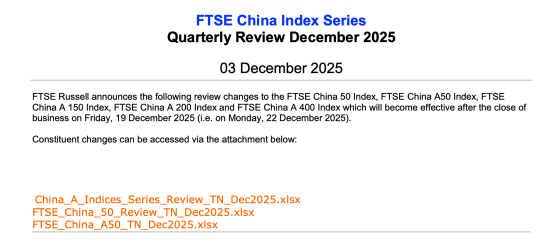
Core Viewpoint - FTSE Russell announced adjustments to several indices, including the FTSE China 50 Index, FTSE China A50 Index, FTSE China A150 Index, FTSE China A200 Index, and FTSE China A400 Index, effective after the market close on December 19, 2025 [1][17]. Group 1: Index Adjustments - The FTSE China A50 Index will include Luoyang Molybdenum and Sungrow Power, while removing Jiangsu Bank and SF Holding [3][19]. - The FTSE China 50 Index will add China Hongqiao, CATL, and Heng Rui Medicine, and remove CITIC Securities, Great Wall Motors, and Li Auto [5][21]. - The FTSE China A150 Index will add Ying Shi Innovation, Jiangsu Bank, Huadian New Energy, SF Holding, Jiangbolong, and Huayou Cobalt, while removing Luoyang Molybdenum, Desay SV, Longi Green Energy, Baoxin Software, Shanghai Pharmaceuticals, and Sungrow Power [9][25]. - The FTSE China A200 Index will include Ying Shi Innovation, Huadian New Energy, Jiangbolong, and Huayou Cobalt, and exclude Desay SV, Longi Green Energy, Baoxin Software, and Shanghai Pharmaceuticals [11][27]. - The FTSE China A400 Index will see a broader adjustment, adding Anji Technology, Baiyin Nonferrous Metals, Yitang Co., and BlueFocus, while removing Chipbond Technology, Yipin Hong, Guanghuan Xin, and Huaxi Biological [12][28]. Group 2: Investment Implications - The adjustments by FTSE Russell are expected to attract passive fund allocations to the included stocks and increase overseas interest in Chinese assets [15][31]. - In the first ten months of 2025, foreign capital inflow into the Chinese stock market reached $50.6 billion, significantly surpassing the $11.4 billion for the entire year of 2024, marking an increase of over three times [15][31]. - UBS forecasts that the A-share market will see an increase in earnings growth from 6% this year to 8% next year, driven by improved nominal GDP growth and a narrowing of PPI declines [16][32]. - Morgan Stanley has set a target for the CSI 300 Index at 4,840 points by December 2026, indicating a stable outlook for Chinese stocks amid moderate earnings growth and higher valuation levels [16][32].





事关A股,重大调整
证券时报· 2025-12-03 13:52
Core Viewpoint - The article discusses the upcoming adjustments to the FTSE Russell indices, specifically the FTSE China 50, FTSE China A50, FTSE China A150, FTSE China A200, and FTSE China A400 indices, which will take effect after the market close on December 19, 2025. These changes are expected to attract passive investment and increase foreign interest in Chinese assets [1][19]. Group 1: Index Adjustments - The FTSE China A50 index will include Luoyang Molybdenum and Sungrow Power, while removing Jiangsu Bank and SF Holding [4][6]. - The FTSE China 50 index will add China Hongqiao, CATL, and Hengrui Medicine, and exclude CITIC Securities, Great Wall Motors, and Li Auto [7][9]. - The FTSE China A150 index will incorporate Ying Shi Innovation, Jiangsu Bank, Huadian New Energy, SF Holding, Jiangbolong, and Huayou Cobalt, while excluding Luoyang Molybdenum, Desay SV, Changdian Technology, Baoxin Software, Shanghai Pharmaceuticals, and Sungrow Power [10][12]. - The FTSE China A200 index will add Ying Shi Innovation, Huadian New Energy, Jiangbolong, and Huayou Cobalt, and remove Desay SV, Changdian Technology, Baoxin Software, and Shanghai Pharmaceuticals [14]. - The FTSE China A400 index will see a broader adjustment, adding Anji Technology, Silver Industry, Yitang Co., and BlueFocus, while excluding Chipbond, Yipin Hong, Guanghuan Xinwang, and Huaxi Biological [15][17]. Group 2: Market Implications - The adjustments by FTSE Russell are anticipated to attract passive fund allocations to the newly included stocks, thereby increasing foreign capital interest in the Chinese market [19]. - Data indicates that foreign capital inflow into the Chinese stock market reached $50.6 billion in the first ten months of 2025, significantly surpassing the total of $11.4 billion for the entire year of 2024, marking an increase of over three times [19]. - UBS forecasts that the A-share market will see further growth in 2026, with overall A-share profit growth expected to rise from 6% this year to 8% next year, driven by improved nominal GDP growth and narrowing PPI declines [19]. - Morgan Stanley has set a target for the CSI 300 index at 4,840 points by December 2026, suggesting a stable upward potential for the index amid moderate profit growth and higher valuation levels [20].

突然暴跌,紧急“救市”!这国央行出手
券商中国· 2025-12-02 15:14
Core Viewpoint - The Indian Rupee has faced significant depreciation, hitting a historic low against the US Dollar, prompting the Reserve Bank of India (RBI) to intervene in the market to stabilize the currency [1][2][4]. Group 1: Currency Depreciation - The Indian Rupee fell below the psychological level of 90 against the US Dollar, reaching a low of 90.058, marking a nearly 5% depreciation for the year, making it the worst-performing currency in Asia [2][4]. - As of October 2023, foreign investors have withdrawn over $17 billion from the Indian stock market, exacerbating the downward pressure on the Rupee [5]. Group 2: Economic Factors - Key reasons for the Rupee's decline include low foreign investment inflows, record trade deficits, and uncertainties surrounding the US-India trade agreement [6][7]. - India's trade deficit surged to $32.15 billion in October, the highest in 13 months, primarily due to a 28.5% drop in exports to the US from May to October [6]. Group 3: RBI's Intervention - The RBI's intervention aims to prevent further depreciation of the Rupee, with analysts expecting the central bank to actively set a ceiling for the USD/INR exchange rate [4][6]. - Despite short-term interventions, analysts suggest that the Rupee may still face further depreciation due to underlying economic pressures, including an expanding current account deficit projected to reach 1.4% of GDP this fiscal year [4][6]. Group 4: Future Outlook - The RBI Governor indicated that a 3% to 3.5% annual depreciation of the Rupee is normal, focusing on curbing excessive volatility rather than maintaining a specific exchange rate [7]. - The International Monetary Fund (IMF) forecasts that if the US-India trade agreement remains delayed, India's GDP growth may slow down, with exports expected to decline by 5.8% in the fiscal year 2026 [7].

流动性相对宽松,国债期货涨跌分化
Hua Tai Qi Huo· 2025-12-02 02:26
1. Report Industry Investment Rating - Not provided in the content 2. Core Viewpoints of the Report - The bond market fluctuates between stable growth and easing expectations, affected by the stock market, delayed Fed rate - cut expectations, and increased global trade uncertainties. It is recommended to pay attention to the policy signals at the end of the month in the short term [1][3] - For trading strategies, the 2603 contract of treasury bond futures is neutral for unilateral trading; pay attention to the decline of the 2603 basis for arbitrage; and short - side investors can use far - month contracts for appropriate hedging due to the medium - term adjustment pressure [4] 3. Summary by Relevant Catalogs 3.1 Interest Rate Pricing Tracking Indicators - Price indicators: China's CPI (monthly) has a month - on - month and year - on - year increase of 0.20%; China's PPI (monthly) has a month - on - month increase of 0.10% and a year - on - year decrease of 2.10% [9] - Economic indicators (monthly update): Social financing scale is 437.72 trillion yuan, with a month - on - month increase of 0.64 trillion yuan and a growth rate of 0.15%; M2 year - on - year is 8.20%, with a decrease of 0.20 percentage points and a decline rate of 2.38%; Manufacturing PMI is 49.20%, with an increase of 0.20 percentage points and a growth rate of 0.41% [10] - Economic indicators (daily update): The US dollar index is 99.42, with a decrease of 0.05 and a decline rate of 0.05%; The US dollar against the offshore RMB is 7.0710, with a change of 0.000 and a decline rate of 0.01%; SHIBOR 7 - day is 1.45, with an increase of 0.02 and a growth rate of 1.18%; DR007 is 1.46, with a decrease of 0.01 and a decline rate of 0.60%; R007 is 1.51, with a decrease of 0.02 and a decline rate of 1.24%; The 3 - month inter - bank certificate of deposit (AAA) is 1.59, with a change of 0.00 and a decline rate of 0.11%; The AA - AAA credit spread (1Y) is 0.10, with a change of 0.00 and a decline rate of 0.11% [10] 3.2 Overview of the Treasury Bond and Treasury Bond Futures Market - On December 1, 2025, the closing prices of TS, TF, T, and TL were 102.41 yuan, 105.84 yuan, 108.04 yuan, and 114.37 yuan respectively, with the corresponding price changes of 0.03%, 0.10%, 0.12%, and - 0.08% [3] - The average net basis of TS, TF, T, and TL was - 0.037 yuan, - 0.149 yuan, - 0.143 yuan, and - 0.139 yuan respectively [3] - There are multiple figures showing the closing price trends, price changes, capital flow, position ratios, etc. of treasury bond futures [7][12][15] 3.3 Overview of the Money Market Funding Situation - From January to October 2025, the general public budget revenue increased by 0.8% year - on - year, with tax revenue improving for eight consecutive months, but non - tax revenue dragging down the overall growth rate. The general public budget expenditure increased only by 2% year - on - year and slowed down for three consecutive months [2] - At the end of October, the social financing and credit maintained a low - level expansion, while government bond issuance remained strong, and the financing demand of enterprises and residents was weak. The M1 declined, and the M2 - M1 gap widened, indicating weak business vitality in the real economy [2] - On December 1, 2025, the central bank conducted 107.6 billion yuan of 7 - day reverse repurchase operations at a fixed interest rate of 1.4% [2] - The main term repurchase rates of 1D, 7D, 14D, and 1M were 1.307%, 1.454%, 1.477%, and 1.519% respectively, and the repurchase rates have rebounded recently [2] - There are multiple figures showing the Shibor rate trends, inter - bank certificate of deposit yields, bank - to - bank pledged repurchase transactions, and local government bond issuance [7][26][29] 3.4 Spread Overview - There are multiple figures showing the inter - term spread trends of treasury bond futures and the term spread between spot bonds and cross - variety spreads of futures [7][28][33] 3.5 Two - year Treasury Bond Futures - There are figures showing the implied interest rate and maturity yield of the two - year treasury bond futures main contract, the IRR of the TS main contract and the funding rate, and the three - year basis and net basis trends of the TS main contract [7][36][46] 3.6 Five - year Treasury Bond Futures - There are figures showing the implied interest rate and maturity yield of the five - year treasury bond futures main contract, the IRR of the TF main contract and the funding rate, and the three - year basis and net basis trends of the TF main contract [7][48][52] 3.7 Ten - year Treasury Bond Futures - There are figures showing the implied yield and maturity yield of the ten - year treasury bond futures main contract, the IRR of the T main contract and the funding rate, and the three - year basis and net basis trends of the T main contract [7][54][56] 3.8 Thirty - year Treasury Bond Futures - There are figures showing the implied yield and maturity yield of the thirty - year treasury bond futures main contract, the IRR of the TL main contract and the funding rate, and the three - year basis and net basis trends of the TL main contract [7][61][67]
人民币对美元近期走强原因,对A股港股有何影响?|资本市场
清华金融评论· 2025-11-29 09:48
文/《清华金融评论》 王茅 近期人民币汇率涨势明显,离岸人民币(CNH) 11月25日 报 7 .0 829 元 (单日涨 0. 3%),11月2 7日盘中最高升至7. 0653 , 逼近 202 4年10月9 日高点。人民币近期 走强主要受内外因素共同推动,短期有望延续偏强 态势,对资本市场尤其是 A股和港股形成显著利好。 人民币近期 走强 主要 原因 外部环境改善 。 美元持续走弱, 2025年美元指数已累计下跌超7%,美联储降息预期升温 , 12月降息概率升至 8 0%以上,削弱美元吸引力 。 中美利差 收窄, 美联储降息频率高于中国央行,中美 10年期国债收益率利差缩小,提升人民币资产性价比。 内部支撑强化 。 我国 经济韧性凸显, 我国 出口超预期增长 , 如四季度结汇需求激增 , 政策工具箱丰富, 这 夯实 了人民币 汇率基础 。 政策主动引 导, 我国 央行通过中间价持续释放升值信号,并收紧离岸流动性抑制做空, 这 稳定 了 市场预期。 此外, 外资增配人民币资产 。 国际投行集体 ( 如高盛、瑞银等 ) 唱多 A股,科技股吸引力增强,跨境资金回流中国资本市场加速,也提振了人民币汇 率。 人民币 ...

750家中企先行,IPO数量与外资流入创新高,沙特正成为中国资本新绿洲
Xin Lang Zheng Quan· 2025-11-11 06:35
Group 1 - The core viewpoint of the article highlights the strengthening economic partnership between China and Saudi Arabia, with bilateral trade exceeding 1 trillion Saudi Riyals and significant Chinese investments in high-value sectors [1][2] - The Saudi capital market is the largest in the MENA region, with a total market capitalization exceeding $2.5 trillion, and is recognized as one of the fastest-growing capital markets globally [2] - In the past year, Saudi Arabia completed 44 IPOs, with 50 companies planning to go public by 2025, covering various cutting-edge industries such as technology and healthcare [2] Group 2 - The participation of foreign capital in the Saudi capital market has surged to $108 billion, marking a 140% increase and maintaining a growth trend for five consecutive years [2] - The Saudi Capital Market Authority plans to promote the first offshore securities business license to enhance cross-border exchanges [2]