
大宗商品超级周期

Search documents
Gold, Silver Continue Wild Swings
Youtube· 2026-01-30 16:25
Market Overview - Recent volatility in gold prices saw a spike above 5500 before dropping below 5000, driven by speculative trading and external factors such as Fed nominations and a rallying dollar [1][2] - The current sell-off is viewed as a healthy correction within a long-term bull market for precious metals and commodities, indicating a potential commodity supercycle in the coming years [3] ETF Performance - The ETF celebrating its one-year anniversary reported a 100% return, reflecting successful positioning in gold, silver, and mining stocks [4] - The portfolio is actively managed, with significant themes including geopolitical and fiscal risks, energy, and various mining sectors [5][6] Investment Strategy - The company has shifted its focus from being overweight in energy to reallocating towards gold and silver, while still maintaining a significant portion of the portfolio in these assets due to ongoing geopolitical and fiscal risks [7] - The strategy remains flexible, allowing for potential shifts to other assets as market conditions evolve [8] Dollar Dynamics - The dollar is experiencing a rebound, but the long-term outlook suggests a continued bear market for the dollar, which may take years to fully materialize [9][11] - Historical analysis indicates that the current dollar bear market aligns with past trends, suggesting that short-term fluctuations may occur within a broader bearish context [10]


商品距离“大牛市”,还差一场经济衰退?
Hua Er Jie Jian Wen· 2026-01-30 10:08
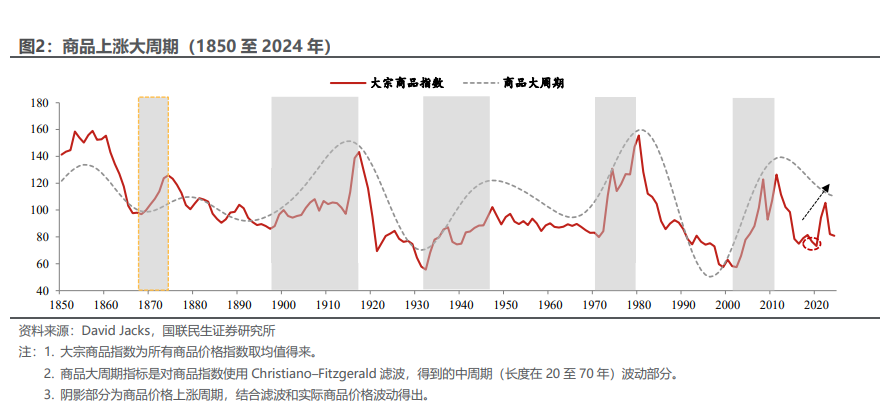
Core Viewpoint - The recent surge in prices of commodities like copper, gold, and silver has reignited market speculation about a "super cycle" in commodities, but the current cycle may not have completed necessary steps for a true bull market [1][19]. Group 1: Historical Context of Commodity Bull Markets - Historically, true commodity bull markets often begin not in prosperity but from economic lows, culminating during periods of economic overheating or recession [1][5]. - A review of commodity price trends since 1850 identified five typical commodity bull cycles, which average about 11.8 years in duration, with real commodity prices rising approximately 79% after adjusting for inflation [2][6]. - Key historical starting points for these cycles include 1897, 1932, 1971, 2002, and 2020, each corresponding to significant economic downturns [7][8]. Group 2: Current Market Dynamics - The current commodity price increase appears to be more of a "precious metals market" rather than a comprehensive commodity bull market driven by real demand [9][10]. - The breadth of commodity price increases has been insufficient compared to previous bull markets, with precious metals outperforming while energy, agricultural products, and some industrial metals lag behind [13][19]. Group 3: Structural Factors Influencing Commodity Prices - Three long-term variables are identified as critical for determining commodity pricing: war, technological revolutions, and emerging demand [10][16]. - Wars do not universally boost commodity prices; they can suppress demand and prices unless they lead to significant destruction of demand [11][12]. - Technological revolutions typically coincide with commodity bull markets, but the current technological advancements, particularly in AI, are still in early stages and have not yet led to a significant demand surge [16][17]. - Emerging demand from new buyers has historically been a prerequisite for commodity bull markets, but there is currently no equivalent to the demand surge seen with China's entry into the WTO [17][18]. Group 4: Conclusion and Future Outlook - The current commodity cycle likely began in 2020, supported by a long-term depreciation of the dollar, but lacks critical elements such as concentrated geopolitical conflicts, clear emerging demand, and a genuine economic recession to validate the cycle [19][20]. - A recession may serve as a crucial test for the current commodity price trends, determining whether they can transition from a structural rally to a full bull market [20].
石油ETF(561360)翻红,连续5日资金净流入超9亿元,资金积极布局,淡季不淡,库存周期酝酿切换
Sou Hu Cai Jing· 2026-01-29 06:52
Group 1 - The core viewpoint of the article highlights a strong rebound in Brent crude oil prices from around $60 to above $65, driven by increasing geopolitical uncertainties and short-term supply concerns [1] - Recent geopolitical risks, particularly related to Iran and Kazakhstan, have heightened market sentiment, leading to increased buying activity in oil [1] - The ongoing Russia-Ukraine conflict continues to create market disruptions, contributing to the volatility in oil prices [1] Group 2 - Supply-side factors include a significant reduction in U.S. crude oil production by up to 2 million barrels per day due to extreme cold weather, particularly affecting the Permian Basin [1] - The article suggests that current oil trading may focus more on the premium arising from supply vulnerabilities, while medium to long-term outlook indicates potential price recovery due to geopolitical disturbances [1] - The oil and gas industry is expected to benefit from rising oil prices, with indications of a potential supercycle in commodities this year, attracting funds towards oil sectors [1]
ETF日报:今年或迎来大宗商品超级周期,或有部分资金会选择高低切,流向石油等板块,关注石油ETF
Xin Lang Cai Jing· 2026-01-28 12:59
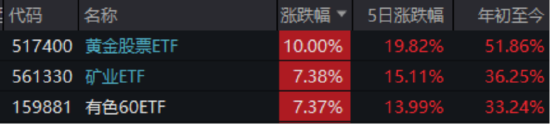
Market Overview - The A-share market showed strong fluctuations today, with the Shanghai Composite Index rising by 0.27% to 4151.24 points, while the Shenzhen Component Index increased by 0.09%. However, the ChiNext Index and the STAR Market Index fell by 0.57% and 0.47%, respectively. The total market turnover reached 2.99 trillion yuan, an increase of 70.8 billion yuan compared to the previous trading day [1][15] - The overall market sentiment is neutral to weak, with over 3600 stocks declining. Small-cap stocks showed mixed performance, with micro-cap stocks underperforming, while growth stocks slightly outperformed value stocks [1][15] Gold and Precious Metals - Spot gold prices surged past the $5200 per ounce mark, leading to significant gains in gold stocks and the non-ferrous metals sector. The Gold Stock ETF rose by 10.00%, the Mining ETF increased by 7.38%, and the Non-Ferrous 60 ETF climbed by 7.37% [1][2][15] - The recent rise in gold prices is attributed to its safe-haven appeal and a renewed "sell America" trading logic, as market confidence in U.S. assets wavers amid a potential interest rate cut cycle and geopolitical tensions [2][16] Commodity Market Trends - The current rise in precious metals and non-ferrous prices reflects the ongoing realization of core market logic, with clear long-term drivers for gold and silver. However, there are signs of potential acceleration towards a peak in this price wave [3][17] - A super cycle for commodities is anticipated this year, supported by a rebound in real estate and infrastructure investments in China, as well as expansionary fiscal and monetary policies in the U.S. during the midterm election year [4][18] Coal and Energy Sector - The Coal ETF saw a significant increase of 4.75%, driven by market sentiment towards resource commodities. The current price of Q5500 thermal coal in Qinhuangdao and Shanxi has stabilized at 685 yuan per ton [6][20] - The oil sector also experienced gains, with the Oil ETF rising by 4.42%. Brent crude oil prices rebounded from around $60 to above $65, influenced by geopolitical uncertainties and supply disruptions [7][22] Investment Opportunities - The coal industry shows strong valuation and dividend potential, with a price-to-book ratio of only 1.59 and a dividend yield of 5.82%, making it attractive in the current low-interest-rate environment [21] - Investors are encouraged to consider the largest Oil ETF, which has a scale of 1.021 billion yuan, as it continues to attract capital inflows [8][23]
现货黄金加速上冲站上5200美元/盎司,有色金属集体狂飙,黄金股票ETF10cm涨停
Sou Hu Cai Jing· 2026-01-28 07:22
Core Viewpoint - The recent surge in gold prices, surpassing $5200 per ounce, is driven by a combination of factors including geopolitical tensions, a weakening US dollar, and increased investor interest in precious metals as a safe haven [2][3]. Group 1: Market Performance - As of January 28, 2026, the Gold Stock ETF (517400) reached a limit up of 10%, while the Mining ETF (561330) and Nonferrous 60 ETF (159881) increased by 7.38% and 7.37% respectively [1]. - The implied volatility of gold has reached 33.13%, indicating a high level of market activity and potential overheating in the precious metals sector [3]. Group 2: Factors Driving Gold Prices - The recent comments by former President Trump regarding the dollar's fluctuations have contributed to a decline in the dollar index (DXY), which fell over 50 points, creating a favorable environment for gold prices to rise [2]. - The Bank of Thailand's announcement to prohibit short selling in gold trading has further supported the bullish sentiment in the gold market [2]. Group 3: Silver Market Dynamics - Silver prices are experiencing extraordinary growth, with a recent target price increase from Citigroup for silver set at $150 per ounce, up from $100 [2]. - The trading volume of silver ETFs is at historical highs, indicating strong investor interest and potential volatility in the silver market [10]. Group 4: Future Outlook - The macroeconomic environment suggests a potential supercycle for commodities, driven by increased infrastructure investment in China and expansionary fiscal policies in the US during the midterm election year [9]. - The current market sentiment is characterized by a mix of emotional trading and capital inflow, suggesting both long-term investment opportunities and short-term risks [12].
全球金属狂欢进行时! 对冲基金巨头城堡杀入工业金属牌桌 拥抱金属交易热潮
智通财经网· 2026-01-28 00:33
智通财经APP获悉,有媒体报道称,作为大宗商品交易市场最成功的对冲基金之一,总部位于美国的对 冲基金巨头城堡投资(Citadel)终于迈入工业金属领域,这也意味着在铜到锡等工业金属价格近期屡次实 现创纪录新高之后,这家华尔街投资巨头改变了多年来回避这一交易板块的谨慎立场。 媒体援引知情人士透露的消息报道称,由肯·格里芬(Ken Griffin)领导的这家对冲基金巨头已聘请伊兰·阿 德勒(Ylan Adler)担任投资组合经理,其职责为负责跨大宗商品配置,其中金属交易将是关键组成部 分。此举发生在各大投资机构围绕工业金属以及黄金、白银等贵金属交易兴趣持续高涨之际,随着市场 愈发火热,许多对冲基金与大宗商品贸易商纷纷扩大对该领域的布局。 据了解,城堡投资的大宗商品业务近年已录得非常可观的投资收益数据——仅在2022年就实现盈利约80 亿美元,其成功也触发了一波竞争对手的"大宗商品挖人潮",试图效仿其路径。迄今为止,该业务主要 聚焦能源市场,并已成为美国最大规模的实物天然气交易商之一。 相较于其部分竞争对手对于金属交易人才的大规模招聘狂潮,聘用阿德勒只是一个温和的动作,但这仍 标志着这家总部位于迈阿密的投资巨头立场 ...

金属狂欢席卷全球!矿业巨头必和必拓市值随铜价狂飙,夺回“澳大利亚股王”头衔
Zhi Tong Cai Jing· 2026-01-27 05:51
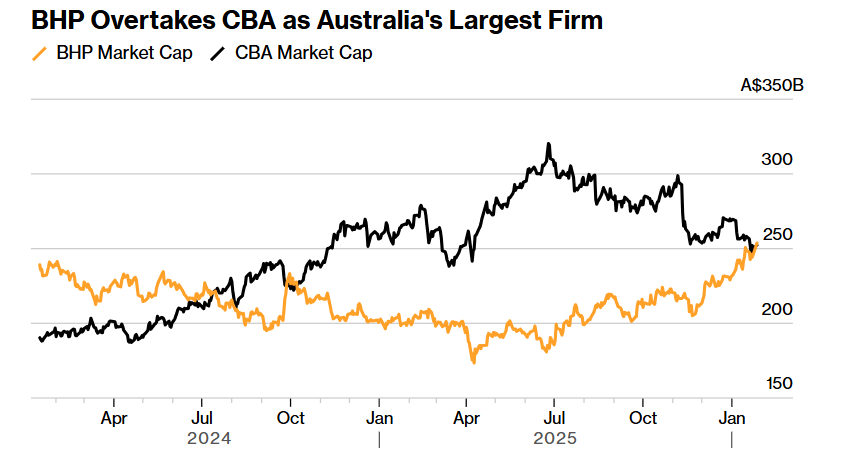
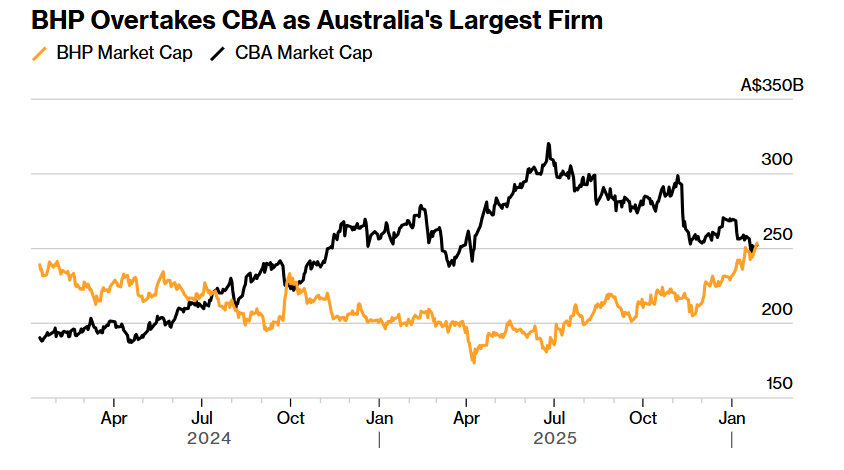
Group 1 - BHP Group Ltd. has regained its title as Australia's largest listed company, surpassing Commonwealth Bank of Australia (CBA) due to a significant rise in global metal prices, particularly copper [1][4][9] - BHP's market capitalization has exceeded AUD 253 billion (approximately USD 175 billion), with a weight of 9.3% in the S&P/ASX 200 Index, while CBA's weight has fallen below this level [1][4] - Since the second half of 2025, BHP's stock price has surged by 50%, driven by a 40% increase in LME copper futures prices, which account for nearly half of BHP's total revenue [4][10] Group 2 - The mining sector, particularly BHP and Rio Tinto, has become a top investment target for fund managers, driven by increased demand for industrial metals due to the AI boom and supply constraints [6][7] - The MSCI Metals and Mining Index has risen nearly 90% since 2025, outperforming major tech stocks and the banking sector [6][7] - Analysts are optimistic about the future of metals like copper, aluminum, and nickel, viewing them as structural investment opportunities rather than cyclical commodities [7][11] Group 3 - Gold and silver prices have seen unprecedented increases, with gold rising 70% in 2025 and silver by 150%, marking the highest annual gains since 1979 [5][9] - The current geopolitical climate and inflation concerns are driving a shift in investment towards commodities, with gold prices expected to reach USD 5,400 per ounce by the end of 2026 [9][10] - BHP's strong performance is linked to its high exposure to copper, which is essential for AI and electrification, leading to increased earnings expectations and valuation [10][11]
金属狂欢席卷全球! 矿业巨头必和必拓市值随铜价狂飙 夺回“澳大利亚股王”头衔
Zhi Tong Cai Jing· 2026-01-27 03:47
Core Viewpoint - The surge in global metal prices has propelled BHP Group Ltd. to reclaim its title as Australia's largest listed company, surpassing Commonwealth Bank of Australia (CBA) [1][4][9] Group 1: Company Performance - BHP's stock price rose by 3.4%, increasing its market capitalization to over AUD 253 billion (approximately USD 175 billion) [1] - Since the second half of 2025, BHP's stock has surged by 50%, with its market value increasing by over AUD 20 billion since the beginning of 2026 [4] - Copper accounted for nearly half of BHP's total revenue at the fiscal year-end, significantly boosting its financial performance [10] Group 2: Market Trends - The LME copper futures price has increased by approximately 40% since the second half of 2025, contributing to the rise in mining stocks globally [4][6] - The mining sector index in Australia has risen by 42% over the past 12 months, while the financial sector index has only increased by 2% [4] - Gold prices surged by 70% in 2025, marking the largest annual increase since 1979, while silver prices rose by 150% during the same period [5] Group 3: Investment Sentiment - Global mining stocks, including BHP and Rio Tinto, have become top investment targets for fund managers due to increased demand for industrial metals driven by AI and supply constraints [5][6] - The MSCI metals and mining index has risen nearly 90% since 2025, outperforming major tech and banking indices [6] - Fund managers in Europe have increased their net holdings in the mining sector to 26%, the highest level in four years [7] Group 4: Future Outlook - Analysts predict that the demand for copper will grow by about 50% by 2040 due to new applications in AI and defense, leading to potential supply shortages [10][11] - The current market dynamics suggest a fundamental shift in commodity investment logic, with mining stocks transitioning from defensive plays to essential portfolio anchors [7][11] - The ongoing geopolitical uncertainties and inflationary pressures are expected to further drive the demand for precious metals like gold and silver [9][10]
如何看待年初周期行情的持续性
2026-01-26 02:49
Summary of Conference Call Records Industry Overview Coatings and Waterproofing Materials - There are opportunities for price increases in the coatings and waterproofing materials sectors, with coatings showing signs of growth in 2025 and waterproofing expected to follow in 2026. Key companies to focus on include Yuhong, Keshun, and Sankeshu [1][2] Pipe Manufacturing - Companies targeting the C-end market are performing steadily with good cash flow and dividends, making them suitable for conservative investors. Recommended companies include Tubao and Weixing [1][2] Glass Fiber Sector - The demand outlook for the glass fiber sector is positive, with significant price increases in ordinary electronic cloth since the beginning of the year. China Jushi and Zhongcai Technology have considerable growth potential in the high-end electronic cloth market [1][2] Construction Sector - Large companies with low valuations and high dividend yields, such as Tunnel Co. and China State Construction, are worth attention. A recovery in traditional construction demand will benefit upstream material suppliers like Honglu Steel Structure and Jinggong Steel Structure [1][2] Non-Ferrous Metals Industry - The non-ferrous metals sector is currently at a high PB valuation, around the 75th percentile over the last 20 years, but still has upward potential based on PE valuation at approximately the 35th percentile. Gold stocks are valued at 12-13 times earnings, with a potential increase of 50%-70% during a bull market. Energy metals like copper and aluminum also show around 40% upside potential. The gold sector has risen 30% since the beginning of the year and is in the middle of a quarterly uptrend [3][4] Coal Industry Current Fundamentals - The coking coal sector shows strong fundamentals, with a recent increase in the coal index by 1.44%, outperforming the CSI 300 index. Supply-side data is low, with significant inventory reductions. As of January 23, coal inventory was 168 million tons, down 3.3% year-on-year, with coking coal inventory down 12% [5][6] Future Expectations - The coal sector is expected to see significant price increases following policy changes that will affect inventory and production levels. High-quality coking coal companies and high-dividend thermal coal companies are recommended for investment [6] Real Estate Sector Market Trends - The real estate sector is nearing the end of its bottoming phase, with recommendations to accumulate stocks that have improved fundamentals but have not yet realized performance. Jianfa Co. is highlighted, with expected losses of 5.2 to 10 billion yuan in 2025 but a commitment to maintain dividends of at least 0.7 yuan per share [7][8] Company Performance - Jianfa Co. has a stable supply chain business with significant growth in overseas operations, achieving sales of 14 billion USD, a 37% year-on-year increase. Major losses are attributed to its home furnishing business and real estate operations [9][10] Future Performance Expectations - The year 2025 is anticipated to be a low point for Jianfa Co., with a projected rebound in 2026, estimating profits between 3 to 3.5 billion yuan. The company is expected to maintain a stable dividend strategy, supported by strong cash flow [11]

1.26犀牛财经早报:全球大宗商品或迎来超预期周期
Xi Niu Cai Jing· 2026-01-26 01:43
Group 1: Commodity Market Trends - The global commodity market is entering a new super cycle, driven by factors such as excessive monetary issuance, a credit crisis in the US dollar, technological innovation, and geopolitical conflicts affecting supply chains [1] - Fund managers are strategically increasing allocations to non-ferrous metals and basic chemicals, viewing them as essential to modern industry [1] Group 2: Gold Market Insights - International gold prices have surged over 14% this year, with significant increases in both gold and silver prices, leading institutions to raise their gold price forecasts [2] - Goldman Sachs has revised its gold price target for the end of 2026 from $4,900 to $5,400 per ounce, citing rising demand from private investors and central banks [2] Group 3: Investment Products and Risks - Gold structured deposits are gaining popularity due to their capital protection and yield flexibility, but some banks are experiencing tight product availability [2] - Experts warn that investing in copper bars carries risks due to an immature market structure and lack of a robust repurchase mechanism, making it difficult to sell [2] Group 4: Industry Developments - A breakthrough in the production of high-end materials, specifically polyolefin elastomers, has been achieved in China, reducing reliance on imports for strategic industries like photovoltaics [3] - The smart glasses market is projected to see a 77% year-on-year increase in shipments by 2026, indicating significant growth and industry chain upgrades [3] Group 5: Market Forecasts - The Chinese潮玩 (trendy toys) industry is expected to exceed 100 billion yuan in total value by 2026, with a projected annual growth rate of over 20% [4] - The domestic innovative drug sector is witnessing a transformation towards sustainable revenue models, with a record number of new drug approvals expected in 2025 [4] Group 6: Corporate Changes and Financial Performance - Nvidia's board member Persis Drell has resigned to pursue new career opportunities, with no operational disagreements reported [5] - Blackstone plans to sell a 45% stake in Leica, with the overall valuation of Leica estimated at approximately 1 billion euros [5] - Guanhua High-tech is shutting down two production lines due to continuous losses and industry overcapacity [8]