
工业企业利润

Search documents
国家统计局:2025年电力、热力生产和供应业利润增长13.9%
Guo Jia Tong Ji Ju· 2026-01-27 01:40
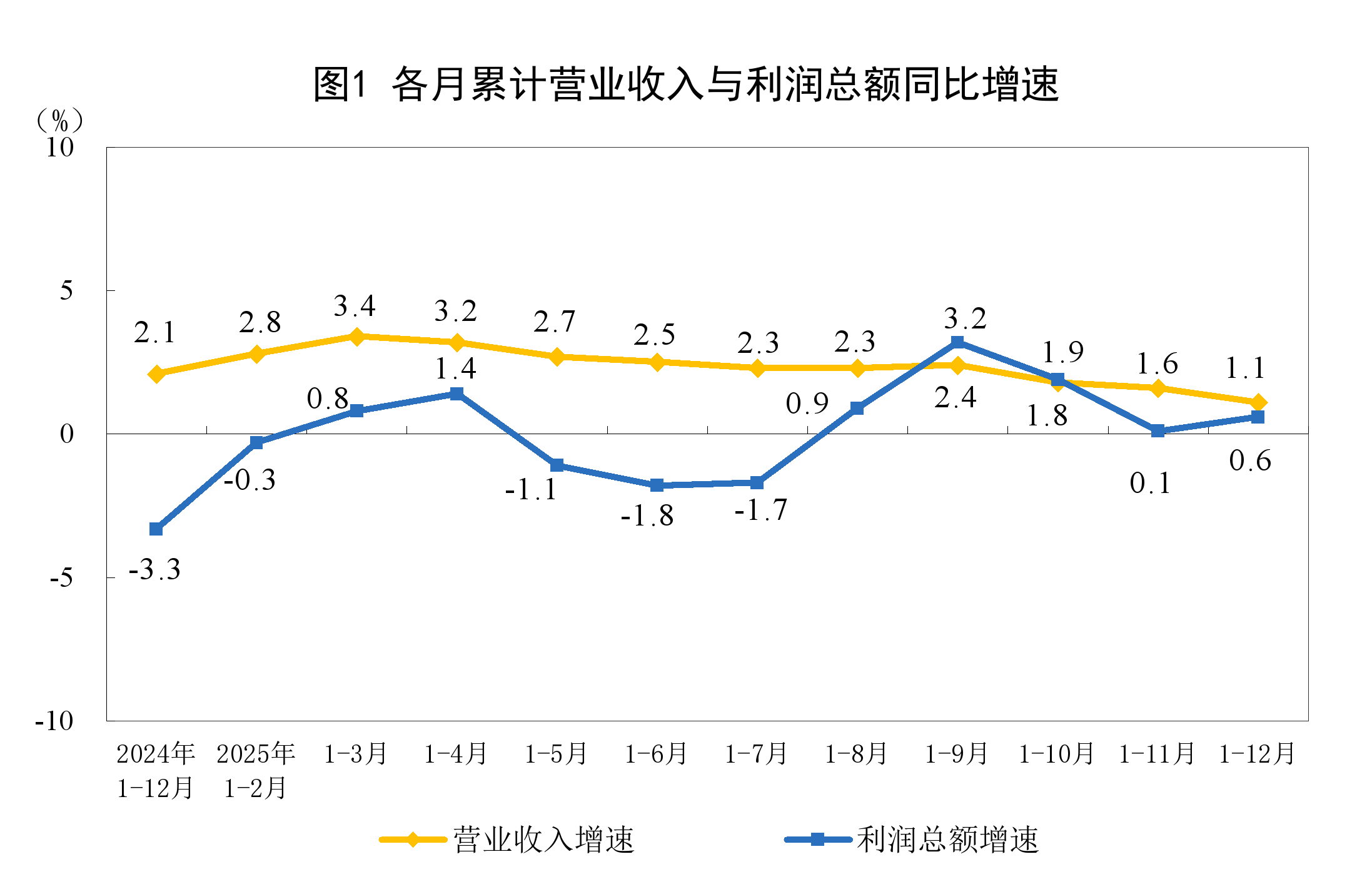
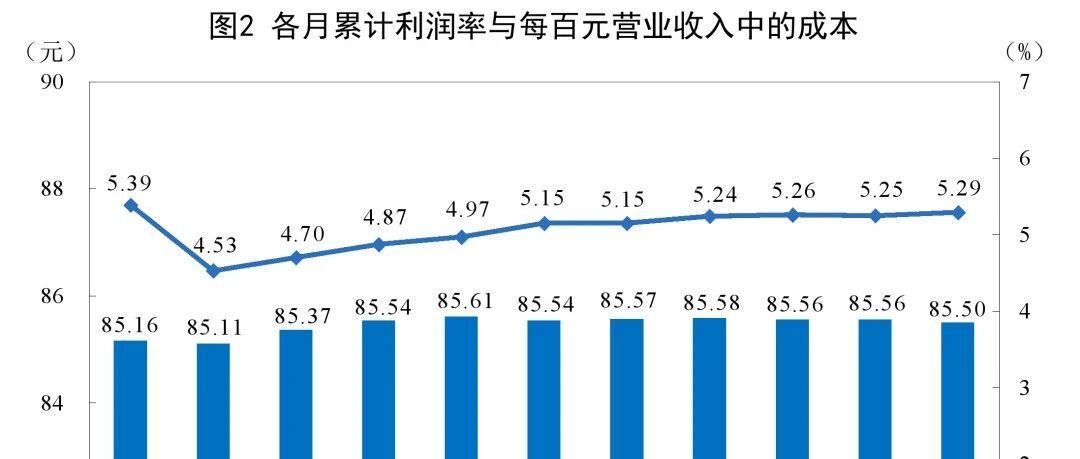
Core Insights - In 2025, the total profit of industrial enterprises above designated size reached 739.82 billion yuan, an increase of 0.6% compared to the previous year [1] - The profit distribution among different types of enterprises showed a decline in state-owned enterprises and joint-stock enterprises, while foreign and private enterprises experienced growth or stability [1][2] Financial Performance - The total operating revenue for industrial enterprises was 13.92 trillion yuan, reflecting a growth of 1.1% year-on-year, while operating costs increased by 1.3% to 11.88 trillion yuan [2][10] - The profit margin for operating revenue was 5.31%, a slight decrease of 0.03 percentage points from the previous year [2][10] Industry-Specific Performance - The mining industry saw a significant profit decline of 26.2%, while the manufacturing sector experienced a profit increase of 5.0% [1][2] - Notable growth was observed in the black metal smelting and rolling industry, which saw profits increase by 3.0 times, and the computer, communication, and other electronic equipment manufacturing industry, which grew by 19.5% [2][10] Asset and Liability Overview - By the end of 2025, total assets of industrial enterprises amounted to 188.41 trillion yuan, up 4.3% year-on-year, while total liabilities reached 108.58 trillion yuan, an increase of 4.2% [2][10] - The equity of owners totaled 79.82 trillion yuan, reflecting a growth of 4.5%, with an asset-liability ratio of 57.6%, down by 0.1 percentage points [2][10] Accounts Receivable and Inventory - Accounts receivable stood at 27.43 trillion yuan, up 4.7% from the previous year, while finished goods inventory increased by 3.9% to 6.73 trillion yuan [3] - The average collection period for accounts receivable was 67.9 days, an increase of 3.6 days compared to the previous year [3]

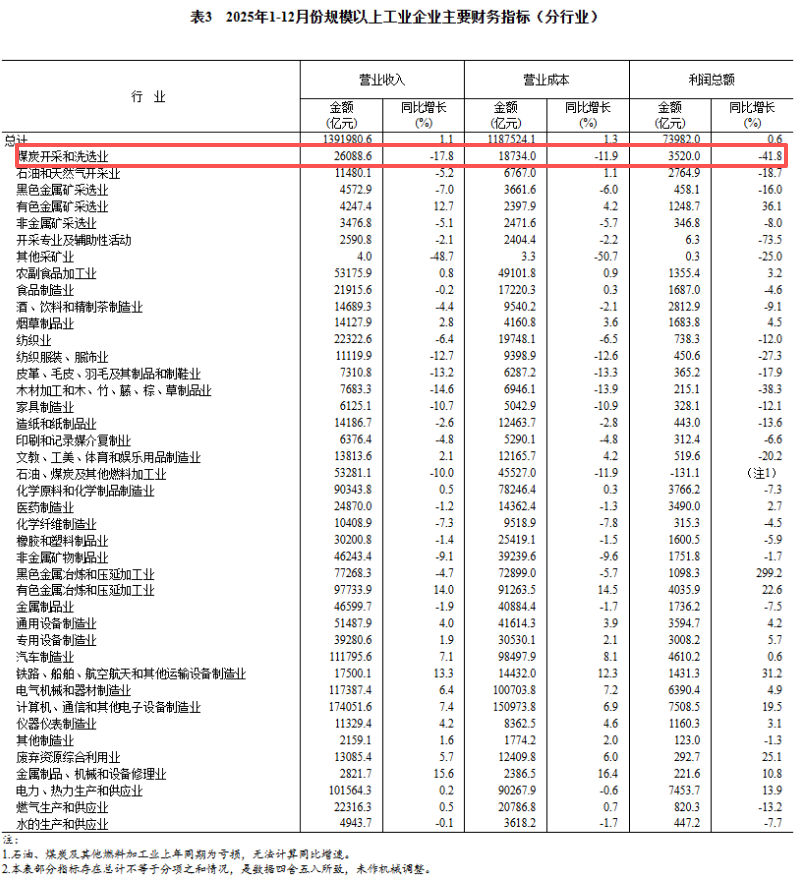
国家统计局:2025年煤炭开采和洗选业实现盈利3520亿元
Guo Jia Tong Ji Ju· 2026-01-27 01:39
Group 1 - In 2025, the total profit of industrial enterprises above designated size in the country reached 73,982.0 billion yuan, an increase of 0.6% compared to the previous year [1] - The profit situation in major industries includes: - Black metal smelting and rolling industry profits increased by 3.0 times - Non-ferrous metal smelting and rolling industry increased by 22.6% - Computer, communication, and other electronic equipment manufacturing increased by 19.5% - Electricity and heat production and supply increased by 13.9% - Special equipment manufacturing increased by 5.7% - Electrical machinery and equipment manufacturing increased by 4.9% - General equipment manufacturing increased by 4.2% - Agricultural and sideline food processing increased by 3.2% - Automobile manufacturing increased by 0.6% - The petroleum, coal, and other fuel processing industry reduced losses compared to the previous year - Non-metallic mineral products industry decreased by 1.7% - Chemical raw materials and chemical products manufacturing decreased by 7.3% - Textile industry decreased by 12.0% - Oil and gas extraction industry decreased by 18.7% - Coal mining and washing industry decreased by 41.8% [1][2]
物价温和回升,央行持续购金
Hua Lian Qi Huo· 2026-01-11 14:00
Report Title - The report is titled "Hualian Futures Macro Weekly Report: Moderate Recovery in Prices and Continuous Gold Purchases by the Central Bank" [1] 1. Report Industry Investment Rating - Not provided in the given content 2. Core Viewpoints - In December 2025, China's CPI showed a moderate increase, with an annual CPI remaining flat compared to the previous year. The PPI decreased in 2025 but showed signs of improvement in December. The manufacturing PMI returned to the expansion range in December, and the non - manufacturing business activity index also rebounded [8][11][251] - The "Two New" policies (equipment renewal + consumer goods trade - in) and housing - related policies were introduced in 2026, which are expected to have an impact on the market, especially in the consumer and real estate sectors [14] 3. Summary by Relevant Catalogs 3.1 National Economic Accounting - GDP quarterly growth rates showed fluctuations from 2023 to 2025. Different industries had different growth trends, with industries like information technology and finance showing relatively stable growth, while the real estate industry had negative growth in some periods [17] 3.2 Industry 3.2.1 Industrial Growth - The growth of the industrial sector was diverse. Some industries such as automobile manufacturing and high - tech manufacturing had relatively high growth rates, while others like coal mining and textile had more moderate or negative growth in certain months [30][32][33] 3.2.2 Industrial Output - Output of various industrial products, including energy, raw materials, and finished products, showed different trends. For example, the output of crude oil and steel had fluctuations, and the output of new energy vehicles increased [35] 3.2.3 Industrial Electricity Consumption - In November 2025, China's total electricity consumption reached 8356 billion kWh, a year - on - year increase of 6.2%. The "14th Five - Year Plan" period is expected to have an average annual growth rate of 4.2% - 5.6% [42] 3.2.4 Industrial Enterprise Profits - From January to November 2025, the total profit of large - scale industrial enterprises increased by 0.1% year - on - year. Different industries had different profit situations, with some industries like electronics and power showing growth and others like coal mining showing a decline [46][50] 3.2.5 Industrial Enterprise Inventory - As of the end of October 2025, the finished - goods inventory of large - scale industrial enterprises increased by 3.7% year - on - year. The inventory of the mining industry decreased, while that of the mid - and downstream manufacturing industries remained stable [57] 3.3 Price Index 3.3.1 CPI - In December 2025, the national CPI increased by 0.8% year - on - year. Food prices had a significant impact on CPI, with fresh vegetables and fruits driving the increase, while pork prices had a downward effect [64] 3.3.2 PPI - In December 2025, the national PPI decreased by 1.9% year - on - year, with a narrowing decline. Production materials prices had a greater impact on the overall PPI decline [73] 3.3.3 Housing Prices - In November 2025, new - home and second - hand home prices in first - tier, second - tier, and third - tier cities generally showed a downward trend year - on - year, with different degrees of decline [83][88] 3.4 Foreign Trade and Investment 3.4.1 Import and Export Trade - In November 2025, China's total import and export value was $520.63 billion, a year - on - year decrease of 0.3%. Exports decreased by 1.1% year - on - year, and imports increased by 1.0% year - on - year [97] 3.4.2 Key Commodity Exports and Imports - The exports and imports of key commodities such as agricultural products, industrial raw materials, and high - tech products showed different trends. For example, the export of high - tech products like electric vehicles increased [105][106] 3.4.3 Foreign Investment - Not provided in detail in the given content 3.5 Fixed - Asset Investment - From January to November 2025, the national fixed - asset investment (excluding rural households) decreased by 2.6% year - on - year. Investment in different industries had different trends, with the secondary industry showing growth and the tertiary industry showing a decline [120] 3.6 Domestic Trade - The growth rates of service retail sales and social consumer goods retail sales showed fluctuations. The retail sales of different consumer goods categories also had different performance [163][170] 3.7 Transportation - The transportation volume of goods and passengers showed different trends in different transportation modes. For example, the railway and civil aviation transportation had different growth rates in passenger volume [173][178] 3.8 Banking and Currency 3.8.1 Social Financing - The new social financing scale and its components showed fluctuations from 2024 to 2025. Different financing methods such as RMB loans, government bonds, and corporate bonds had different growth trends [188] 3.8.2 Monetary Liquidity - In October 2025, the growth rates of M1 and M2 decreased. The M2 - M1 scissors gap widened slightly, and the money activation trend slowed down [204] 3.8.3 Interest Rates and Exchange Rates - The central bank emphasized reasonable interest rate control to reduce the financing cost of the real economy. The RMB exchange rate remained basically stable against a basket of currencies [213][231] 3.9 Fiscal and Employment 3.9.1 Fiscal Revenue and Expenditure - Fiscal revenue and expenditure data showed different trends in different months. Tax revenue and non - tax revenue, as well as different expenditure items such as infrastructure and people's livelihood, had different growth rates [239][240] 3.9.2 Employment - Not provided in detail in the given content 3.10 Business Climate Survey 3.10.1 Global Manufacturing PMI - The global manufacturing PMI showed fluctuations from 2024 to 2025. Different countries and regions had different manufacturing climate situations [248] 3.10.2 China's Manufacturing and Non - manufacturing PMI - In December 2025, China's manufacturing PMI returned to the expansion range, and the non - manufacturing business activity index also rebounded. Different industries within the non - manufacturing sector had different degrees of recovery [251][259] 3.11 US Macroeconomy 3.11.1 US GDP - The US real GDP had different growth rates in different quarters from 2022 to 2025, with private consumption, investment, and net exports having different impacts on GDP growth [266] 3.11.2 US Employment - The US non - farm payrolls and unemployment rate data showed the employment situation in the United States [269] 3.11.3 US Treasury Yields - The yields of different - term US Treasury bonds showed different trends, and the yield curve inversion situation also changed [274] 3.11.4 US Retail Sales - The US retail and food service sales had different growth rates from 2024 to 2025, with different categories of goods having different performance [277] 3.11.5 Federal Reserve's Assets and Liabilities - The Federal Reserve's asset structure and federal funds rate, as well as the changes in the reverse - repurchase amount on the liability side, were presented [278][281]
1-11月全国煤炭开采和洗选业营业收入下降18.8%
Guo Jia Tong Ji Ju· 2025-12-30 01:48
Core Insights - In the first eleven months, the total profit of industrial enterprises above designated size reached 66,268.6 billion yuan, a year-on-year increase of 0.1% (on a comparable basis) [1] - The profit performance varied among different types of enterprises, with state-controlled enterprises experiencing a decline of 1.6%, while foreign and Hong Kong, Macao, and Taiwan-invested enterprises saw a growth of 2.4% [1] Group 1: Profit and Revenue - The mining industry reported a total profit of 7,896.3 billion yuan, down 27.2% year-on-year [2] - The coal mining and washing industry achieved a profit of 2,970.1 billion yuan, reflecting a significant decline of 47.3% [2] - The total operating revenue of industrial enterprises above designated size was 125.34 trillion yuan, marking a year-on-year growth of 1.6% [2] Group 2: Costs and Financial Ratios - The operating costs for industrial enterprises amounted to 107.17 trillion yuan, an increase of 1.8% year-on-year [2] - The operating profit margin for these enterprises was 5.29%, a decrease of 0.08 percentage points compared to the previous year [2] - The asset-liability ratio stood at 58.1%, which is an increase of 0.1 percentage points year-on-year [2] Group 3: Inventory and Receivables - As of the end of November, accounts receivable totaled 28.40 trillion yuan, reflecting a year-on-year increase of 5.5% [2] - The finished goods inventory was 6.92 trillion yuan, up 4.6% year-on-year [2] - The average collection period for accounts receivable was 70.4 days, an increase of 3.7 days year-on-year [3]
【数据发布】2025年1—11月份全国规模以上工业企业利润增长0.1%
中汽协会数据· 2025-12-29 07:59
Core Viewpoint - In the first eleven months, the total profit of industrial enterprises above designated size reached 66,268.6 billion yuan, with a year-on-year growth of 0.1% [1][4]. Group 1: Profit and Revenue Overview - In the first eleven months, state-controlled enterprises achieved a total profit of 20,083.6 billion yuan, down 1.6% year-on-year; joint-stock enterprises reported a profit of 49,565.6 billion yuan, down 0.4%; foreign and Hong Kong, Macao, and Taiwan-invested enterprises saw a profit of 16,355.3 billion yuan, up 2.4%; private enterprises reported a profit of 19,319.9 billion yuan, down 0.1% [1]. - The mining industry recorded a total profit of 7,896.3 billion yuan, a decline of 27.2% year-on-year; the manufacturing sector achieved a profit of 50,317.9 billion yuan, an increase of 5.0%; the electricity, heat, gas, and water production and supply industry reported a profit of 8,054.4 billion yuan, up 8.4% [1]. Group 2: Industry-Specific Profit Trends - In November, the computer, communication, and other electronic equipment manufacturing industry saw a profit increase of 15.0%; the electricity and heat production and supply industry grew by 11.8%; the non-ferrous metal smelting and rolling processing industry increased by 11.1%; the automotive manufacturing industry grew by 7.5% [2]. - Conversely, the coal mining and washing industry experienced a profit decline of 47.3%; the oil and natural gas extraction industry fell by 13.6%; the textile industry decreased by 8.2% [2]. Group 3: Financial Metrics - In the first eleven months, the total operating revenue of industrial enterprises above designated size was 125.34 trillion yuan, a year-on-year increase of 1.6%; operating costs amounted to 107.17 trillion yuan, up 1.8%; the operating profit margin was 5.29%, down 0.08 percentage points year-on-year [2]. - By the end of November, total assets of industrial enterprises above designated size reached 189.28 trillion yuan, a year-on-year growth of 4.8%; total liabilities were 109.96 trillion yuan, up 5.0%; total equity was 79.32 trillion yuan, increasing by 4.5%; the asset-liability ratio stood at 58.1%, up 0.1 percentage points year-on-year [2][3]. Group 4: Efficiency Indicators - By the end of November, accounts receivable amounted to 28.40 trillion yuan, a year-on-year increase of 5.5%; finished goods inventory was 6.92 trillion yuan, up 4.6% [3]. - The average cost per 100 yuan of operating revenue was 85.50 yuan, an increase of 0.18 yuan year-on-year; the average expense per 100 yuan of operating revenue was 8.39 yuan, a decrease of 0.06 yuan year-on-year [3].
第一创业晨会纪要-20251229
First Capital Securities· 2025-12-29 07:56
Macroeconomic Group - In November, the total profit of industrial enterprises above designated size in China reached 6.63 trillion yuan, a year-on-year increase of 0.1%, but a decline of 1.8 percentage points compared to October, marking two consecutive months of decline [4] - The manufacturing sector saw a year-on-year growth of 5.0% from January to November, down 2.7 percentage points from October [4] - In November, the profit of industrial enterprises decreased by 13.1% year-on-year, compared to a decline of 5.5% in October, primarily due to the rise in PPI being concentrated upstream without transmission to downstream [4] Industry Overview - The upstream sector is experiencing differentiation, with poor performance in downstream industries and better results in the midstream [5] - Industries with higher year-on-year growth from January to November include non-ferrous metals, transportation equipment manufacturing, electronic equipment manufacturing, and automotive manufacturing [5] - Industries with lower year-on-year growth include coal, steel, furniture manufacturing, textile and apparel, paper, and pharmaceuticals [5] Advanced Manufacturing Group - Leading companies in lithium iron phosphate cathode materials, such as Hunan YN and Wanrun New Energy, have announced production halts, expected to reduce monthly output by approximately 20,000 to 55,000 tons, tightening market supply [12] - The price of battery-grade lithium carbonate has rebounded over 50% since mid-year, currently exceeding 100,000 yuan per ton, constituting over 40% of the cost of lithium iron phosphate [12] - The supply-side expansion is constrained, with low willingness to expand production and increased quality thresholds limiting effective supply growth, while demand remains strong due to the high demand in new energy vehicles and energy storage [12] Consumer Group - The current operations of the company are still in an adjustment phase, with a high single-digit decline in all-channel sales for Q3 of FY2026 (September to November 2025) [14] - The management acknowledges pressure on the full-year net profit guidance, but deviations are manageable [14] - The core brand Nike has increased support for the Chinese market, helping the company clear old inventory and stabilize gross profit and cash flow [14]
兼评11月企业利润数据:利润延续放缓,工企库销比显著走高
KAIYUAN SECURITIES· 2025-12-28 04:14
Group 1: Profit and Revenue Trends - From January to November 2025, the cumulative profit of national industrial enterprises increased by only 0.1% year-on-year, down from 1.9% in the previous period[3] - Cumulative operating revenue for the same period rose by 1.6%, a slight decrease from the previous 1.8%[3] - In November, the monthly profit decline expanded to -13.1%, a drop of 7.6 percentage points compared to the previous month[4] Group 2: Factors Affecting Profitability - The profit growth rate is influenced by three factors: industrial added value (+4.4 percentage points), PPI (-2.1 percentage points), and profit margin (-11.4 percentage points)[4] - The cost structure in November showed that costs accounted for 84.9 yuan, expenses 8.6 yuan, and investment income -0.8 yuan per 100 yuan of revenue, indicating a significant drag from investment income and expenses[4] Group 3: Sector Performance - The profit share of midstream industries increased to 40.4%, while upstream and downstream sectors saw slight declines[5] - From January to November, upstream profits fell by 8.8%, with significant declines in non-metallic mineral products and chemical fibers, while black metal industries showed improvement[5] Group 4: Inventory and Demand Indicators - The inventory-to-sales ratio rose significantly in November, indicating weak demand and passive inventory accumulation by industrial enterprises[7] - Nominal inventory increased by 0.9 percentage points to 4.6%, while actual inventory rose by 1.0 percentage points to 6.8% year-on-year[7]
1-11 月工业企业利润点评:当出口链回暖遭遇利润率回落
Changjiang Securities· 2025-12-27 12:04
Group 1: Profit Trends - In November, the profit growth rate of industrial enterprises fell to -13.1% year-on-year, marking the weakest level since September 2024[5] - Revenue growth for the same month showed a slight improvement, decreasing by only -0.3% year-on-year[5] - The decline in profit growth is primarily attributed to a significant drop in profit margins, despite a recovery in volume growth[6] Group 2: Export and Industry Performance - While profits in export-related industries showed improvement, they did not offset the overall decline in profits across sectors[6] - The mining industry experienced a profit decline of -21.2%, while the manufacturing sector's profit growth rate fell to -13.5%[6] - The recovery in exports, particularly in electronics, automotive, and pharmaceuticals, contributed to a 5.9% year-on-year increase in exports, boosting overall profits by 4.98 percentage points[6] Group 3: Inventory and Operational Pressure - By the end of November, the nominal year-on-year growth rate of finished goods inventory rose to 4.6%, indicating a passive accumulation of inventory due to weak demand[6] - The turnover days for finished goods increased to 20.5 days, reflecting worsening operational pressures on enterprises[6] - The overall business pressure is expected to continue accumulating, with potential implications for the employment market[6] Group 4: Future Outlook - There is a significant possibility that policy measures will be implemented in early 2026 to stimulate growth and stabilize profits amid weakening external demand[6] - The upcoming national development and reform meeting emphasizes the need for proactive policy measures to ensure a strong start in 2026[6]
2025年1-11月工业企业利润分析:利润增速压力显现
Yin He Zheng Quan· 2025-12-27 07:48
Profit Growth Pressure - Industrial enterprises' profits from January to November 2025 reached 66,268.6 million, showing a slight increase of 0.1% year-on-year[1] - The profit growth rate has narrowed to 1.9%, down from 13.1% in the previous year, indicating significant pressure on profit growth[1] - The decline in production and profit margins, along with the diminishing low base effect, are the main reasons for the slowdown in profit growth[1] Production and Price Trends - Industrial production in November 2025 decreased by 4.8%, while the Producer Price Index (PPI) showed marginal improvement at 0.1%[1] - The profit margin for industrial enterprises fell to 5.29%, a decrease of 0.04 percentage points compared to the previous year[1] - Manufacturing profit margins improved, but mining and utility sectors saw a decline compared to October 2025[1] Internal Demand and Cash Flow - Weak domestic demand has led to passive inventory accumulation, with inventory levels increasing by 6.92% in November 2025[1] - Companies are facing accumulating cash flow and operational pressures, with cash flow indicators showing a decline[1] Future Outlook and Risks - The profit growth for the entire year is under pressure, with potential impacts from anti-competitive policies that may temporarily suppress profit totals[2] - Future policies related to domestic demand expansion and external demand risks will be crucial for profit recovery[2] - Investment strategies should consider the structural adjustments in industries and the potential for profit pressures in the short term[2]
前11月全国规模以上工业企业利润增长0.1%
Xin Lang Cai Jing· 2025-12-27 02:14
Core Insights - The total profit of industrial enterprises above designated size in China reached 66,268.6 billion yuan from January to November, showing a slight year-on-year increase of 0.1% [1] - The profit performance varied across different types of enterprises, with state-owned enterprises experiencing a decline of 1.6%, while foreign-invested enterprises saw a growth of 2.4% [1] - The mining sector faced a significant profit drop of 27.2%, while the manufacturing sector reported a profit increase of 5.0% [1] Summary by Category Profit Performance - In the first eleven months, the profit of state-owned enterprises was 20,083.6 billion yuan, down 1.6% year-on-year; joint-stock enterprises reported 49,565.6 billion yuan, down 0.4%; foreign and Hong Kong, Macao, and Taiwan-invested enterprises achieved 16,355.3 billion yuan, up 2.4%; private enterprises made 19,319.9 billion yuan, down 0.1% [1] - The mining industry recorded a profit of 7,896.3 billion yuan, down 27.2%; the manufacturing industry achieved 50,317.9 billion yuan, up 5.0%; and the electricity, heat, gas, and water production and supply industry reported 8,054.4 billion yuan, up 8.4% [1] Revenue and Costs - The total operating revenue of industrial enterprises above designated size was 125.34 trillion yuan, a year-on-year increase of 1.6%; operating costs were 107.17 trillion yuan, up 1.8% [2] - The operating profit margin was 5.29%, a decrease of 0.08 percentage points year-on-year [2] Asset and Liability Overview - By the end of November, total assets of industrial enterprises amounted to 189.28 trillion yuan, up 4.8%; total liabilities were 109.96 trillion yuan, up 5.0%; and total equity reached 79.32 trillion yuan, up 4.5% [2] - The asset-liability ratio stood at 58.1%, an increase of 0.1 percentage points year-on-year [2] Industry-Specific Insights - The computer, communication, and other electronic equipment manufacturing industry saw a profit increase of 15.0%; the electricity and heat production and supply industry grew by 11.8%; and the automotive manufacturing industry increased by 7.5% [2] - The high-tech manufacturing sector's profit growth accelerated to 10.0%, surpassing the average growth rate of all industrial enterprises [6] - The equipment manufacturing sector's profit increased by 7.7%, contributing significantly to the overall profit growth of industrial enterprises [6] Challenges and Future Outlook - Despite the overall profit growth, challenges remain due to international uncertainties and the need for structural adjustments in the industrial sector [8] - The focus will be on promoting traditional industry upgrades and fostering new productive forces to ensure sustainable industrial economic development [8]